Not that long ago, I came across this incredible article about a thief who made more than a million dollars over the past few decades robbing people at race tracks across the Southeast. What was even more amazing about the story is that I'm 95 percent certain my dad was one of the victims.
In 1987, my father (who was also a driver) had his wallet stolen while he was racing at Talladega Superspeedway in Alabama. That was this guy’s M.O. -- he stole wallets in bunches and immediately charged credit cards at places nearby, and he’d time his thefts around practice sessions or on race days, especially around preliminary events. That day, my dad was racing in a prelim, so he was a perfect target.
It was a pretty tough day for my family as I remember it, a little bit humiliating and a little degrading. And it definitely was the sort of thing that makes you lose trust in people.
MORE: Honoring Bruce Halle
Reading that story really got me thinking -- first, because the theft also affected me personally. At the time, I was still really young, and it made my parents reluctant to let me go out on my own. So whenever we were at a track and my parents needed to work on the race car or whatever, I’d be locked in the trailer or motorhome with my siblings to keep us safe from sketchy people.
But the other thing that story did was trigger a slew of memories. It got me thinking about the life I led as a kid, and how it revolved around life on a race track. It was a different kind of life from anyone else I knew growing up back home in Michigan, special and hard in ways that were totally unique.
ON THE ROAD
When I was a kid, my family’s life revolved around racing. I knew that was how my family made a living, and that's the way it had to be.
In some ways, it was kind of frustrating. We never went on spring break because it was racing season, and we spent our summers on the road. But in other ways, it paved the way for me to be where I'm at now. So I don't particularly have any regrets, but without a doubt, it shaped a lot of who I am.
I’ll start with the traveling. It wasn't always great. There were a lot of bad stories of my siblings and me being cooped-up on car rides, and locked-in trailers with no AC, stuff that you’d probably get put in jail for today if you did it. And when we told people we were traveling, they always made the mistake of thinking that we’d gone on a vacation or something. If we went down to Florida, they’d say, “Oh, you must have gone to Disney World."
Well, no. We went to a race track in Florida, and stayed at the track for three days.
Killing time on the road was rough, too. If I have to take my daughter Scarlett somewhere that’s more than a two-hour drive, it can be pretty miserable pretty quick. We traveled on six, eight, sometimes 24-hour drives. And what gets me through those drives now with my daughter is, "Here's an iPad. Watch a video."
[caption id="attachment_108634" align="aligncenter" width="922"] Wife Paige and daughter Scarlett are fixtures at the track. Jerry Markland | Getty Images[/caption]
We didn't have any of that stuff when I was a kid, and even if the technology had existed then, we would never have been able to afford it. We were the kids in the back that were saying over and over, "Are we there yet? Are we there yet?" And I know we annoyed the crap out of my mom and dad. It had to be miserable for them. It really did.
All of that said, there were a lot of good parts. We got to see a lot of things. By 14 years old, I had seen 20-some states. Not a lot of people can say that.
Most of the time, we stayed in our motorhome at the race tracks, but sometimes there weren’t any accommodations. When that was the case, we’d get a hotel, and that was the best thing ever, especially when we got one with a pool. We would play in that thing as long as we could. We used to call the really nice hotels "Holidome," which was kind of code for a Holiday Inn that had a dome on it, and had a pool, too.
And when we would get to stay in a hotel, because we were broke and whatnot, the kids slept on the floor and it was two adults to a bed.
We didn't know any different. It was just the deal, and we loved it.
LIFE AT THE TRACK
Then of course, there were the race tracks.
My dad drove mostly in the ARCA Series, but to me, it was the biggest series because he was in it. For me, my dad was Dale Earnhardt, and my whole life revolved around life at the track.
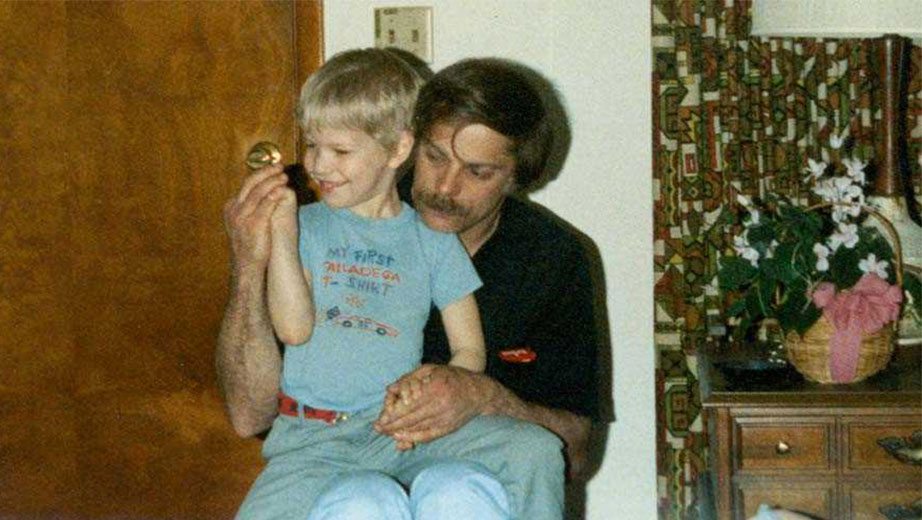
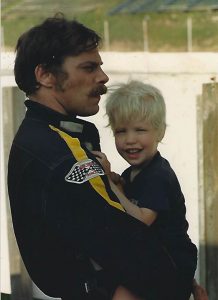
[caption id="attachment_108623" align="alignleft" width="218"] Bob Keselowski and a young Brad. | Photo courtesy of Brad Keselowski[/caption]
I loved the places with campgrounds like Watkins Glen. I remember the really good midways, too. Any track with a great midway was awesome. There were only a few that had them, but I would go hang out at those tracks and we would have a blast. We would go through all their stuff and play on the simulators. Sometimes, they would let you ride them for free, which was great. Or they’d have a ball pitch or dodge ball, you know, different things for kids to do. Those were the coolest tracks.
One of the other things I remember is that back then, you couldn’t be around the race cars until you were 16. That was the age restriction all the way up to 2001. Once you hit age 16, you could be in the garage. You could even drive a race car if you wanted to.
Until then, the cars and the garage were off limits.
What that meant for my brother and me was that during races, we’d either be locked in the race car hauler or our motorhome, which we had for a time due to a sponsorship from Winnebago. And once we had that run-in with the thief I mentioned earlier, we were locked in even more.
Still, that didn’t stop me from coming out of the hauler when I wasn’t supposed to. I actually got thrown out of tracks a couple of times. Every time, I was rescued by a man named Ron Drager. Today, he’s the president of ARCA, but back then, I knew him as the man who always took care of my family, and who always came to rescue me.
It would happen like this … I’d leave the trailer, then get caught, and they’d put me out in the parking lot with a security guard. Because my parents were usually in the middle of racing, Ron would hear about it over the track radios and come find me. He always made a thing out of talking to the security guard on my behalf -- he always started with, “Look, can you help me out here?” Then he’d take me back to the trailer, giving me the kind of finger wag you’d expect an adult to give an 8-year-old kid.
My dad stopped racing ARCA in 1995, but when I got older -- basically, from ages 13 to 16 -- a man named Wayne Auton basically took over for Ron. (Wayne's now the NASCAR Xfinity Series director.)
Every time I'd get into trouble, Wayne and Ron would always leave me with a final, “No more, Brad. I’m serious this time.” And I’d answer back, “Yes sir, I know.”
Until the next time.
THE FAMILIES
What really stands out to me are the people we met at the tracks. I was never home for the summer, so I never became really close with any of my friends there because we were always gone. But I enjoyed making friends at different race tracks.
I remember when we’d arrive at a track and pull in to park, if we’d parked right next to another family, I’d be so excited because it meant I’d make some friends. And when there was more than one family, you were able to play football or tag. I remember there were some tracks that had wooded areas next to them, and we’d go climb through the woods and play outside. (Once, I came back with a tick, so my mom made me take a break from the woods for a bit.)
PHOTOS: Keselowski through the years
That said, it had its own challenges. Friends that we’d make at the race tracks would be there one week, and gone the next. Or you’d get to know a family for a summer, and then you’d never see them again.
Still, there were one or two families that stuck around for probably a half dozen summers that we would hang out with. I remember always feeling like, "I hope our dads don't have a run-in on the race track, because then we won't get to play together anymore.” That's what you think about when you're a kid.
There was the Strait family. Their dad’s name was Bob Strait. They’d travel from Chicago, and he had two boys my brother and I played with. I bumped into one of them about five years ago, and he had just served his second tour in Iraq or Afghanistan. That was really neat.
Bobby Bowsher had kids that we hung out with, too. He and my dad raced each other hard, week in and week out, and sometimes, they didn’t get along. That was always bad for us kids, because when they didn't, we weren't allowed to play together.
There was a family out of Wisconsin, the Brevak family -- the dad was Bob as well. (And so was mine, which makes four Bobs.) Their two kids are still in racing; in fact, both of them work for NASCAR.
But one of the families we were closest to were the Marmors. The dad’s name was Don, and up until I was about 6 years old, we would travel up and down the road together, his family and our family.
Then, one day, Don got in a really big crash. It was the 1988 Atlanta 500 ARCA race, and he probably should have died.
Miraculously, he survived. The story of how that happened is amazing in itself. Dr. Jerry Punch, a racing commentator, was working the track at the time; he also happened to be a doctor. Punch stripped off his TV gear, got to Don while he was in the car and somehow got him breathing again. After that, medical staff got him out of the car and airlifted him to a hospital, where doctors finished the job of saving his life.
But then, just like that, the Marmors were gone. They never came back to a race track, and that was it. That was a lot of what being a kid on the road was like. It wasn’t just rooting for and watching your dad, but it was watching your friend's dad race, because they were the people that might travel with you. One summer, they're with you all the time, and they’re your friends. Then just like that, you never see them again for the rest of your life.
And you never knew when it was going to happen.
LIFE LESSONS LEARNED
The race track was also the place where I began to understand just how fragile life could be.
In 1992, we were at a little track in Salem, Indiana. I was 8 years old. For whatever reason, that specific track would block off the infield and let kids play on it. It was great. In fact, that track was probably one of my favorites to go to for that reason. We’d have 40 kids or so, and we’d be playing any game you could think of: baseball, tag, you name it.
That day, we were playing football in the infield.
On a race day, they’d have as many as six different divisions race. They were running one of the preliminary races that day, which my dad wasn’t in, and this guy wrecked. I’ll never forget it. It was a huge wreck. We could see the race track from the infield -- the whole racetrack, because it was so small.
Everything at the track just kind of stopped.
[caption id="attachment_108635" align="alignright" width="475"] Brad Keselowski and daughter Scarlett. | Brian Lawdermilk | Getty Images[/caption]
About 15 or 20 minutes went by. There was no on-track action, and a whole bunch of people were surrounding the area where the wreck had happened. It wasn’t far away from where all of us kids were, no further than 75 yards or so. But we couldn’t tell what was going on. So we just went back to playing.
And then -- I’ll never forget -- a couple of hours later, there was an announcement over the public address system. The driver had died. The remaining events of that night would continue in his name and honor. And that was that. As a kid, I had no idea. I didn't know the guy died. None of us did, and we didn't really have any kind of reference. We saw wrecks all the time. Every other time, people just said, “Oh, he’s fine.”
This one had looked exactly the same. This time, it was, “Oh, he’s dead.”
From that point on, the race track felt like the real deal. You knew that every time you went there, somebody could die. You hate to say it that way, but as a kid, I learned that.
I don't know why it doesn't scare me to do it, to be a race car driver.
But man, after that, it scared the crap out of me to watch my dad race.
PHOTOS: Brad and Paige through the years
THE JOY OF WINNING
That fear was one of the things that made winning such a big deal.
For a lot of reasons, there was nothing like when our family won a race.
Like I said at the start of this blog, garage restrictions and sketchy guys like that wallet thief made sure my brother and I were locked in our motorhome during most races. It was bad enough being stuck in there, and not being able to roam around and be a kid. I have this memory from around 1990 when I watched my dad win a race from inside the hauler, and couldn’t get out to celebrate because we were locked in.
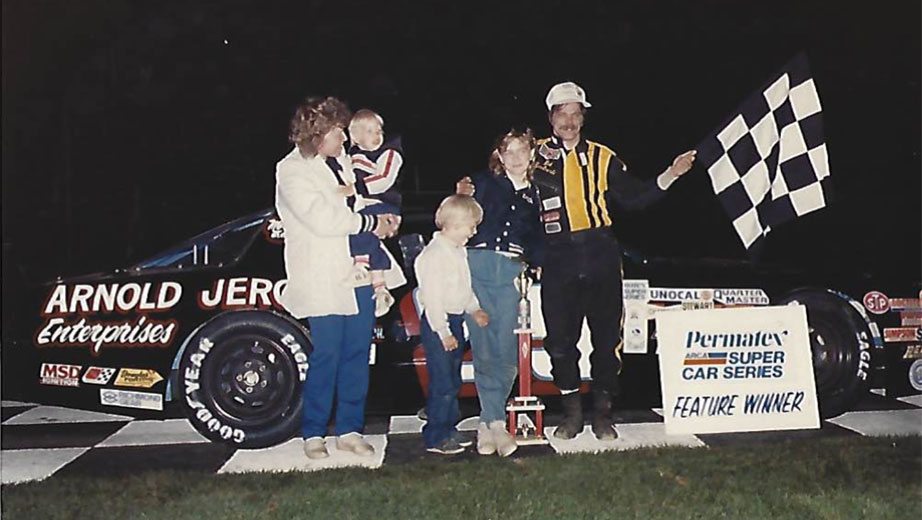
That experience made it that much sweeter when my dad won a preliminary race at Michigan, our home track, two years later.
We got to get out of the motorhome jailhouse, and went to Victory Lane with my dad to celebrate. I’ll never forget that. There’s a picture of me, my brother and my dad, walking out of Victory Lane. I think I'm carrying the trophy and my brother is holding my dad's hand, or vice versa. I can't remember.
But that was one of my most vivid memories -- we got to go in the garage and see the cars after the race because my dad had won. That was such a big deal. I remember the smell, the smell of burnt rubber and the grease smell, the oil-burning smell. That's pretty vivid.
I remember to this day how hot everything was. A race car gets really hot, and as a kid, it was always, "Don't touch it; it's hot!" That day, my dad’s winning race car was burning hot. And I'll never forget that, either.
I remember just being with my dad, too. That was special. When it was time to work on the car or drive, he was really focused. If he was at work, he was at work. If the garage was open, he had his game face on and there was no horseplay at all.
But he was really good about trying to be with us when the time was right, and when he won, it was pretty right.
It’s funny, though -- even though he’d won that day, he wasn’t all that excited. It’s really striking, thinking about it. He was just like that. He was always even-keeled and calm, even when he lost. Being who I am now, that's almost more amazing to me than anything else. When the No. 2 Crew has a bad day, I’m so down it hurts. He never let us see that as kids.
Maybe it comes with age.
Either way, looking back, that’s something about him that I’m especially impressed by now.
MY FAVORITE MEMORY
It’s funny what you remember. I’ll never forget eating at the race track because we couldn't afford concession food -- you know how expensive that can be.
My mom would go to a nearby grocery store and get a pound of ham or turkey, cheese, mustard and a loaf of bread. Maybe a couple of Gatorades. We’d eat that at the track for the next two or three days. (Funny enough, I still have ham and cheese sandwiches when I'm traveling between tracks.)
It was because we ate so humbly at races that the following memory is so strong for me.
Whenever we drove home from a road trip, we'd pass this restaurant called Big Boy on the Ohio-Michigan border. We usually didn't reach it until fairly late at night. If we hadn't had a good race -- and I happened to wake up as we went by -- my mom would simply whisper, “No Big Boooooooyyyy," and I'd let out a sigh of disappointment, and drift on back to sleep.
But if we'd won, well, that was a different story. We'd stop at Big Boy, and all of us would just pile into a booth. There was something special about that, stopping together to celebrate as a family. And every time, my mom would order a strawberry milkshake, and I'd sit there with her, and she'd share it with me. I'll never forget that.
Best thing I've ever tasted in my life.
To this day, whenever I happen to order a strawberry milkshake, I’ll think about my mom, and our family’s days on the road.
YOUR MEMORIES OF RACING
I wanted to share some of these memories with you because they played a huge part in shaping who I am today. And perhaps, after hearing them, you’ll want to share some of your memories around racing, too.
Are there visits to tracks that you remember? Do you have experiences with family and friends that shaped who you are that you’d like to pass along?
If so -- or even if you just have questions or comments for me -- go ahead and post them with the hashtag #MyRacingMemories on Twitter, Instagram or Facebook.