Brave new world: iRacing drivers nearing the next frontier
Terrin Waack
With two laps to go at virtual Daytona International Speedway, Dale Earnhardt Jr. was prepared to pit from the lead, knowing he couldn’t survive with .3 gallons of fuel left in his tank. Before he could veer off, though, a wreck broke out behind him. It drew the only caution of the night, and because the green-white-checkered flag policy had yet to be implemented, the race finished under yellow with Earnhardt sputtering across the start/finish line still in first.
That’s right. On Feb. 9, 2010, Earnhardt became the first-ever NASCAR iRacing World Championship race winner, a milestone that continues to carry weight.
“I will say, he won it on fuel mileage only,” said Brad Davies, who finished outside the top 10 in that season opener but runner-up in the 2010 final rankings. “We just want to get that straightened out. ... However, it was really cool to have him involved in the series that year. I think that helped the series gain a lot of traction to kick-start it off.”
RELATED: Complete eNASCAR coverage
A decade later, Earnhardt now owns an iRacing team through JR Motorsports. Davies is one of his drivers. Michael Conti then completes the two-car stable.
Conti, 22, was the 2014 series champion and has won nine races since he joined in 2012. Davies, 35, is one of four competitors left from the league’s inaugural season and has won six races since then.
“You have to be really well-rounded to be in this series,” Conti said. “You can’t just be a racer. You can’t just be a setup builder. You can’t have absolutely no knowledge of social media. You have to know a little bit about everything to succeed.”
NASCAR.com’s Terrin Waack spent time with Davies and Conti to learn the ins and outs of the present-day eNASCAR Coca-Cola iRacing Series and how the two prepared for the first race of the new season tonight at Daytona (9 ET on Facebook, Twitch, YouTube and eNASCAR.com).
Climbing the ladder
Literally anyone can join iRacing. All it takes is an online subscription of $13 per month -- and right now, iRacing is offering 40% off new memberships.
Sounds like a free-for-all once in, and it kind of is considering there are more than 100,000 users with access to at least 80 different cars and tracks.
Don’t be fooled. Making the eNASCAR Coca-Cola iRacing Series is no easy feat. There’s a thorough ladder system in place to vet the drivers on this career path.
“Most people, it takes two to three years to get to this point -- at least,” Conti said. “Some, it takes much longer. Took me two, which is pretty short.”
Looking at the oval path alone, there are five classes out of which a driver must advance to reach professional status. Each class provides a different type of car. iRacing purposefully does this so drivers learn and grow as they progress rather than just mastering one form of racing.
So, in the simplest terms, everyone starts out in the Rookie Class with basic entry-level vehicles, such as Legend cars and Street Stocks. There’s then the D Class with Late Models. Classes C, B and A follow and match the NASCAR national series in order: Gander Trucks, Xfinity Series and Cup Series cars.
“You cannot skip anything,” Conti said. “You have to do all of it, and you have to be good -- one of the best -- to get through.”
It doesn’t end there either.
Those who make it out of the A Class move into the Road to Pro Series, which has its own season that overlaps with the Coca-Cola iRacing Series season. Once both seasons have concluded, the top 20 Road to Pro drivers and the bottom 20 eNASCAR drivers then make up the Pro Series in the offseason (the top 20 drivers in the Coca-Cola iRacing Series automatically qualify for that series next year). The top 20 drivers in the Pro Series from that field determines who qualifies for the next Coca-Cola iRacing Series season and completes the final 40-driver field.
Among these series, drivers can move up and down. Use Davies as an example: Twice he has finished outside the top 20 in the eNASCAR Series, got demoted to the Pro Series and earned his spot back in the eNASCAR Series.
“I don’t know if that’s surprising, but it kind of blows my mind at how well that system works,” Davies said. “It keeps the people that don’t need to be racing in Pro out of Pro. The people that should be in Pro -- because they’re talented and they’re good at what they do -- they can make it there.”
Building the series
NASCAR and iRacing debuted their eNASCAR Series back in 2010. Formal teams weren’t introduced until 2019 when 12 of them, including JR Motorsports, took part in a two-round driver draft. Four more teams joined later in the year, as the rest of the field raced independently.
Things have truly taken off since then, as many NASCAR names have gotten involved in the eNASCAR world. Joe Gibbs Racing, JTG Daugherty Racing, Roush Fenway Racing, Stewart-Haas Racing and Wood Brothers Racing all field individual teams. Clint Bowyer, Kyle Larson, Denny Hamlin and William Byron have each formed their own teams, too.
Driver contracts weren’t required last year but are this year after a free-agency period placed everyone on one of the 20 teams.
“It’s a little weird,” Davies said. “I’ve never had to sign a contract for sim racing before. But it just goes to show you how quickly this has blown up and how much this is growing. I’m just looking forward to living up to my end of the deal here.”
JR Motorsports already has sponsors onboard after a successful trial run last season when Conti sported a FilterTime paint scheme. The intention of that collaboration was to see what kind of return on investment a company can get while sponsoring an eNASCAR car. Earnhardt himself is a FilterTime partner, enlisted by founder Blake Koch before the deal was made.
This season, Conti’s No. 8 Chevrolet will be sponsored by WR1 Sim Chassis, a company that sells custom-built simulator rigs. Davies, meanwhile, will have TrueTimber Camo on his No. 88 Chevy for 2020.
Every case will be different, but with contracts and sponsorship deals comes money from the team.
There’s also the league’s new entitlement sponsor, Coca-Cola, that significantly boosts the end-of-season prize pool. The 2020 total now tops $300,000. That’s triple 2019 and exponentially better than $10,000 in 2018.
Last season’s champion, Zack Novak, walked away with $40,000. Whoever is crowned this season will take home $100,000.
“That’s mind-boggling,” Davies said. “Obviously that’s the goal this year: to be first.”
Pushing the limits
Probably the biggest differences between NASCAR and eNASCAR is the fear factor. It’s absent from simulator racing. No matter the severity of a wreck, no one gets hurt.
That means sim racers can find the limit -- cross it during practice, toe it during races -- of how hard is too hard when it comes to pushing their car.
Practices are fair game. There’s a reset button any time damage is sustained. Races do require repairs to be made on pit road.
“Most of us -- maybe not all but most of us -- understand that we are not driving real cars,” Conti said. “We are not putting ourselves in the same situations as real drivers. We’re not putting our lives on the line. We get that. But we are doing a lot of the same things.”
Like tinkering with the vehicle’s setup.
iRacing provides all drivers with a base model. Drivers are allowed to alter it any way they please -- nose weight, steering ratio, ride height, spring rate, bump stiffness, etc. -- as long as it passes inspection before hitting the track.
WATCH: 'Big One' strikes during Clash
Setups are secret and usually shared with teammates only. Some drivers, including Conti and Davies, do have outside alliances with whom they exchange intel from telemetry data or seek guidance on what to adjust.
“There are thousands of combinations you can come up with in the garage to try to make the car faster or handle better,” Davies said. “Whatever it is, 99% of that is just trying to find one or two combinations that’ll work to give you an advantage over your opponent.”
Winning is always the goal, of course, but the higher a driver finishes in a Coca-Cola iRacing Series race, the more points he or she acquires. Points determine standings, and the top eight make the playoffs at the end of the regular season. The win-and-in guarantee is only valid during the postseason for the finale.
Knowing points like that are on the line should be enough to keep drivers from driving recklessly. If not, there’s also a penalty system in place. Competitors have to drive clean or risk suspension.
“You can bump people, knock them out and stuff,” Conti said. “But you can’t pull a Denny Hamlin and Chase Elliott at Martinsville (Speedway) a couple years ago and just completely turn someone around.”
It all goes back to that lack of fear. Without the points or penalty leverage, drivers could wreck each other without any repercussions.
“The mental focus for sim racing is through the roof compared to anything else,” Davies said. “Sweat is pouring off me by the end of the race, and I’m just sitting in an air-conditioned condominium.”
Envisioning the future
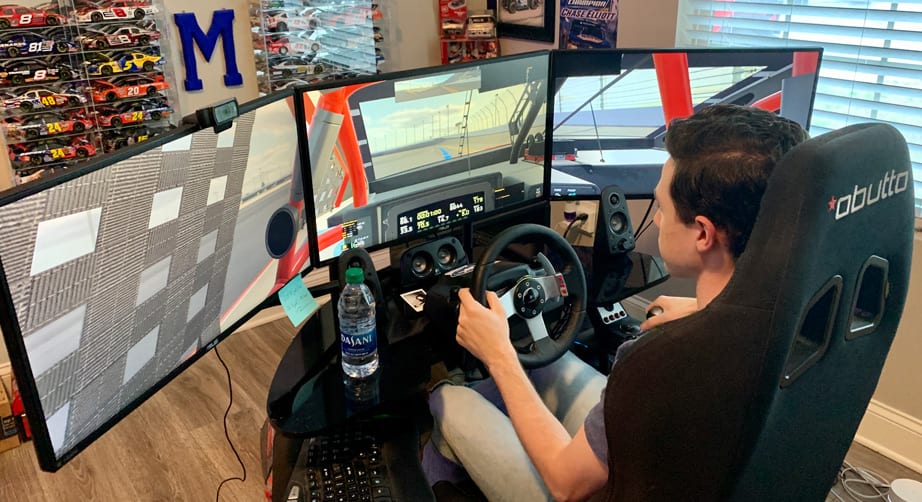
Conti dedicates an entire room to stock-car racing, where NASCAR memorabilia mixes with iRacing accolades. His championship trophy and novelty check sit prominently on a shelf. Diecasts cover an entire wall in front of his three-screen simulator.
Davies’ rig isn’t as expansive, though he also has three monitors. His space purposefully doubles as an office. A standard desk and chair do the trick.
Either preference is perfectly fine as long as they have a reliable computer, a pedal set and a steering wheel.
“The amount of effort and time we put into this isn’t something that can be discounted,” Conti said. “We have real jobs just like you guys do, right? This is not our main source of income. It’s not even close to that.”
RELATED: Full 2020 schedule
Conti lives in Concord, North Carolina, and works as a service advisor at Hendrick BMW in Charlotte. Davies lives in Charlotte and works as the IT administrator at JR Motorsports in Mooresville. Each have a 30-minute commute -- at the very least -- when there’s no traffic.
These are their full-time jobs.
Both had dreams of being a professional race car driver growing up, though neither had the means to make it work. Simulator racing was much more realistic -- and affordable.
“I’ll still do iRacing even if I can’t compete at this level anymore,” Davies said. “I see myself doing this as long as it’s in existence basically. It just scratches that itch to race and be competitive.”
There are now 20 (up from 18) biweekly races in iRacing’s top series -- 16 regular-season races, four postseason races. Conti spends anywhere between 12 and 20 hours practicing in those two weeks. Davies ideally tests at least an hour per day between events.
Races, which start after a 10-minute qualifying session and a 20- to 30-minute practice period, last around two hours. They’re on Tuesdays at 9 p.m. ET. The last six will air live on NBCSN.
Then, drivers are back to work in the morning. Some are still in school.
“With as much effort as we’ve put into this and as much as I believe in this season, I would love nothing more than to say one day, you know what, I’m done with my day job,” Conti said. “I’m just going to be a sim racer, and that’s all I’m going to do. …
“Do I think we’re going to get there this year? No. Next year? Probably not. It’s going to take some time, but if we continue at the rate we’re going, we’re going to get there.”