Based on average finish, Chicagoland Speedway is Chase Elliott’s best race track. While his second- and third-place results in two Monster Energy NASCAR Cup Series starts may inspire optimism in the 22-year-old driver’s chances at winning there this weekend, he’ll need the 400-mile contest to break a specific and perhaps unlikely way to contend for his first series victory.
It’s certainly possible for Elliott to emerge the winner, but it’s easier said than done as his bid for the checkers begins with a diminished dependence on the single attribute that matters most in racing.
Elliott doesn’t have elite speed
An issue plaguing all of Hendrick Motorsports is the lack of elite speed. Elliott’s No. 9 Chevrolet is the fastest of the organization’s four cars, but it ranks just 11th in Central Speed through last week’s race at Sonoma. Tracks like Chicagoland, a 1.5-mile venue with moderate banking, have rewarded the fastest cars with a 1-to-1 correlation between speed and winning dating back to last year. Martin Truex, Jr. won all six races on moderate intermediates in 2017 while having the fastest overall car in the series; Kevin Harvick, utilizing the fastest car for all of 2018, has won two of two this season.
PHOTOS: Chase Elliott through the years
Elliott’s speed deficit presents two problems. First, it’ll be difficult for him to track down Harvick, Kyle Busch and the other speedsters in a straightforward race, barring an unforeseen advancement in Hendrick’s aero design. Second, Elliott’s greatest strength, his long-run passing ability, will be neutralized in the event long green-flag runs dominate the proceedings. While a race with few cautions would allow Elliott ample time to carve through traffic — he’s accumulated 54 positions on such runs at non-restrictor plate tracks this season — it’d also allow the faster cars, likely in clean air, to drive away from him.
What’s a driver to do when his strength is rendered irrelevant?
Pit now!
Chicagoland’s weathered surface is so rough on tires that grip quickly diminishes and lap times swell by nearly 2 seconds on natural green-flag runs. This makes short-pitting — pitting laps in advance of cars higher in the running order — an amenable strategy to those crew chiefs willing to stop early in the pit window.
RELATED: Tire, surface play pivotal role
Alan Gustafson, Elliott’s crew chief, has retained his driver’s running position on 77.78 percent of green-flag pit cycles this season, an above average-rate among all crew chiefs. This yielded 63 additional spots on the track for Elliott, the fourth-biggest net positional gain from green-flag stops. While Gustafson’s pit strategy has provided a positive output, he still may need to step outside his comfort zone in order to overtake those running ahead of the No. 9 car Sunday.
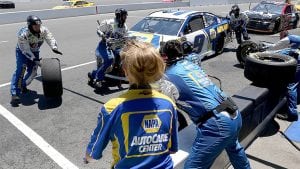
Nearly 89 percent of Elliott’s green-flag stops can be described as “conservatively timed,” having come when pit road was at its most populated within a cycle; the series average for crew chiefs pitting conservatively is 75 percent. Less than 4 percent of Elliott’s stops were done using a short-pitting strategy, the ideal game plan for those seeking giant leaps of track position at Chicagoland. In order to get around the likes of Harvick, who retains top-five running positions on more than 63 percent of green-flag stops, Gustafson will have to reference a seldom-used page from his playbook.
In the instance his crew chief remains conservative, there’s one other likely way for Elliott to emerge the victor.
Chaos equals restarts and restarts equal chaos
Based on recent history — 4.3 restarts per race dating back to 2015’s event — long green-flag runs rule at Chicagoland, meaning its races don’t elicit many restarts. That’s bad news for Elliott.
In prior years, Elliott had a faster car at his disposal and in 2017 he ranked as a top-five position defender in each restart groove. Neither of those high marks is in place this year, as Elliott is suffering through a 28 percent decrease in total restart position retention. Still, he scored four positions on two preferred groove restart attempts in last year’s Chicagoland race — perhaps his affinity for the track supersedes his yearlong dip — and lane assignment could fall in his favor.
MORE: This week’s paint schemes
In 2017, occupants in Chicagoland’s outside groove retained their positions on 89 percent of restarts from inside the first seven rows, while those in the inside groove did so 32 percent of the time. If Elliott ever finds himself in an even-numbered running position prior to a restart, that fortunate placement provides the ideal opportunity to score track position that may otherwise elude him, setting the tone for the rest of his race.
A caution-filled race, atypical but still possible, could allow for a large number of such opportunities, helping level the playing field for Elliott, a seemingly excellent Chicagoland driver in need of a non-traditional pathway to victory.
David Smith is the Founder of MotorsportsAnalytics.com. Follow him on Twitter at @DavidSmithMA.