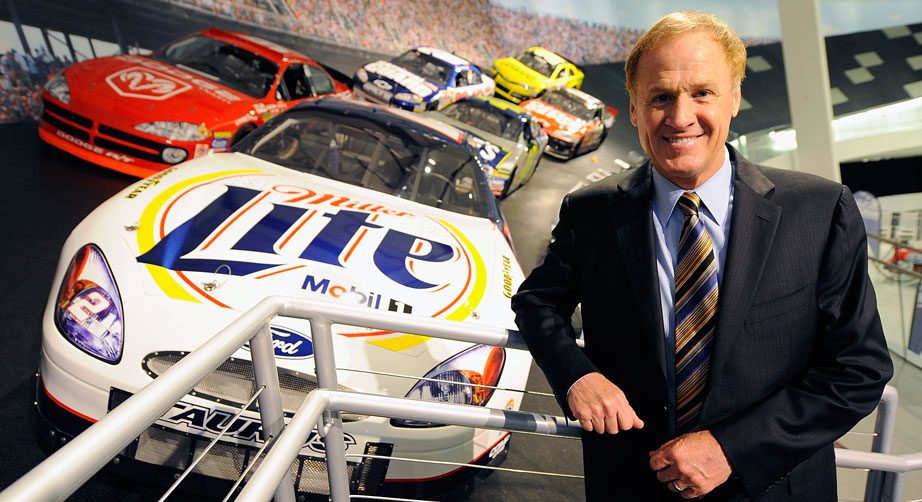
WATKINS GLEN, NY — Rusty Wallace never could escape racing. He never wanted to.
Somehow, someway, the 1989 Cup Series champion needed to stick around the sport after retiring from the series in 2005. He found his path back to the race track in broadcasting, allowing the 11th-most winningest driver in NASCAR Cup Series competition to stay connected thanks to the Motor Racing Network.
After spending nine seasons as a broadcaster with ESPN, Wallace now serves as MRN’s lead analyst for 14-18 races a year for its live radio coverage. This week, although he has a personal off-weekend, Wallace is still on-site, serving as the Grand Marshal for the Go Bowling at The Glen at Watkins Glen International on Sunday (3 p.m. ET, USA Network, NBC Sports App, MRN, SiriusXM NASCAR Radio).
MORE: Watkins Glen schedule | At-track photos
“I can’t imagine myself ever being away from the sport,” Wallace told NASCAR.com. “And so that was one of the reasons I was really excited to get involved with Motor Racing Network and do things with those guys, because it kept me really involved in the sport. And they’re so smart. That team of people over there know everything about NASCAR. I mean, they live it every single week, and they’re so doggone smart about it. It’s unreal. So that’s one of the reasons I enjoy working with Motor Racing Network a lot.”
Wallace, a 2013 inductee of the NASCAR Hall of Fame, earned two of his 55 career wins at Watkins Glen, but his road-racing prowess should not be forgotten. In 46 road-course starts, Wallace snagged six victories, 19 top fives and 25 top 10s. That was no coincidence for Wallace, who also earned two wins apiece at Sonoma Raceway and the now-defunct Riverside International Raceway.
“Well, I took it serious. We built really good cars,” said Wallace, who turned 66 on Aug. 14. “Number one, back then, guys would take their short-track cars and get them ready to run a road course to make them turn left and right. And they usually took their crappiest car to do that with. Well, we built brand new road-course cars. I went to the Bob Bondurant (School of High Performance Driving) out in, back then it was Sonoma, California. Now they’re in Arizona. But I did that, really a lot of tutoring from him.”
Returning to Watkins Glen brings back plenty of strong memories for Wallace, but perhaps none more thrilling than his victory in 1987. Wallace had dominated the day in the No. 27 Pontiac for car owner Raymond Beadle. But the closing circuits were anything but straightforward.
RELATED: A look back on Wallace’s career
Wallace led Terry Labonte by some 20 seconds in the last two laps. Coming to the white flag to begin the final lap, Wallace saw his fuel pressure light flash on, indicating he was running out of gasoline.
“I told the pit crew in just a millisecond, I said, ‘hit pit road!'” Wallace recalled. “I hit pit road leading the race, pitted and still won the race. I had a lead that was that big. But back then, that was before pit road speed. So I can come down pit road 180 miles an hour. So I mean, you would be coming down pit road as hard as I possibly could, get stopped, throw gas in it and went out and still won. And that’s one of the most dramatic stories I’ve had in my career to be able to do something like that.”
Pit-road speed limits pose just one example of how the sport evolved throughout Wallace’s storied career, which spanned from 1980 through 2005. The young drivers at the tail-end of Wallace’s Cup career are now today’s veteran leaders — Kevin Harvick, Kurt Busch, Kyle Busch and Martin Truex Jr. At 60 wins apiece, Harvick and Kyle Busch are the only active drivers with more career wins than Wallace. Wallace holds Harvick in high regard as the veteran driver of today, he said.
This season also marks the first of the Next Gen era, with a radically different approach to the concept of a Cup car.
“I really like the car,” Wallace said. “I was really surprised to see how much different it was. But I love the concept of building a real race car — independent rear suspension, sequential shifting, you know, a car that basically took a lot of drivers that I looked at and said, ‘Man, these are up and up and coming drivers, but they’re not veterans,’ and all of a sudden they’re winning. And then the veterans that were mainstays, all of a sudden they’re struggling to keep up with these guys, you know?”
One of the young drivers who has gone to Victory Lane this year is rookie Austin Cindric, who scored the No. 2 Ford’s first Daytona 500 championship for Team Penske in February. Wallace made Penske’s No. 2 car famous throughout the 1990s and early 2000s and offered sincere excitement about the rookie’s Cup future.
“He’s got speed, man,” Wallace said. “Sometimes, it’s really hard to get a driver that just doesn’t have the speed up to speed. Well, he’s already way up to speed and you got to pull him back a little bit. You know, sometimes when it gets wild, you got to get him back on a railroad track, so to speak. And that’s what they’re doing with him. I mean, you turn him loose man, it’s like a racehorse, he’s gonna roll, you know? You just hope he doesn’t roll right into the wall or something.
“But no, he’s got it. He’s got all the talent, you know? And he’ll tell you, ‘I made this mistake. I made that mistake.’ And he’s just a big sponge right now learning from the mistakes he’s made. But he knows he’s got a great team. He’s super fast. He just gotta harness all that right now.”