A star is born: Jeff Gordon’s 1995 championship season
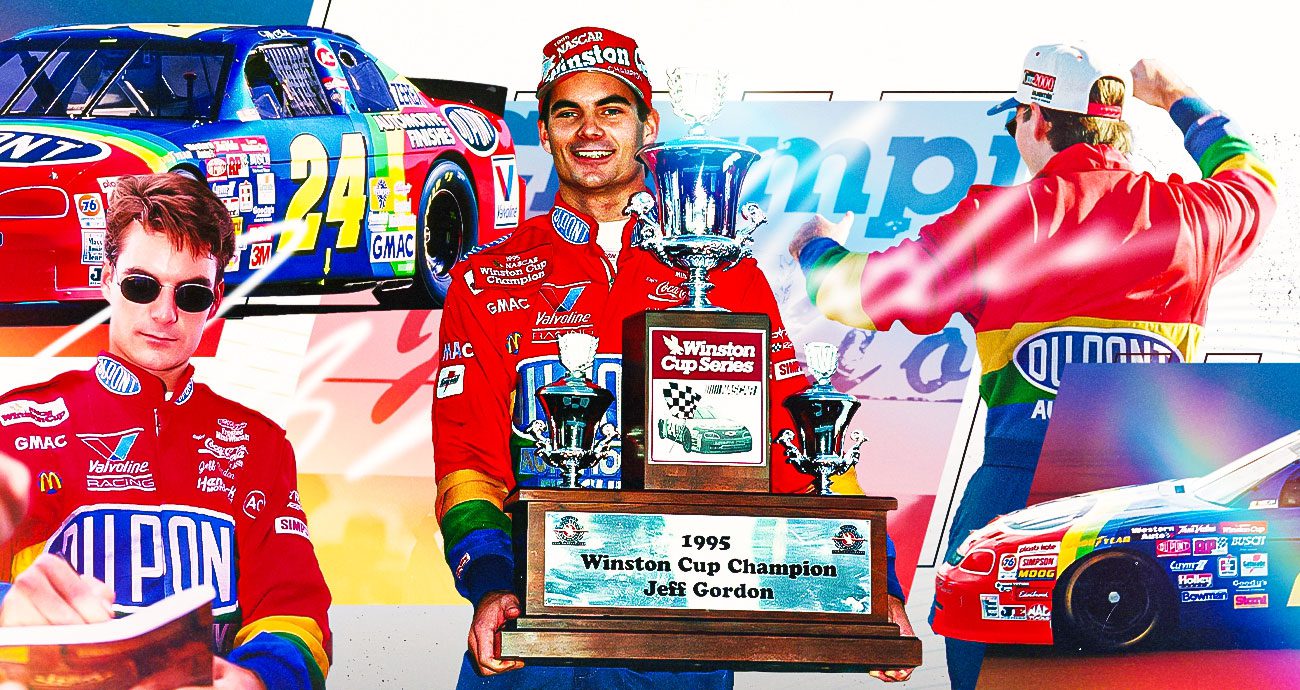
Jeff Gordon arrived in New Hampshire for the summer race in 1995 straddling the two parts of his career -- the learning and the applying. He had spent 1993 and 1994 fast but more likely to crumple his car into the wall than to drive it into Victory Lane.
Through the 15 races in 1995 before New Hampshire, he had been jarringly inconsistent -- nine top-three finishes and five 16th or worse. When he hit the wall in qualifying at New Hampshire and was forced to start deep in the field, it looked to be a key test. Champions overcome mistakes like that. Mere contenders wilt under them. Earlier in his career, Gordon would likely have driven over his head to try to make up for the mistake.
But he had made a huge leap the year before as a driver and the brand-new Monte Carlo was stellar that season, so he knew he didn’t have to force it. He sliced and diced to reach 12th before the first caution flag on Lap 37. Crew chief Ray Evernham called for a two-tire pit stop, which vaulted Gordon to the lead.
Another two-tire call later in the race -- which the TV commentators described as so fast it looked like a gas and go -- pushed Gordon to the lead again. He led the most laps and won the race, took over the points lead and held it for the rest of the season to capture the first of his four championships.
Gordon won so many big races (that was seven of 93) that this one has been lost to history. Even Gordon himself, asked about that race on its 30th anniversary (July 9), could recall nothing of it. Memorable or not, it marked a clear turning point for Gordon and his No. 24 Hendrick Motorsports team as it transitioned from contender to champion and eventually, to dynasty.
"The team could've packed it in after that wreck, but they didn’t miss a beat," team owner Rick Hendrick says. "They fixed the car, stayed focused and went out and won. That told me everything I needed to know. It felt like a shift. Jeff had been fast all season, but it was the first time it really felt like he was taking control of it. They were a different team after that."
And Gordon was a different driver.
Gordon entered 1995, his third full season in Cup, as a precocious talent who had showed an abundance of speed but an inability to consistently capitalize on it. He ended it well on his way to becoming the most transformational figure the sport has ever seen.
In claiming his first title, Gordon won seven races, ignited a rivalry with Dale Earnhardt that became one of the most polarizing in racing history and kick-started a revolution that took NASCAR out of the Southeast and into the rest of the country.
And NASCAR has never been the same since.
In 1995, the sports world was ripe to welcome a new icon. Major League Baseball was dealing with the aftereffects of a strike that canceled the 1994 World Series and delayed the start of the 1995 season. The NHL canceled its 1994-95 season because of a lockout. Michael Jordan disappeared into baseball, leaving a void in the NBA landscape.
Even NASCAR was in a major transition, with the retirement three years earlier of Richard Petty, the deaths of Alan Kulwicki and Davey Allison and the closure at the end of 1995 of Junior Johnson’s team, one of NASCAR’s greatest and most innovative teams.
Into that sports world in flux stepped Gordon, a stock-car driver unlike any in the sport’s history to that point -- in age, racing pedigree and more. "The sport was on the verge of breaking out," Hendrick says. "We were getting more national attention, the fanbase was changing, and there was this sense that something was coming. Jeff was right at the center of that -- young, different background, polished, media savvy."
Gordon charmed sponsors, beat veterans, enraged old-school fans and attracted a legion of new ones drawn to his youthful good looks, undeniable talent and winking confidence as he dusted established drivers week after week and eventually year after year.
"He was a new breed of driver, so clean-cut and polished that he immediately raised NASCAR’s corporate image beyond its moonshine roots," wrote Jenna Fryer, who covered Gordon’s career for The Associated Press, in "Jeff Gordon: NASCAR's Driven Superstar." "NASCAR was suddenly a legitimate power on Madison Avenue as tens of thousands of new fans flocked to automobile racing in the late 1990s and 2000s."
That growth started before 1995, and it continued for years after. But Gordon’s first championship lit the wick on an explosion in NASCAR’s popularity and place in American pop culture.
"It was a seismic shift across the sport," says Ken Martin, the director of historical content for NASCAR Studios, who has known and covered Gordon since Gordon was in high school. "People today, I don't know if they can really comprehend what the impact was back then. All of a sudden, we were cool."
Before Gordon made NASCAR cool, first he had to learn to keep his own.
Hendrick Motorsports has been the best team in NASCAR for so long it's easy to forget that the team chased its first title for 11 seasons before Gordon finally caught it. It has now won a whopping 14 Cup championships. The first one came because of a driver on the cusp of greatness getting into a dominant car.
Heading into the 1995 season, Evernham built a test car he dubbed Blacker. It had skull and crossbones on the hood, and that thing was fast. It would be even faster, Evernham wrote in his memoir, Trophies and Scars (from which this account of the events is drawn), if he tweaked the tail. He wanted it to be narrower. He made a new tail that he thought would be great, but he wasn't sure NASCAR would approve it.
Hendrick suggested he build another one that went far beyond the gray area. Evernham knew it had no chance to be approved. He put that obviously illegal tail on the car, and NASCAR officials inspected the car. As expected, he didn’t like the tail. Hendrick made the case for it, saying his Hendrick Motorsports Monte Carlos needed help to compete against Fords and Pontiacs.
Acting chagrined, Hendrick said well, we've got this other one, and pointed to the one Evernham actually wanted to use, but we really want to use the one that's on the car now.
"Holy (expletive)," Evernham wrote. "Rick just snookered those guys. That was the car salesman in him."
Evernham says Blacker won 13 races combined in 1995, 1996, 1997 and 1998.
"Even in the (preseason) testing," Gordon says, "we knew right away that we had something special brewing. It was just, could we do it all year long?"
That was the right question. No matter how fast the Monte Carlos Evernham built for Gordon were, it would not matter if Gordon kept crashing them. He had DNFs in 22 of his first 62 races. Veterans grumbled to his face and behind his back. NASCAR Hall of Famer Darrell Waltrip -- then a former Hendrick driver and future co-worker of Gordon on FOX broadcasts -- told Hendrick that Gordon crashed so often he would never make it.
"I was embarrassed how many times we wrecked and tore stuff up," Gordon says. "But there were little glimmers of hope when we finished some of the most grueling races right up there with the top guys. That kept us together as a team and me as a driver to get that confidence back that I was losing from wrecking."
Many elite drivers go through the same learning curve. They arrive at the Cup level with more speed than sense. They wreck cars and anger veterans with too-aggressive moves. They either learn or lose their jobs. Starting late in 1993 and continuing through 1994, Gordon learned.
In 1995, he applied that education. He had more top-five and more lead-lap finishes than the previous two seasons combined. He led an astounding 2,610 laps, the most of his career (even though subsequent seasons had five more races).
"Gordon was one of these guys who was fast out of the box, but he needed to learn the race craft of NASCAR Winston Cup racing, and that just takes a couple years," says Tom Jensen, who as a journalist covered Gordon's career and is now curatorial affairs manager at the NASCAR Hall of Fame. "He was putting it all together and learning when to be patient and when to be aggressive, instead of just going out and trying to put the car someplace it doesn't want to go."
There's an old saying in racing that it’s easier to get an over-aggressive driver to calm down than it is to get a timid driver fired up.
"Rick saw something in me and Jeff that we didn't even see in ourselves. And what he saw, he enjoyed," Evernham wrote. "It gave him confidence. Rick was patient when it came to cultivating talent. There aren’t many owners that would’ve been tolerant enough to let Jeff and me get through our first two seasons together."
Evidence that Hendrick’s patience would pay off came in the first race of 1995.
Gordon and Evernham frequently had spirited exchanges over the radio. In the 1995 Daytona 500, Gordon had the fastest car. But a backup jack man dropped the car too soon, and when Gordon exited the pits, a tire popped off. Their chances to win disappeared.
Evernham thought Gordon would throw a fit on the radio. But he didn’t. According to Evernham, he said, Don't worry about it. We'll get it next week. There's gonna be another race.
"Right there and then, his maturity and leadership pulled the team together. It was a huge moment for me and for the team," Evernham says.
Says Hendrick: "Jeff wasn’t just this fast kid with a ton of talent anymore. He was becoming the guy you could build something around."
The resulting cohesiveness within the 24 team proved crucial as Gordon remained locked in a tight points battle with Earnhardt and Sterling Marlin, with each taking a turn at the top. As they entered the race at New Hampshire, the 16th of the season, 15 before and 15 after, Marlin was in first with 2,200 points, Gordon was second with 2,193 and Earnhardt third at 2,184.
Gordon left New Hampshire with the points lead during a torrid run -- 14 straight finishes of no worse than eighth, with four wins and an average finish of 3.6. "That was the championship right there," he says.
He never relinquished that lead, no matter how much Earnhardt tried to intimidate him into choking it away.
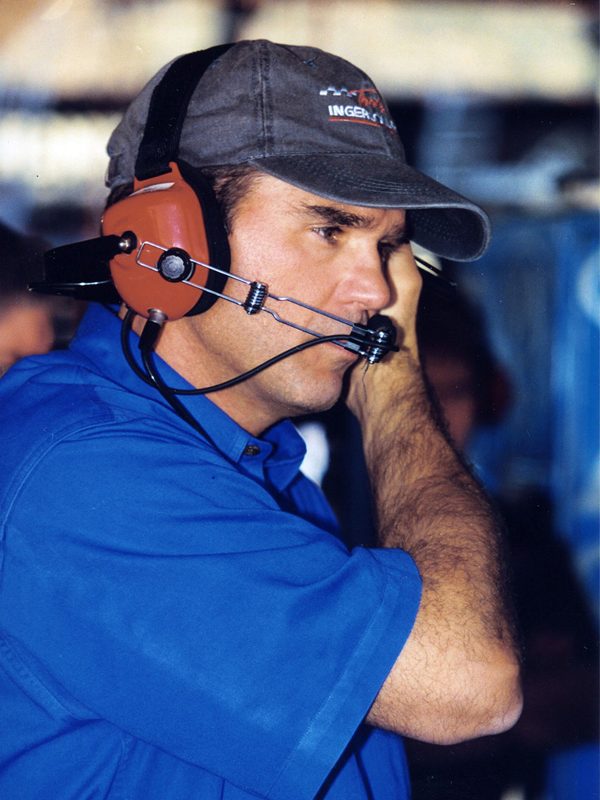
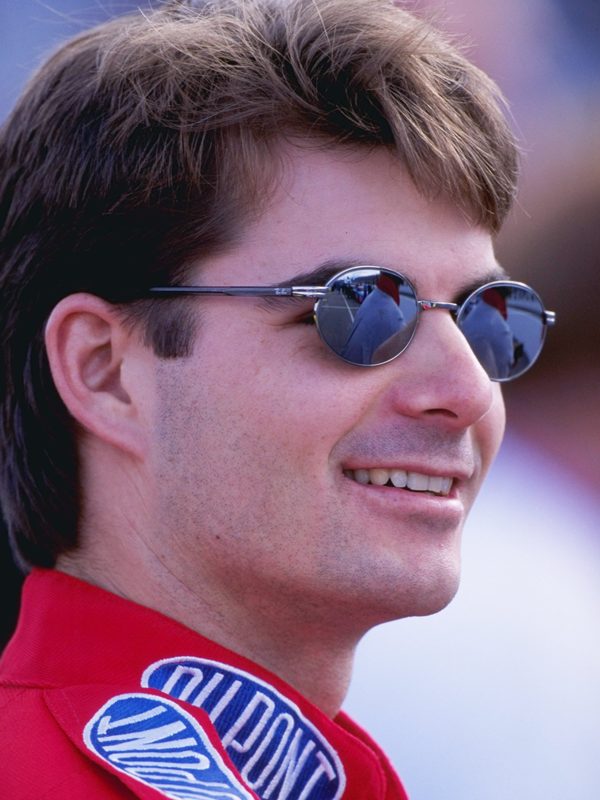
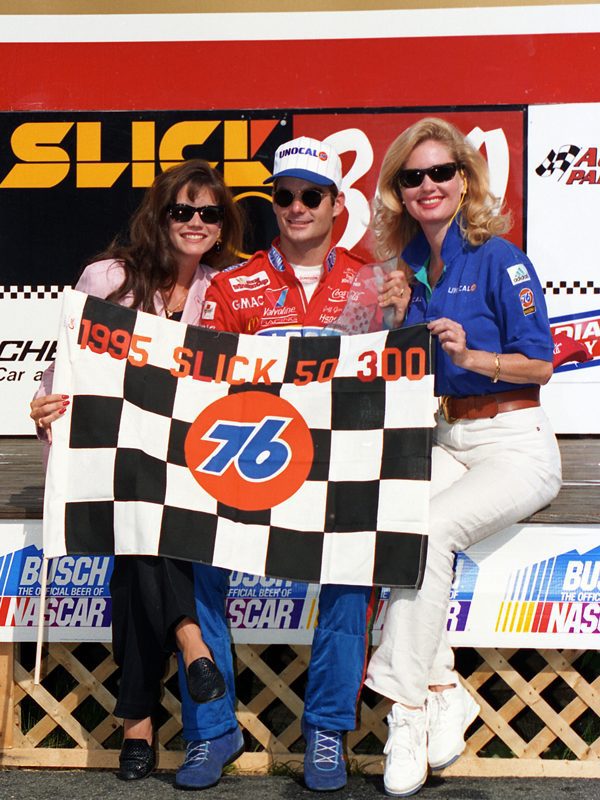
Before 1995, the rivalry between Earnhardt and Gordon really wasn't one. Earnhardt won the championship in both of Gordon's full-time seasons, and Gordon was not good enough for the tension between them to be called a rivalry.
That started to change in 1994, when Gordon won the inaugural race at the Brickyard, a win Earnhardt wanted desperately. It grew again in 1995 after the spring Talladega race. Gordon and Earnhardt left that race with the same number of points, but Gordon was named the leader because he had more wins. Their budding rivalry became the talk of the sport.
After New Hampshire, Gordon built up a huge lead, squandered most of it late in the season when the team fumbled a more conservative approach to protect that lead, and held on to win the championship by just 34 points over Earnhardt -- slightly less than seven positions over the course of 31 races, a razor thin margin in those days.
Earnhardt scored more points than Gordon in 17 of 31 races (they tied once). Earnhardt had a better average finish (9.2 to 9.5), the same number of top 10s (23) and two more top fives (19 to 17). Gordon won two more races (7 to 5), and Gordon led laps in an astounding 29 of 31 races while Earnhardt led in "only" 24.
Earnhardt the grizzled veteran delighted in needling the much younger Gordon. He called him Wonderboy and joked that if Gordon won the championship, the season-ending banquet would have to serve milk to accommodate him. Gordon refused to engage ... until he won the championship.
The two eventually became business partners, and their relationship is sometimes characterized as all in good fun. But that's not true. "I didn't like him at that time," Gordon said on Kevin Harvick's Happy Hour podcast. "This guy went from being my hero that I respect so much to now he's trying to get in my head. He's messing with me on the track and off. It was a love-hate relationship there for a little while."
Earnhardt was called the Intimidator for good reason. But he respected drivers who stood up to him, and this season and for the rest of the time they raced together, Gordon did exactly that. "We knew if we were ever going to become NASCAR champions, we had to go through the No. 3 car. There was no way around it," Evernham says.
As the Hall of Fame's Jensen points out, sometimes in sports fans don't appreciate greatness until after it's over. But with Gordon and Earnhardt, fans knew they were watching history being made. "You saw those two going at it every week, and they were damn near both in the top five every week, you knew you were witnessing something great," Jensen says. "It was thrilling to watch."
That was true from the outside, but not the inside. Gordon never looked beyond the next race. "You were just waiting for something to crumble," he says. "I certainly look back on it now and, wow, you're in awe of that. Here was this Goliath, and here's this young team and driver. You're going up against Goliath, and at least that second half of the season, you're taking him down on a regular basis. I didn't recognize it at the time, but I was enjoying my role in it."
NASCAR driver eras are clearly defined by championships. Jeff Gordon won four championships, but he never won another one after Jimmie Johnson won his first of seven in 2006. Richard Petty won seven championships, but he never won another one after Dale Earnhardt won his first of seven in 1980. And Earnhardt never won another one after Gordon won his first in 1995.
A moment at the 1995 champion’s banquet serves as the symbolic end of Earnhardt's era and beginning of Gordon's. During his speech, Gordon paused to recognize Earnhardt’s tireless efforts to win his eighth championship -- a quest Earnhardt never fulfilled.
As Gordon spoke, a waiter appeared at his side. He gave Gordon a champagne flute and pulled from a bucket of ice a carton of milk. Gordon filled the flute and raised it in salute to Earnhardt, an obvious nod to Earnhardt’s wisecracks that season, the first time Gordon acknowledged Earnhardt’s gamesmanship. "Luckily I got the last word because I'm the champion," Gordon says.
Earnhardt stood up and raised a glass to Gordon, a smirk hiding underneath his mustache.
Goliath looked as if he knew he had met his David.