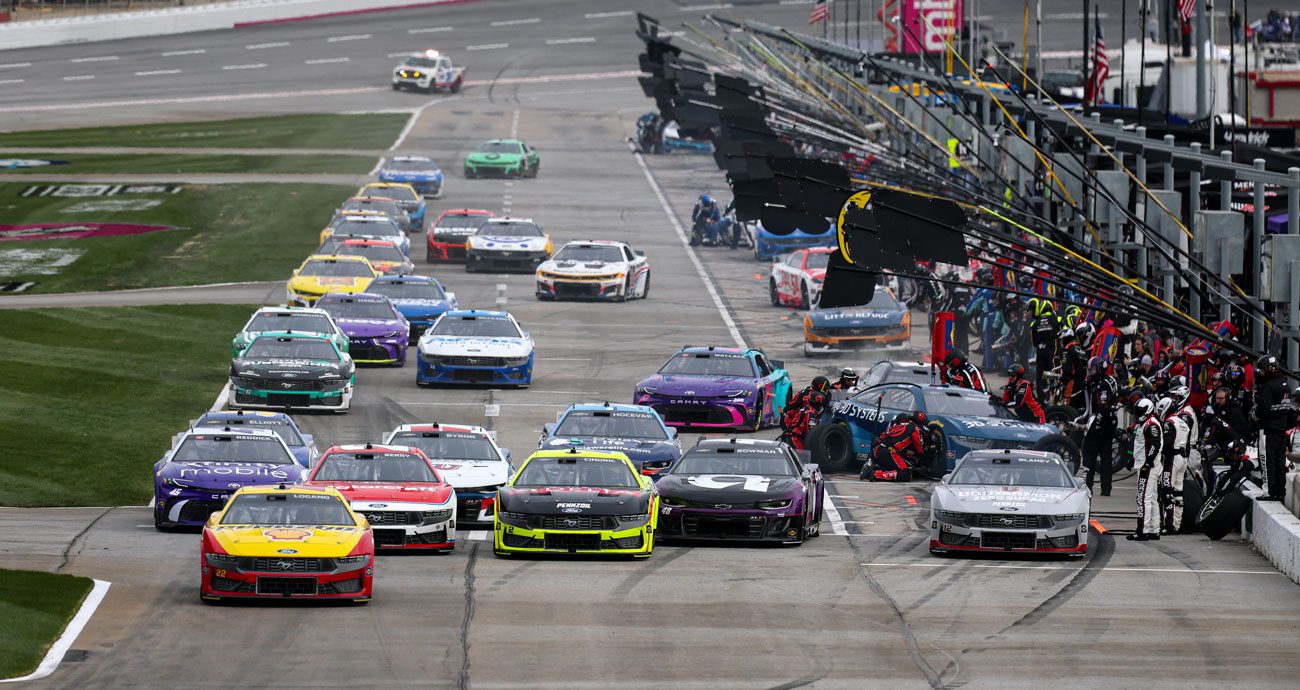
HAMPTON, Ga. — Another week, another superspeedway, and another opportunity for crew chiefs to strategize their drivers into race-winning contention.
With EchoPark Speedway next on the NASCAR Cup Series docket on Sunday (3 p.m. ET, FOX, HBO Max, PRN Radio, SiriusXM NASCAR Radio), fuel strategy will be top of mind once again, just as it was last week in the season-opening Daytona 500.
RELATED: EchoPark schedule | 2026 Cup schedule
But two other unique variables separate EchoPark’s 1.54-mile high banks from Daytona’s 2.5-mile layout: new Goodyear tires and a far trickier pit road.
No practice and a washed-out qualifying session Saturday leave teams with no track time ahead of Sunday’s Autotrader 400, but crews will have some familiarity with Goodyear’s tire compound heading into the event with the same left-side tire that has been used at the Georgia race track since 2023.
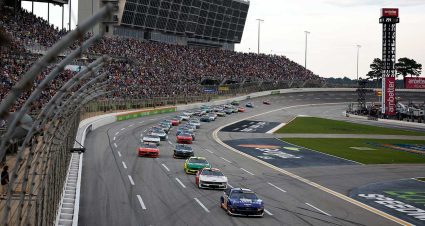
“Typically, the tires we use at EchoPark Speedway are only used at this track, and its smooth surface doesn’t naturally lead to much tire wear,” Rick Heinrich, Goodyear’s NASCAR product manager, said in a press release. “As such, we develop tires that encourage wear, and we have seen consistently good racing here since it became a superspeedway.”
How that factors into Sunday’s 260-lap feature remains to be seen, but Travis Peterson, crew chief of the No. 71 Spire Motorsports Chevrolet and driver Michael McDowell, carries little concern into Race 2 of 2026.
“Goodyear has done several of these types of construction changes, and they’ve been fine,” Peterson told NASCAR.com Friday. “If anything, they’ve probably been a gain in terms of not seeing people pop tires and not be really significant otherwise. It’ll be interesting to see, though, because we haven’t done a lot of that on speedway-style tires. Typically, you come to speedways, and you don’t think about it being a big deal on tires and all that. But here you definitely see more of it. So it could be a dynamic, but like we’re all going to find out together in Stage 1.”
With qualifying canceled, the starting lineup set was per the rule book, using a metric that factors in last week’s results and current owner points positions. As such, McDowell is set to roll off 20th on the starting grid and Chase Briscoe 34th. That meant worse pit-stall selection as crew chiefs select their respective stalls in order from first on the grid to last.
Why does that matter? EchoPark’s pit road is arguably the most unique on the circuit. Its pit entry starts at the beginning of Turn 3, making its 3,900-foot pit road the longest on the NASCAR schedule. However, its pit stalls are tied for the shortest on the calendar at just 27 feet, 6 inches long. To make matters more challenging, pit-road speed limits differ under green-flag conditions — a 90-mph limit from Turn 3 to the actual pit-road entrance before it reduces to 45 mph — and yellow-flag conditions, which maintain a 45-mph limit for the entirety of pit road.
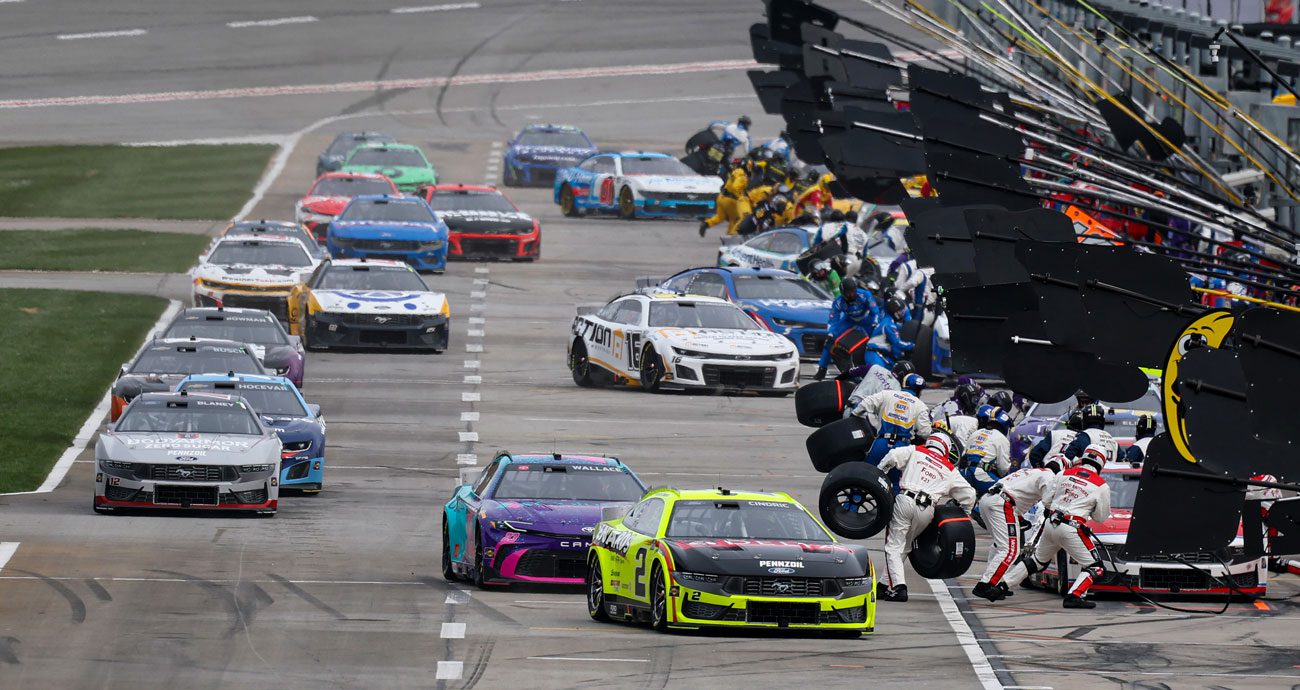
That’s why Briscoe’s 36th-place finish at the Daytona 500 hurts most this week. With limited options for crew chief James Small to pick from, Briscoe will have pit stall No. 25 in Sunday’s race, trapped between Austin Dillon’s No. 3 team and Alex Bowman’s No. 48 team.
“This is the hardest pit road I think we have, just from the standpoint of the room,” Briscoe said Saturday. “And when we come down pit road, the whole field is going to be on the lead lap. So it just makes it where you’re always going to be coming around somebody or have somebody in front of you. So yeah, it will not be ideal at all (Sunday), but that’s the cards that we’re dealt, and we’ll make the most out of them.”
What complicates matters further is many teams will be aiming for quick refuelings, limiting the amount of time the car is stopped in its box before returning to action.
“When you do these style stops, and you’re either doing short fills, or you’re doing group choreographed stops, being able to qualify well to give yourself selection is very important,” Peterson said. “And then you think about even like what happened at Daytona, it’ll happen here too. If we get cautions at certain times, you’ll see us all come take a splash and go. Well, that’s when your pit-stall selection matters more than any time because it’s not everybody doing the same thing, and you’re trying to pull in and out of your box, and everybody else is still coming down pit road. And it can get really messy depending where you are on pit road.”
MORE: Paint schemes racing at EchoPark | Fantasy Fastlane: EchoPark
Peterson nearly calculated fueling to perfection one week ago in Daytona. Peterson kept McDowell on the track by his lonesome in the closing laps of the Daytona 500 in an attempt to stretch the fuel tank over 65 laps and win the race. Those dreams were thwarted by a late crash farther behind him, drawing a caution flag, bunching the field back to his rear bumper and leading to a late-race restart before the No. 71 car was collected in a last-lap crash.
If that caution flag doesn’t fly at Lap 192 of 200, though, Sunday’s outcome could have been different.
“When the pack started saving so aggressively there, and we were kind of already at the back and a little bit wounded,” Peterson said, “we started to look at the mileage we were getting and started to do the math and saw there was a chance. And it was just going to be dependent on how late everybody else waited to pit. It worked out where the opportunity presented itself. …
“But the two laps of data we got lap-time wise and mileage wise, versus what the pack was running, I did a little bit of math this week, and obviously it’s only two data points, but I do believe we would have finished probably about a second ahead of the pack with just barely enough fuel. And I think even worst-case scenario, it would have been quite the finish with our car out of gas coasting.”