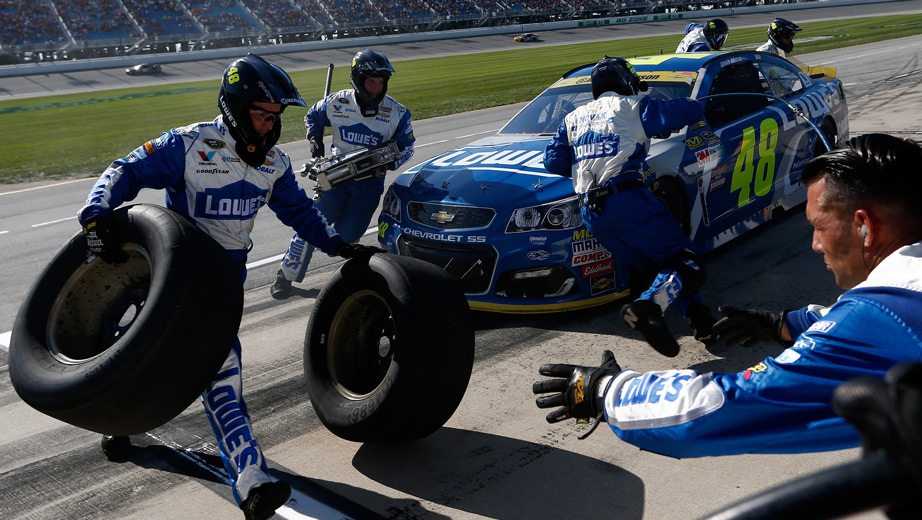
Sunday’s race in Chicago had its fair share of speeding penalties entering and exiting pit road. In total, there were 11 penalties called on teams for speeding — including, three Chase contenders (Nos. 18, 20 and 48).
The most damaging penalty was on the No. 48 Hendrick Motorsports team (Jimmie Johnson) during a cycle of green-flag pit stops. The team served a pass-through penalty on Lap 236 after speeding while exiting pit road. Johnson led a race-high 118 laps.
You might be asking, how this happens and what can be done to fix it?
Drivers don’t use speedometers for maintaining speed. Instead, they use gear and RPM. Thus, before a race they know what gear and RPM to use in order to maintain pit road speed. NASCAR, then, controls the speed by using timing lines in multiple sections of pit road. So whenever there is a penalty NASCAR can tell the teams what section the speeding was in.
Since the race at Indianapolis, NASCAR added extra pit road speeding lines for all tracks in this stretch except Bristol, meaning drivers and teams have had to make an in-season adjustment.
Teams will pick pit stalls depending on a few things but an important factor is timing lines — which can be tricky. If a driver is good at getting in and out of their pit box and can get all he can on the timing lines, then that team has an advantage over the field.
The disadvantage, howvever, occurs when you risk it and get caught. The penalties, as was the case of Johnson, can end the day on a sour note.
The Chicagoland event saw eight of the 11 penalties from speeding while exiting pit road. Six occured under green flag conditions.
After this weekend, teams might start to think twice about risk vs. reward when it comes to speed on pit road.
For more pit crew news, visit PitTalks.com.