For those of us NASCAR fans and industry observers wondering earlier this season when the future of the sport might arrive, well, the answer is apparently right now.
Granted, when it wasn’t riding the wave of separate long winning streaks by Tyler Reddick (age 30) and Denny Hamlin (age 45), the 2026 season has seen three different checkered flags captured by first-time winners Ty Gibbs, Carson Hocevar and Corey Heim — each of whom also happens to be age 23 or younger this season.
That’s the first time in the Cup Series’ modern era (since 1972) that three different drivers in their age-23 seasons or younger won their first career races in the same season, and only the second time — joining 2018 (with Chase Elliott and Erik Jones) — that multiple drivers even joined that club at all in the same season.
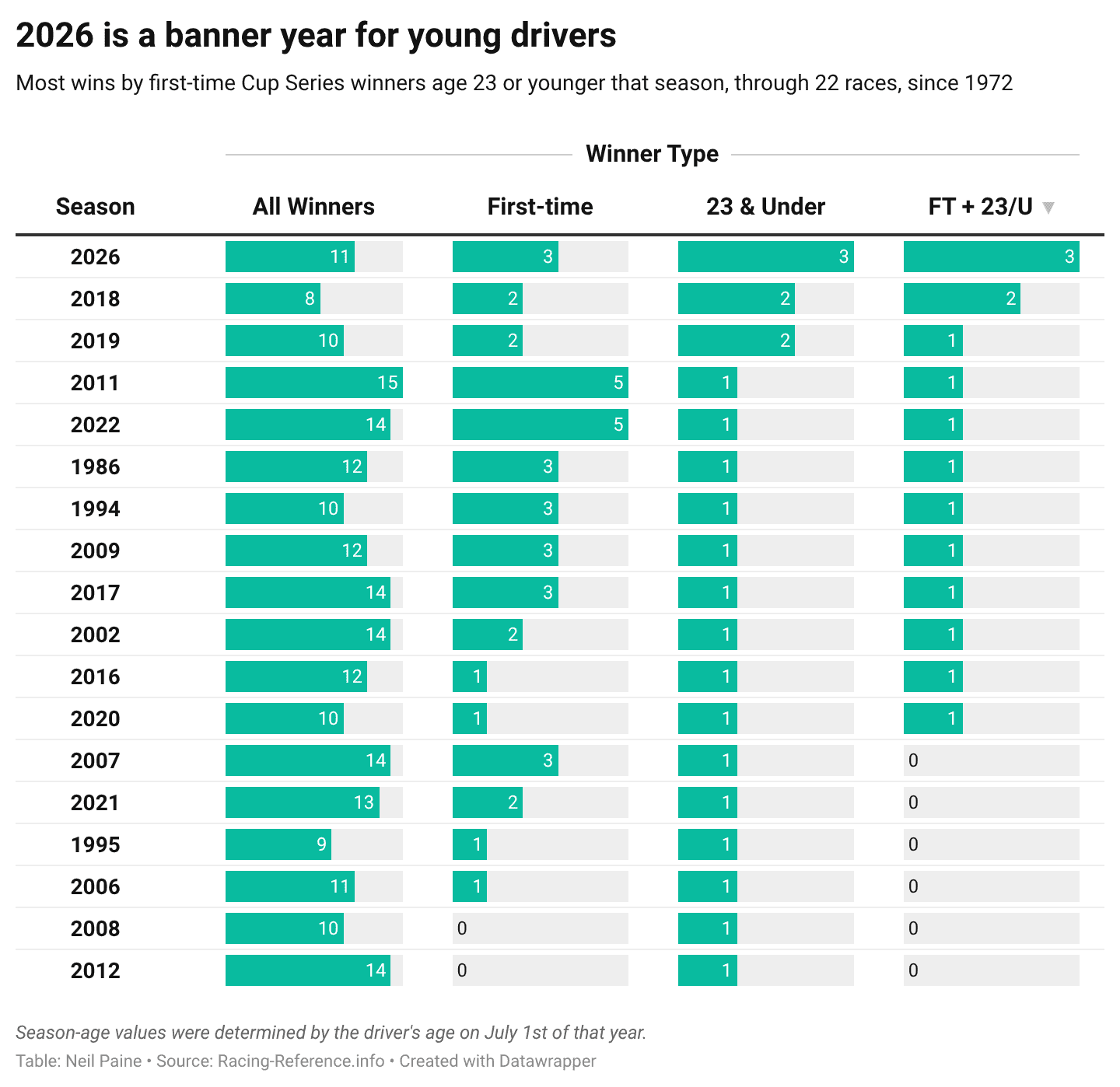
In a growing class of up-and-coming drivers that also includes the generationally hyped (and generationally unlucky) Connor Zilisch at age 19, it perhaps wasn’t too difficult to imagine that young drivers would break out this season. But in the race to multiple career wins out of that age cohort, a surprising winner has jumped to the front of the line in the form of Heim, who won his second career Cup race on Sunday at Indianapolis Motor Speedway in just the 15th start of his career:
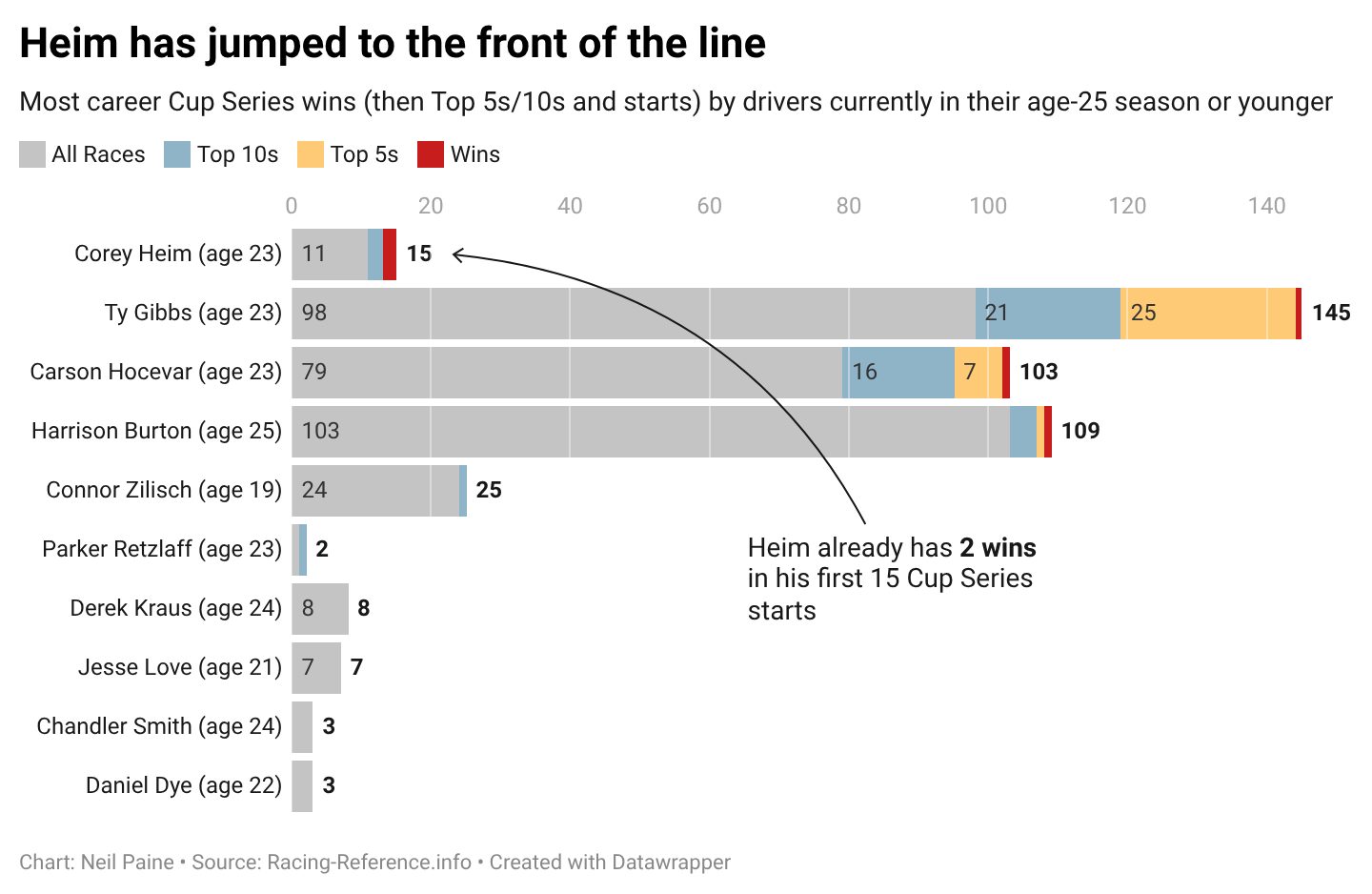
Why is Heim surprising? It’s not talent. Heim went out and absolutely dominated the Truck Series last season with 12 wins — not only the most ever in a single season, but the first time any driver had ever reached double-digits in a campaign at all — and he has 26 career Trucks wins in 95 starts, good for a 27.4% winning percentage that ranks second only in series history to the late, great Kyle Busch (i.e., NASCAR’s winningest driver) at 37.5%.
More so, it’s because of opportunity. Despite his runaway dominance in the Trucks, Heim went into the 2026 season without any full-time seats available at 23XI Racing — where he’d run four races in 2025 — or within the Toyota pipeline in general, limiting his Cup schedule to a part-time workload while also running (and continuing to dominate) part-time in the Trucks as well.
Heim’s patience, ability and loyalty to the Toyota program were rewarded in late May, when it was announced he would be permanently taking over at the helm of 23XI’s No. 35 car in 2027, a ride that has been driven by Riley Herbst this season. “Heim Time” will finally get to be full-time.
In the meantime, though, that gives Heim a chance to keep building upon a 2026 season that already ranks among the best “part-time” performances in Cup history. In addition to Sunday’s win at Indy, Heim also won at San Diego a little over a month ago. Among drivers in the modern era (since 1972) who ran fewer than half of all available Cup races, Heim has joined AJ Foyt in 1972 and Tim Richmond in 1987 as the only names to ever win multiple races in a part-time season.
Foyt, of course, was a four-time Indianapolis 500 winner — and seven-time IndyCar Series champion, to go with titles at the 24 Hours of Le Mans and other prestigious wins — who would also routinely run a handful of Cup Series races per season, driving the iconic Wood Brothers No. 21 car to victory at the Daytona 500 and Miller High Life 500 at Ontario Speedway among his six Cup starts in 1972. As for Richmond, he was one of the most talented race car drivers to ever climb behind a steering wheel, but his life was tragically cut short just as he was hitting his prime. Following a No. 3 finish in the 1986 standings, Richmond missed the first half of the 1987 schedule due to failing health, but returned in June to win back-to-back races at Pocono and Riverside — making just eight starts before his condition forced him to step away permanently.
“Daddy thought he was one of the best he’d raced against,” Dale Earnhardt Jr. would say many years later. “I’ve said it before, I think if Tim had lived and competed for many more years, Daddy wouldn’t have seven championships for sure.”
Heim has thrown his own hat into the ring for the title of best part-timer, though there are other candidates on the shortlist. We have a few options to measure this: Across each race, we can track not only a driver’s actual wins, but also their “expected” wins based on how often a driver with their particular Driver Rating tended to win any given race. If we compare each measure to the rates for an average Cup driver in the same number of starts, we find that Heim is up +1.79 actual wins above average and +0.59 expected wins above average, both of which already rank among the best by a part-time driver in modern history:
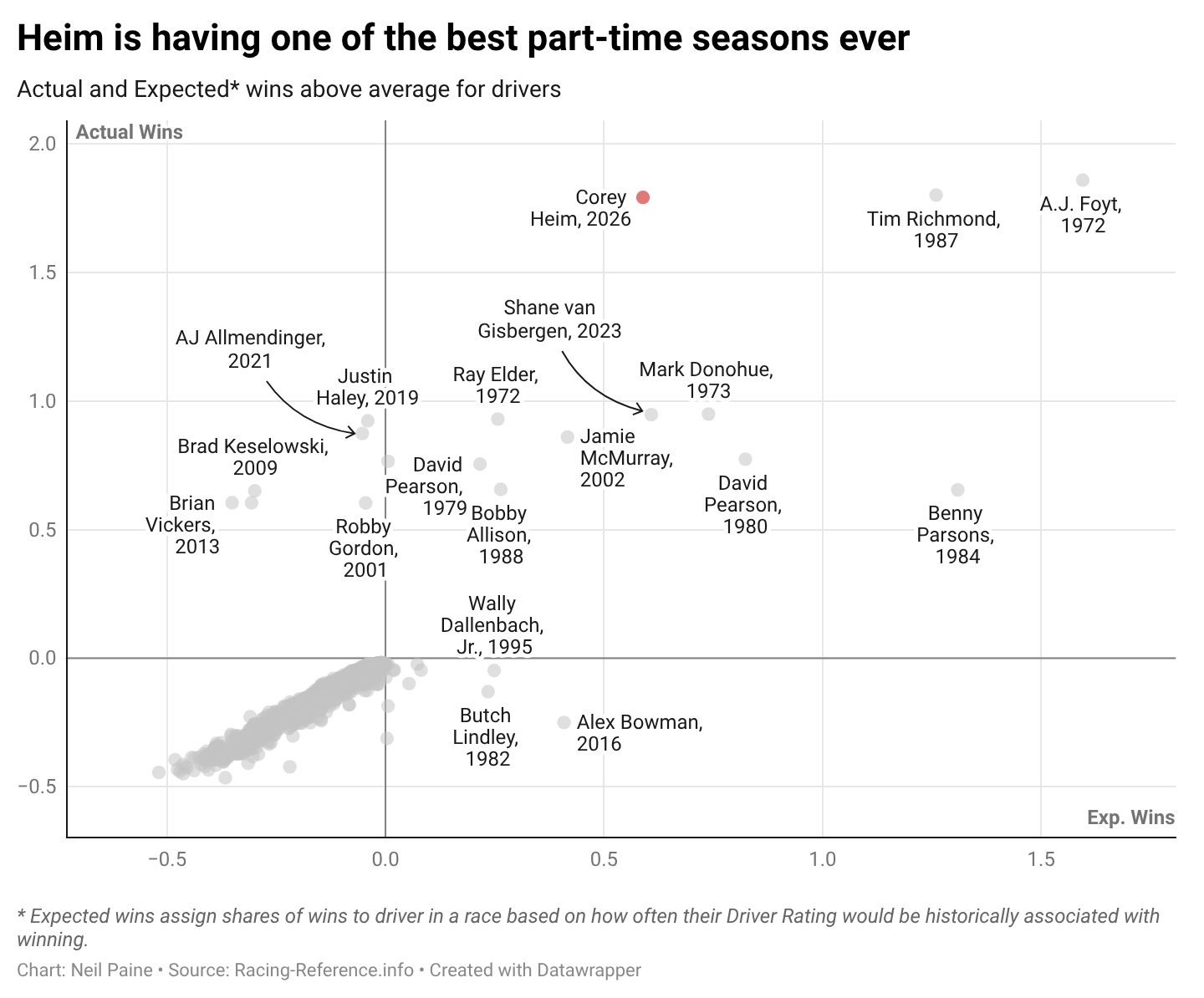
In the actual wins above average ledger, only Foyt and Richmond rate higher on the y-axis of the chart. Expected-wins-wise, Heim ranks seventh — behind not only Foyt and Richmond, but also Benny Parsons (1984), David Pearson (1980), Mark Donohue (1973) and Shane van Gisbergen (2023) — because in his non-wins, Heim hasn’t been quite as dominant. (His average rating in those non-wins is 70.2, barely above average, with an average finish of 21.2.) But how ever you slice it, Heim is doing more with less time on track this season than just about anybody in Cup Series history.
In even better news for Heim and his growing number of fans? We’ll get to see him on track four more times this season, starting Aug. 29 at Daytona International Speedway in the regular-season finale. That means four more chances to add to his win total and/or otherwise rack up stats in a campaign where Heim has proven without a doubt that he belongs at NASCAR’s highest level, even amongst a crowded group of young guns.