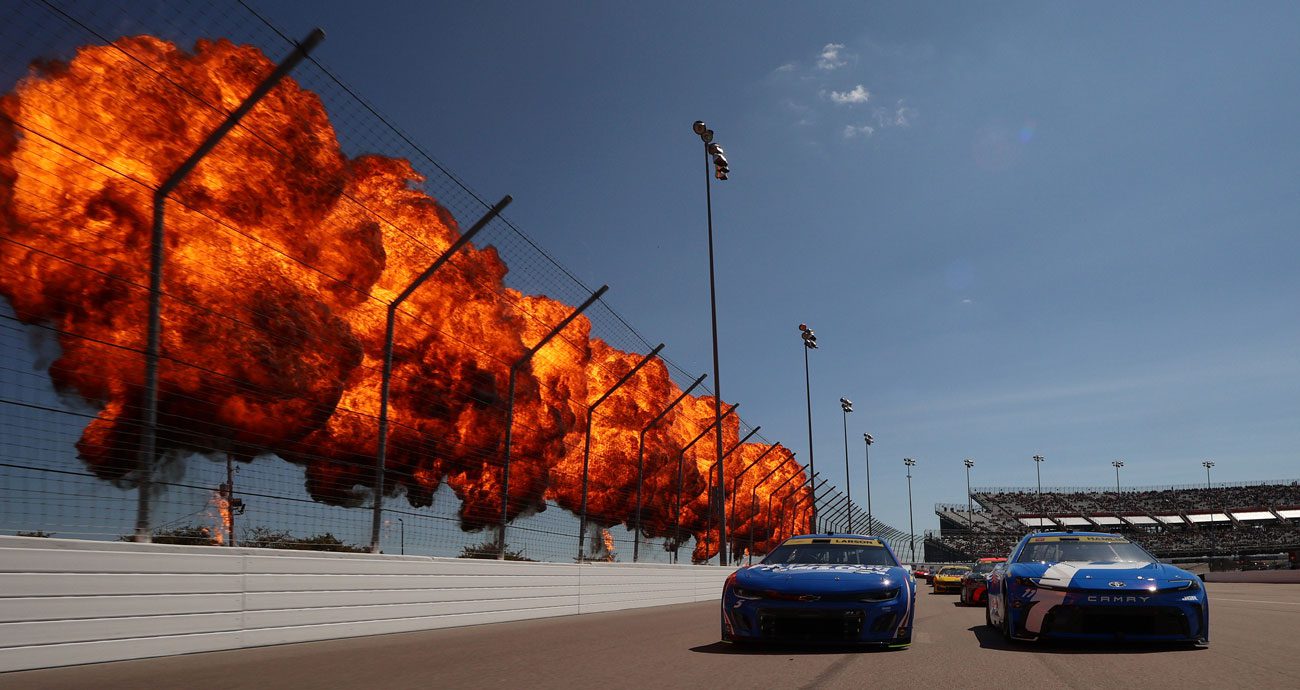
MADISON, Ill. – Since World Wide Technology Raceway at Gateway joined the Cup Series schedule in 2022, brake failures have become an all-too-familiar sight. Now, teams face another challenge at the 1.25-mile, egg-shaped oval on Sunday, where managing brake temperatures could be critical to surviving the Enjoy Illinois 300 (3 p.m. ET, USA Network, HBO Max, MRN Radio, SiriusXM NASCAR Radio).
The long straightaways and tight corners lead to drivers slamming the brakes entering Turns 1 and 3. Maximum brake heat could reach upwards of 1,200 degrees Fahrenheit entering the two vastly different sides of the race track. Down the straightaways, those same brake components cool significantly to a couple hundred degrees. There is a balancing act, however, as overcooling the brakes can lead to brake shake. The constant shift in temperature can lead to big failures.
“This is the hardest kind of educated guessing we’ve done on breaks this year,” James Small, crew chief for Chase Briscoe told NASCAR.com on Saturday in the St. Louis suburb.
MORE Sunday’s starting lineup | Cup Series Chase standings
The No. 19 Joe Gibbs Racing team experienced brake issues of its own during practice and qualifying last month at Iowa Speedway. Small stated that woe is akin to recent happenings in Australian V8 Supercars. After the issues in the “Hawkeye State,” he knew that package wouldn’t be returning to the track at Gateway, where Briscoe finished second last year.
“It’s honestly quite daunting,” added Small, whose driver enters fifth in points with nine races remaining. “Having 50 minutes of practice here and coming here with a new package, more power, weight less drag, less downforce. The brake energy has gone up considerably, and they’re already a finicky thing on this car, and you get on the wrong side of it, and you can have issues. So yeah, definitely a major concern, and it was a tough decision on what was the right thing to bring here to meet all objectives and hopefully not have an issue in the race.”
Road-course ace AJ Allmendinger has also had success wheeling a Cup car around Gateway. In three attempts, he has a pair of top-15 finishes, including a 10th-place effort in the inaugural 2022 event. Trent Owens, leader of the No. 16 team for Kaulig Racing, believes that success boils down to the three-time Cup winner excelling at venues with high brake pressures.
“I think a lot of it is on the driver more so than the team itself,” Owens said of Allmendinger’s success in the blistering Midwest heat. “Hopefully, we got a good setup for him to run this weekend too, and keep that consistency up.”
The last time the Cup Series visited the heartland region of the United States, Allmendinger earned an eighth-place result at Iowa, a venue comparable to Gateway. At Nashville Superspeedway in late May, the No. 16 bunch won the opening stage in a photo finish over Kyle Larson and was in line to score major stage points in Stage 2 until the waning laps when a front brake rotor exploded and dropped him to 35th in the finishing order.
Owens learned a lesson that evening that could help for Gateway, despite believing the two circuits are vastly different.
“Ultimately I did not have enough cooling on the brakes at Nashville when we had our trouble. I was just greedy with everything,” Owens said. “I didn’t think the brake-pad combination we were running was going to run that hot, and I think it was just ultimately my fault.
“If you say I did learn one lesson from Nashville, like for here, the cooling has been moved inward, which would provide more cooling than by having them outward like I did in Nashville. Then obviously I got more opening on the right front.”
Teams have the option to run the “heavy duty (HD) option” of brakes at Gateway. Normally, that package has been implemented at other high-braking race tracks, including all the road courses and Martinsville Speedway.
Another concern for teams is balancing both ends of the race track with how different the layouts are. Goodyear has also settled on using the intermediate left-side construction for the tire setup, which is “not your friend” at a flat track, according to Small.
All the Gateway nuances, including the differing in-race strategies putting an importance on gaining track position, makes for a challenging battle atop the pit box.
“From an engineering, crew chief’s perspective, [Gateway] does offer a lot of options to try and work the setup,” Small concluded.
Briscoe will take the green flag in fifth position. Allmendinger will roll off the starting grid in 17th.