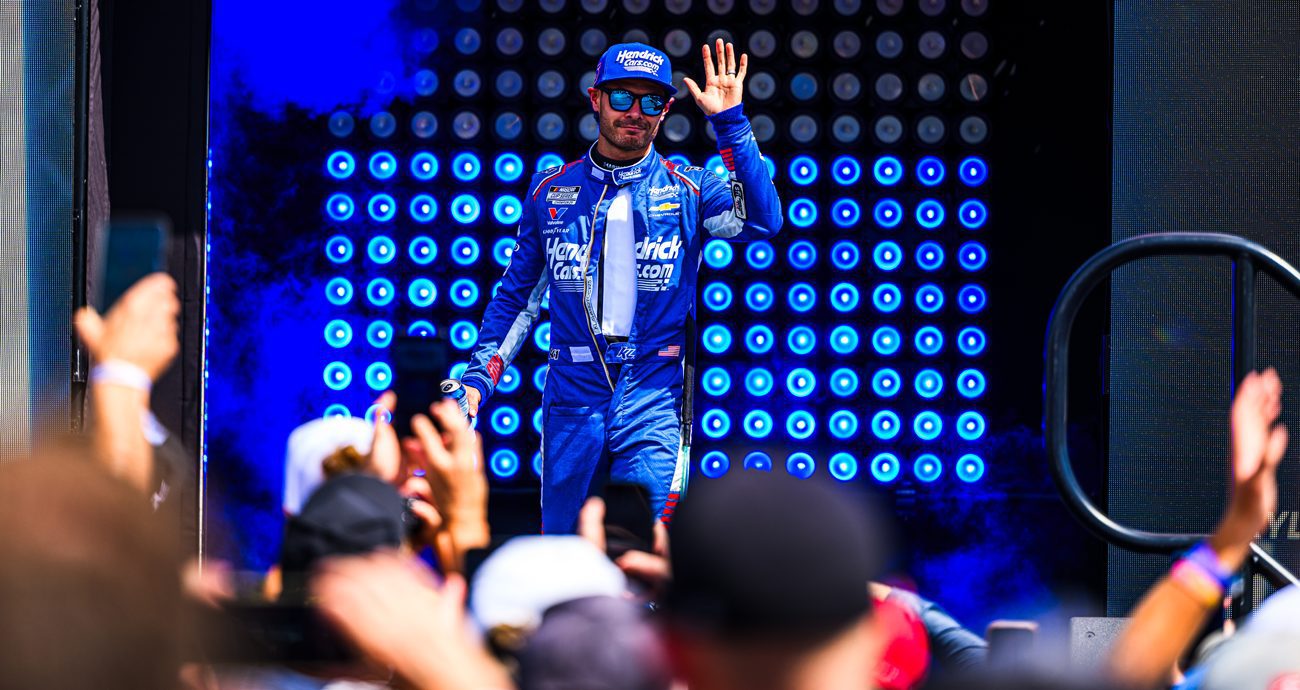
At mid-race of Sunday’s Enjoy Illinois 300, Kyle Larson faced a restart sequence that seemed to threaten yet another promising run with an underwhelming result. Larson fired off next to the recently resurgent Josh Berry and went door-to-door with the No. 21 car, needing to recover from a wobble to avoid crashing through the turn. Then, later in the same lap, Larson went three-wide with Berry and Denny Hamlin, once again bouncing off a rival’s car, clipping the wall and maybe even drawing contact with the front bumper of Joey Logano behind him.
But somehow, Larson stayed intact through all that — and a lot more — to later claim victory in the shadow of the Gateway Arch, a result that may have shaken up the 2026 Cup Series championship picture with just eight races remaining in The Chase presented by Mobil 1.
For a driver who, at various moments in his Cup tenure, has made success actually look quite easy, ending a 51-race winning drought — the third-longest of his career, spanning 490 days since Kansas in May 2025 — was, at times, as difficult as it gets. Not only did Larson have to repeatedly fight his way through the kind of hand-to-hand combat highlighted above, but he also needed to survive multiple pressure-packed late restarts, including two in overtime.
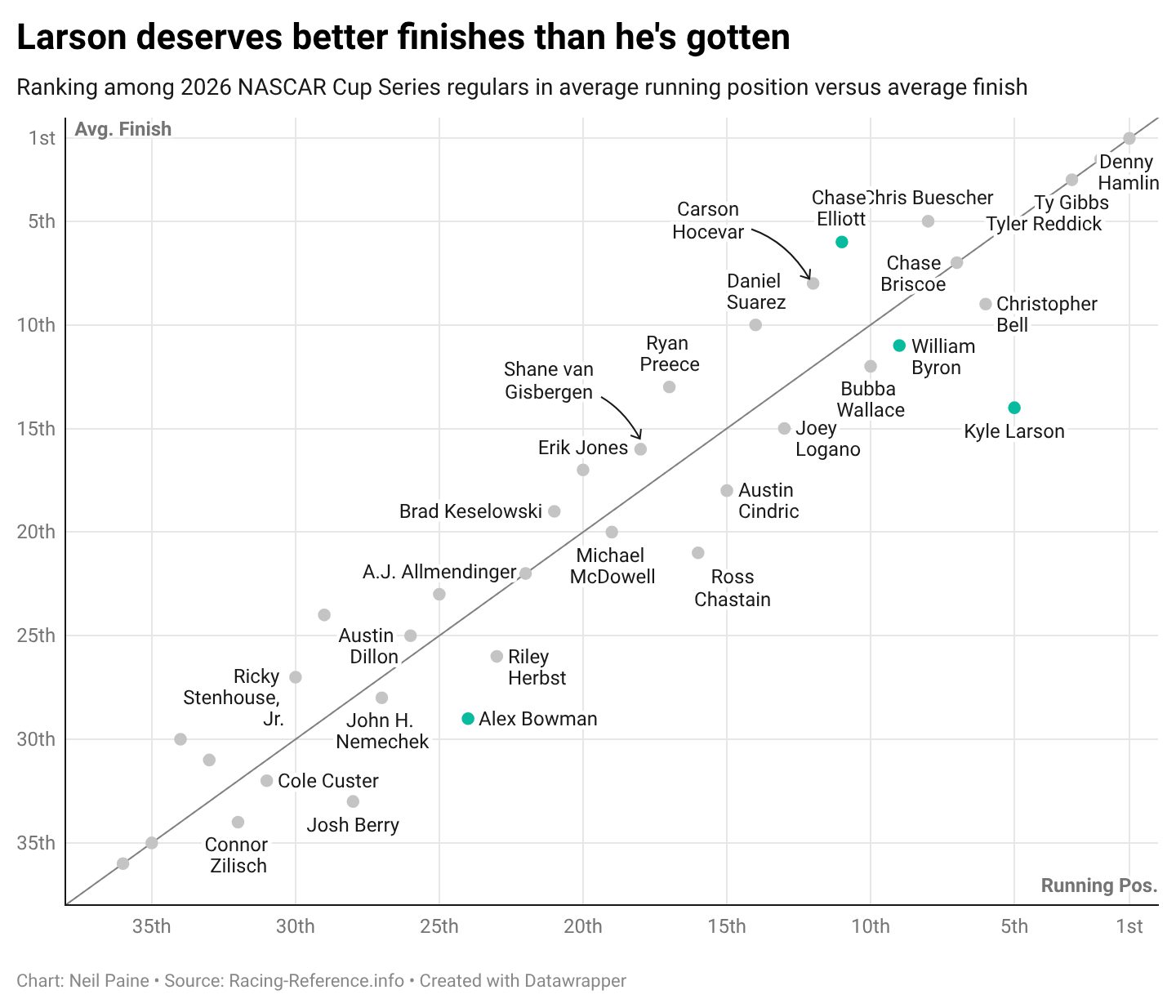
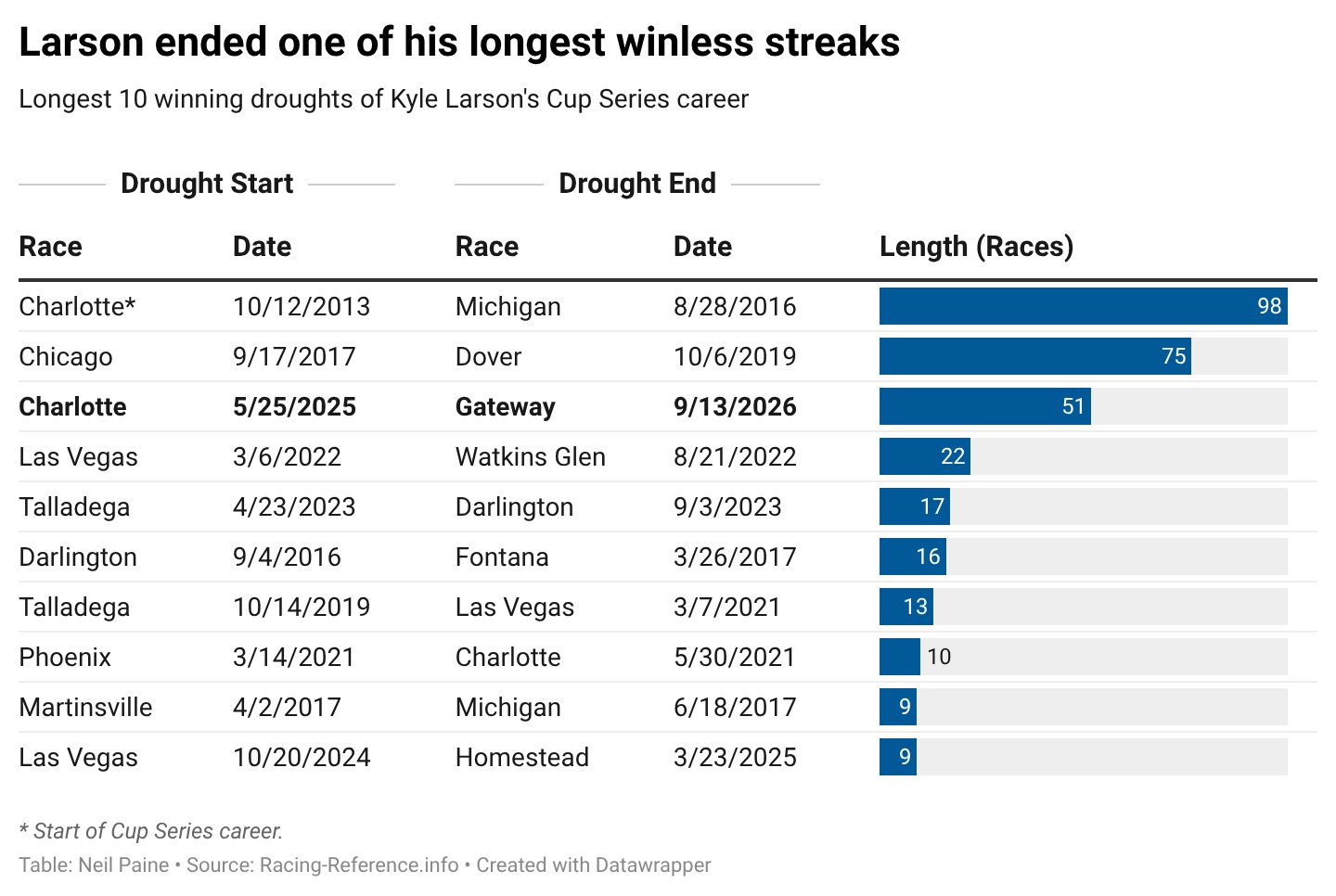 Wins are wins, and we’d been waiting for Larson (and Hendrick Motorsports in general) to break out of a losing slump for a long time. Multi-time champions with the knack to find Victory Lane 33 times don’t tend to go too long between checkered flags. In fact, we’d been banging the drum for Larson deserving better finishes — based on his race-long form — than the ones he’d gotten for most of the 2026 season.
While Larson has had seasons with more dominant Driver Ratings than his 94.8 mark in 2026 — such as when he posted a 112.4 en route to the 2021 championship, or a 101.2 in 2024 — he still ranks fourth-best among all Cup drivers this season, trailing only Hamlin (100.1), Ryan Blaney (99.4) and Tyler Reddick (95.9). And despite his winless drought overlapping this entire season up until Sunday — even now, a single victory is his fewest in a full-time season since 2019 — Larson has consistently driven well enough to win: He’s tied with Blaney (at 13 apiece) and just behind Hamlin (14) for the most triple-digit-rated races on the year.
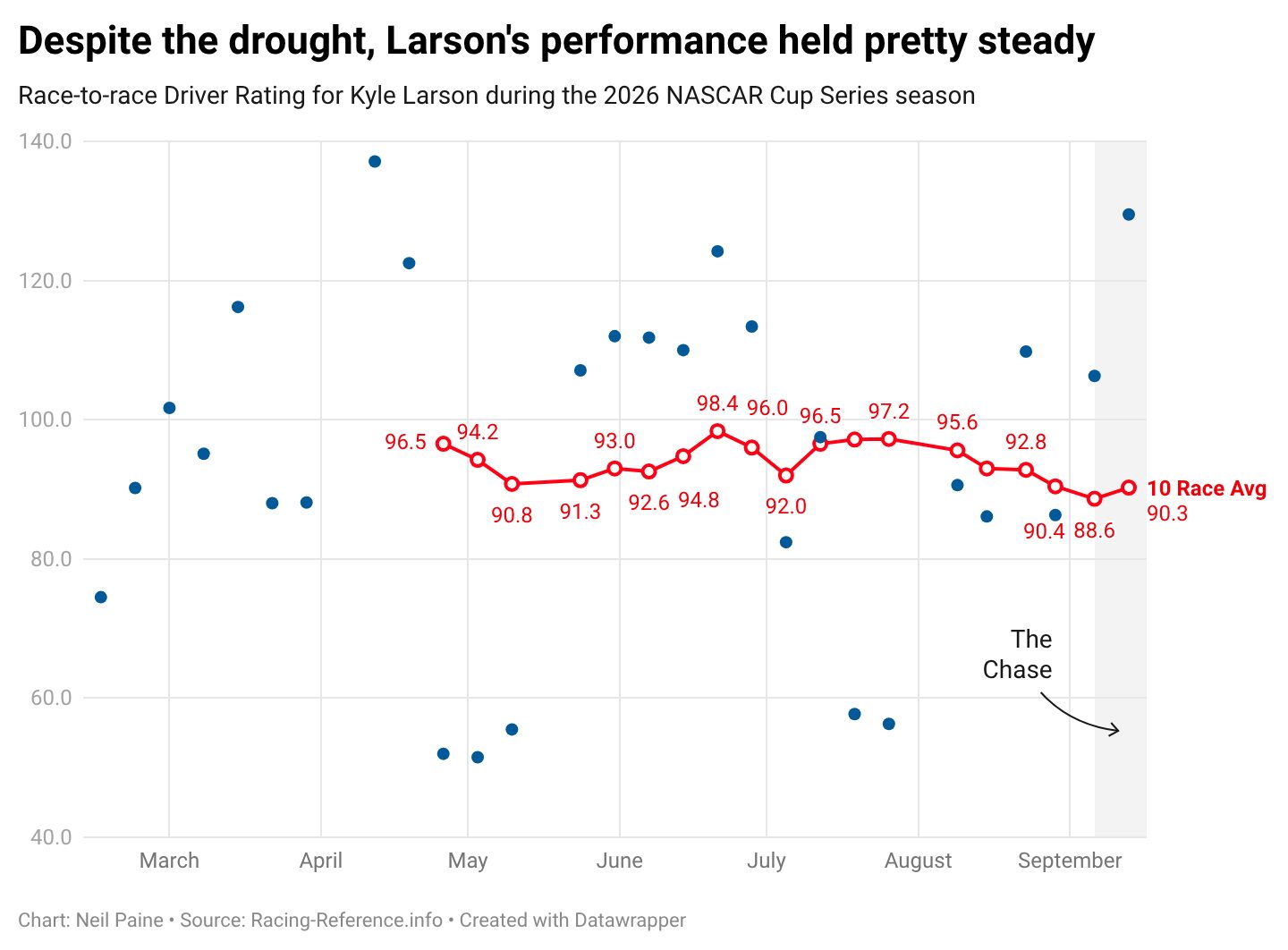
Just as importantly, Larson’s consistent baseline in performance has been a weapon in moving up The Chase standings. Among full-time Cup drivers, only Blaney (five) has fewer races rated below 80.0 than Larson (six). Week in and week out, you know you’re going to get at least a pretty good outing from the No. 5 car. And that ability to avoid mediocre days start-to-finish — even if the final results falter — matters a lot in this current scoring and championship system, where not coincidentally, only Blaney (239) has more stage points this season than Larson’s 230.
In our podcast, Podracing, my co-host Tyler and I always say that “the season doesn’t really start until Kyle Larson wins a race.” Well, now that Larson has finally done that in 2026 — and moved within single digits of Hamlin for the top spot in The Chase standings — the title battle feels like it is legitimately on between Larson, Hamlin, Blaney, Reddick, Christopher Bell, Chase Briscoe, Ty Gibbs, Joey Logano and the rest of the top Chase suspects.
My forecast model — which uses track-specific projected Driver Ratings to simulate every race, and The Chase overall, 10,000 times — still considers Hamlin the favorite at 36%, a number that didn’t really budge much despite the chaos at Gateway. The main difference is Larson (22%) leapfrogged the rest to join Bell (21%) in the next tier, ahead of Blaney (9%) Reddick (4%) and Briscoe (4%).
Because Larson and Hamlin are traditionally so good at the intermediates — only the former (10) and latter (seven) have more than five wins in the 2020s at 1.5-mile ovals — the middle section of The Chase schedule (Kansas/Las Vegas/Charlotte) is now looking like a custom mini-tournament between them, jockeying for advantage coming out on the other side with four races to go (one of which includes another intermediate for good measure, in Homestead-Miami for the finale).
But Larson will have opportunities outside the intermediates as well. We’re coming up on a track — at Bristol — where he has the best average finish (7.0) and Driver Rating (118.3) of anyone in the Next Gen era, including Hamlin (8.1/110.3), despite the two being tied 2-2 on wins. Also, two of Larson’s patented near-perfect drives have happened at “The Last Great Colosseum” in that span, a 149.7 Driver Rating in 2024 and a 149.6 in 2025. With a brand-new win under its belt, the No. 5 team may be close to another super-dominant performance along those lines.
And then, Phoenix and Martinsville are intriguing places for Larson as well. He has a better projection on flat tracks than Hamlin, despite all of Denny’s many trophies at those particular tracks, and while Denny has the better Next Gen Driver Rating at Phoenix/Martinsville (106.9 versus 104.7), Larson has him beat there on average finish (7.2 versus 10.1).
Last season’s championship infamously came down to a single restart between Larson and Hamlin in the desert, with Larson getting the better of his rival — but with the whole affair providing some of the impetus to switch to a different championship format, one that accounts more for the season overall and takes a wider view of performance across a variety of key tracks.
Here we are a year later, though, under the new system — and it might just end up coming down to Larson and Hamlin in another dead heat, this time over eight races with just as little separating them as there was entering that final restart at Phoenix last fall.