After winning at Gateway a few weeks ago, when he was still just one of the challengers in a crowded Cup Series Chase presented by Mobil 1 field, Kyle Larson pumped the brakes on talk that he was fully “back.”
“Back to what?” he said. “Back to 2021? No. Back to 2023? No.”
“But we’ve been definitely building to get back to Victory Lane. I don’t know if we’re quite yet to where we can go dominate like we have in the past, but a day like today definitely gives you confidence.”
Larson was just coming off a 51-race winless streak before driving to Victory Lane in St. Louis, which was itself not among his most dominant career wins; with a Driver Rating of 129.5, it was his 10th-least dominant victory out of 34 in his career. (To wit: Joey Logano had the higher rating on the day despite Larson winning.) So he could be forgiven for still thinking the No. 5 team was in the process of rebuilding its form.
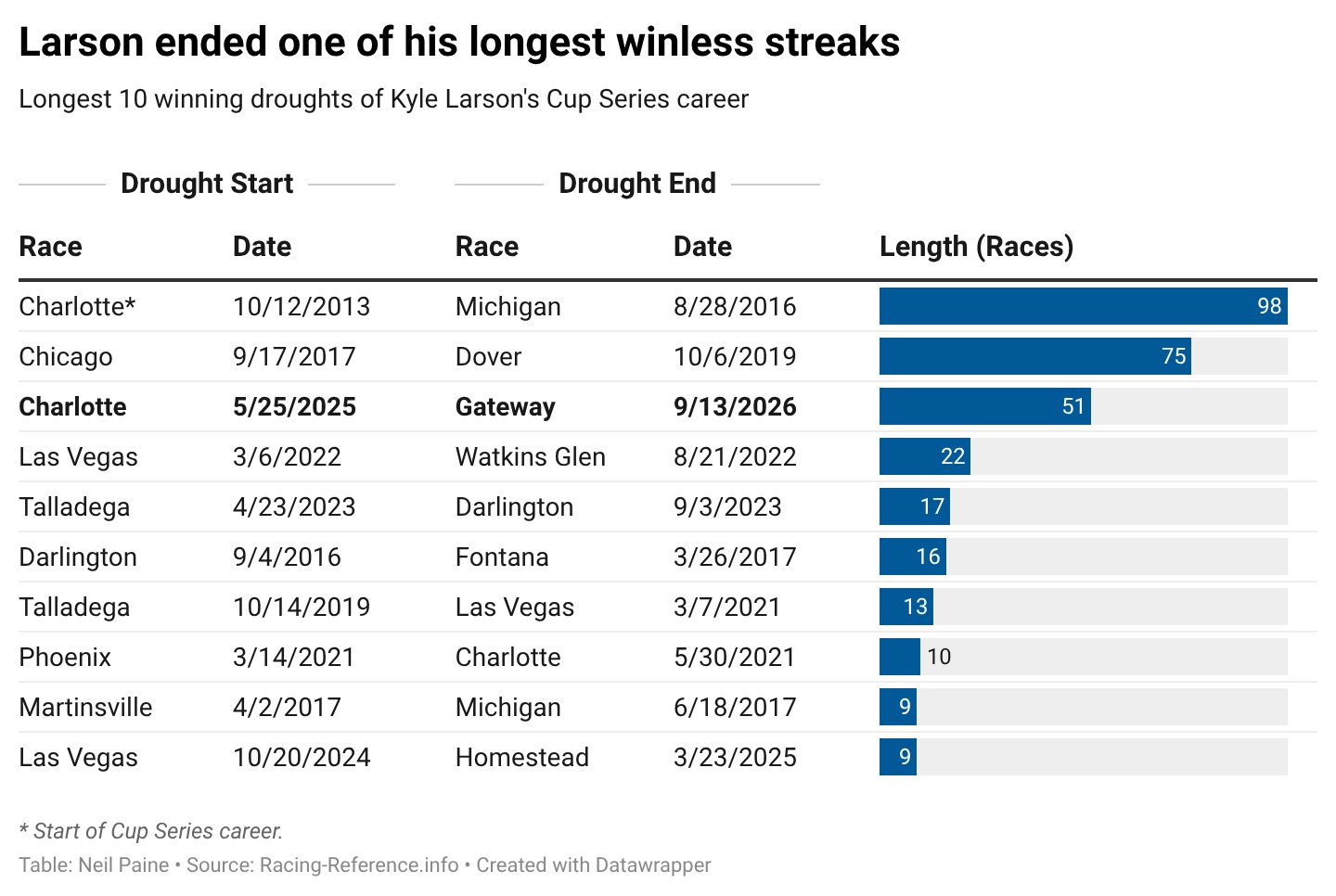
Now, though? It’s impossible to deny that Larson is back to dominating races the way he did at his peak.
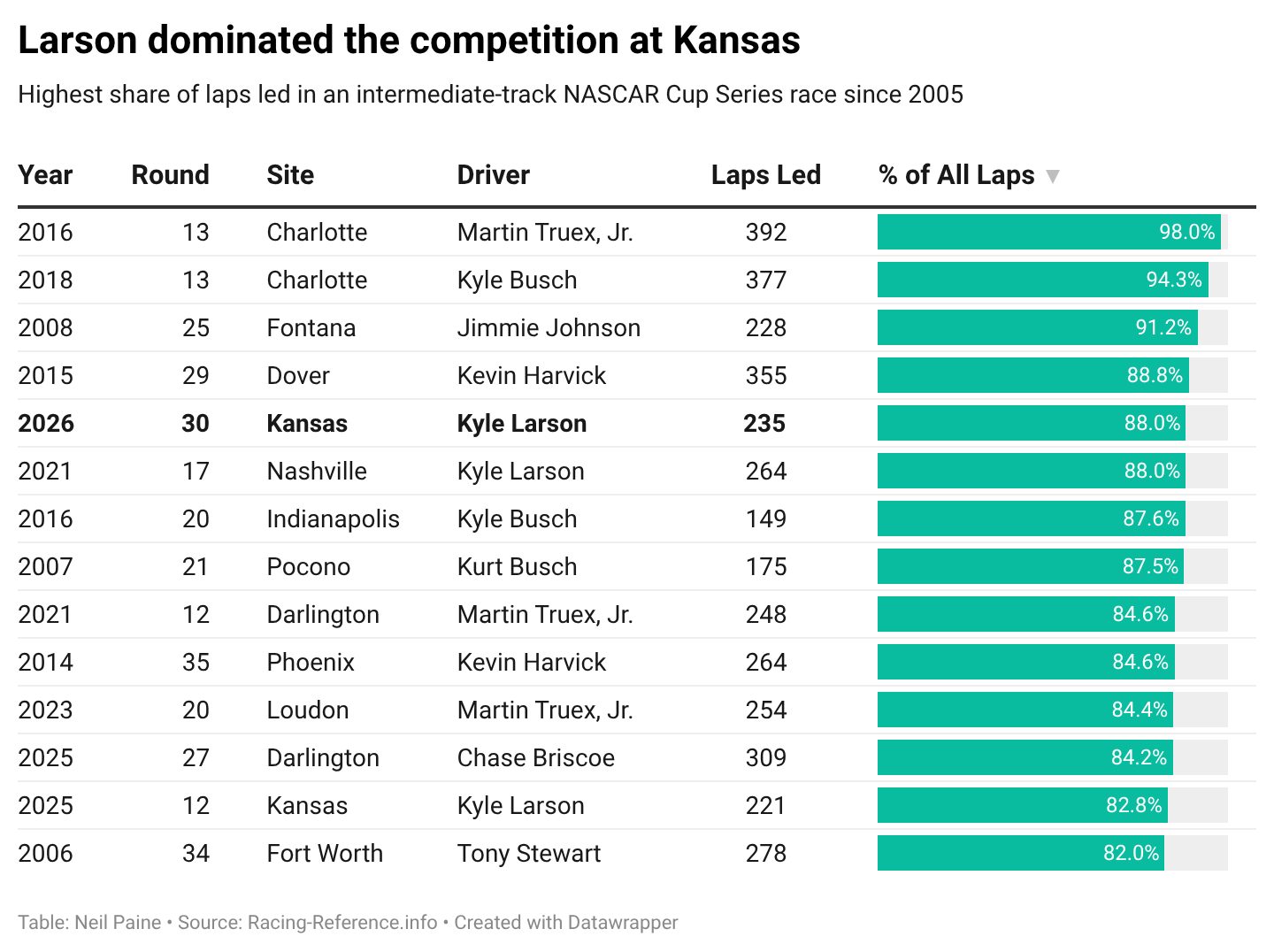
Following a second-place finish behind Logano at the Bristol Night Race, Larson rattled off a ridiculously dominant drive at Kansas to secure his second win in three races. He set a new track record (at any level) with 235 laps led, plus swept the stages and the fastest-lap bonus to tally a 76-point day, the maximum possible under the current scoring system. Larson’s 88% share of laps led was the 13th-highest by a winning driver in the loop-data era (since 2005), and the fifth-highest at an intermediate track in that span:
The only time Larson was challenged was when Chase Briscoe passed him for the lead on Lap 238 and led each of the next 23 times around the track. But Larson stayed close to the bumper of the No. 19 car and, with seven laps remaining in the race, re-took the lead for good.
We mention Larson’s brush with second place to illustrate the fact that, in NASCAR, there is no such thing as true perfection. Only three modern-era races have ever seen a winning driver lead 100% of all possible laps — Jeff Burton at New Hampshire in 2000, Cale Yarborough at the Nashville Fairgrounds in 1978 and Yarborough at Bristol in 1973. Of those, only Burton’s came in the past 48 years, and only Yarborough at Bristol was truly wire-to-wire, starting on pole as well.
But there are degrees of perfection to be had, regardless. The Driver Rating formula — which grades drivers on a combination of finishing position, average running position and average speed, with bonuses for things like winning, leading laps and running up front — is capped at the top with a mark of 150.0 deemed to be the “perfect” performance. (This is our NASCAR version of the fabled 158.3 QB rating in football.) And Larson pitched one of those perfect games on Sunday, recording a nice, round 150.0 in the rating column at Kansas.
Again going back to 2005, that was just the 30th perfect 150.0 race recorded anywhere, the fifth of the Next Gen era (since 2022), and the first since Briscoe at Darlington more than a year ago.
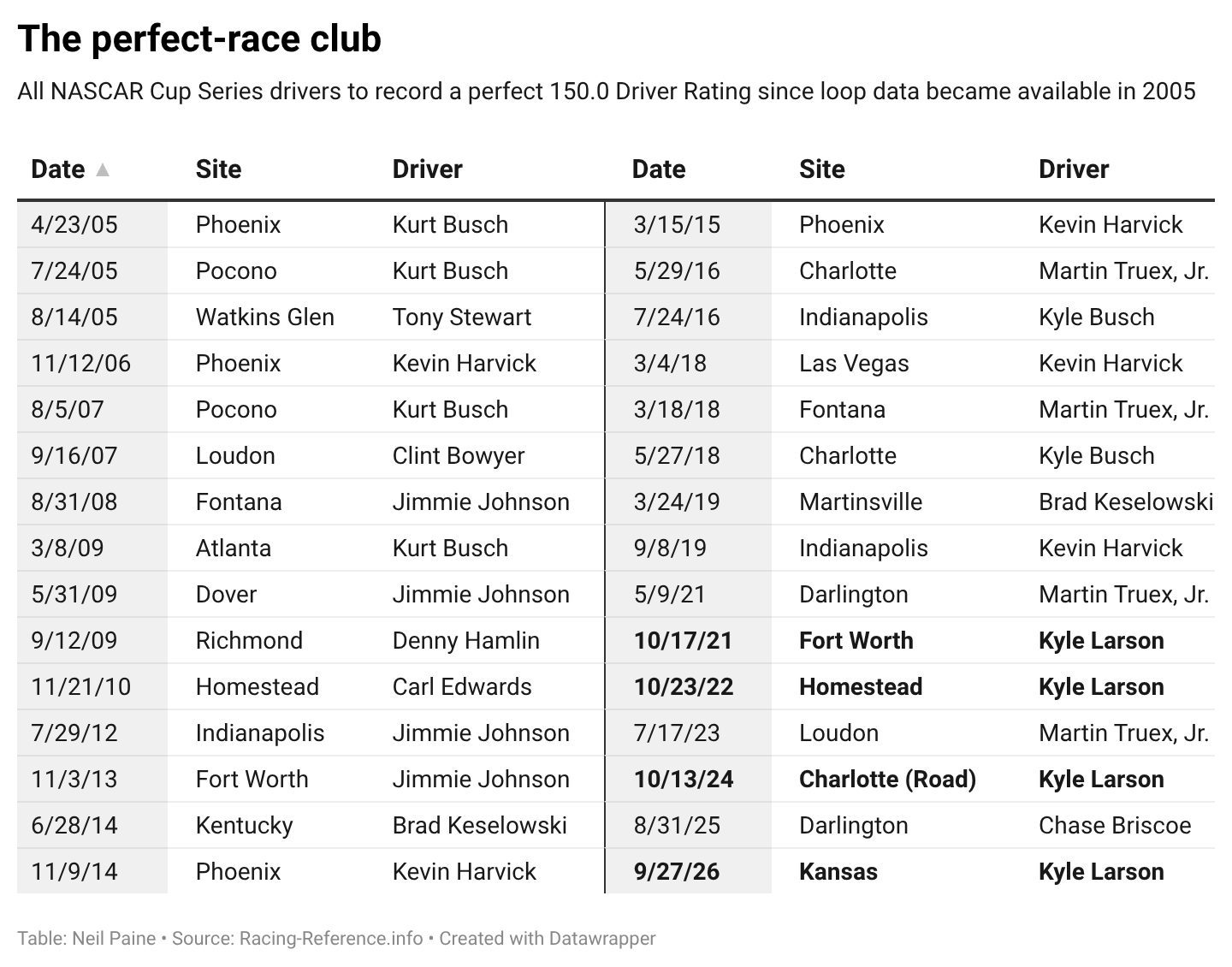
As we’ve noted before, Larson is the active king of the perfect (or near-perfect) drive. He owns four of the past six perfect-rated days to happen in the Cup Series, dating back to the 150.0 he notched at Texas during the 2021 playoffs. He’s also had them at Homestead-Miami (2022), the Charlotte Roval (2024) and, now, Kansas (2026).
He’s also had a number of near-miss brushes with perfection — six races with a rating greater than 149.0 but less than 150.0 (yes, somehow those fractions of a point shy of perfection are meaningful):
- 5/30/2021: Charlotte (149.5)
- 6/6/2021: Sonoma (149.2)
- 6/20/2021: Nashville (149.7)
- 9/21/2024: Bristol (149.7)
- 4/13/2025: Bristol (149.6)
- 5/11/2025: Kansas (149.7)
In that piece from May 2025, we concluded that no current-day driver was more liable to explode for such a dominant showing in any given race than Larson. But that hadn’t necessarily been as true in 2026 until recently. During the regular season, Larson had just three races rated 120.0 or higher — Bristol (137.1), San Diego (124.2) and Kansas (122.5) — and saw none crack 140.0, much less challenge for a 150.0. By comparison, rival Denny Hamlin had seven races grade out at or above 120.0, four at or above 130.0 and one at or above 140.0 for good measure.
While he still ranked fourth in average Driver Rating (trailing only Hamlin, Ryan Blaney and Tyler Reddick), we noted that Larson’s consistency — i.e., his ability to avoid poorly rated days — was becoming as much or more of an asset than his high-ceiling performances.
When the high ceilings are back, though, look out. With an average rating of 123.7 through the first four races of The Chase, none lower than a 106.3, Larson is off to one of the hottest four-race starts of any Playoff/Chase driver since 2005:
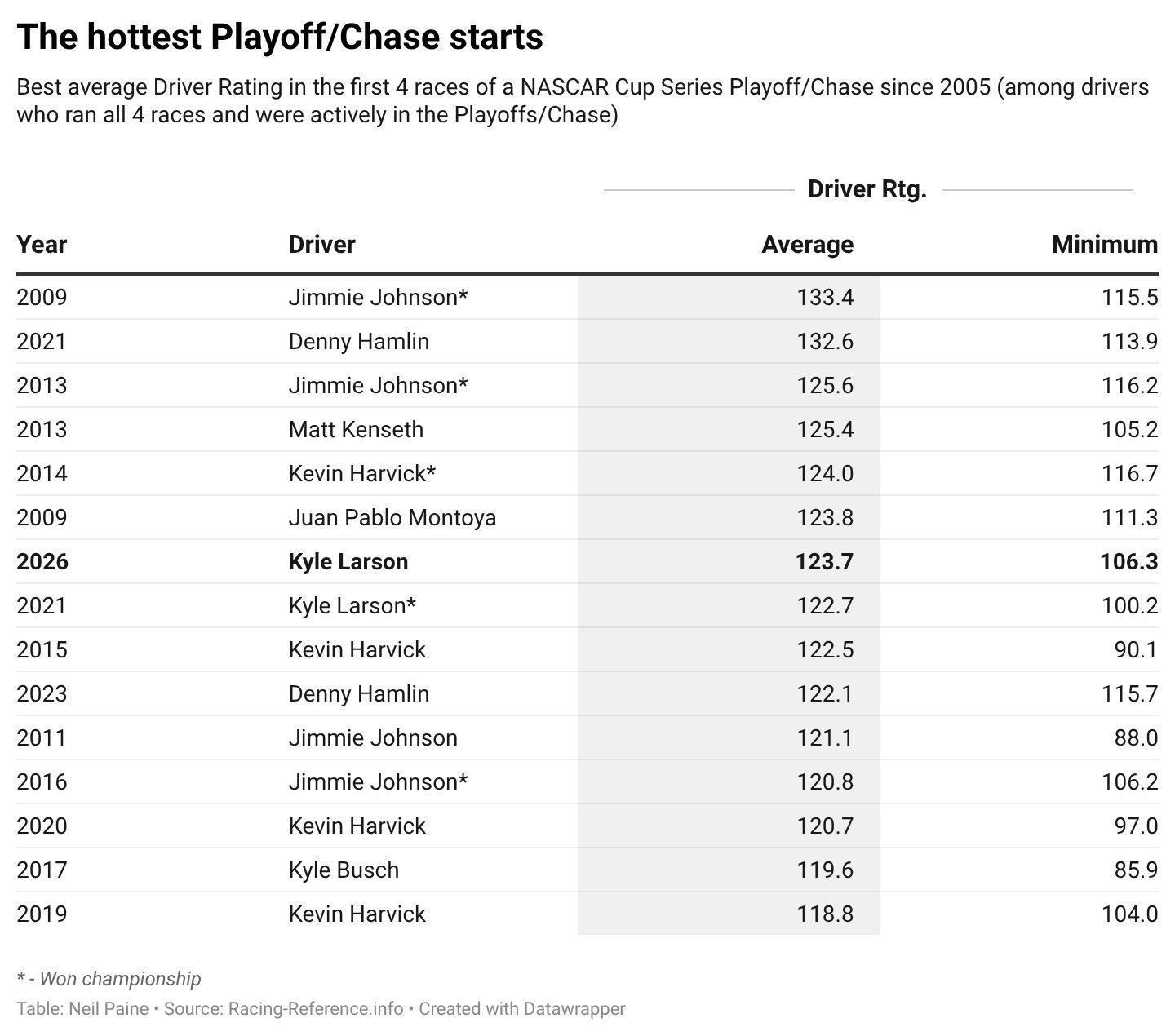
Those types of early runs don’t always guarantee a championship, of course. For every Jimmie Johnson in 2009, there was a Denny Hamlin in 2021, Matt Kenseth in 2013 or Juan Pablo Montoya in 2009. But Larson’s barrage has coincided with less dominant runs and/or finishes from some of the leading counter-candidates for the 2026 crown. (Hamlin has seen his average rating fall from 100.6 in the regular season to 98.9 in The Chase, while Blaney has an average finish of 19.3 since The Chase began.)
As a result, Larson has gone from being in a dead-heat with Hamlin at the top of my Chase forecast odds to being the clear favorite at 57%, versus 29% for Denny and 10% for Christopher Bell. In other words, The Chase is suddenly Larson’s to lose — and while under the old system, we still might not have seen him race for the championship, his recent dominance in the current one may make him awfully hard to catch.