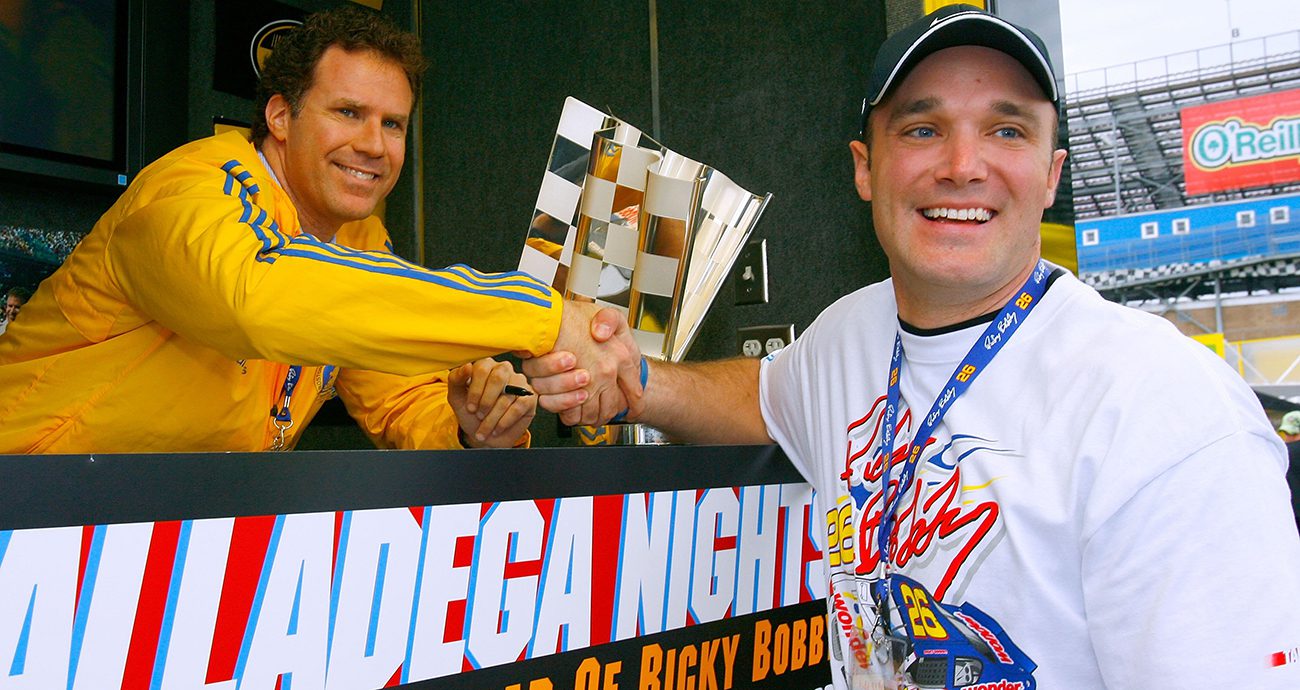
Ricky Bobby never made a NASCAR start.
He never earned a Busch Light Pole Award, scored a stage point or made The Chase. You won’t find his name on the Harley J. Earl Trophy as a Daytona 500 winner, nor are there any barroom arguments about his Hall of Fame credentials, or even a page for him on Racing Reference to pull up some numbers to help sway your opponent.
He might as well have.
Twenty years after “Talladega Nights: The Ballad of Ricky Bobby” introduced him, Ricky Bobby feels as real as ever, somehow a stock-car racing institution and NASCAR legend in his own right, embodying everything about this sport that makes it the spectacle that it is, and also so personal to so many of us.
Deep down? We all just wanna go fast.
His Wonder Bread colors have competed in actual Cup Series races. His movie car has been on display at the NASCAR Hall. The sport has made room for him in places that usually require far more than a screenplay and a few hours of laughs.
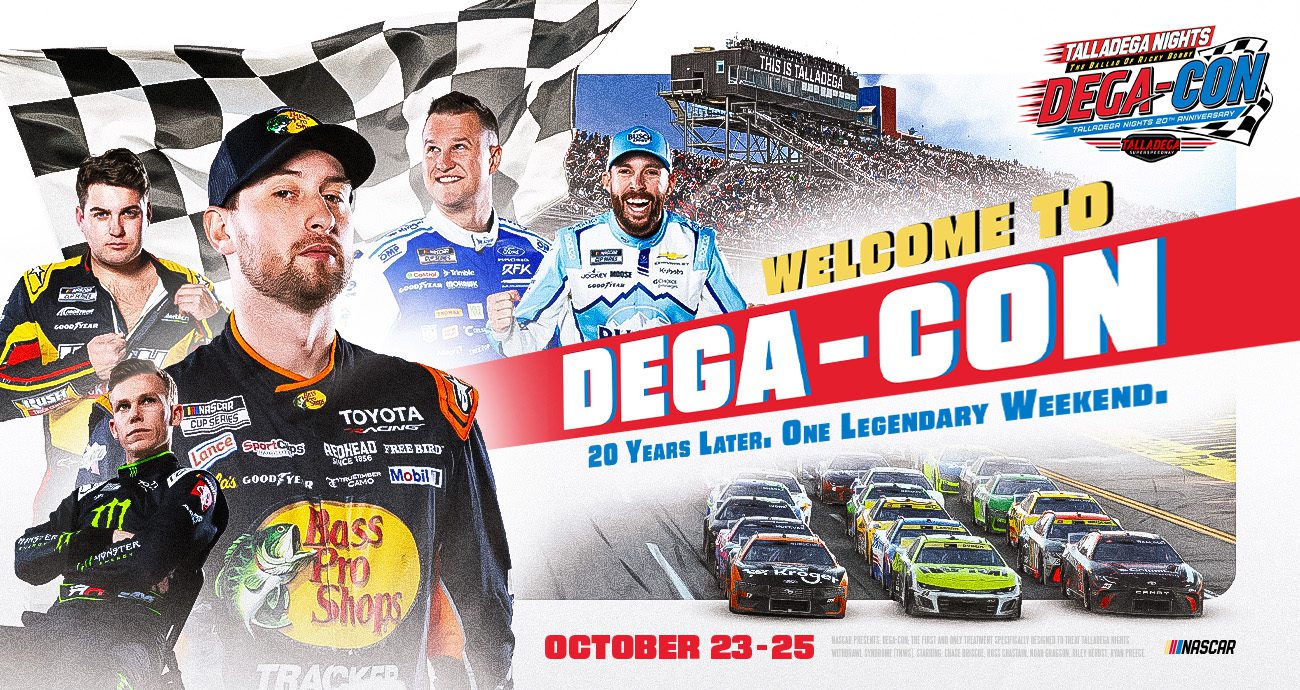
It’s hard to believe it’s been two decades, but it’s easy to see why the ballad is still being sung.
Some of the cast who helped bring Ricky Bobby’s world to life are returning to Talladega Superspeedway for Dega-Con this weekend, an anniversary celebration during the Chase weekend tripleheader that will culminate with Sunday’s crucial YellaWood 500 NASCAR Cup Series race (2 p.m. ET, NBC, HBO Max, MRN Radio, SiriusXM NASCAR Radio). The festivities include a film screening, a cast reunion Q&A and an attempt to set a Guinness World Record for the largest gathering of Ricky Bobbys.
Yes, you read that right.
Ricky Bobby has no official statistics. His fans are trying to get him into the history books anyway.
It’s a remarkable second act for a character whose entire racing career, in theory, should’ve just unfolded on a movie screen and that was that. Plenty of comedies remain quotable decades later. Far fewer become so thoroughly embedded in the culture they portray that the line between fiction and reality starts to look like a minor technicality.
Yet that’s where Ricky Bobby finds himself in 2026: still deeply woven into NASCAR’s colloquialisms, imagery and sense of humor, with fans dressed as him in the stands at every Sunday while remaining a familiar entry point for people who might otherwise know little about the sport.
And somewhat fittingly, some of the people who brought his world to life needed an introduction to it themselves.
DEGA-CON: Full info | Shop ‘Talladega Nights’ gear
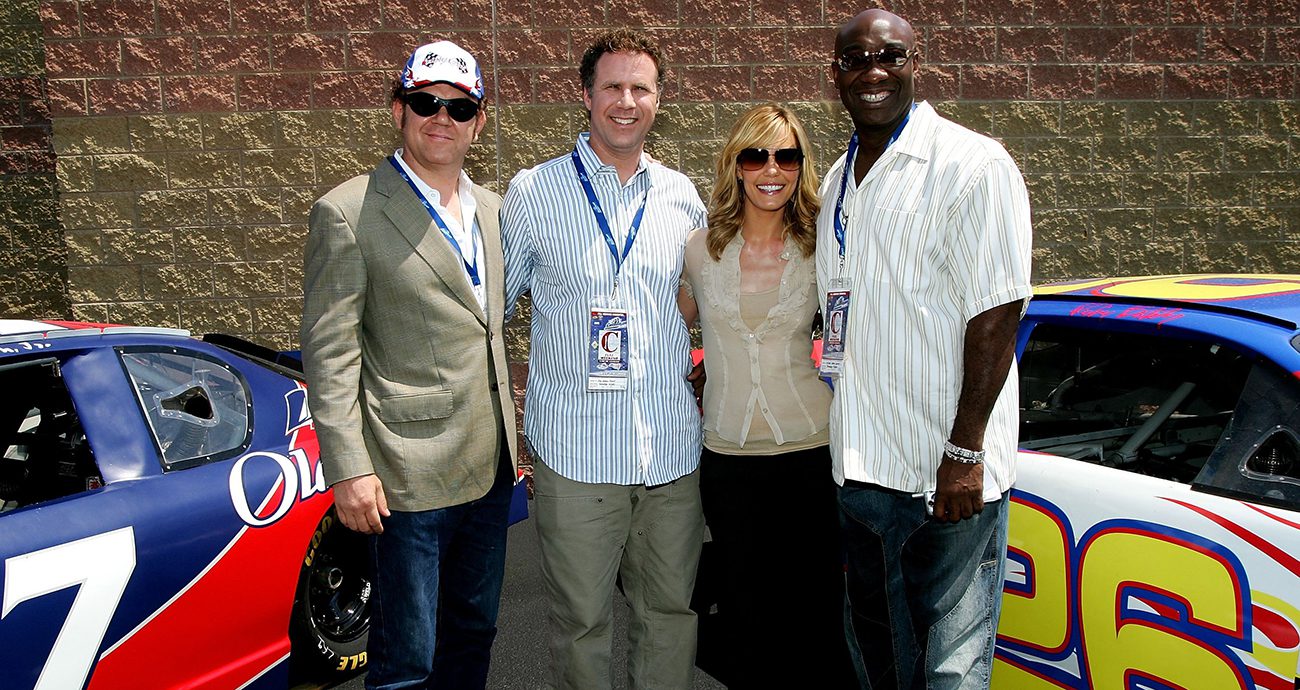
Getty Images
David Koechner, for one, had to learn how to work the jack. He then quickly learned it, uh, wasn’t for him.
Koechner arrived in Alabama for filming in October 2005 to play Hershell, one of Bobby’s pit crew members, with a racing background largely consisting of seeing some sprint cars at the Missouri State Fair and the occasional demolition derby. Football was his sport. The immediate draw of “Talladega Nights” was mostly another chance to work with his buddies Will Ferrell and director Adam McKay, whom he’d just collaborated with on “Anchorman.” NASCAR? Hell, why not?
Then came the education.
“The fascinating thing for me was getting into the science of NASCAR because, you know, the perception is just a bunch of good old boys getting out there and getting a good time and racing, racking up with each other,” Koechner, who once portrayed NASCAR’s founder, told NASCAR.com. “No, it’s a science. It’s a science.”
He remembers being taken through the precision of pit stops, the specialized responsibilities assigned to each crew member and the athletic backgrounds teams sought when filling those roles. Teams recruited former college football players and other athletes for positions that required particular combinations of speed, strength and coordination. And they weren’t all alike.
“Each member of the pit crew is recruited from specific sports positions, from college athletes,” Koechner recalled. “I’m like, ‘Are you kidding me?’ A shortstop does one thing, a linebacker does another thing, a defensive end or tight end does another thing. And that’s what was fascinating to me and makes complete sense.”
His surprise wasn’t that NASCAR required talented people. It was how thoroughly each person’s talents had been matched to a particular task.
“Oh, good Lord, just like anything that gets to this level, this is a high-precision sport, and there’s not a detail that is left to chance,” he said.
What looked from the outside like a group of people changing tires in a hurry was, he discovered, an operation with little room for improvisation or failure. The actors trained for their respective assignments, and Koechner recalls initially being designated the jackman because of his height.
This proved an insufficient qualification.
“So the jackman is going to be a defensive end, right? Because he’s long, lean, got strength. So originally I was supposed to be a jackman. So we’re rehearsing, I guess, basically, or we’re training to play our parts.
“So, you know, I’m taller, so that’s why they gave me jackman. Now that is a very hard job. And at the time, I probably weighed 195. Jackman’s got to be 225. He’s got to be 23 years old and pop that thing. So I tried a couple times. I said, ‘Nope.’ I grabbed a clipboard and said, ‘This is what I’m gonna do.’ “
Koechner’s introduction to Talladega itself was hardly less memorable.
He recalls the cast and crew flying to Alabama aboard a chartered Hooters Air plane – an entirely appropriate mode of transportation for a movie that would eventually feature a cougar-sponsored race car. Getting into the speedway proved considerably less efficient. Koechner remembers spending roughly three and a half hours in a vehicle with fellow actors Jack McBrayer and Ian Roberts before finally reaching the track. A helicopter ride out with Ferrell, McKay, John C. Reilly and others was substantially quicker.
But what happened between those two very different commutes is what made the deeper impression.
The production needed an actual pit stall to film its crew scenes during a real race. Koechner expected a lengthy wait before one became available. Instead, he remembers the opportunity arriving almost immediately.
“Because I’m thinking we’re gonna wait here for a couple hours,” he recalled. But then a car pulled off, and it was time to go. “It’s immediate. There’s a pit open, we take over.”
Suddenly, the sport the cast had been studying was unfolding all around them in real time, with Koechner experiencing the fury of a NASCAR field at speed from pit road.
“And just the raw horsepower, the feel of raw horsepower. That was the most awesome. I tell you, that moment was the most awesome. Like, my dear God. It’s a bit harrowing, but also thrilling. And then the adrenaline pumping. But now we’ve got to do dialogue. Like, are you kidding me?”
The noise presented a problem that doesn’t typically arise on a comedy set: nobody could reasonably expect to hear the actors, with 40-something machines roaring by at pace.
Koechner recalls McKay instructing them to carefully articulate their words – to “chew” the dialogue – so their performances could be matched with replacement audio later.
“We know that we’re gonna match this in post,” Koechner said. “Because there’s no way they’re gonna be able to hear us.”
That commitment to authenticity was central to the production. NASCAR cooperated with Ferrell and McKay, helping provide access to real tracks, crowds, teams and racing environments. Dale Earnhardt Jr. and Jamie McMurray appeared as themselves, while familiar broadcast voices helped make the fictional races sound like the real thing.
“In life, you get to have experiences for whatever reason, and because you’re an actor, you have probably so many wonderful, unexpected experiences, and that was certainly one of them.”
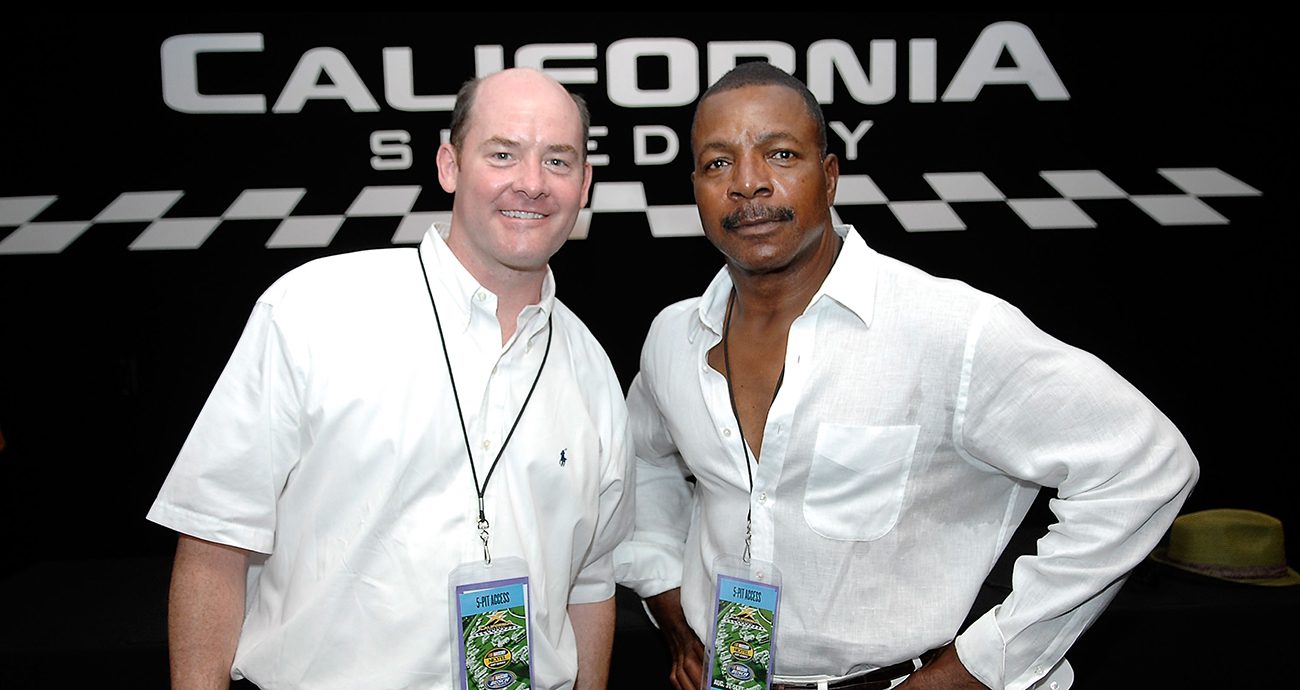
David Koechner and fellow actor Carl Weathers at Auto Club Speedway in 2007 (Steve Grayson | Getty Images for NASCAR)
As Ferrell explained in a 2016 ESPN oral history, the filmmakers wanted to have fun with NASCAR rather than simply make fun of it. That meant finding the sport’s actual peculiarities, then stretching them until they became ridiculous.
Greg Germann, who played fictional team owner Larry Dennit Jr., discovered a similarly unfamiliar world.
Germann’s childhood racing experience included witnessing a figure-eight race and demolition derby in Colorado. The scale of NASCAR, its enormous following and the intensity of the action at track level came as something of a revelation.
“When we did the movie, you know, 20 years ago, that was one thing that really surprised me. I was shocked at how many people. I mean, we’re all in our own bubbles. But how big the fan base is, you know, relative to, I don’t know, the NFL, NBA, even like the World Cup?” Germann told NASCAR.com. “That was eye-opening for, I think, a lot of us, to see how big the fan base is and how exciting it is and stuff. And, you know, we’re not exposed to it.
” … Talladega, it’s like, to be down there on the track when they’re going. It’s insane. It was eye-opening, really.”
Two decades later, he remains interested enough to ask questions and catch back up after his NASCAR absence. During an interview about the film’s anniversary, Germann wanted to know how the current championship format worked, where Talladega fit into the schedule and which drivers were still in contention.
A participant in this weekend’s Dega-Con festivities, it’s the film that brought him to NASCAR in the first place – and back to it.
That might be as useful an illustration of the movie’s broader appeal as any box-office statistic.
“Talladega Nights” opened at No. 1 in August 2006, eventually earning more than $148 million domestically. Its audience was vast, reaching well beyond NASCAR’s existing fan base and introducing millions of moviegoers to a world they might never have explored otherwise.
For some, Ricky Bobby may have been the first NASCAR driver – real or fictional – they came to know. Through him, the sport became something more than cars circling some track down south. The movie offered recognizable teams, rivalries, sponsorships, personalities and an entire ecosystem of people whose lives revolved around what happened on Sundays.
Ricky and Cal Naughton Jr.’s “Shake and Bake” partnership turned the complicated relationship between NASCAR teammates into something immediately understandable, and the sponsors were practically supporting characters themselves. Bobby’s Wonder Bread, Naughton Jr.’s Old Spice and the green Perrier car of Jean Girard (portrayed by Sacha Baron Cohen) gave each driver an instantly identifiable, distinct personality.
And Ricky’s responsibilities, like every other NASCAR driver, hardly ended when he climbed out of the car. There were commercials to shoot, sponsors to satisfy, reporters to entertain, crêpes to refuse to eat and an entire public identity to maintain.
None of this was intended as a documentary, obviously. But beneath the absurdity was a surprisingly functional introduction to the sport’s relationships, business and spectacle.
The movie didn’t teach NASCAR’s rule book; it taught the shape and culture of the sport.
Still, the authentic racing environment alone doesn’t explain why Ricky Bobby has endured. Plenty of fictional worlds look convincing, and far fewer produce characters that people keep bringing along into their own lives.
Ask Koechner to explain the movie’s cultural staying power, though, and he initially wants no part of an elaborate analysis.
Trying to explain why a comedy connects with an audience, he suggests, is a fine way for an actor to wander into territory where he doesn’t belong.
“If it made you laugh, then it’s good,” he said. “That’s as far as I could go.”
Fair enough.
But ask why people still connect with Ricky Bobby himself, and there’s considerably more thread to pull on.
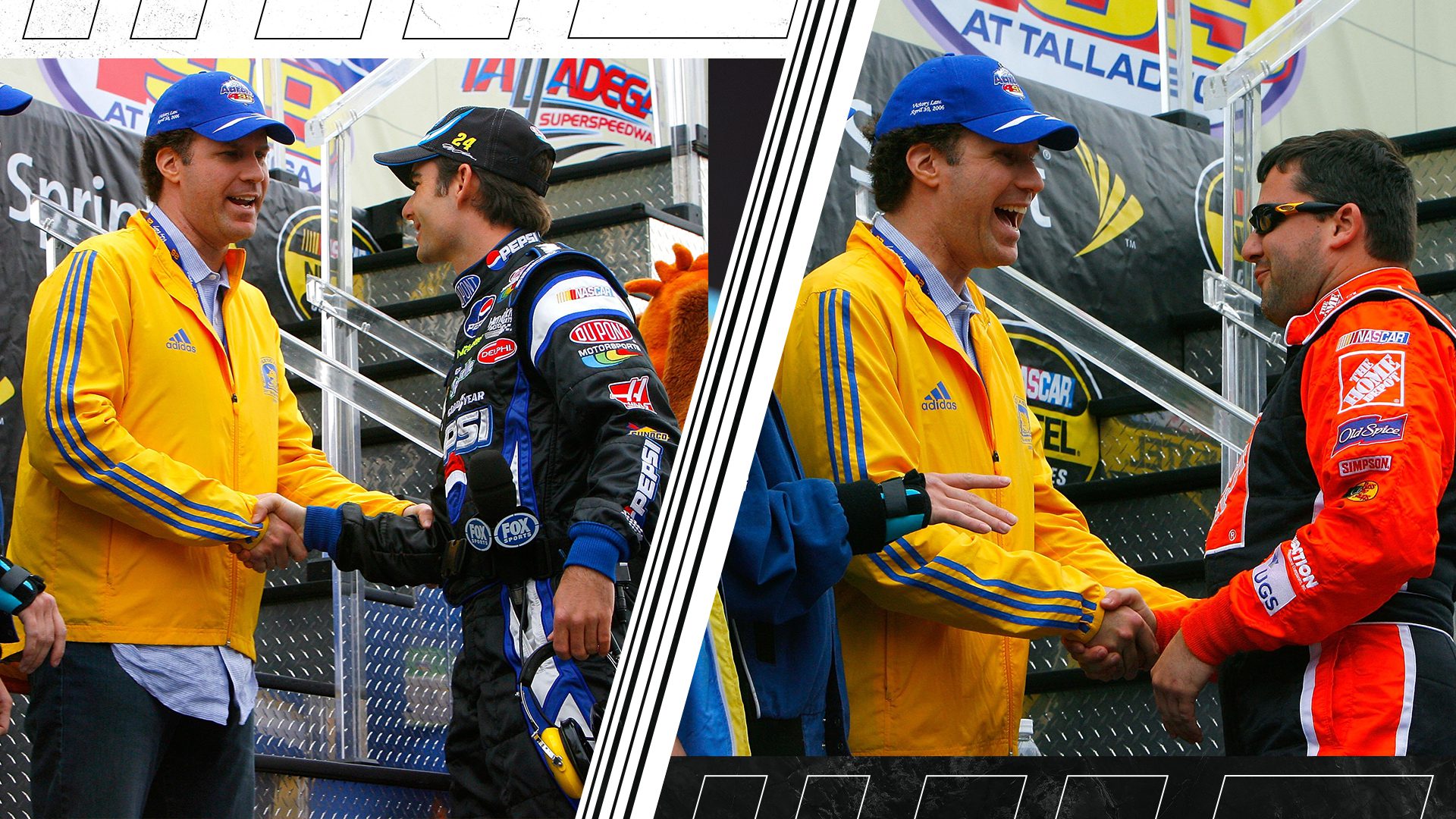
“Well, for me, if you’re asking me, it’s because he has a dream.”
Getty Images
“So Ricky Bobby’s dad takes off. We’ve got abandonment and neglect right there, so he’s got to overcome those things. You know, it’s all back to Joseph Campbell’s hero’s journey. And as Plato says, the cave … you’ve got to go through the cave to get to the light, and do you remain in the darkness or do you come out in the light?
“When you talk about why people respond to it, they might not be intellectually aware of what they’re necessarily doing. … I’ve had hardship, I’ve had disappointment. I felt that I wasn’t good enough. … So then we all have to thrust ourselves out there to be seen in the way we want to be seen. So that’s really the story of this whole thing.”
Germann finds the character’s humanity in the man playing him.
“That’s Will,” he said when asked why Ricky remains so recognizable. “You know, like with ‘Anchorman,’ with Ron Burgundy, or the other characters that Will has created. You know, he’s iconic. All this stuff on ‘Saturday Night Live’ … and then you add to that, but he’s genuinely one of, like, the nicest guys around. I think that has … what kind of comes out of his work when you see him is he’s a genuinely good guy. So his comedy really connects with people.
“He has a kind of a magic ability to do that. And I think that’s why Ricky Bobby really radiates in that way.”
The jokes may be enormously quotable, but the feelings underneath them are ubiquitously relatable. And once audiences made those characters their own, they didn’t seem especially interested in giving them back.
Koechner sees that evidence whenever he travels for his stand-up career.
He has appeared in “Anchorman,” “The Office” and a long list of other recognizable projects, but which credit follows him most closely depends on where he happens to be performing. In some places, it’s “Anchorman” or “The Office.” Back home in Missouri, and particularly across the South, “Talladega Nights” tends to move up the billing.
“The fun for me, because I tour and do stand-up in different parts of the country, I’ll be known for different things,” Koechner said. “It’s interesting to kind of clock the regional thing you’re known for.”
But it’s the interaction with fans – sometimes people who have carried a favorite movie with them for two decades – that provides the occasional reminder of how far that shared experience has traveled.
“In your day-to-day life, you don’t think about yourself in (the movie),” he said. “You think about yourself and your family in the world. But then when you’re out in the world, you go, ‘Oh, that’s right. I did something that a lot of people have shared.’ And so be aware of that, which is just joyful. But you don’t look for it, but when it happens, you go, ‘Oh, that’s right. Yeah, look how fortunate I’ve been. Look how, you know, blessed I have been, or am.’ So, you know, to think about 20 years, you’re like, well, that was such a fun thing. And it worked, because in movies you don’t know it’s going to work. But it worked, and you were in it.”
At NASCAR tracks, that shared experience has long since extended beyond repeating favorite lines.
Getty Images
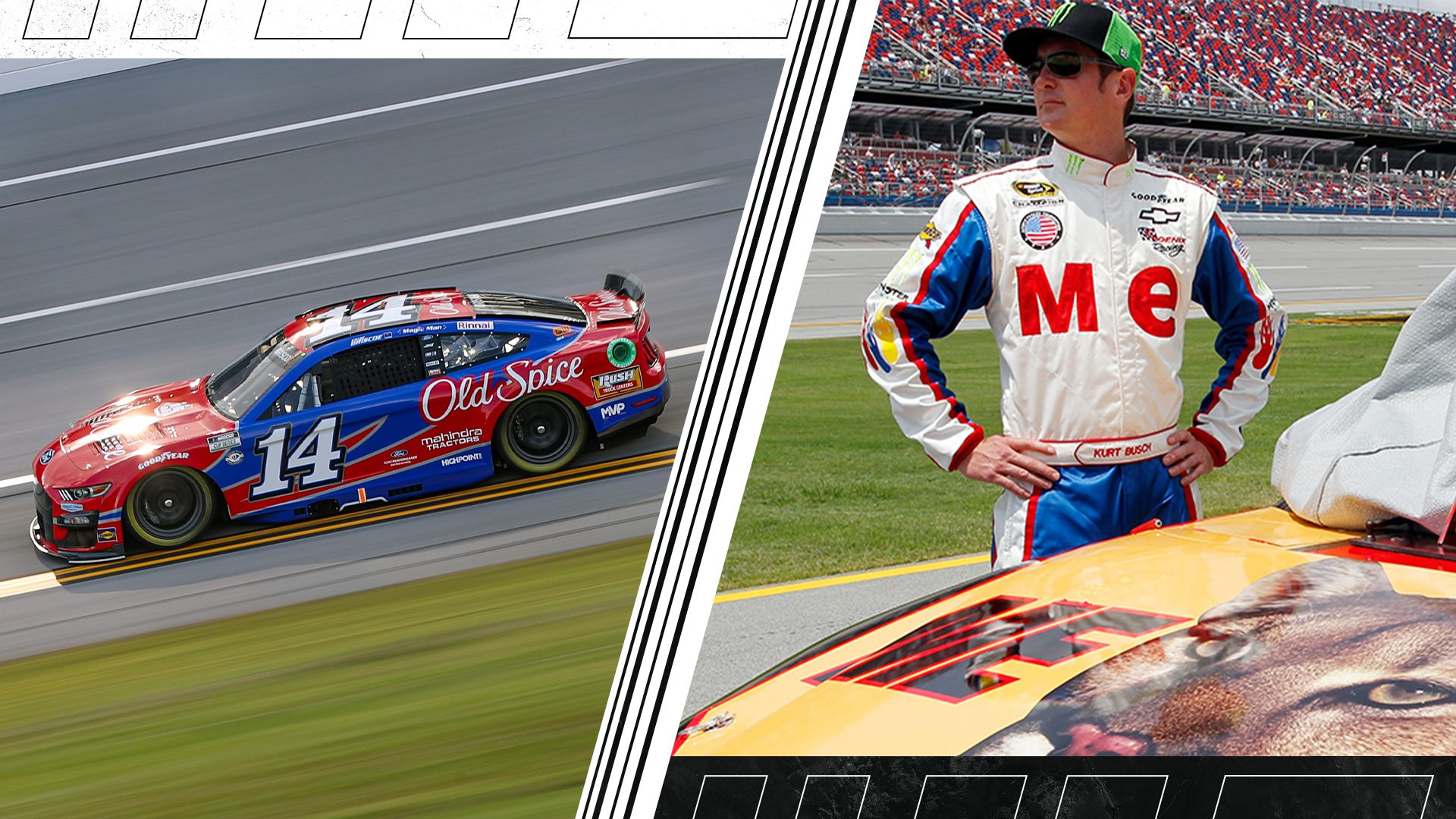
NASCAR Hall of Famer Kurt Busch brought Ricky’s cougar-emblazoned “ME” design into actual Cup Series competition at Talladega in 2012, then returned the following year with Wonder Bread colors on Furniture Row Racing’s No. 78 Chevrolet.
In 2023, Chase Briscoe and Ryan Preece brought the movie’s most famous partnership back to the track, with Briscoe’s No. 14 Ford carrying Cal’s Old Spice colors – and his face carrying a sweet-ass handlebar mustache – and Preece’s No. 41 sporting Ricky’s Wonder Bread scheme.
And the connection has hardly remained confined to what happens on the race track. In 2023, Cup Series champion Kevin Harvick literally purchased the Lake Norman mansion used as Ricky Bobby’s home in the film.
The staying power isn’t simply a matter of nostalgia or clever marketing. NASCAR fans recognized enough truth beneath the exaggeration to claim the film as their own, while people who knew little about the sport found the characters and their world accessible without needing to understand everything happening under the hood.
This weekend’s Dega-Con celebration takes the relationship to its logical extreme, turning a 20-year-old comedy into a gathering built around the characters, jokes and images fans have kept alive themselves. All during a pivotal postseason weekend for each national series.
And as Hollywood prepares another trip into NASCAR with Tom Cruise’s return as Cole Trickle in a “Days of Thunder” sequel scheduled for 2028, the sport has another opportunity to introduce itself to audiences through the shared stories, community and personalities that surround the competition.
“Talladega Nights” demonstrated how effective that invitation could be, even when delivered by a man who believed in himself first and foremost, because if you ain’t first, you’re last.