Kyle Larson went the entire 26-race regular season without a victory. A mere 10 Chase races later, he was a three-time NASCAR Cup Series champion.
Larson clinched his third Cup title Sunday at Homestead-Miami Speedway, completing a remarkable championship turnaround and securing his second consecutive crown in the No. 5 Hendrick Motorsports Chevrolet.
The 34-year-old Californian mathematically clinched the championship at the conclusion of Stage 1, finishing fourth and collecting seven stage points after Chase Briscoe’s No. 19 Toyota went up in smoke to bring out a caution on Lap 78. Larson entered Sunday needing nine total points to guarantee the title regardless of his rivals’ results, but his seven stage points proved sufficient. Christopher Bell finished third in the stage, earning eight points, while Denny Hamlin finished sixth with five, eliminating both from championship contention. Bell still trailed Larson by 66 points with only 66 available the rest of the race, and Larson was guaranteed at least one additional point for his finishing position.
“Good job to you. We’re going to keep our eyes forward, and we’re just going to keep running through this race, how’s that?” crew chief Cliff Daniels radioed to his title-clinching driver shortly after.
Larson, ever the racer, replied, “Yeah, love it. Let’s go.”
RELATED: Live leaderboard | Homestead photos
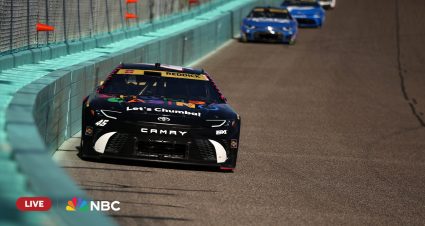
For the first time since Jimmie Johnson completed his remarkable five-title run in 2010, the Cup Series has a back-to-back champion. Larson also joins Lee Petty, David Pearson, Cale Yarborough, Darrell Waltrip, Tony Stewart and Joey Logano as a three-time champion.
“Congratulations to Kyle Larson, Cliff Daniels and the entire No. 5 Chevrolet team on their third NASCAR Cup Series championship,” said Mark Reuss, president, General Motors in a Chevrolet release. “Championships are earned through preparation, trust and execution, and this team demonstrated all three throughout the 2026 season. They stayed focused through adversity, and performed the best when it mattered most.”
Larson’s path here was anything but straightforward.
The Chase presented by Mobil 1 returned in 2026 with a single points reset following the regular season, followed by a 16-car field and 10 races without eliminations. Wins carried a 55-point reward, but stage points and avoiding bad afternoons mattered, too.
Larson turned out to be exceptional at both — he just needed an entire regular season to find that version of himself again.
Held winless through the opening 26 races, Larson rode a 51-race drought into September while Hamlin entered The Chase as the dominant No. 1 seed, 55 points ahead of seventh-seeded Larson. There was obvious speed in the No. 5. What hadn’t been there consistently were the finishes to match it.
That changed at World Wide Technology Raceway at Gateway, where Larson snapped his drought in the second Chase race, then kept turning competitive cars into extraordinary points days as the No. 5 team appeared to grow stronger race by race. He opened the postseason fifth, first, second, first and second, a 2.2 average finish through five races — the best start in the format’s history, according to Racing Insights. He scored 273 points in that run, averaging 54.6 per race to nearly double his regular-season pace.
At Kansas Speedway, he swept both stages, led 235 laps and scored the maximum 76 points. At Las Vegas Motor Speedway, a 26-second pit stop dropped him a lap down, but he and crew chief Cliff Daniels recovered to finish second.
Kansas showcased the No. 5’s speed. Vegas demonstrated why its championship mettle was becoming the strongest in the field.
SHOP: Kyle Larson 2026 Champion gear
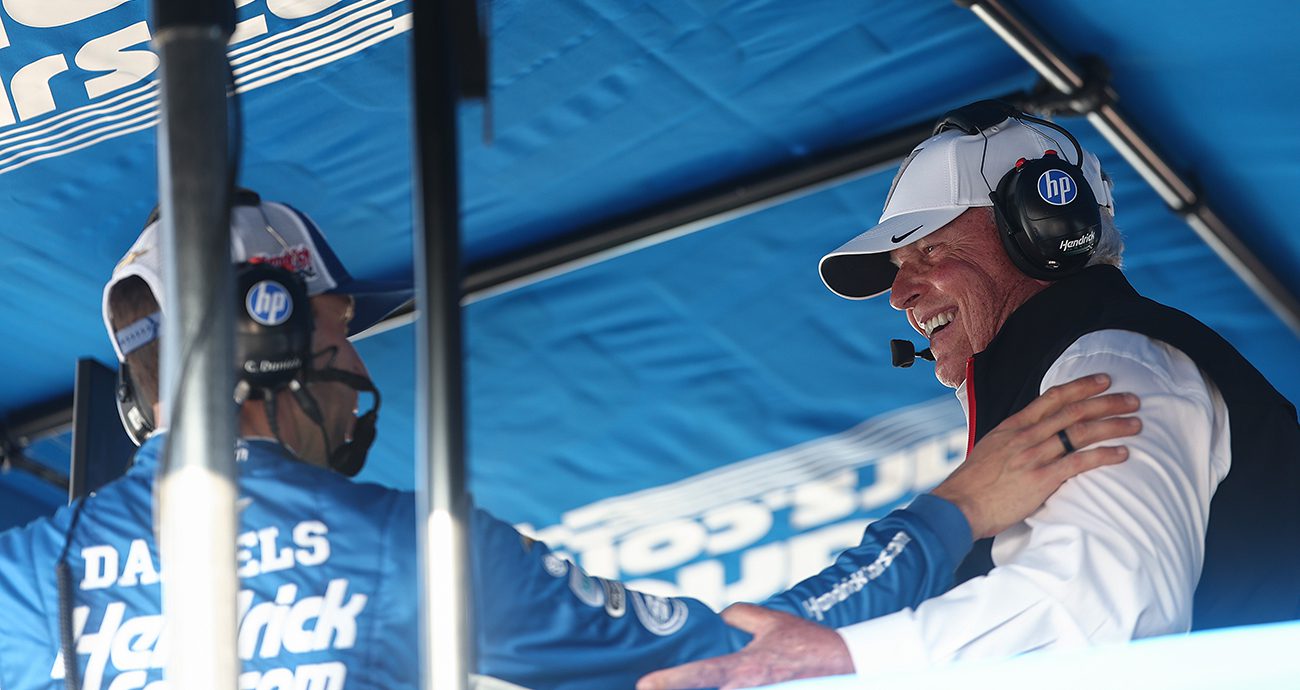
Daniels deserves a substantial share of the credit. During the winless stretch, he acknowledged that the team had sometimes overreached in its search for speed, but kept the tight-knit group focused on continually building a foundation of excellence. With questions swirling throughout the first half of 2026, the response wasn’t to invent a new identity, but to dig deep and rebuild around the fundamentals of the team itself.
After Charlotte, Daniels summarized the team’s approach: “I feel like it’s us against us, and it’s always been that way,” emphasizing the importance of focusing on internal improvement rather than the competition.
And then came Phoenix.
Larson had warned after Charlotte that he wouldn’t feel comfortable with his championship lead until it was over. Disaster in the desert displayed why.
His sixth-place finish at Charlotte ended his run of five consecutive top fives, and things took a turn a week later. At Phoenix, handling problems and a tire failure sent him to 34th, with just three points. His 49-point championship lead shrank to five. Seven drivers suddenly sat within 56 points of one another.
What had seemed increasingly inevitable suddenly wasn’t — with arguably Larson’s unluckiest track next on the docket.
Yet Talladega resulted in one of the least likely defining statements for the No. 5 team imaginable.
Larson, winless in his previous 58 drafting-track starts, led 23 laps and banked 16 stage points but fell from the lead to 11th on the final lap. Then came a remarkable charge back through the tri-oval in a stunning last-gasp rally for his first career superspeedway victory, netting a whopping 71 points.
The championship lead went from five points to 73 in one afternoon. The entire complexion of The Chase had changed again.
Not all that separation was Larson’s doing. His rivals endured tire failures, pit-road mistakes and damaging crashes; all 15 other Chase drivers encountered some kind of trouble at Talladega. But the No. 5 had put itself in position to capitalize, collecting stage points, surviving the wrecks and making the decisive move when the chance came.
Martinsville Speedway offered one final reminder that nothing was guaranteed.
Larson went a lap down after an unsuccessful opening-stage strategy and left the first two stages without a single point. A caution following contact that sent Joe Gibbs Racing teammates Bell and Hamlin spinning gave him the free pass, and he recovered to finish ninth with 28 points.
His championship lead slipped slightly, but the damage was minimal. Larson entered Homestead 67 points ahead of Bell and 70 clear of Hamlin, needing only nine points — or a 28th-place finish without stage points — to guarantee another title.
Larson’s three championship runs could hardly look more different.
In 2021, he won 10 races and led 2,581 laps, capping a dominant first season with Daniels by winning the Phoenix finale. In 2025, he never led a lap at Phoenix, yet Daniels’ two-tire strategy following a late caution helped Larson finish third and claim the championship while Hamlin’s dominant race slipped away.
This time, there was no single restart or late strategic gamble to define the championship. There was a sustained Chase run that managed to accommodate dominant victories, remarkable recoveries and even the occasional miserable afternoon.
The result is another chapter in Hendrick Motorsports history. Larson delivers the organization’s record 16th Cup championship, following four with Jeff Gordon, seven with Johnson, one each with Terry Labonte and Chase Elliott, and now three with Larson.
Daniels was a race engineer on Johnson’s 2016 championship team before becoming Larson’s crew chief, directly linking two generations of prolific Hendrick title winners. And the No. 5 carries a history of its own, dating to Geoff Bodine’s April 1984 Martinsville victory that helped keep Rick Hendrick’s fledgling operation alive.
Forty-two years later, the same car number has delivered another championship, this time at Homestead — a track where Larson also won the most recent Cup race in March 2025.
Perhaps the most telling part of this latest title is how different it looked from the first two. In 2021, Larson overwhelmed the competition. In 2025, he survived the moment that mattered most.
In 2026, he learned to do both.
This story will be updated.