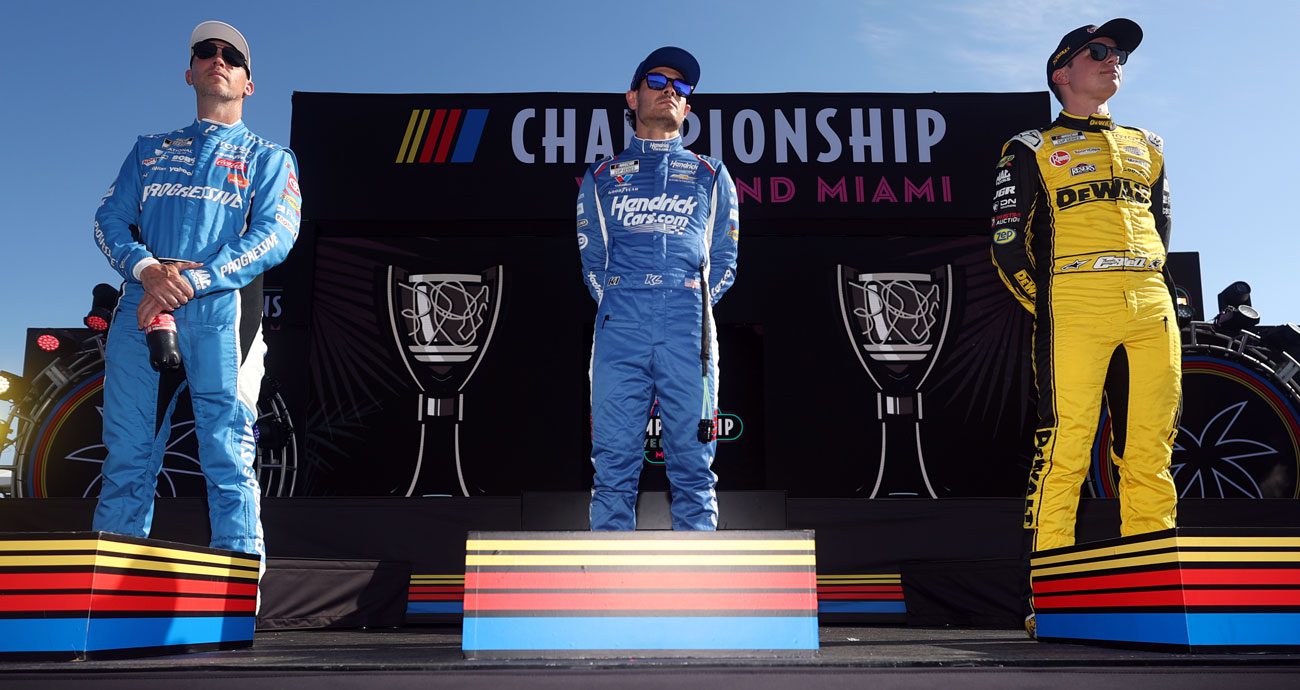
The 2026 season is over, and champions across all three NASCAR national series have been crowned, culminating with Kyle Larson capturing the NASCAR Cup Series honors at Homestead-Miami Speedway for his third career title.
This year's postseason, of course, had a different flavor than in previous years. With a return to a Chase-style format, start-to-finish consistency, coupled with the importance of accumulating race wins at the right time, became significant as drivers navigated the fresh postseason landscape. The result was a race campaign full of speed, strategy and a bit of luck, culminating in a final contest that concluded the season in rousing fashion.
RELATED: Final Cup Series standings | Homestead results
Of course, there was plenty more to dissect from The Chase presented by Mobil 1 than just that summary. This week's “Last Call” segment focuses on Year 1 of The Chase, with our NASCAR.com insiders sharing their biggest takeaways from the postseason format's fresh look and return.
What was your biggest takeaway from the 2026 Chase?
Dustin Albino: Putting together a seamless 10-race stretch during a grueling NASCAR season is no easy feat. Yet many of the sport's top contenders repeatedly stumbled throughout The Chase, allowing Kyle Larson to capitalize. With a remarkable 7.3 average finish across the postseason, including a 34th-place DNF at Phoenix. Larson built an insurmountable advantage and clinched the championship with nearly 300 miles left in the season finale at Homestead-Miami Speedway. Denny Hamlin entered The Chase as the No. 1 seed and favorite to capture his first championship, but costly miscues at Darlington, Las Vegas and Phoenix derailed his hopes. Christopher Bell, typically one of the series' steadiest performers, made a pair of mistakes in the final three races, while Ryan Blaney's four finishes of 33rd or worse at traditionally strong tracks doomed his title bid. Chase Briscoe also dug himself into an early hole with three finishes of 27th or worse in the first eight races, effectively ending his championship hopes. Consistency has become increasingly difficult to sustain in the Next Gen era, making Larson's 10-race run all the more impressive. The No. 5 team's third championship in six seasons was a testament to its ability to avoid the mistakes that plagued the competition.
Zach Sturniolo: My biggest takeaway has to be how heavily mistakes are penalized in the points standings throughout this 10-race mini-season. As quickly as an error can seemingly be erased by a near-after race win, the in-moment loss of points is striking. As Dustin alluded to, the advantage of Hamlin's No. 1 seed was quickly diminished thanks to mistakes on track that hemorrhaged points from his race-ending totals. Stage points helped elevate an 18th-place finish at Darlington Raceway to a 35-point performance, but so many “what-ifs” linger. A miserable result at Phoenix Raceway paid Hamlin just 21 points — one of his four lowest points-paying days of the season. The high of a race win — which pays a minimum of 55 points — can fix everything, and even more so than most anyone expected before The Chase began. But the penalty of a mistake is arguably harsher, and I'm all in on a points system that demands excellence.
Pat DeCola: The future of NASCAR arrived in a big way in 2026 … and The Chase reminded us the present isn't going anywhere just yet. Ty Gibbs, Carson Hocevar and Corey Heim all earned their first Cup victories at age 23 or younger — the first time three drivers that young accomplished that in the same season during NASCAR's modern era. And honorable mention to Ryan Preece, who joined the first-time winners' club at Daytona in August. But then came The Chase, and the breakthrough victories stopped. Ten races, seven different winners, all between 28 and 36 years old. Not a single first-time winner in the bunch, and no non-Chase party crashers, either. It's hardly an indictment of the younger generation, whose talent is undeniable, but an interesting reminder of the gap between breaking through and establishing yourself among the sport's elite. We've spent much of this year talking about the exciting wave of talent coming up through NASCAR's ranks, and rightfully so. But while those drivers were busy announcing their arrival, the established contenders were reminding everyone why they've been at the top for so long. The future is bright. The changing of the guard, apparently, is still off in the distance.
Cameron Richardson: The value of the almighty win still reigned supreme in the “what's old is new again” Chase format. While visiting Victory Lane automatically advanced you in years past, it naturally built a buffer for those fortunate enough to win one of the 10 races if they did slip up at some point. Larson won two of the first four to pocket 40 more points than his title contenders and after a disastrous Phoenix race that earned him just three points — he was still the title frontman. A third win at Talladega and that was all she wrote. Bell, Briscoe and Logano winning when they did all kept them in the title hunt and Reddick's Phoenix stunner vaulted him within striking distance despite a pedestrian first six races of The Chase. Earning the No. 1 seed clearly brings its own value as it vaulted Hamlin all the way to still being in the fight until the end of Stage 1 of Homestead, but dropping 60 points to Larson iced out the heat Hamlin carried into The Chase.
Zack Albert: The idea that the Cup Series champion would emerge from one of the leading six seeds in this new Chase format led to the theory of the “Mythical Top Six.” When Kyle Larson went on a postseason tear from a humble No. 7-seeded starting point, the “myth” part of that phrase became bitingly true. Getting hot at the right time helped Larson buck the analytics, continuing this season's trend of performance ebbs and flows — with Tyler Reddick the early-season dominator, Denny Hamlin the consistent midseason leader, and Larson the eventual champ with a stellar finishing kick. The premium for winning races in the new points structure helped tilt the balance of power, and the importance of stage points reached new heights. Racing Insights' predictive models projected that 85% of simulations resulted in one of the top six regular-season finishers becoming Cup Series champ. Number-crunching only goes so far, however, showing that championship races aren't determined on paper or in the computer lab.