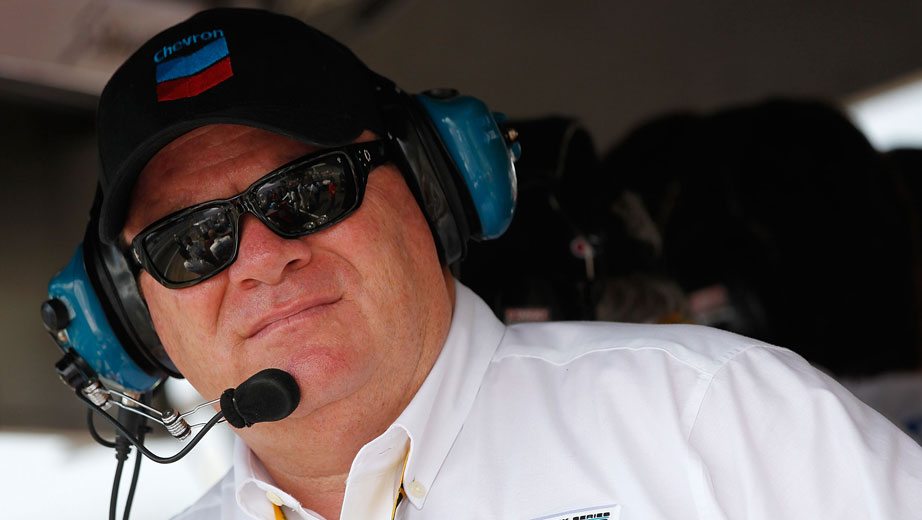
Team owner won at the Brickyard in 2010 with driver Jamie McMurray
Indianapolis Motor Speedway holds a special spot in Chip Ganassi’s heart, as a backdrop to his five starts as an IndyCar driver to his five wins as a car owner — one in NASCAR and four in the Indianapolis 500. The track’s rich history, the sense of place — all are palpable when his team sets up camp in Gasoline Alley for a race weekend in either series.

But despite his fondness for Indy, Ganassi insists there’s not a Target-red marker to circle the Speedway’s place on the NASCAR calendar for emphasis. With seven races left to get his drivers Jamie McMurray and Kyle Larson in position for the Chase for the NASCAR Sprint Cup playoffs, the 57-year-old team owner said each event carries its own importance.
“I don’t think there’s any extra pressure. If there’s any pressure at all, it’s every race,” Ganassi says. “There’s a certain amount that goes with every event, but I mean, Indy is in some sense a big event and I know our guys like big events. In another sense, it’s just another race and we want to approach it the same way, but we’re certainly excited about going there.”
The sense of time and place is also meaningful for McMurray heading into Sunday’s Crown Royal Presents the Jeff Kyle 400 at the Brickyard (3:30 p.m. ET, NBCSN, IMS, SiriusXM), an event he won as part of his banner season of 2010, his first with the team that is now known as Chip Ganassi Racing with Felix Sabates.
In some ways, McMurray says, his Brickyard victory seems like a distant memory but in other ways not as much. Ganassi’s longest-tenured driver said he often frames events now in relation to his children’s ages. At the time of his Indy win, his wife, Christy, was pregnant with the couple’s first child, Carter — now 4 1/2 years old.
Their status as happy parents-to-be comes through in all the photos from Victory Lane and the traditional kiss of the yard of bricks at the start-finish line, but so is the joy shared by Ganassi and Sabates savoring their first stock-car triumph at the birthplace of Indianapolis-style racing. The venerable Speedway certainly remains cherished, but McMurray said the approach doesn’t change for this weekend.
“I don’t remember Chip ever mentioning anything about this race being more important to him than any other race, even though he has the background with the IndyCar team and has the shop based there,” McMurray said. “It was a really big deal for us to be able to win there in 2010 — the pictures, the memories … I loved getting to watch the TV footage afterward of how excited Chip was with Felix being able to win there. But honestly, I don’t remember him ever mentioning anything about we need to put more effort into this weekend over any other.”
Some extra effort will be necessary this weekend, if only because a new, high-drag aero package awaits Sprint Cup teams. To help teams adjust to the rules changes, Friday practice has been expanded to three sessions totaling four hours and 40 minutes, an increase of one hour, 25 minutes from 2014.
The extra time might be welcome for crew chiefs such as Matt McCall, in his first year overseeing McMurray’s No. 1 Chevrolet. A raised rear spoiler and other aero devices are expected to produce closer, almost pack-style racing at Indianapolis this weekend and at Michigan International Speedway next month but McCall said he’s reserving judgment on how cars will react until his team can log track time.
“Obviously, you’ve got wind tunnel data to think you know what it’s going to be like, but until they actually make some laps …,” McCall said, trailing off with a slight shrug. “I think a couple of cars put the package on at the Chicago test (last week), so with a little bit of feedback, we’ll be able to pay attention to that. Still, once you get most of the cars on the race track, you’ll get a better idea of what will happen.
“It’s different, so that’s sort of good. Any type of change that’ll get your mind thinking a different way, I’m all about it. Sometimes the setup gets so repetitive that it’s the same every single week, so pretty cool to have a chance to play on something different.”
NASCAR officials instituted a low-downforce package two weeks ago at Kentucky Speedway, producing a harder-to-handle car that placed greater emphasis on driver input. The result was the most competitive Sprint Cup race — measured in green-flag passes — in the series’ five-year run in the Bluegrass State.
The widely different trim of the Indianapolis package may be signaling a shift toward track-specific setups, all in the hope of promoting better racing with tailor-made aerodynamics. With that concept just beginning to take root, Ganassi said it’s still too early to weigh potential benefits against possible drawbacks.
“I have mixed feelings about it and what I’ve found, I had some feelings about the Kentucky package that really were unfounded concerns, I realized later,” Ganassi said. “So I want to be careful what I say about Indianapolis and kind of go in with an open mind. I think in one sense, it’s a bit of an equalizer in that no one’s tested that package there. So it’s going to be interesting to see what happens and it could be an advantage for us.”