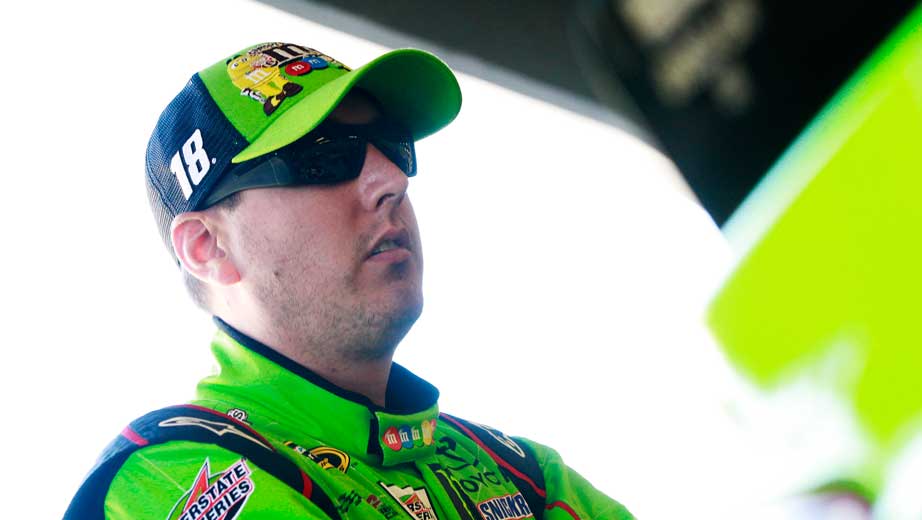
JGR driver spoke to the media for the first time Wednesday since his accident
Play: NASCAR Fantasy Live
Kyle Busch didn’t suit up at Daytona International Speedway for the start of the season ready to be NASCAR’s driver safety spokesman, but circumstances have propelled him into a powerful, if unexpected, advocate.
Speaking to the media Wednesday for the first time since he severely broke his right leg and left foot in a crash in the Feb. 21 season-opening XFINITY race in Daytona Beach, Florida, Busch wouldn’t go so far as to name himself an official safety envoy, but he was insistent that his accident should help with improvements near-term and far.

Busch’s Toyota impacted an inside wall that was not outfitted with SAFER (Steel and Foam Energy Reduction) Barrier – one of the few places at the massive track that didn’t have one.
“As far as being an advocate for safety, I just think it’s useful when you’re in that situation to help as much as you can, to give those answers to the NASCAR engineers and to help them innovate to make some changes to our cars, to make some changes to the race tracks to get the race tracks to step up and make those change,” said Busch, who still has no timetable for his return to the drivers seat of the Joe Gibbs Racing No. 18 Toyota.
“Anything and everything is useful. Any information that us drivers can give is beneficial to those individuals and, more times than not, we’d really appreciate it if they listen to us.”
NASCAR has listened and so have the tracks that host races.
Before the sun had set the day of Busch’s accident, Daytona International Speedway President Joie Chitwood had workers making immediate, temporary changes to the walls in time for the following day’s Daytona 500 with a more permanent improvement completed in time for the July race there.
“The Daytona International Speedway did not live up to its responsibility today,” a very candid Chitwood said following Busch’s accident. “We should have had a SAFER barrier there today, we did not. We’re going to fix that. We’re going to fix that right now.”
And, Chitwood promised, “Following that, the Daytona International Speedway is going to install SAFER barrier on every inch at this property. This is not going to happen again. We’re going to live up to our responsibility. We’re going to fix this and it starts right now.”
The “soft walls” as the SAFER Barriers are known, are common at all the race tracks the Sprint Cup Series visits, but not every venue is completely covered in them. After Busch’s accident, Talladega Superspeedway, Kentucky Speedway, New Hampshire International Raceway and Atlanta Motor Speedway were among several — like Daytona — that said they would add additional SAFER barriers.
Bristol Motor Speedway, where the series races this week, is another track committed to increasing its soft wall coverage.
“I was disappointed that the wall wasn’t covered, but I am encouraged by the acts that the race tracks have taken and the steps they’ve taken in order to get things going and in the right direction for driver safety,” Busch said. “We work for the fans. Obviously, the fans are what drives this sport and we do everything possible for them as well as our sponsors and everyone involved in the business. Driver safety needs to be one of those items at the top of the list. I think most of us would agree to that.
“With being able to get tire barriers up or SAFER barriers up, in the right circumstances – if there’s a wall that needs a tire barrier, put a tire barrier there. If it needs a SAFER barrier, put a SAFER barrier there. But, it can’t be constructed overnight, so there’s a timetable there. I understand that, but we’re all hoping sooner rather than later.”
One of the detours Busch has made during his rehabilitation is a stop at NASCAR’s massive, high-tech Research and Development Center outside Charlotte, North Carolina. It’s there that NASCAR engineers have come up with some of the safety innovations that Busch feels prevented his accident from being worse.
He said he was impressed with the breadth and depth of detailed information everyone was able to learn and gather from his accident.
“I’m alive today just because the fact that the restraints worked, the seat worked, the HANs device worked – everything worked,” Busch said. “It was just the pure foot cockpit of the area that obviously injured me. I can’t say enough about NASCAR and their innovations. From knees up, no problem, not a mark on me, not a bruise, not a headache, not a neck ache, nothing – it was all great. It was just a matter of your flailing feet when you’re in a wreck like that.”
And Busch said he was reassured by the commitment to use his misfortune as a way to make improvements for the entire sport.
“The wreck was so bad, you have to go to NASCAR and have them understand what happened in the car so we can continue to evolve safety and make the car better,” Busch said. “A driver got hurt, so we have to fix that. Will we ever be able to reengineer every single crash scenario there may be? No. The ones we do have that I’m here for, I can help. I feel like I can be a help for that.”
MORE:
|
|
PLAY: Sign up
|
WATCH: Latest
|
FOLLOW LIVE: Get
|
|---|
NASCAR news


