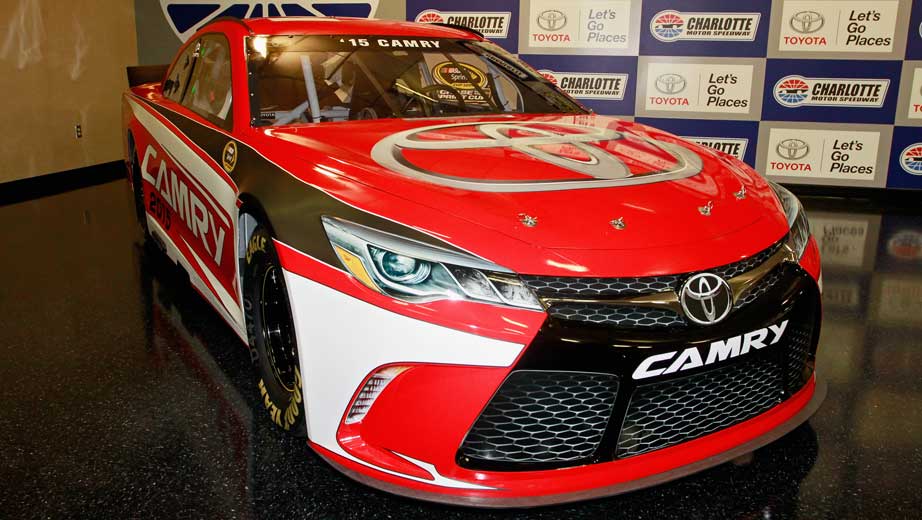
Manufacturer adds new nosepiece, but will it lead to an about-face in results?
Play: NASCAR Fantasy Live
While the organizations it supports placed three drivers in NASCAR’s Chase for the Sprint Cup, and one driver managed to finish third in the points standings, the 2014 season was not a particularly memorable one for Toyota.
Just one year after Toyota-branded teams hauled in 14 victories, the most since the brand debuted in Sprint Cup in ’07, those same organizations scored just two victories in the series’ 36 points-paying events.

Joe Gibbs Racing placed all three of its drivers — Denny Hamlin, Matt Kenseth and Kyle Busch — in the Chase, and Hamlin advanced all the way to the Championship Round.
But Hamlin finished third, Kenseth and Busch fell by the wayside earlier, and there was nothing to crow about from the other major Toyota organization, Michael Waltrip Racing, as its two teams failed to make the Chase altogether.
“Yes we came 12 miles from winning our first championship, but setting all that aside, it was extremely disappointing,” Dave Wilson, president and general manager, Toyota Racing Development, USA, said. “It was the worst season since our debut in 2007 when we won zero races.”
“Any way you slice it, it was tremendously disappointing. We collectively did not perform well through the regular season. I think Chicago things started coming together, and I think we had really good speed during the Chase but that’s not good enough. … It just was not a year that we feel good about.”
There are big changes ahead for all Sprint Cup teams this year, with new technology used to officiate pit road and a new rules package aimed at decreasing both horsepower and downforce. Even the schedule looks different with a three-race West Coast swing on tap early and a move back to Darlington on Labor Day weekend at summer’s end.
Toyota teams face an additional challenge — for ’15 the Camry has been redesigned and features a new nosepiece.
“Ultimately we had two critical wind tunnel tests,” Wilson said. “Those were the tests where not only does NASCAR come to evaluate, but our colleagues from Ford and Chevy were also there. That’s part of our deal, transparency, because we need everybody to buy into this and believe it’s inherently fair.”
Still, he admitted, everyone wants to be as close to the line as possible from a competitive standpoint. And Toyota pushed it as far as it could. Toyota officials were “sweating bullets,” Wilson said. “They were a little nervous.
“We passed; we were within in the box so here we go.”
With limited testing for ’15, teams aren’t sure how the new piece will react when paired with the rules package changes. Wind tunnel tests and simulation programs provide some information, but the proof won’t come until teams get on the track for the first time this week at Daytona International Speedway.
Jason Ratcliff, crew chief for Kenseth, said the change to the front end “provides a lot of opportunity for us in the cooling area, the brake duct packaging.
“Even though the (total) area is the same, it’s allowed us to grow in that area and do some things better than maybe we did several years ago when we came out with the 2014 nose,” he said.
Other factors were taken into consideration as well when incorporating the piece into the race-car version of the Camry. Teams don’t want something on the front of the car that could more easily collect and retain debris from off the track and lead to overheating issues, a situation Ford teams found themselves in soon after the debut of its Gen-6 entry.
“Is it something that’s going to take us out of the race?” Ratcliff said. “How durable is it to debris, maybe a lug nut or something? Is it going to penetrate it and get to the radiator?
“So there’s a lot of engineering that goes behind the grille opening, not just for cooling but for many other things.”