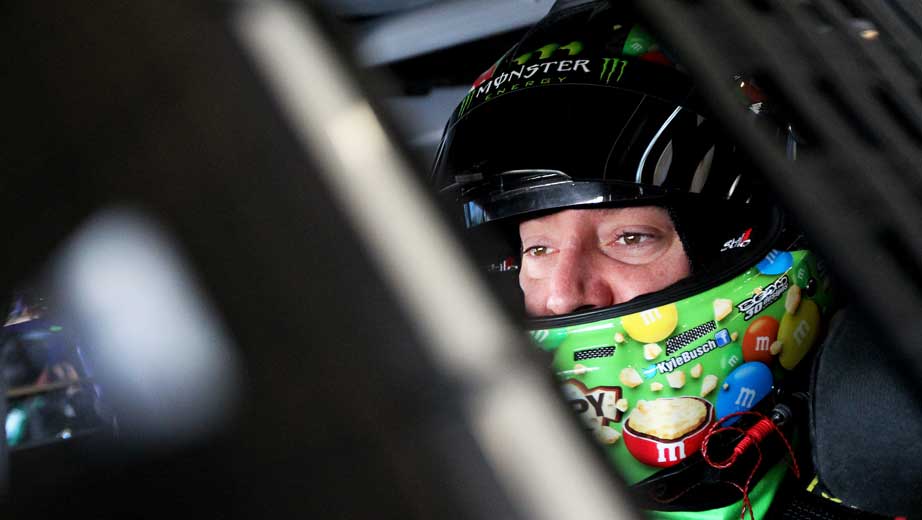
‘Game of chicken’ expected for Sunday’s event (1:30 p.m. ET, FOX)
Play: NASCAR Fantasy Live | Vote: Ultimate Daytona Challenge
DAYTONA BEACH, Fla. — When Austin Dillon zoomed his way around Daytona International Speedway to earn the pole for last year’s season-opening Daytona 500, he did so without any aerodynamic assistance from his fellow competitors.
There was no “pack” qualifying with multiple cars grouped on the track, each trying to catch the draft of those in front or get a push from those behind.

FULL SERIES COVERAGE
• Latest news
• Standings
• Schedule
FASTEST DAYTONA 500 POLE SPEEDS
| Speed (mph) | Driver | Year |
|---|---|---|
| 210.364 | Bill Elliott | 1987 |
| 205.114 | Bill Elliott | 1985 |
| 205.039 | Geoff Bodine | 1986 |
| 201.848 | Cale Yarborough | 1984 |
| 198.864 | Ricky Rudd | 1983 |
| 196.966 | Ken Schrader | 1989 |
| 196.515 | Ken Schrader | 1990 |
| 196.434 | Danica Patrick | 2013 |
| 196.317 | Benny Parsons | 1982 |
| 196.049 | Buddy Baker | 1979 |
| 196.019 | Austin Dillon | 2014 |
It was simply a man, a machine and 2.5 miles of asphalt in a battle against the stopwatch.
In a matter of exactly 45.914 seconds, Dillon, 23, became the youngest pole winner of the Great American Race.
He also became the last official pole winner under what’s long been known as “single-car” qualifying in NASCAR’s Sprint Cup Series.
The Daytona 500 was the last holdout. This year, the determination of positions 1-2 will be made based on group qualifying, just as it was for the other 35 points races last season.
And some drivers are not happy about it.
“I think teams spend all winter long trying to massage a Daytona 500 car to go out there and sit on the pole,” Joe Gibbs Racing driver Kyle Busch said. “The engine builders build strong engines to try to sit on the pole. … It’s all car and engine.
“Now it’s all circumstantial. It doesn’t even (take) any driver skill to qualify on the pole for the Daytona 500. It’s strictly being able to get out there in the right pack, transfer through and then make it in the right spot when it comes down to the end.”
Qualifying for the 500 has always featured its own unique format, with only the front row previously established through single-car runs, the bulk of the field determined via finishing positions of two qualifying races and the remainder based on qualifying speed and owner points. As with other events, one position is available should a former champion fail to qualify through other means.
In 2013 NASCAR instituted group qualifying to determine the starting lineup for road-course events; last year that format was tweaked and put into use for all points-paying races except for the Daytona 500.
Sunday’s format will feature three qualifying rounds, with the first round featuring two groups determined by random draw. Those that draw an odd number will be in the first group with even numbered draws making up those in the second. Teams in each group will have a five-minute window in which to complete an official qualifying lap.
RELATED: Daytona 500 qualifying order
Following a 10-minute break, the fastest 24 drivers will advance to the second round for another five-minute session. Following a seven-minute break, the fastest 12 in that round will advance to the third and final round, which will also be five minutes in duration.
The fastest two in the final round will make up the front row for the 500.
At restrictor-plate tracks, the format has created an unusual situation in which teams often wait until the last moment before going out to make their attempt. However, if their pack doesn’t get up to speed, doesn’t get to the line in time to post an official lap or is forced to slow for some reason, the results can be disastrous. Such was the case last October at Talladega Superspeedway where Roush Fenway Racing driver Ricky Stenhouse Jr. and Justin Allgaier of HScott Motorsports were among those who failed to make the 43-car field.
“I don’t believe in the qualifying format, especially as what we do at restrictor-plate tracks,” said Ryan Newman of Richard Childress Racing. “At the non-restrictor plate tracks I could argue it, even in my own head, because it’s still the driver and the race track. But having other cars manipulate you in an effort to qualify, especially at one of the biggest races of the year, to me is not in the best eyes of our sport.”
Greg Biffle (Roush Fenway Racing) says the format is “a big game of chicken, and it bit a lot of guys at Talladega, including (Stenhouse).
“I think here people can’t afford that. It is the Daytona 500. You have to get a time. You have to get the fastest time you can,” he said.
There are game-plans, some elaborate and some as simple as that of Team Penske driver Joey Logano, who said his consists of “going … really, really fast.”
“You definitely have a plan,” six-time Sprint Cup champion Jimmie Johnson said. “You want to be the last car in a big group, so whenever that group rolls, you want to be towards the end, and everybody knows that, so it’s going to be very interesting; I think we saw that at Talladega, where people were playing the waiting game and left pit road without enough time to even come back and take the green.”
Drivers will pair up with teammates, and manufacturer allegiances come into play. But Johnson said ultimately it’s just a numbers game.
“Especially just getting up to speed and the way it works out,” he said, adding that his No. 2 qualifying run at Talladega wasn’t even “at speed.”
“We had a huge moment where everybody checked up in (Turns) 3 and 4 coming into the green, and when I got to the start‑finish line I wasn’t even at full speed,” he said, “and because of the whole cat‑and‑mouse game that’s going on with everybody positioning themselves, it still turned out to be second fastest.”
It’s a guessing game, and one that teams have yet to master.
“No one figured it out at Talladega,” said Denny Hamlin, driver of the Joe Gibbs Racing No. 11 Toyota. “It just was by chance that some guys made time and other guys didn’t.
“Hopefully, everyone is a little bit smarter now because of it, but really your front row guys are just going to be the ones that get in a lucky spot and put themselves in a good spot and hopefully the cars around them work with them.”
“There is not really any skill to it,” said Jamie McMurray, a Daytona 500 champion but yet to be a pole winner for the event. “I think (winning the pole) is probably most important here because it is the Daytona 500. This is the one time at a plate race that being first or second has some meaning.”