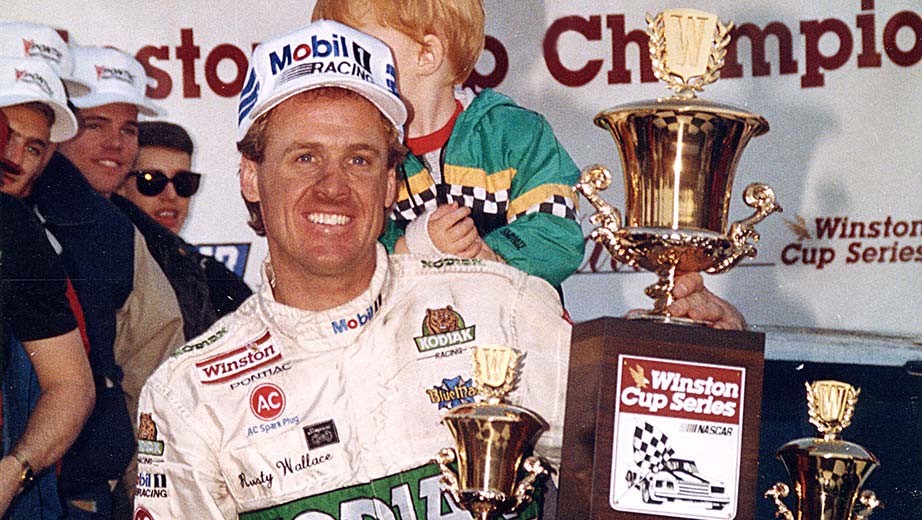
Former champ helps celebrate Mobil 1’s big anniversary
RELATED: Learn more about NASCAR technology
Rusty Wallace was there when Mobil 1 made its entry into NASCAR, when Ronald Reagan was the president, people were wearing acid-washed jeans and Michael Jackson was truly the King of Pop.
That was 1986.
Flash forward to today and Rusty Wallace is still Mobil 1’s biggest fan.
How it came about, Mobil 1’s entry into NASCAR was like a lot of such events, Wallace said.
“I’ve got to give credit where credit is due,” Wallace said. “Raymond Beadle is the man who started all of the Mobil 1 stuff in NASCAR. He had the relationship with all the folks at Mobil 1 when I came on at Blue Max back in 1986 and then he was able to get them on the car. When I left, Beadle and Raymond decided to shut the team down, we were able to carry that sponsor on over to Penske. That’s where it all started. It was a great ride.”
What made it such a great ride? Wallace said it was the great product and the advantage of synthetic oil in a racing application.
“Mobil 1, when we had it in the car, it really gave us peace of mind,” Wallace said. “We knew, from all the dyno testing up in Fairfax, Virginia, that the product was way, way ahead of anybody else when it came to performance, and it really still is today. We could run engines hotter, and we noticed that when we had problems during the race, overheating really bad during the race, the engines would come back and look fine when you thought they were kind of destroyed.
“We could run our engines harder and it gave us a real sense of security when we got in a real tough situation. You’d have a hot dog wrapper on the front of the car, and the water temperature would be up at 280 degrees and you’re saying, ‘Aw, man, this baby’s gonna burn down.’ But it would stay going.”
Mobil 1’s early success with Wallace and the Blue Max team made an impression in the garage, he said.
“This synthetic oil just spread through the garage like wildfire,” Wallace said with a laugh. “I remember the guys that were sponsored by other oil companies, we would get them the oil under the table and they would put it in different jugs and put it in their car. That’s a true story.
“I would watch guys put the Mobil 1 in because their engine builder said, ‘Look, I know we’re sponsored by these guys, but this is a better deal.’ It was common practice.”
Wallace said he was drawn to Mobil 1 because, quite simply, it was the best stuff going. That mattered to Wallace.
“Back then, all I wanted to be involved in was the best stuff,” he said. “We had to have the best engines and the best power. The extra protection from Mobil 1 was just free to me. I said, ‘Look, if this is the best stuff, let’s go with it.’
“When the sponsorship came about (with Beadle and Blue Max), I’m going, ‘Why do they want to bring all the engine builders up to Fairfax and the laboratories all the time?’ Man, I used to think they were overthinking everything. They were constantly trying to develop. I was always saying, ‘It’s working great. If it isn’t broke, let’s not fix it. Let’s not mess with something that might give us a problem.’ “
Development, especially with a synthetic, is the key to success. Development that intense brings a whole crop of new stuff to the fore, and Wallace said it led to a banner year for him.
“That’s the thing about Mobil 1. They would constantly develop,” he said. “Qualifying got to be a big thing then, where we wanted to have the lightest lubricants and the thinnest stuff. They developed a complete line of qualifying oil, and in 2000, I won nine poles that year, with the special qualifying oils. We had the thinnest oil, the thinnest transmission and rear end grease, the thinnest wheel bearing grease … we’d change all that stuff out and put the race stuff in. It was really something.”
That development and commitment to breaking new ground has served Mobil 1 well in the first 40 years. NASCAR’s new rules package is going to optimize the protection aspects of the product as well, Wallace said.
“When you have less horsepower, you have less strain (on the engine),” Wallace said. “When you have less strain, you probably won’t need as much protection. So they’re probably going to come with thinner oil, thinner everything. That falls right in Mobil 1’s wheelhouse right now.
“They’ve already done it, and they’ve had many things happen since then. That’s a company that is so race-oriented that when there’s a rules change, they can react to try and make things better. I’m positive they’ll be doing that.”
The new roller lifters in the 2015 engines are a big improvement, he said, and that will help the valve train, traditionally the weakest link in any internal combustion engine, with a lot of power.
“We were having so much trouble with having to break those flat lifters in,” he said. “There was a whole process. When I came up, in ASA and All-Pro, all we ran was roller cams, drag racing was all rollers. They were looking at NASCAR like, ‘Really? Flat-tappet cams?’ That change is good, but late.”
What it won’t help, from the builder’s side or Mobil 1’s, is parts weight. If lighter parts go in, strain increases, and you’re right back where you started.
“If you have less power, you can put lighter parts in,” Wallace said. “I haven’t talked to NASCAR about that, but if they leave the parts the same size, then you’re going to be able to run those engines for a long time.”
That’s the name of Mobil 1’s game: endurance, protection and speed. The next 40 years are going to be interesting, to say the least.
MORE:
|
|
PLAY: Monitor your Chase Grid Game picks
|
WATCH: Latest
|
FOLLOW LIVE: Get
|
|---|

Chase news


