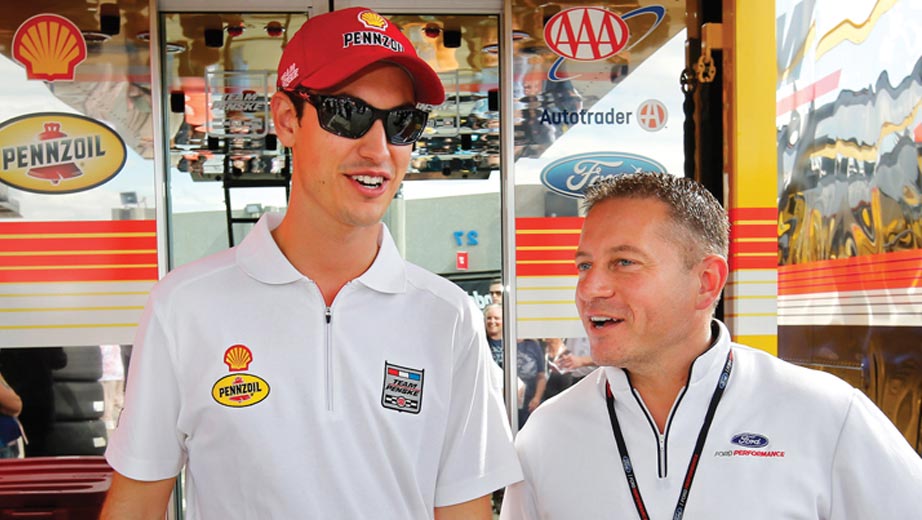
Photo credit: Nigel Kinrade/NK Photography
For 2017, Ford Performance will field seven Monster Energy NASCAR Cup Series organizations featuring 13 teams.
Driving Ford Fusions for the first time this year are Stewart-Haas Racing drivers Kevin Harvick, Kurt Busch, Clint Bowyer and Danica Patrick. Harvick won the series title in 2014 while Busch was the last Ford driver to win the series’ championship, in 2004 with what is now Roush Fenway Racing.
“I think you’ve seen over the past year with the formulation of Ford Performance that we have a different approach to our racing program,” Global Director of Ford Performance Dave Pericak said when the agreement with SHR was announced early last season. “A lot of people have heard me say that we don’t race to race, we race to win and we also race to learn. So we’re truly using racing as an innovation test bed in development of new technologies, tools and our people.
“I think Stewart-Haas brings with it just an enormous amount of expertise and the way that they approach racing is a very technical way, so all of that is going to blend very well with what we’ve been doing within Ford Performance and how we are approaching now our racing program.”
In the past four years, Ford teams have visited Victory Lane 35 times and six of its drivers have earned a spot in the 10-race, championship-determining playoff. Team Penske‘s Joey Logano has advanced to the Championship Round in two of the past three seasons.
“There does seem to be an increase in engineering support again,” noted one long-time team owner. “It’s nice when Raj (Nair) and Dave, guys dedicated to winning, show up at the track. You know they are there for one reason – to see a Ford win.”
It’s something that doesn’t go unnoticed to Ford drivers.
“With the transition to Ford, right off the bat the thing I’ve enjoyed most is it’s the head honchos you’re talking to,” Bowyer said. “Raj Nair has made this Ford Performance the reality it is today, and he’s the guy you’re talking to.”

‘RACE – WIN – INNOVATE’
Under the leadership of Raj Nair, executive vice president of product development and chief technical officer for Ford, and Dave Pericak, global director of Ford Performance, the Ford Performance team was unveiled two years ago to bring together Ford’s racing arm, its performance parts division, and its high performance divisions (SVT and RS) on a global scale.
In making the announcement at that time, Nair said the new Ford Performance team “ties together racing, performance vehicles and parts. It will allow us to more quickly introduce parts and accessories that meet the needs of customers around the world on-road and on the track.”
But what has Ford Performance meant for teams competing in NASCAR?
GROUND SUPPORT
The Ford Performance Technical Support Center was up and running prior to the formation of the Ford Performance program – it opened in the summer of ’14 – and it has been an integral part of developing not only Ford’s racing efforts, but the company’s production vehicles as well.
Housed in Concord, N.C., the 33,000-square-foot building features a full-motion simulator that allows teams to ferret through various track-specific setups, obtain a better understanding of changes made to their race cars and be in position to fine tune those setups once they arrive at the track. It’s the next-best thing to being on track, and there’s never an issue with weather.
For drivers, use of the simulator has also helped shorten the learning curve for those going to a track for the first time, while helping others reacquaint themselves with different venues.
“We would not have made that switch if we didn’t see that dedication from Ford Motor Company,” Stewart said. “When you look at their history, Ford’s won every major race around the world. Not most of them. They’ve won all of them at some point.”
With limited testing and a new rules package in ’17, the opportunity to simulate how those changes affect performance is more crucial than ever.
The Center also houses additional equipment, such as a kinematics machine, chassis rig and center of gravity machine to fine-tune, test and measure specific areas of the race car.
Technological advancements gleaned by engineers at the Center aren’t limited to the race track. Engineers on the production side also utilize the facility for development and to improve the existing performance characteristics of Ford’s street vehicles.
THE END GAME: MORE WINS ON THE TRACK, MORE AWARDS FOR PRODUCTS
In its first two years, the Ford Performance platform has already proven an invaluable asset to bettering its breed.
“Certainly, getting the production vehicles out — the GT350, the Raptor, the Focus RS and, obviously, the Ford GT — and on the racing side a big challenge I asked the team was we want to go win 24 Le Mans in 2016 and celebrate that 50th anniversary of the Ford GT the right way and they’ve done that,” he said.
But manufacturer and driver titles in NASCAR’s top series remain elusive.
“I would say both are important,” Nair said. “For us as a manufacturer, obviously, the fight with Chevy and Toyota is really important, but the driver’s championship is equally as important. So we want to win both and we are doing everything we know how to do that. Whether it’s bringing in a lot more engineering resources to bear … whether it’s our wind tunnel programs, our dyno programs, our computer simulators, our actual simulator (at the Tech Center), but also bringing the right personnel on board and the team that Dave has built, and obviously bringing the right partners on board.
“We have a great partner in Roush Fenway, a great partnership with Roush Yates Engines. We brought (Team) Penske on board (in ’13) and that’s been very successful for us, and now getting Stewart-Haas — the caliber of the organization and the caliber of those drivers — I think we’ve got a lot better chance to achieve that end goal.”