RELATED: Key moments in family history | NASCAR is France family business
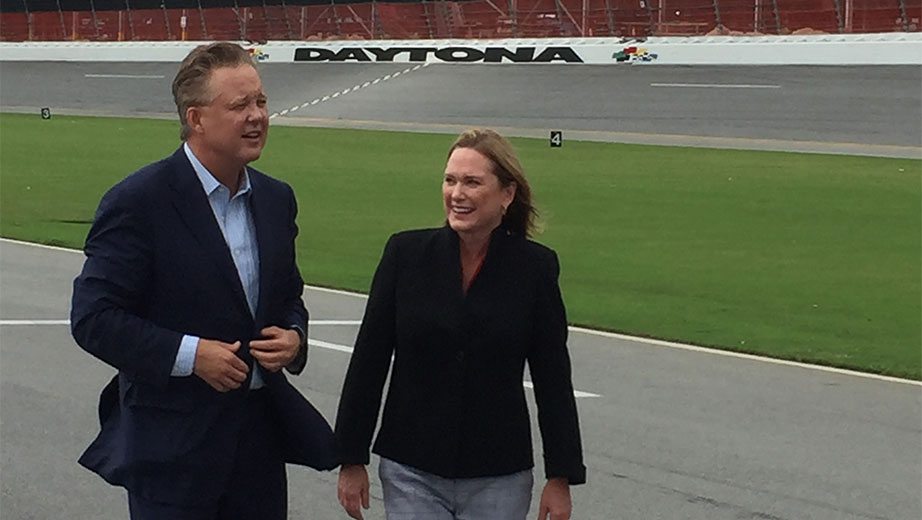
It’s been one year since a red ribbon was cut to signal the official opening of DAYTONA Rising, a $400-million overhaul of NASCAR’s iconic venue-the Daytona International Speedway (DIS). It was an exciting time for Brian France, Chairman and CEO of NASCAR, and his sister, Lesa France Kennedy, CEO of International Speedway Corporation (ISC) and Vice Chairperson of the NASCAR and ISC Board of Directors.
This year brings similar excitement as they gather for Daytona’s three NASCAR national series races, highlighted by Sunday’s 59th running of the DAYTONA 500.
There are a number of reasons why. A green-and-white checkered flag will wave twice during each race, followed by the traditional black-and-white checkered flag at the finish. More than just colorful flags, they will usher in a dynamic format in which races will be contested in three stages designed to deliver more dramatic moments over an entire race, where every lap matters and every moment can have a massive impact on a season.
While Kennedy’s ISC projects include a modernization of Phoenix Raceway and construction of ONE DAYTONA, the premier mixed-use retail and entertainment destination sprouting across the street from DIS, France looks to continue to build on the collaboration that has impacted the NASCAR industry over the past several years.
MORE: France talks key to running family business
“Brian has such diverse talents,” says Kennedy. “He has a great feel for the racing side of the sport, yet he’s also great at marketing, a true visionary. He doesn’t always get the credit he deserves for running this sport, but he was there early thinking ‘big’ alongside my father (Bill France Jr.), and he’s still thinking big today, not only with our family but also now with the entire industry.”
“I am so proud of what Lesa has done here, from DAYTONA Rising to ONE DAYTONA — and that’s only in the last few years,” says France. “She’s done it with passion and persistence, two of her biggest attributes. Lesa is without a doubt the best developer in the family. We are ushering in the next era of motorsports entertainment facilities, something this industry needs as our sport continues to focus on modernizing itself for the next 10, 20 and 30 years.”
IN-DEPTH: Daytona rises even higher

France always is looking ahead, though he occasionally pauses to reflect on his past. This includes the time his father dispatched him to work at a family-owned motorsports facility in Tucson, Arizona.
“I really enjoyed my time at the track, and learned a ton,” France said. “Lesa and I did everything related to motorsports when we were growing up here. I gravitated toward the racing side — I even served as Race Director for a while for what’s now known as the XFINITY Series — while she enjoyed the financial and fan-consumer side of the business. But we did it all, from picking up trash to operations.”
“One thing Brian and I both learned early,” says Kennedy, “was that nothing was promised to us.”
France and Kennedy now oversee the two primary family businesses — NASCAR and ISC — and work together to drive and evolve the sport. They have pushed the industry the past several years to work more collaboratively, leading NASCAR’s decision to grant five-year sanction agreements to tracks. The previous single-year agreements made it tough for many promoters to make long-term capital investments in their facilities. They also ushered in a new Charter business model for NASCAR teams, tying the teams’ business interests directly to NASCAR while also providing team owners with an improved long-term operating model.
MORE: Lesa lends own vision
This week, the “Great American Race” is under the vibrant banner of a new premier series entitlement partner, Monster Energy. More than 100,000 fans will enjoy the DAYTONA 500 in person on Sunday, but many more millions will consume it in other fashions, whether via the FOX television broadcast, NASCAR.com, a live Snapchat story or many other ways.
NASCAR fans spend an average of nearly 10 hours a week following NASCAR, according to data compiled by research agencies. Last year, FOX and NBC Sports broadcasts attracted 58 million unique viewers, with an average of 4.6 million viewers tuned in to the Monster Energy NASCAR Cup Series race each week. NASCAR’s digital platforms boasted 55 million unique visitors last season, garnering one billion page views for the third consecutive year, while NASCAR’s social media accounts (Facebook, Twitter, Instagram, etc.) generated more than four billion impressions.
Despite its large scale and reach, NASCAR remains a family business. Last year, France served as keynote presenter at a family business conference in Phoenix, Arizona. He shared stories about everything from learning the business from the ground up to emphasizing communications with every member of the family, something he reiterated this week.
“I talk to Lesa probably seven, eight times a week on average,” France says. “If I have any problem within the industry, or something personal, she will be my first call. I want you to know this is coming down the road … Here’s what we’re facing… Can you please give me your view on this… That kind of interaction.”
As Brian and Lesa prepare for another historic DAYTONA 500, with different but closely tethered responsibilities, they both know the sport is driven first and foremost by its fans.
“We can’t do enough for our fans,” Kennedy says. “Most people don’t realize that when our grandfather built this track, the high banks were constructed not just to make the racing more exciting and fast, but also to make it easier for fans to watch the action from anywhere in the facility. DAYTONA Rising was built with the same philosophy in mind. There’s not a bad seat in the house.”
“The DAYTONA 500 is NASCAR’s must-attend race,” France adds. “It’s an iconic, distinctly different sporting event that provides an entertainment experience unlike any other, now against the backdrop of the world’s only motorsports stadium. This year, we’ve got the return of Dale Earnhardt Jr. competing against the new generation of hard-charging drivers such as pole winner and Duel winner Chase Elliott, a second-generation driver. Also competing will be former NASCAR Drive for Diversity and NASCAR NEXT driver Daniel Suarez, and the brothers Austin and Ty Dillon.
“It’s an exciting time to be a NASCAR fan,” France concludes. “NASCAR is, and always will be, about the fans. We know that, and we work hard every day to deliver the best racing possible for the fans.”