

Alon Day kept his No. 54 Chevrolet dutifully in line as a parade of race cars pulled ahead of him across the parking lot of a city square in a tiny town called Heusden-Zolder in Belgium. Officials from the NASCAR Whelen Euro Series had pleaded with drivers not to screw around as they drove from the city square to the race track, and for the time being at least, Day complied with that request as the competitors against whom he raced all season drove ahead of him.
Day pulled onto the street and rumbled through town. He used his left hand to take cell phone video and his right hand to shift, and that left no hands for the steering wheel. Ah well, the houses were set pretty far back from the road and we were not going that fast anyway.
Then again, it was extremely important that Day not crash the car. Day, an Israeli born member of the 2016-17 NASCAR Next class and seen by many in the NASCAR industry as a future star in America, was the points leader of the top-level Elite 1 division headed into the final two races that October weekend of the 2017 NASCAR Whelen Euro Series season. And he was driving his actual race car, which he had to race twice that weekend in pursuit of the championship.
Day considered a NWES title as a possible springboard to a full-time ride in one of NASCAR’s top three series … but he had to hope the races went better than the parade so far. He hadn’t driven half a mile when all of his fellow Euro drivers were gone — poof! Did they turn somewhere? Or did they pull that far ahead of him?
Being dead last in a row of race cars was a new experience for Day, but at least he had a good excuse. He didn’t want to drive too fast with me sitting next to him, and I use the word “sitting” only because there’s no word for the position of my body in his race car. I did not, technically, have a seat, seeing as how NASCAR race cars always only have one person in them. So forgive Day if for once in his racing life he couldn’t keep pace with his fellow drivers.
Day laughed when he had to stop because a black van pulled out of a gas station in front of us. There were five regular cars ahead of us and no race cars. We looked to be just two guys out for an afternoon drive … in a race car with 450 horsepower and eight cylinders but only one seat. I’ve heard of drivers crashing on the parade lap but losing the parade? Well, I guess we weren’t lost, exactly, but we didn’t know where we were going, either. Finally, a police officer at a roundabout pointed Day right, and there, in the distance, were the rest of the cars.
Day is well known for adjusting quickly to new racing situations — cars, tracks, series, countries, continents — and he adapted to this one. There was a long straight stretch of road between us and the rest of the parade. “Hold onto something,” he said a fraction of a second before he pushed the throttle to the floor. Soon we were going way faster than I would ever tell NWES officials.
At least he was holding onto the wheel.
PHOTOS: Behind the scenes in Belgium
European flair
Such was my introduction to the NASCAR Whelen Euro Series in mid-October over the final four races of the 2017 season. I had dozens of questions to probe as I arrived. The first: Is NASCAR in Europe like NASCAR in America? The answer, which I learned over and over again: Yes … except for when it’s different. Case in point: Everything about my ride with Day could have happened in America … except there is absolutely positively no way in the world that any crew chief would have let Day drive his race car on a city street, no matter how many hands he had on the steering wheel … though I would love to see Chad Knaus’ face when someone floated the idea.
The American NASCAR vibe transplanted to Europe and tweaked to fit the culture is explicit and intentional, a way to introduce the uniquely American NASCAR experience to the rest of the world in a way the rest of the world can understand. Jerome Galpin, a delightfully charming and fast-talking Frenchman who founded and owns the NASCAR Whelen Euro Series with his wife, Anne, studied NASCAR culture and the France family before they started the series. They traveled to the U.S. in the early to mid 2000s to attend NASCAR races and were mesmerized by the noise they heard, the power they felt and the relationships they saw.
“We don’t have that kind of cars, atmosphere and spirit in Europe,” Jerome said, and he decided to change that. Galpin created a series that’s about fans, drivers and the relationships between them. That allows Galpin to introduce NASCAR and its culture to Europeans as well as makes his series stand out in a crowded European racing field.
As NASCAR looks to expand its place in the global market, the combination of brand identity and uniqueness relative to what else is available is an important consideration. It’s a delicate balance as NASCAR has moved into international markets in the last half decade, with the NWES, the NASCAR Pinty’s Series in Canada and the NASCAR PEAK Mexico Series. NASCAR still has to be NASCAR, and it also has to be aware that a word-for-word translation of what works in America might not always make sense abroad.
MORE: Coverage of NASCAR in Mexico, Europe, more
The approach appears to be working. In the years before NWES was affiliated with NASCAR, it was a secondary series to bigger circuits and the average attendance was 5,000. In 2017, the sixth as a NASCAR branded league, NWES was the main attraction and average attendance was 25,000.
What’s behind the growth? The focus on the race weekend as an event rather than just a sporting event. Galpin designs his race weekends to be family-oriented gatherings that transcend cars on the track. As much as he could, Galpin imported how NASCAR races look, sound and feel … and sometimes he co-opted other American cultural icons and plopped them into NASCAR even if they have nothing to do with each other, by which I mean there were cheerleaders in Victory Lane and football players at the podium ceremony.
• • •
On Friday afternoon of the championship weekend, Galpin jumped in his compact red car and drove through the infield of Circuit Zolder. He parked in a wooded area and walked to Turn 12, a corner infamous because Gilles Villeneuve died there in a qualifying crash in 1982.
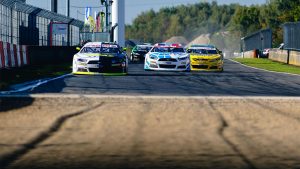
Galpin says this is his favorite place to go at Circuit Zolder and Friday afternoon is his favorite time to go there. He watches races from race control, and he sees only what TV cameras allow him to see. But down here, a stone’s throw from the most treacherous turn on the track, he sees what fans see, feels what fans feel, experiences what fans experience. He wants his races to be good races, of course, but he also wants them to be good shows, and this is the best place for him to analyze whether they are.
As Galpin watched cars handle that tricky turn, he told the birth story of the NASCAR Whelen Euro Series, which, true to NASCAR form, starts with nothing, ends in victory and has as many twists and turns as a season’s worth of races at Circuit Zolder. “We came from nowhere, knowing nobody,” said Galpin, who competes in rally races with Anne. “We had never organized any series.”
Jerome and Anne attended an automotive convention in Orlando in the mid 2000s. They walked up to the NASCAR booth, introduced themselves to Bob Duvall, NASCAR’s senior director for business development, and gave him a business card. They asked if it was OK if they called him occasionally about the series they planned to start in Europe. Galpin followed up with Duvall every six months or so to give him an update on the Racecar Euro-Series, as it was known when he started it, and to ask for advice.
In 2010, Duvall and other NASCAR officials made an exploratory trip to Europe as part of a broader move by NASCAR to expand its reach into international markets. While there, they attended a Racecar Euro Series event at the famed German track Nurburgring. “It looked like a NASCAR race. It felt like a NASCAR race,” Duvall says. “We felt like it could develop into something.”
Soon the deal was struck. Starting with the 2012 season, Galpin and NASCAR partnered to create a NASCAR series in Europe. Duvall brokered a deal that made Whelen the title sponsor beginning in 2013, a pact that recently was extended through 2024.
RELATED: Whelen announces entitlement extension
Both Duvall and Galpin want to see the series grow but only if it’s slow, steady and manageable. For now, that means six race weekends per year with a total of four races per weekend, two each for the Elite 1 and Elite 2 divisions.
As attendance has grown, so has the quality of the racing, drivers and cars. The top drivers have at least XFINITY-level skill, and several of them have made starts in that series. As Duvall walked through the garage one morning at Circuit Zolder, he saw a team working on bump stops, which is a piece of rubber on the shock so the car rides as low as possible without bottoming out. “Three years ago, there may have been one team doing that,” he says. “Now, there are 20.”
American dreams
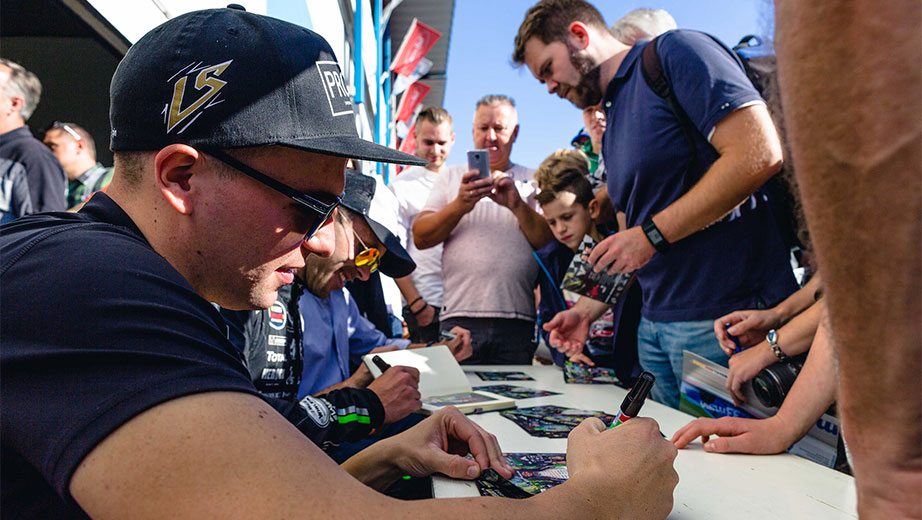
Joerg Bensemann, a dentist who helps make the schedule at Hockenheim, a race track in Germany, took a classic NASCAR trip two years ago. He attended a race in Talladega, drove to the NASCAR Hall of Fame in Charlotte, and then headed north to Martinsville Speedway and another race. He enjoyed himself so much that when he got back to Germany, he decided he needed to bring NASCAR to Hockenheim.
Last year, he met with Galpin in a small office in Circuit Zolder, and in 10 minutes, they hashed out a plan for what became this year’s race at Hockenheim. Bensemann budgeted for 5,000 fans; he got 10,600. He says the event was such a success that other series have called him to ask to have their events scheduled on the next NASCAR weekend.
And so here Bensemann was in the same office again at Circuit Zolder, meeting with Galpin and Duvall, who manages the schedules for all of NASCAR’s developmental series, to plan next year’s race. They quickly narrowed it down to two dates in September. No final decision was made for several weeks, but Bensemann left delighted as he knew he would host one of two playoff weekends next season.
RELATED: 2018 Whelen Euro schedule
Duvall, Galpin and Bensemann also kicked around ideas of how to make the weekend better — possibilities include holding a sponsor summit, getting the nearby U.S. Army base involved and inviting an American NASCAR driver, the bigger the name, the better, not necessarily to race but maybe to serve as grand marshal.
The Jeff Gordon sticker on the back of Bensemann’s cell phone suggests who his preference would be. A certain retired driver who has won the Most Popular Driver Award 15 times in a row and who proposed to his now-wife while on vacation in Germany a few years ago might draw some attention, too.
The entire conversation took about 30 minutes, and it provided a telling look into how the NASCAR Whelen Euro Series operates — a German track official, the French owner of the series and an American NASCAR executive all spoke English as they worked out details of next year’s schedule.
This is how Galpin loves to do business — face to face, friend to friend, and if the circumstances allow for a bottle of wine, all the better. Everything Galpin does with NWES — from the schedule to the rules to dealing with owners and drivers — is based on relationships, and that’s an approach he unabashedly admits he copied from how NASCAR works in the United States.
• • •
Perhaps the most obvious “that won’t happen in America” moment of the entire weekend came Sunday morning, when Day showed up at the TV booth to serve as a commentator for online coverage of the Elite 2 race. Day is Israeli and his native tongue is Hebrew. He joined Andre Wiegold (native tongue: German) and Gian Guiglia (Italian). In English, they described on-track moves in Belgium by drivers from Brazil, France, Belgium, Italy, Japan and more.
Even with that, there were still signs on this final race of the season that this was very much a NASCAR day. After Day dominated and won Saturday’s race — the next to last of the season — there was confusion about what exactly he had to do in Sunday’s final race to guarantee himself the championship. He had not clinched, but it was very close. At last official word came down: Day had only to complete one lap to win the championship.
Easy, right? Yes … but not quite so easy as it sounds. Day and his teammate, Arianna Casoli, drive literally the same car, and she had to race it first on Sunday in the Elite 2 race. If she wrecked it, he would have no car to drive. The lead drivers wrecked the first two times they piled into turn 1. “I hope my race isn’t going to be as eventful as that,” Day said after the second crash. “I hope it’s boring.”
He stood up to watch as Casoli drove by a few laps later. “I just wanted to make sure the car is in one piece.” The rest of the race was uneventful … until it was over. The winner of the Elite 2 championship — Thomas Ferrando, the French driver of the No. 37 Knauf Racing Ford Mustang — ripped a few donuts … an event unusual enough in Europe that it caught Day’s attention.
I want to do donuts if I win, Day thought. In the United States, the tire-screaming, smoke-billowing celebration is almost a requirement. But in Europe, it’s against the rules — the sanctioning body (FIA) fines drivers who do burnouts, sometimes as much as 5,000 Euros. “A championship is a championship,” Day says. “But I don’t want to lose that money.”
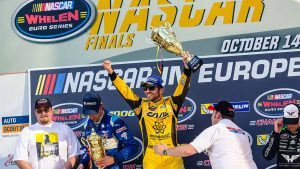
In America, drivers prefer to ask for forgiveness than permission. Not so in Europe, at least not in this case. Day left the broadcast booth and walked across a bridge over the track and into offices occupied by NWES officials. He was looking for Galpin and wanted to ask him whether it was OK if he did a burnout. Before he found Galpin, he ran into Phillipe Godet, the race director, and asked him.
Godet told him it was OK, and the two of them hatched a plan of how to do it. Day would finish the race and pull to the left of the track, snug against the wall, and let the rest of the field pass him. Then Godet would tell Day’s crew chief via radio when it was OK for him to squeal into Turn 1 and let ’er rip.
To be doubly sure, Day asked Godet again if he would be fined.
“No,” Godet said. He smiled and reassured Day by saying this: “We are NASCAR.”
coast to coast
NASCAR officials hope the NWES turns into a pipeline to bring European drivers to America, and they want those drivers to be ready for the American style of racing when they get here. The adjustments are myriad — from post-race celebrations to conducting media interviews, dealing with spotters and understanding inspections. These are all a bigger part of NASCAR Whelen Euro Series than they are of other European series, and that’s on purpose.
The allure of racing in America is baked into the series. As part of their reward for how they finish, NWES drivers are given money to spend on getting to America and racing here. And that’s when their real racing education begins.
THROWBACK: Relive Day’s Monster Energy Series debut
Let’s start this explanation with the drivers meeting on Friday at Circuit Zolder. Drivers shuffled into a conference room. They sat down on folding chairs. Bored, they looked at their phones. It was just like every other NASCAR drivers meeting I’ve ever been to. Then the meeting started, and the similarities ended.
Over and over again, Galpin and Godet warned, cajoled, insisted, demanded and every other harsh word I can think of the drivers not run into each other. By comparison, rules at, say Daytona, are presented as optional. It was one step removed from yelling at them, and the opposite of, “Boys, have at it,” the famous quote from Robin Pemberton, then NASCAR’s vice president for competition, that was perceived as letting American drivers settle every real and imagined grievance on the track.
Now, to be fair, Circuit Zolder featured the last two races of the season, and Galpin and Godet did not want the championship decided by a wreck. Along the same lines, the season-ending race at Miami requires a different standard of behavior than a race in mid-June. But there’s also a cultural difference. In America, stock-car racing is a contact sport. In Europe, it isn’t.
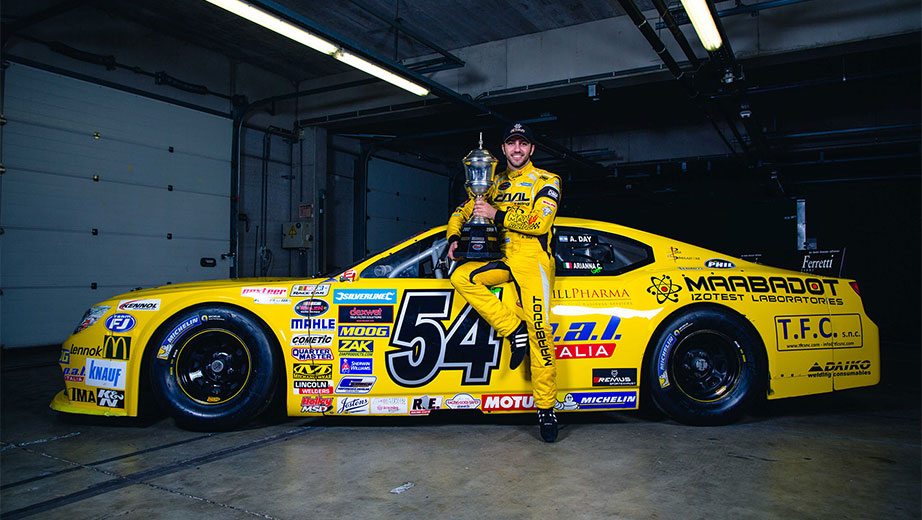
Galpin wants close quartered, door handle to door handle racing. But he doesn’t want anything beyond incidental contact, and he definitely does not want one driver to knock another out of the way to advance his position. More than just not wanting it, he has rules against it. He would have been apoplectic if one driver did to another what Denny Hamlin did to Chase Elliott at Martinsville.
MORE: Day celebrates, more pictures
This cultural difference means that when drivers get to America, they need a few races to get used to contact, intentional or otherwise. I interviewed three NWES drivers who have raced at Bowman-Gray Stadium, the famed short track in North Carolina, and their descriptions of racing there can be summed up in one word: crazy. The drivers and NWES officials say all that’s needed to overcome those differences is seat time, and that will come in fits and starts until a driver proves himself worthy of a full-time ride.
Day is the consensus pick as the best candidate to make the full-time leap across the Atlantic. In the last two years, he has run two NASCAR Camping World Truck Series races, two NASCAR XFINITY Series races and one Monster Energy NASCAR Cup Series race. He has the resume, looks and compelling personal history — he was born and raised in Israel and still lives there. He already understands being a NASCAR driver involves much more than going fast — he has to carry himself in a certain way and charm sponsors.
“I absolutely think having an international driver compete in NASCAR is important in general,” Duvall says. “I think it would help the United States open up new markets and a new culture for drivers coming into NASCAR. Clearly that’s a horizon we’re looking at. Being more diverse is part of the world now.”
When his final race started, Day finished his first lap without incident, which sealed the championship. He spun off the track twice during the race, perhaps with help from overzealous fellow drivers who weren’t paying attention in the drivers meeting … or didn’t care, as this is, after all, NASCAR.
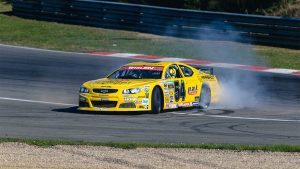
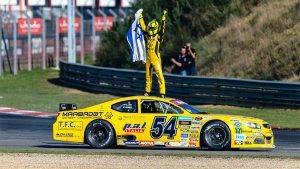
After finishing fourth, Day executed the donut plan to perfection. He climbed out of his car, smoke billowing behind him, pulled out an Israeli flag and jumped onto his roof. Later, in Victory Lane, he performed his winning ritual — pretending to play the violin, an inside joke with his Italian crew members meant to show that they create beautiful music together.
If this was the first day of the rest of Day’s life — if winning the NASCAR Whelen Euro Series title catapults him to a full-time ride in America like he hopes it will — it was a fun and exhausting one. Hours after the race ended, Day sat on top of a table in the media center near a window that faced the start-finish line. He manages his own PR efforts and already he had talked to the minister of sports in Israel, done an interview with the biggest online news organization in Israel and spoken with several journalists at Circuit Zolder, in addition to his stint this morning as a commentator for the Elite 2 race.
He had a clear plastic cup full of beer in one hand, his phone in the other and a broad smile on his face. Messages from friends continued to pour in. By the time he responded to one, more had taken its place. “I can’t keep up the pace,” he says.
That was the second time that happened this weekend.