The Riverhead Way
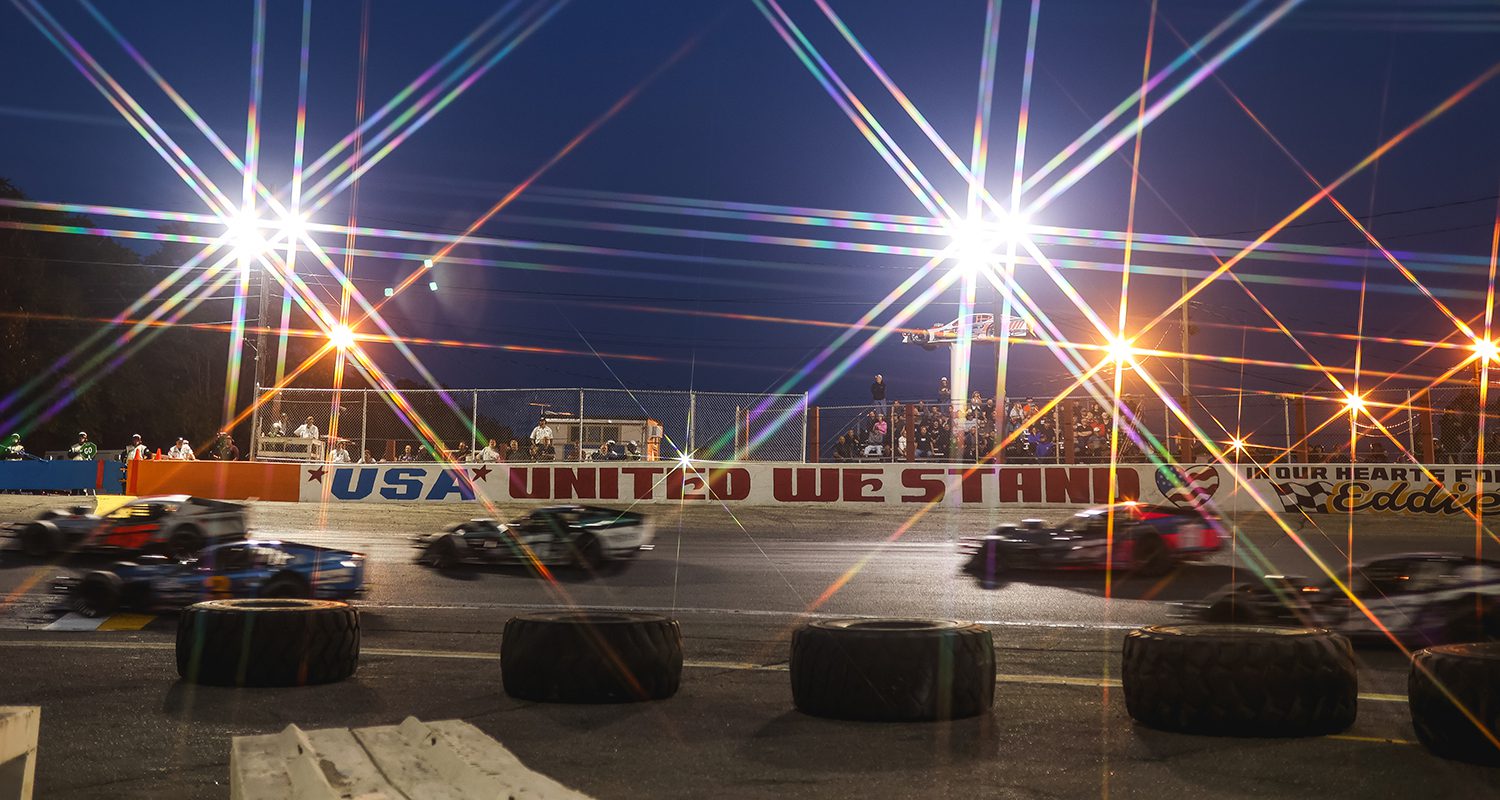
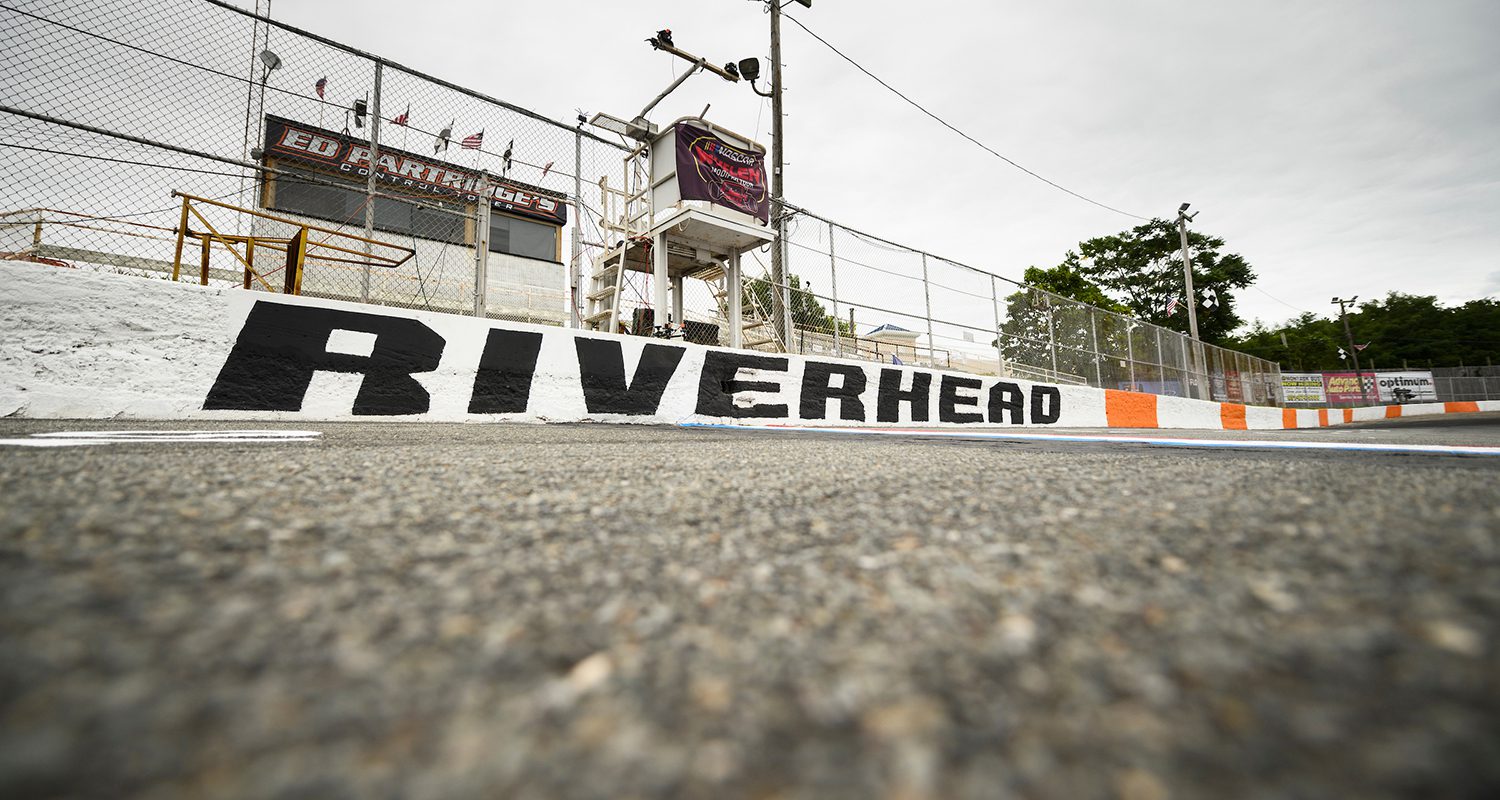
The haulers, if they may be called that, lined up outside Riverhead Raceway, a quarter-mile track tucked amid strip malls and big box stores in Riverhead, New York. The queue ran four abreast and 10 deep, and the trucks and trailers (and the race cars inside them) ran the financial gamut, from spit-shined and liveried on par with a Cup hauler to a beat-up midnight blue pickup with "class of 2025" hand-painted in pink on the side.
Some drivers and crew men leaned on their hoods, sweating under the hot summer sun. Others hid in their air-conditioned cabs. A mechanic barreled down the gravel driveway, dust billowing from his tires and Ozzy Osbourne blaring out his open windows. The track wouldn't open for another 30 minutes, and the races wouldn't start for hours after that. And yet here they were, eager to be let in to the only track on Long Island.
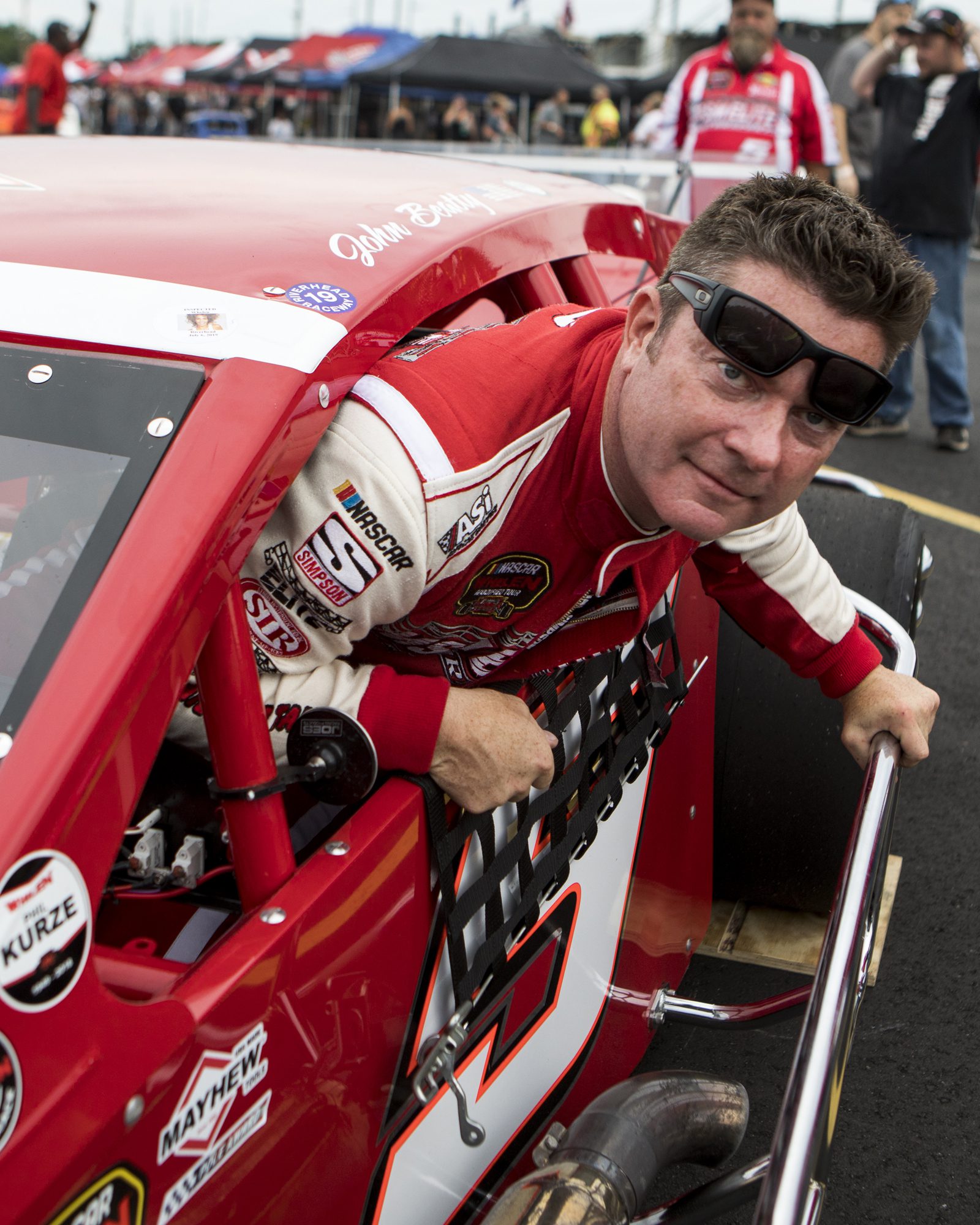
They were early, because what the hell else were they going to do on a race day, and also because the first in line gets the best spot in the garage. Well, make that second best. John Beatty Jr., the two-time defending champion in the NASCAR Buzz Chew Chevrolet Tour-Type Modified division, was guaranteed the best spot. After that, it's first come, first served.
Dozens of haulers across the six divisions racing that day pulled in through a gate with a sign that says in all caps, "thru this gate pass the best damned drivers in the north east."
Best damned is one way to describe them. Enduring fits, too, as Riverhead has survived into this, its 75th season, even as short-track racing nationwide has faced the never-ending challenge of how to put butts in seats, cars on the track and cash in the register.
And there's one more description of Riverhead I'll offer after spending four days there this summer: funnest.
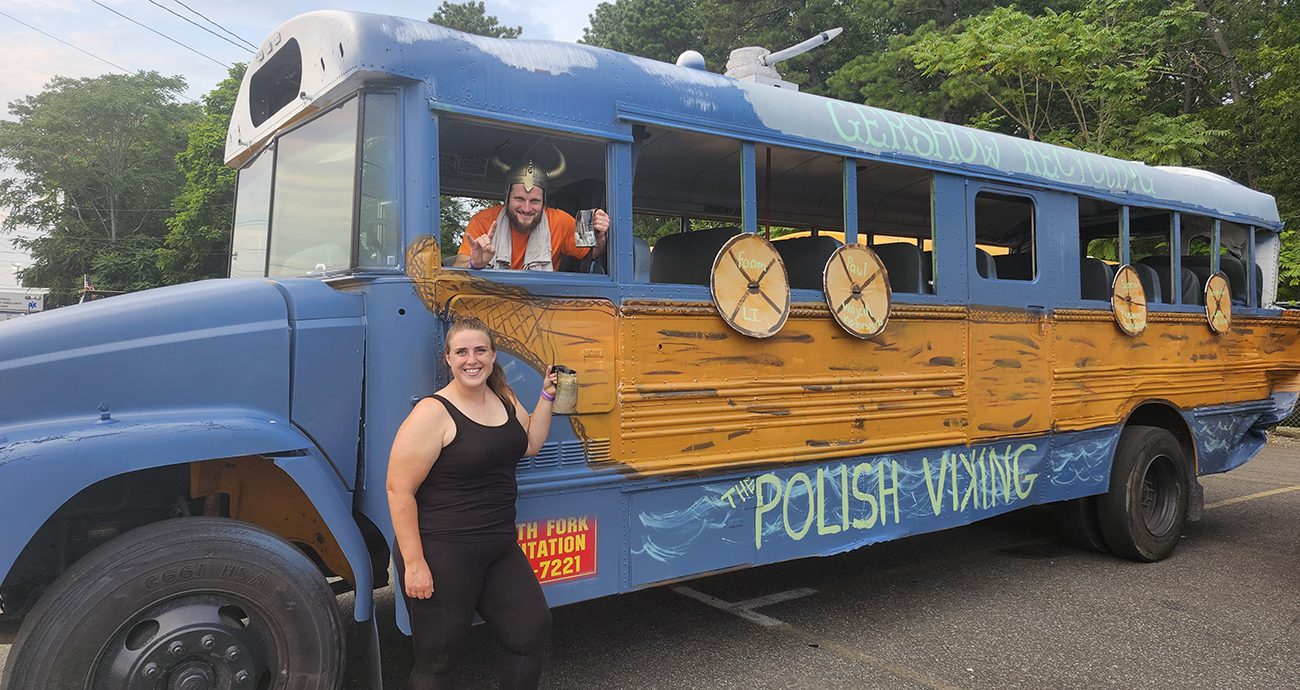
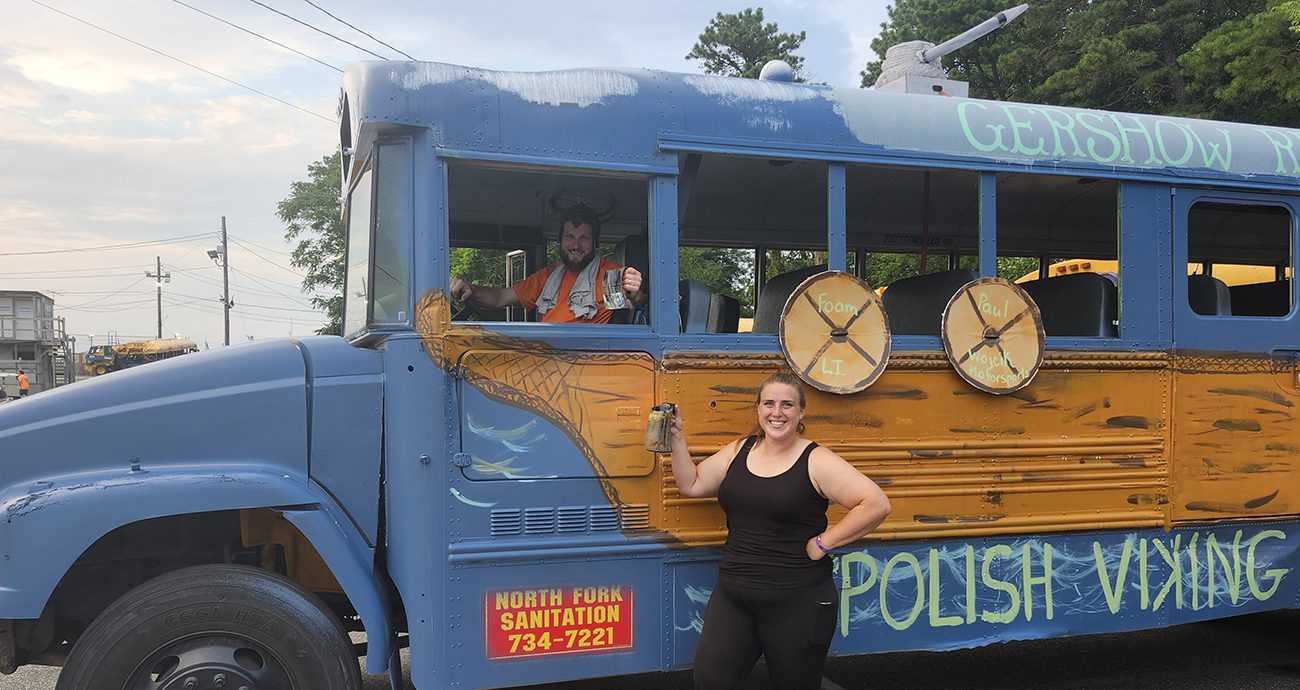
By which I mean I helped paint a school bus to look like a viking ship so a race car driver nicknamed The Polish Viking could drive it in Riverhead's school bus demolition derby.
***
Hours after the gates opened, Kevin Temme leaned against the fence outside Turn 4 watching a Legends race. He won a Legends championship as an owner with Beatty as his driver, serves as a consultant on Beatty's Modified team and has been attending races here as long as almost anyone. If anyone is qualified to capture the spirit of this place, it's him.
He used one word: tough.
Tough to drive, tough to pass, tough to win.
No sooner had he said that than the first- and second-place Legends drivers wrecked in Turns 1 and 2. The dumped driver exited his car and confronted the dumpee by raising his arms as if to say, "What the hell did you do that for?"
Tough, indeed: Those same two drivers wrecked in the same place and from the same positions four days later.
From angry drivers to the long line of haulers waiting to get in before the races started to the beer-nursing conversations long after they ended, passion for racing at Riverhead overflows. In addition to on-track dustups, I saw multiple garage-area shouting matches, and that was just among Beatty's crew.
"It's a tight-knit place," says Mark Mina, the owner of Beatty's team, MSM Elite Motorsports. "Everybody knows everybody. Friendships last a long time. And enemies last even longer."
Friends, enemies, rivals, teammates: Everyone at Riverhead wants the same thing -- great racing, full fields, packed stands. But there are as many opinions about how to get those as there are drivers in the garage.
The state of short-track racing at Riverhead is, to use Temme's word, tough, as it is across the country. It's tough to attract fans. It's tough to attract drivers. It’s tough to put on a good show.
That's why it helps to have a bunch of old school buses and drivers willing to wreck them.
***
On a sweltering Monday night deep in Riverhead Raceway's back lot, school buses lined up, just like the haulers did the Saturday before. Well, no, not like that. This time buses were lined up in the same way cars at a junkyard are lined up.
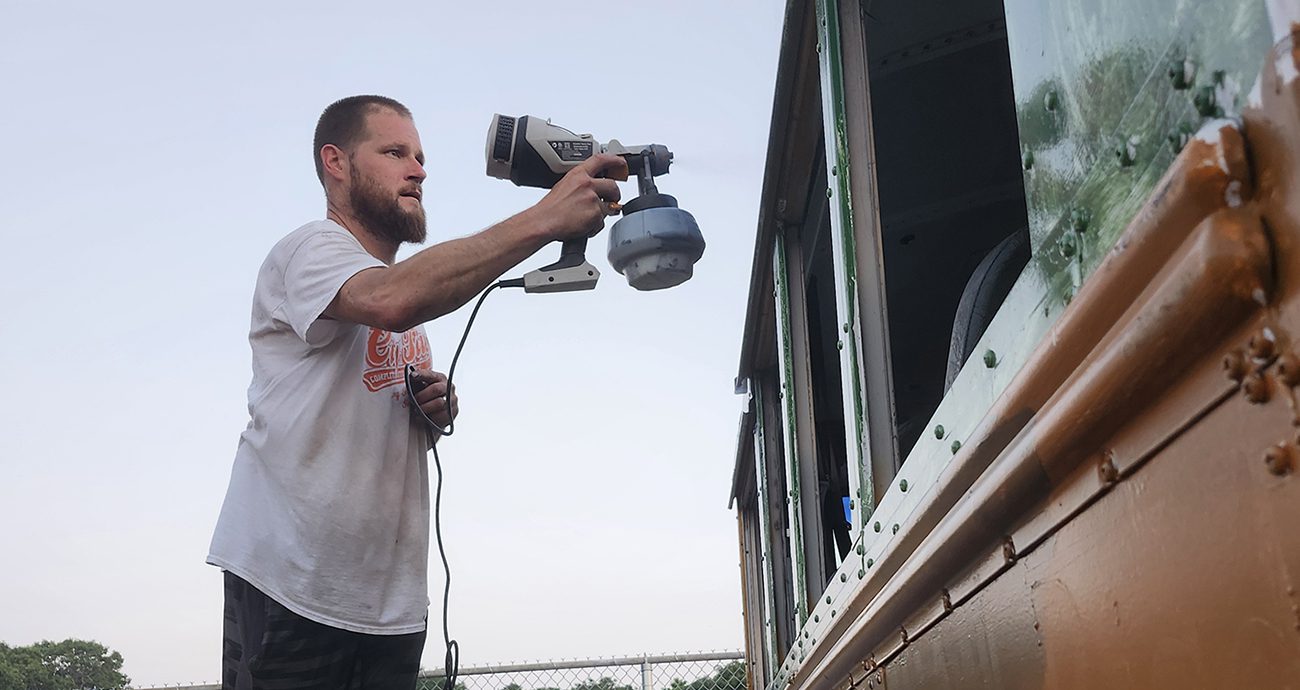
The track bought the buses, which were in various states of disrepair, and charged Frank "The Tank" Dumicich Jr. with taking care of them. In that role, The Tank, a Super Pro Truck division driver, is part mechanic, part event director, part demolition derby sage. He directed a battery to be taken from this bus and put in that one, gas to be drained from this one and put in that one. He used a welding torch to cut off the back of one that has been smashed in and more.
Glistening with sweat, trading laughs and talking junk, Dumicich and his delightfully rogue crew of drivers prepared their buses for the demolition derby two nights later. Some still looked like regular school buses. Some looked like school buses if a graffiti artist tried to make them look like race cars. All of them were at least a little dinged up, none of them had side windows, one had no seats, and one ... well, one told a romantic story of love and adventure in Iceland.
Paul and Melissa Wojcik have visited that island country several times. They got married there last year in the Caves of Hella, which is (perhaps) where Vikings landed when they arrived.
And so when Paul (demolition derby nickname: the Polish Viking), a two-time champion in the Mini-Stock division who has three wins this season, finally graduated from wanting to participate in the school bus demolition derby (which was true throughout their seven-year relationship) to actually doing it, they knew they had to go all out.
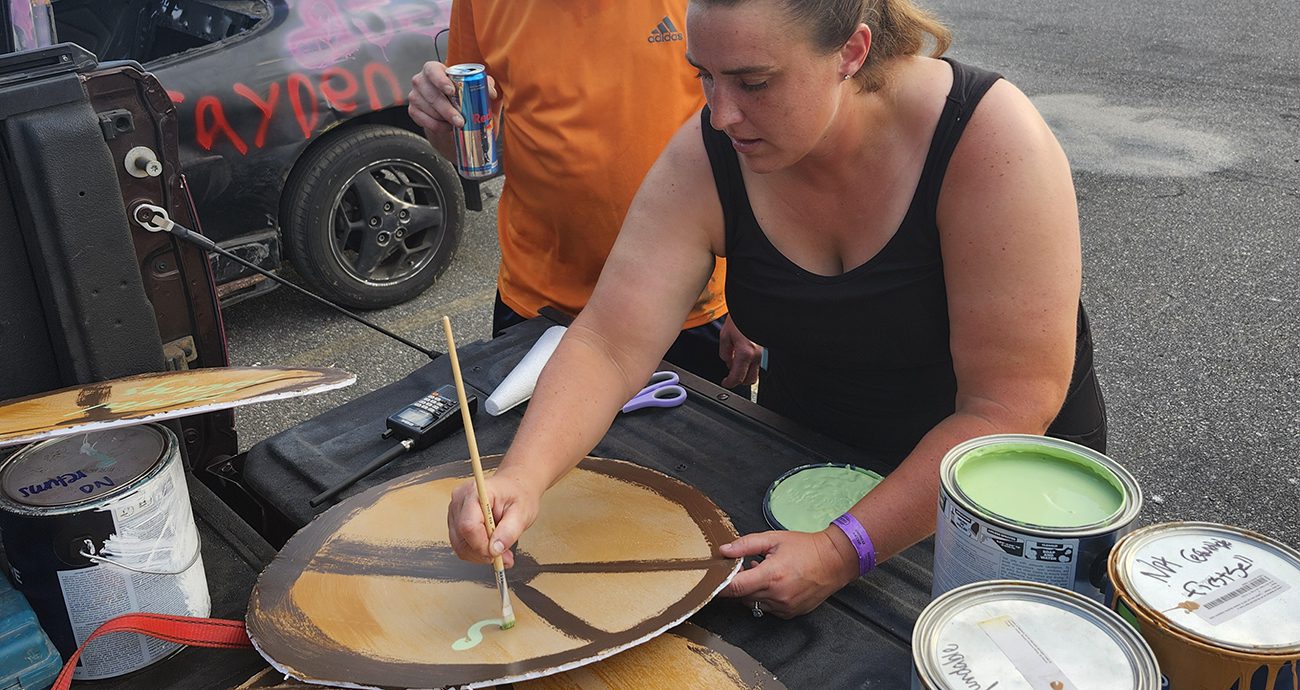
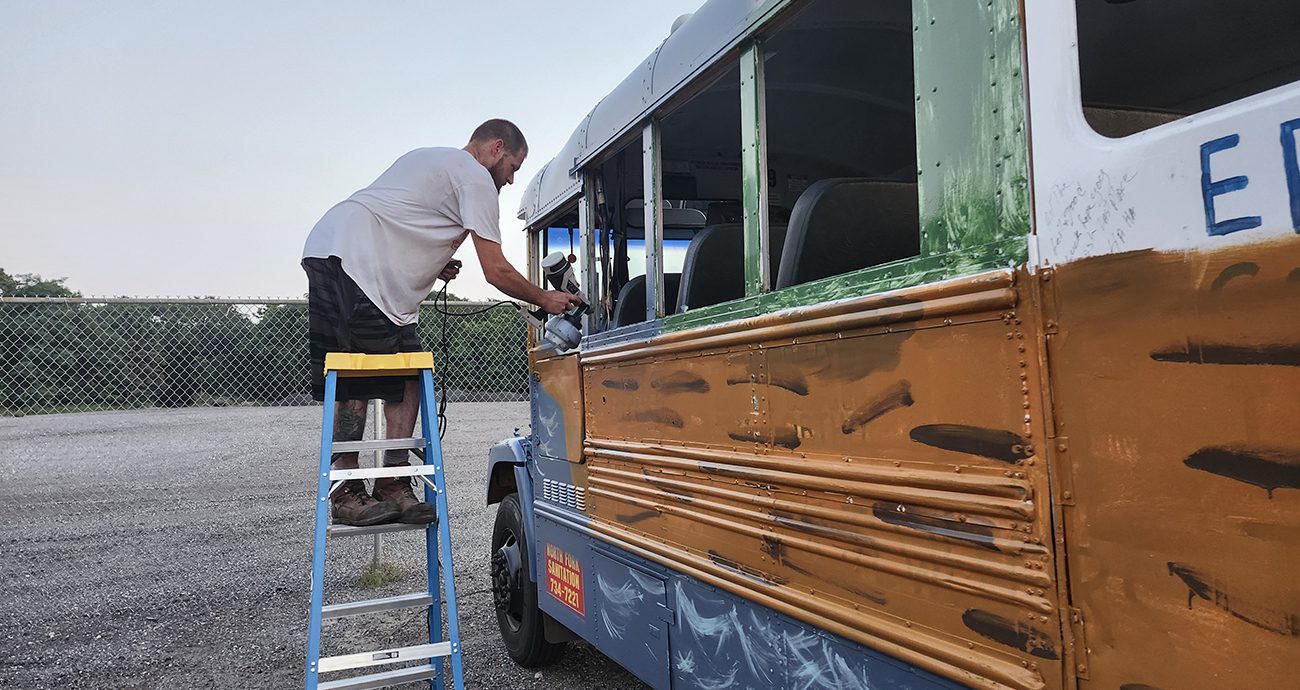
That's why they were busy painting over the myriad local sponsors -- Sophie’s Restaurant, Village Orchard and (my personal favorite) Anonymous Donor -- to make their bus look like a viking ship, complete with a homemade horned viking helmet ratchet-strapped to the emergency exit on the roof and eight handmade cardboard shields with stenciled sponsor names zip-tied to the window frames.
Paul and Melissa stopped at Lowe's to buy paint. The clerk was so impressed with the story behind the purchase that she gave them the paint for $1 each per can, with the added stipulation that they had to bring in a picture of the finished product.
On Day 2 of the prep, Paul and Melissa, both huge Cup fans, brought with them stickers to spell a sponsor's name (Gershow Recycling), a step above (to say the least) the spray-paint jobs on every other bus. Paul affixed each letter with meticulousness incongruous with the fact that the point of the event was to demolish the bus.
I asked why he bothered. He shrugged and said he loves Riverhead Raceway, wants to see it thrive, and if careful lettering on The Polish Viking Ship helped, it was the least he could do.
Also, that's just how they roll, Paul an electrician and Melissa an entrepreneur with a marketing background. The first big fun event they did as a couple was to enter a cardboard boat race. Paul applied the same level of detail to every seam as he did to The Polish Viking Ship. That cardboard vessel was waterproof, and they won the freaking thing.
They worked deep into the dark Tuesday, long after the track closed, and Melissa watched in delight as a shooting star blazed across the night sky.
***
Big names past and present have raced at Riverhead, from the Bodines and Baldwins to Richie Evans to Ryan Preece to Justin Bonsignore. John Ellwood, who began racing at Riverhead in 1989 and has been the track manager since 2010, says the place has been a proving ground for legends because of its configuration. "It will groom you to be a perfect racer," he says.
You can race and pass, but you can't do either without occasional contact. "Something happens, you're right on top of it. You go to other venues, it's like going on vacation," he says. "You run Thompson Speedway, you basically can crack a soda going down the backstretch."
Beatty and Mina are well on their way to adding their names to the legends of the track. They met at Riverhead a few years ago. Mina wanted to buy Beatty a set of tires. Offers like that come often; it's a more generous version of buying the race winner a beer. Mina, who owns 14 production companies, including the largest sound stage on the East Coast, gave Beatty his card and told him to call that Monday.
"I waited a day," Beatty says, "kind of like you have to with a girlfriend on a date. You know you've got to give him a day to think about it."
From that beginning sprang a partnership in which Beatty runs everything to do with the car. Mina handles everything else.
Mina joked Beatty does a good job of not wasting his money … and that Mina does plenty of that on his own. His MSM Elite Motorsports crew's uniforms were crisper, cleaner and more abundant than those any other team. Half the crew warned me I'd be fat after hanging out with them because of Mina's catering. The other half were too busy eating to warn me.
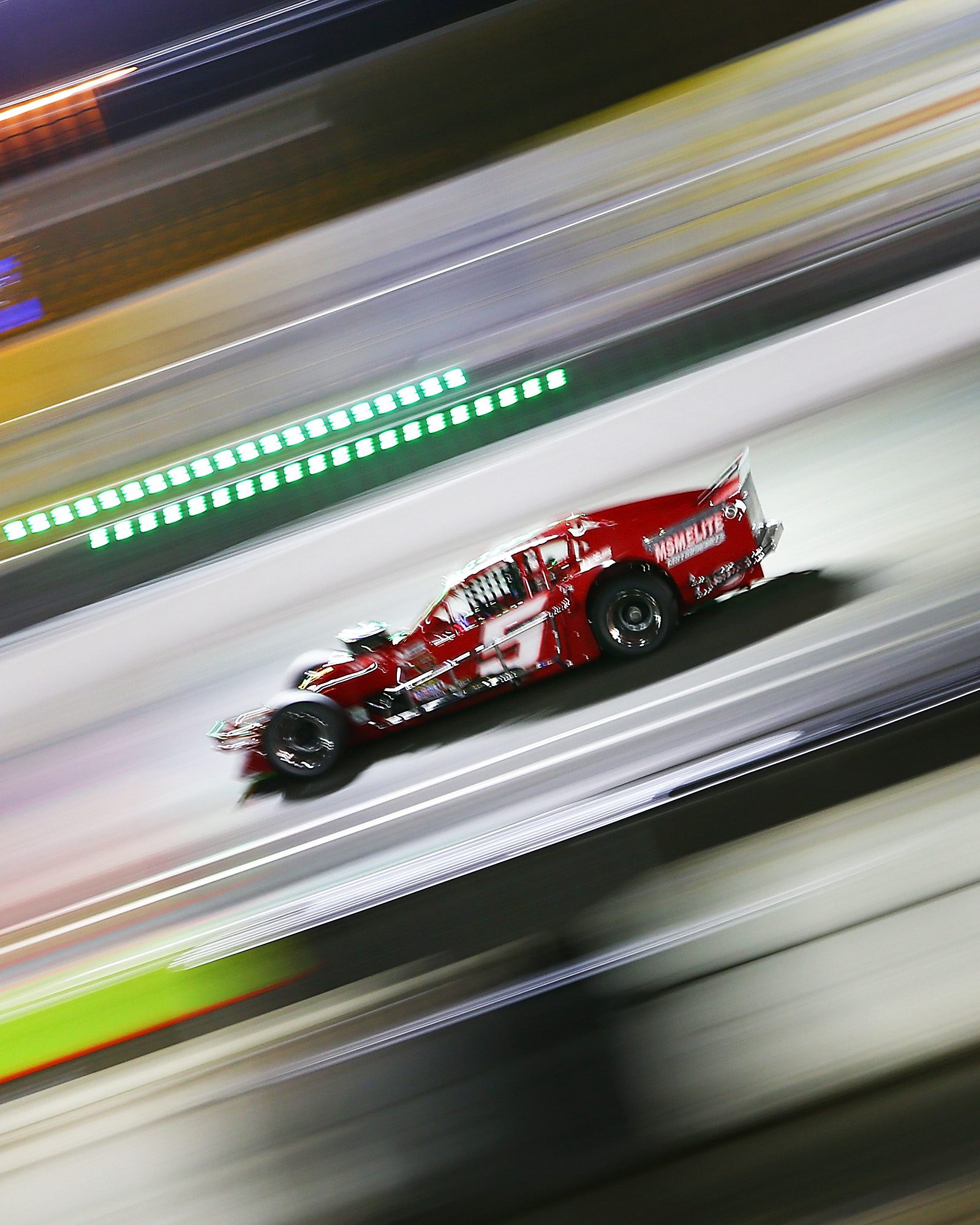
Not far from the spread of chicken, sandwiches, hot dogs, brownies and more, Beatty's car sat behind its hauler, red and gleaming and beautiful. Someone told me the man who waxes it, Greg Gerber, spends five hours doing so. Gerber told me that's an exaggeration, unless there are crewmen yap-yap-yapping when he's trying to work, then maybe.
Beatty, a Long Island police officer, is calculating and precise and sarcastic and driven, always, to be better. His pre-race routine is to walk the garage and watch as teams thrash on their cars. It cracks him up. Riverhead is the same today as it was last week as it was last season. What is there to do on race day, he can't help but wonder, that couldn't have been done a day, a week, a month ago?
"The only thing different might be the person who works in the beer stand," Beatty said.
And so the gleaming No. 5 sat there relatively untouched. Beatty, 49, was in a tight battle for his third straight championship.
As Greg Smith — whom Mina describes as a fabricator who can build anything — said, "races are won in the shop, not at the track."
Much of that work was done by Beatty. Out of a shop at his home, he nuts and bolts the car to exacting specifications. "You could swear on your mother's life that you did it right," starts Greg Immerman, a mechanic, and Mina finishes the thought: "But John is going to check it, and if it's a thousandth of a millimeter off, he'll find it."
Beatty's devotion to the car informs how he races. He's the rare driver who compresses his aggressiveness into wisdom. "Everything is immaculate. It's cared for," Beatty says. "And I'll be damned if I go out there and I try to do something stupid and jeopardize myself, my equipment, and put my team in that spot."
As race time approached, Mina waited near the car as everyone else went to watch. He likes his face to be the last one Beatty sees before he drives to the track. "I call it stupid-stition," Mina says.
Beatty started sixth and and jumped to fourth on the first lap before a caution stalled the event.
Said spotter Dennis Freeze: "What you got, pal?"
Beatty: "I think we'll be OK. This car is like an old lady. It takes a while to warm her up."
Freeze: "You know just what to do with her."
He jumped from fourth to second after the restart and had a shot at a pass for the lead, but the caution came out again. There was little to no bottom groove, and he didn't want to risk going down there for an ill-fated attempt at pass for the lead. Instead, he followed the leader for the rest of the race and finished second.
That's the kind of race that breeds short-term frustration and long-term championships. Points racing like that annoys Beatty even if he knows it's the right way.
He calls racing "the drug they can't test for."
"It keeps you alive," he says. "You suffer for six days to put everything you got into one single day. That day might get rained out. You never know what's going to happen. It could be the best day. You could win. It might be the worst day of the week. What keeps you passionate is you always want to do better."
***
The eight buses in the demolition derby were driven by Bam Bam, the Redneck Renegade, Frank the Tank, Dirty Mike, The Polish Viking, and others. Four started on the front stretch, four started on the back, and all of them lined up perpendicular to the track with their noses facing the wall. Most of the action took place in the track's paved infield.
The rules, if they may be called that, are:
- You hit people in reverse, because if you hit them with your nose, you will knock the fuel pump out of it.
- You hit people on the passenger side.
- The derby lasts until only one bus can drive ... or 20 minutes.
Ryan "Z-Man" Zukowski is a 10-year veteran of Riverhead's school bus demolition derby. He entered his first derby at 14 at the urging of his father, and he won. Wearing an impish light grin and scruffy dark beard, Z-man described his strategy: "Drive around, run into each other."
He's either the craziest, the nimblest, his bus had the sharpest turn radius, or all three, as he was the clear artistic winner (if there was such a thing) … until Frank the Tank's bus tipped over onto the passenger side, the first such capsize in many years.
Z-man jumped out of his No. 69 bus and ran to The Tank's bus, climbed through the emergency hatch on the roof and found The Tank held aloft by his death-grip of his steering wheel and the soft embrace of his seatbelt. The track crew wanted to cut the seatbelt to free The Tank. "NO!" Tank said, "Just unlatch it! I will need the seat belt for the next derby!"
So Z-man lifted Tank up so he could unlatch the belt.
Soon Tank emerged from his bus, and the crowd reacted with a cheer befitting the fact he is a fan favorite. They just left his bus sitting on its side. The drivers had to weave their way around it like warriors sidestepping a slain metal dragon. When it was put back on its wheels afterward, it appeared to drive better and definitely looked better than the rest of the buses.
Meanwhile, Paul's The Polish Viking Ship lumbered even when he floored it. ("Can you soup it up a little bit?" Melissa asked later). Slow though he was, he received and administered numerous hits. He took one lick that made Melissa, who was wearing a Viking helmet in the stands, cringe as his body lurched forward and back.
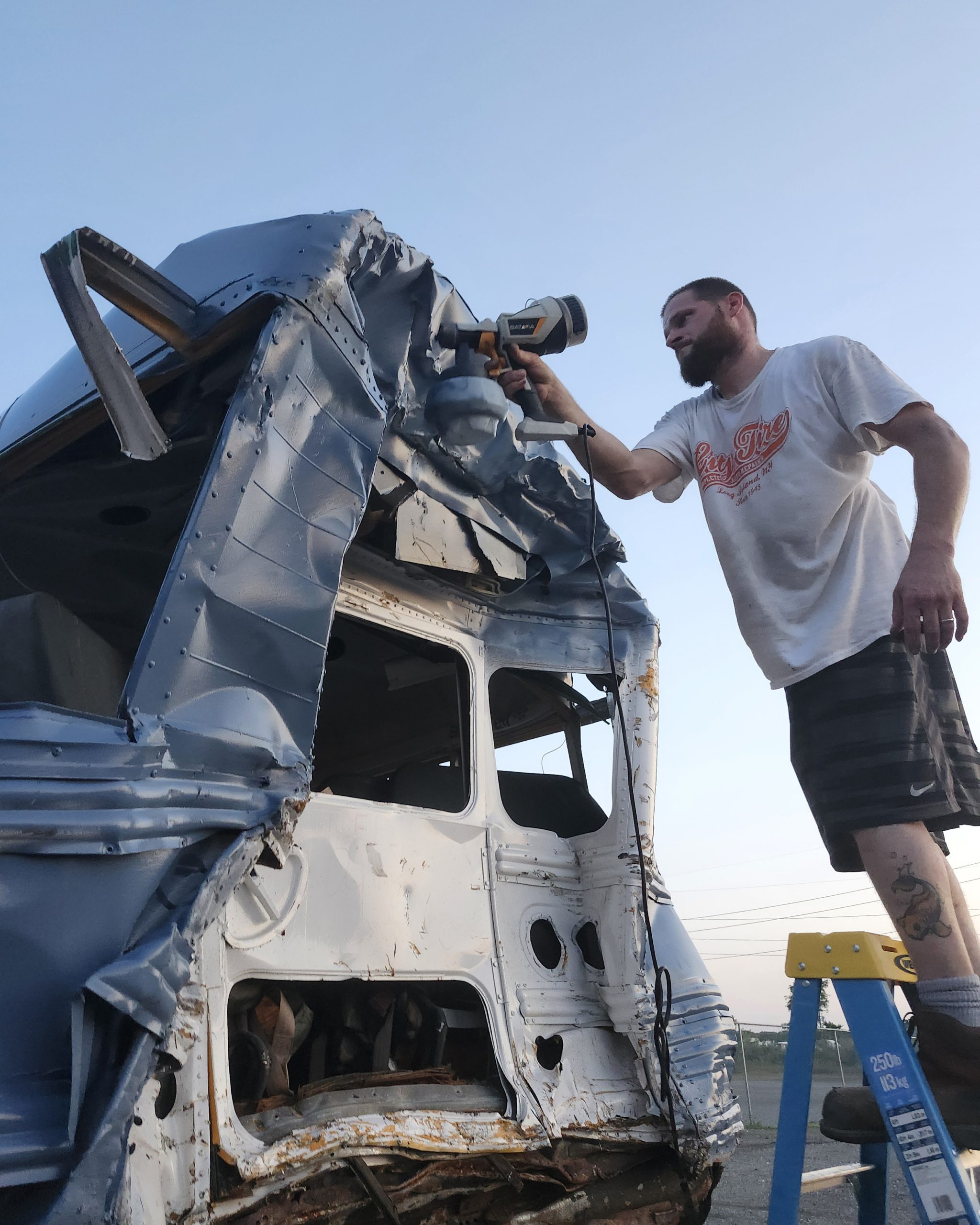
The Polish Viking Ship stopped running after about 15 minutes, which meant Paul finished in I-have-no-idea-and-nobody-cares place. As he walked off the track, helmet in hand, the carnage of eight buses behind him, his smile creased his face and his eyes danced. "I can't wait do to the next one," he said.
A derby veteran warned him that he'd either leave or wake up with a sore neck. The only thing that hurt was his leg, which got bashed by something under his seat.
The Polish Viking Ship suffered much more. The track crew got it fired up again to get it off the track, and it limped to the back lot like a wounded soldier longing for Valhalla.
Six of the eight hand-made cardboard shields with stenciled sponsor names were still zip-tied to the window frames, and the viking helmet ratchet-strapped to the emergency exit on the roof was still there. But other than that, The Polish Viking Ship was a mess.
The floor was buckled near the top stair, and the roof was crinkled a third of the way down from the driver. The back was caved in several feet, and just in front of the back wheel, the passenger side had an enormous dent shaped exactly like the back of a bus. I'm guessing that was from Z-man, because only he moved fast enough to create a dent that big.
The Polish Viking Ship's frame or body or both were bent and rubbing against the tires. It looked like it was no longer seaworthy.
It'd be a shame if it lasted only one event.
Then again, painting another one would be a blast.