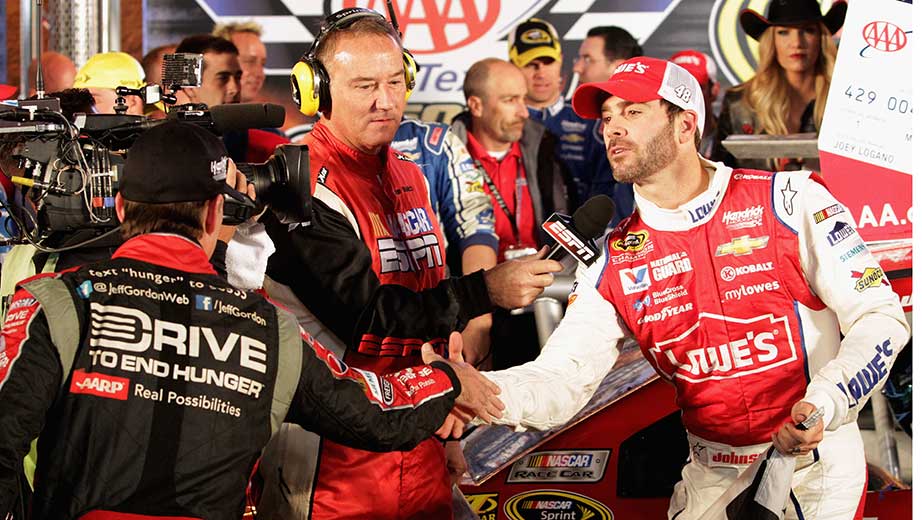
No. 48 driver tells story of how instrumental Gordon was in his early career
Play: NASCAR Fantasy Live | Vote: Ultimate Daytona Challenge
DAYTONA BEACH, Fla. — As Jimmie Johnson continues his pursuit of a seventh NASCAR Sprint Cup Series title, teammate Jeff Gordon renews his own pursuit for a fifth championship.
The biggest difference, outside the career totals, is that Johnson, at 39, has time on his side.
Gordon, at 43, does not. But not because of his age, as his highly competitive 2014 effort proved. While his career could be extended by several years, Gordon announced last month that that would not be the case. The 2015 season will be his last.
MORE: Full coverage of Gordon’s final full-time season

“I look at my own arc in life and in motorsports,” Johnson said Thursday during the annual NASCAR Media Day at Daytona International Speedway, “and the fact that he gave me my chance, created a team for me to go racing, and then what has happened from there.
“You won’t see another competitor out there singing his praises, I think, like me.”
Before Hendrick Motorsports team owner Rick Hendrick offered Gordon a piece of a new Sprint Cup team that would debut in 2001, there was no No. 48 team at HMS. Johnson, a former off-road racer, was a level below Sprint Cup, looking for a break.
Gordon, already a three-time champion, was a fellow racer from the west coast, one of the first to successfully make the crossover from open wheel sprints to the heavier stock cars. He might not have known who Johnson was, but Johnson surely knew of Gordon’s exploits.
“I doubt he’ll remember and we never had a chance to formally meet,” Johnson said, but at test sessions, I guess in ’99 and even in 2000 when he was running some (XFINITY) stuff … every now and then the 24 car would be there and I would always try to linger by his pit and try to introduce myself to him, and it never worked out.”
Eventually, Johnson said he took matter into his own hands. His team at the time, owned by William Herzog, was exiting the series and he needed career advice.
RELATED: Johnson reflects on Chase format a year later
At Michigan in the summer of 2000, he got more than that.
“The only opportunities I had involved switching manufacturers … and I knew Jeff left Bill Davis and Ford and went to Rick Hendrick and Chevy and I thought he had like the magic answer, so I introduced myself at the drivers’ meeting, asked him for a few minutes of time,” Johnson said. “He brought me back to the transporter, we talked briefly before the start of the race, and after I told him my situation, he gave me some advice, and then said, ‘you’re not going to believe this, but we’re talking about starting a fourth team, and your name is the only name that’s been brought up.’
“So just in a 30‑minute window of time, what all went on, starting out trying to work up the nerve to introduce myself to him, looking for some advice, and then practically leaving with the job was just insane. It was the wildest 30 minutes of my life.”
But it’s not only the impact on his own career, Johnson said, that stands out. Gordon opened the door for NASCAR on a number of levels on and off the race track.
RELATED: Find out how Kahne learned of Gordon’s decision
“I think now since we know it’s his final year, we’re all looking back and having some ‘aha’ moments,” Johnson said.
“He really was instrumental, in my opinion, in helping car owners and sponsors realize that there are drivers far and wide that can come in and be competitive, and he opened the door for (Tony) Stewart, and Stewart opened the door further for myself and Kasey Kahne, Ricky Stenhouse. Now we have more drivers from the state of California than any other state; it’s wild to think in NASCAR that that’s the case, and I think Jeff is responsible for that trend happening.
“You look at when Jeff and Dale Earnhardt and their competitive nature in our sport, kind of falling into mainstream media at that point — we needed a clean‑cut, well‑spoken person to kind of carry the sport. Jeff was that guy. His dominance helped our sport.”