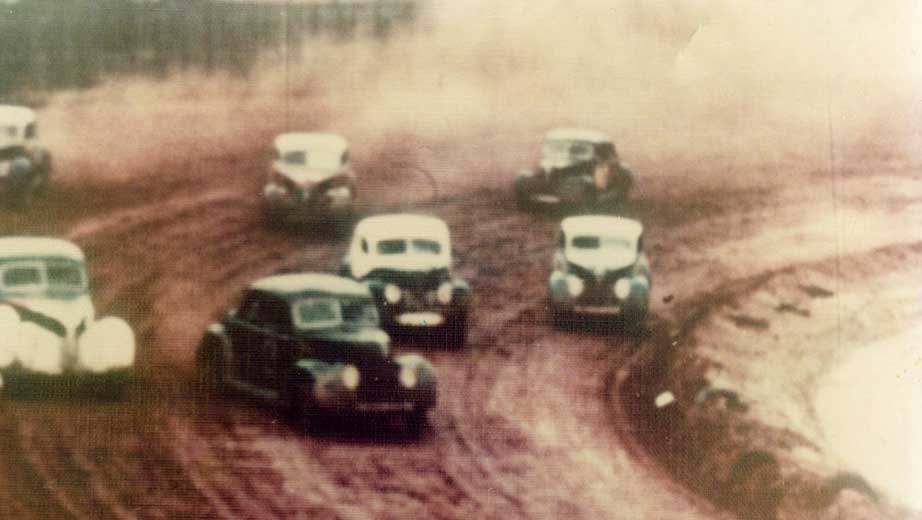
Storied paperclip oval was one of original tracks on NASCAR circuit
Vote: Who will win at Martinsville? | Play: NASCAR Fantasy Live
NASCAR’s Sprint Cup Series heads to Martinsville (Va.) Speedway this weekend, one of two annual treks to the legendary half-mile that have taken place for more than 65 years.
Before Charlotte, Bristol, Texas or Talladega. Before Daytona or Darlington even, there was Martinsville.
They were racing at Martinsville before NASCAR grew from an idea into reality.

“Stock car racing makes its debut at the new Martinsville Speedway next Sunday afternoon when more than 35 of the nation’s leading drivers risk their necks and cars for over $2,000 in prize money. … The new track boasts the largest grandstand of any speedway in the South, a huge affair which will seat 10,000 spectators. The total capacity of the speedway is 20,000 people. Built at a cost of $85,000, the Martinsville Speedway is regarded as one of the finest half-mile dirt tracks in the United States.”
The item appeared in one of the region’s daily newspapers. The date was Monday, Sept. 1, 1947. NASCAR was officially incorporated in February 1948.
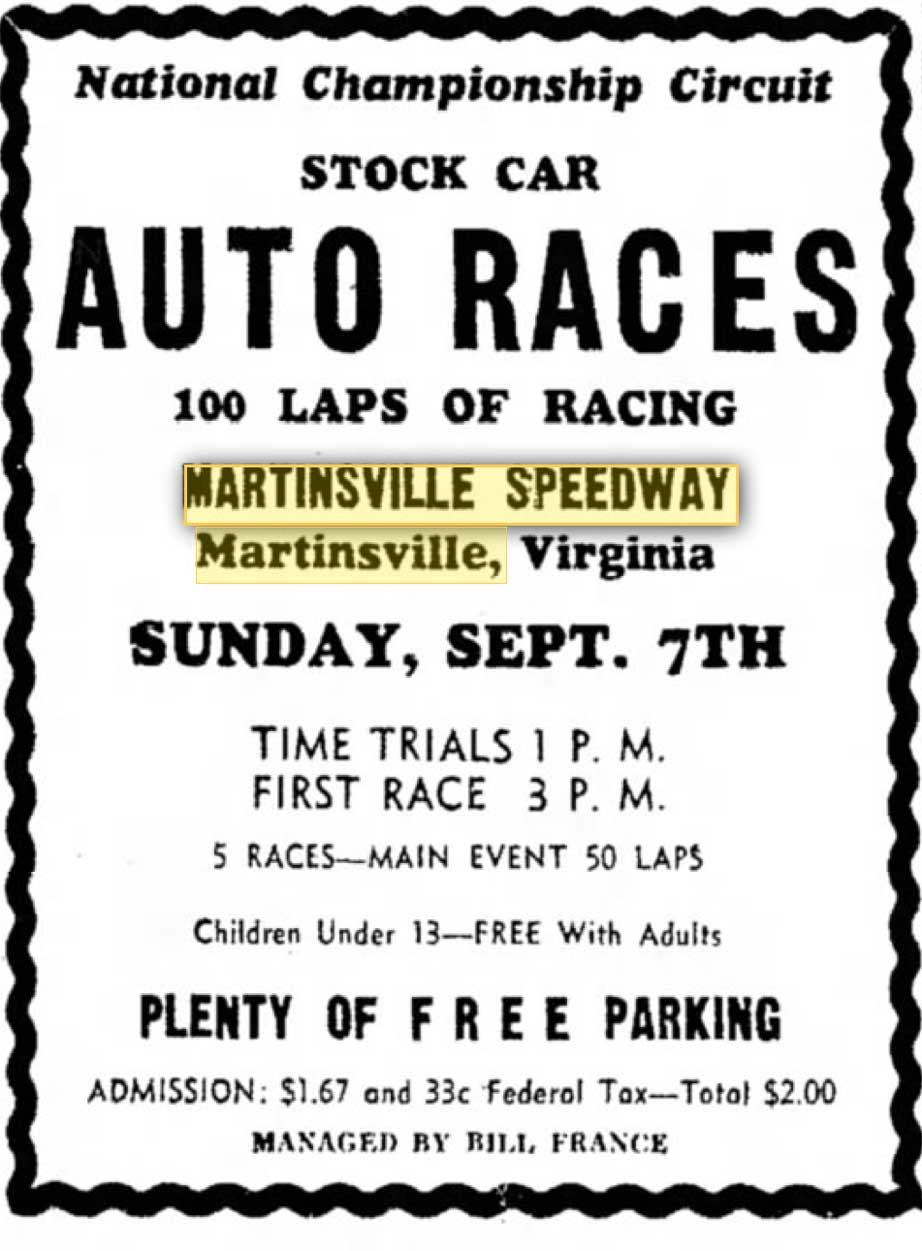
Built by local businessman H. Clay Earles, Martinsville hosted one of the eight original stops on the NASCAR Strictly Stock schedule in 1949. Before that, drivers who would become some of stock car racing’s earliest stars could be found hustling their way around the paperclip-shaped track. Red Byron, winner of the inaugural ’49 race, won the track’s first official event two years earlier, a 50-lap affair for Modified stock cars. Fonty Flock won there in ’48 just as NASCAR was getting started.
One by one, the other tracks on the schedule that first season eventually fell by the wayside – Charlotte Speedway, Daytona’s beach and road course, Occoneechee Speedway in Hillsboro, North Carolina, Langhorne and Heidelberg (Pennsylvania), Hamburg (N.Y.) Speedway. Even North Wilkesboro, a staple from the start, eventually faded into the background when NASCAR departed after the ‘96 season.
Martinsville, however, remains.
“It means we, and by that I mean going back to when the place was built by my grandfather all the way through until now, are doing something right,” said Clay Campbell, grandson of the track’s founder and president of the facility since 1988.
“A lot of guys that started close to the same time, obviously they aren’t around now. I think my grandfather had the vision to keep investing in the facility and doing things that were necessary not only from a fan standpoint but from a competitor’s standpoint and everything that he did, I think we’re pretty much following the same philosophy.”
• • •
“It was dirt to begin with,” Richard Petty said, easing back in the recliner inside his motorhome. “I never ran on it when it was dirt. My daddy did and he won some races.”
Outside, cars are circling Phoenix International Raceway, site of the recently completed CampingWorld.com 500 NASCAR Sprint Cup Series races. PIR is roughly 2,000 miles from Martinsville, and Petty, now 77, is nearly as removed from his days as a championship driver.
One of the five inaugural members of NASCAR’s Hall of Fame, Petty is the sport’s all-time leader in premier series wins with 200 and is one of only two drivers to win seven championships.
He’s also a valuable link to NASCAR’s past. And Martinsville, much like the Petty family, is an unbroken piece of ribbon that has run through the sport from its earliest days.
Petty’s father, Lee, was NASCAR’s first three-time champion. A Hall of Fame member as well, Lee Petty won 54 times. Three of those victories came at Martinsville – two when it was dirt and a third after the track was paved.
“When they asphalted it (in ’55), it was completely different,” Richard Petty said. “When they re-did the track, they cleaned up the infield. When (NASCAR) ran there and it was dirt, there were bushes in the infield, a little creek running down through there. All that was there was the track.
“Once they asphalted it, they didn’t just do the track, they cleaned up everything else. It was like a brand new track. It was shaped the same, but everything else was different.”
The creek is still there today, running underneath the track and working its way from one end of the speedway to the other.
Petty won 15 times at Martinsville, a record matched only by his success at North Wilkesboro.
It’s no surprise that Martinsville remains a staple on the schedule after all these years. “Not really,” he said. “It’s just so different from any other track we run.”
At 0.526 mile, it’s the shortest of the short tracks and unlike other venues, there’s only the slightest banking in the turns. Turn 43 cars loose all at one and it isn’t just close-quarters racing — it’s the closest-quarters racing fans are likely to see all season long.
“Back when we had drum brakes, the deal was being able to run 500 laps and have brakes when the race was over,” Petty said. “Probably wasn’t but two or three cars that had brakes that could stop the thing when it was over with.
“It was just a good track for the way I drove and the way (crew chief) Dale Inman set up cars; we just had a good combination for that race track. We understood the track.”
From 1967-73, Petty won 10 times at Martinsville, including five straight starts between ’68-71.
“We spent more time working on the brakes that week than we did on getting (the car) to handle or run fast,” Petty said. “From our strategy standpoint … a lot of times we didn’t race that hard. We saved our brakes, stayed in the race. But as far as going out and trying to lead all the laps and everything, that wasn’t our deal. It was more of a survival track. Over a period of time they got the brakes better and it got to where you had to race all the time.”
• • •
The lone block concession stand in the infield is one of the few reminders of Martinsville’s past.
“The last piece of history,” Campbell said. “It goes back as far as the ‘60s, probably longer than that.”
Other structures have been upgraded or replaced through the years. The sport has changed, and those that follow it have as well.
Keeping up with the fast-paced sport, and everything it entails “is difficult,” Campbell said, “but therein lies the fun part of the business and the challenge of it.
“It’s no different than the competitors – they have to keep changing to newer things and keep up with the pace; and the same thing for the facilities. Fortunately now with us being a part of ISC and a bigger global picture we’re more in touch with things that we need from a social media standpoint, Wi-Fi and on and on and on. Things we now have and things we’re exploring for the future.”
International Speedway Corp. owns 12 of the 23 tracks hosting NASCAR Sprint Cup Series events in 2015. The company purchased the speedway in 2004.
Nearly 170 tracks have hosted one or more NASCAR premier series races since that inaugural 1949 season, from Airborne to Wine Creek, Auto Club to Watkins Glen. Most are now gone.
Martinsville, one of the very first, is still there.
“We’re very fortunate that we had the things we needed and on are par with most of the others so we can keep on moving right along,” Campbell said. “Things like the garage, access roads coming in, the (Turn 4) tunnel, the suites, and things of that nature.
“Luckily, as time went on with my grandfather, he didn’t sit still and that was a good thing. Because had he done that we’d be playing catch-up, and now’s not the time to be playing catch-up.”
MORE:
|
|
PLAY: Sign up
|
WATCH: Latest
|
FOLLOW LIVE: Get
|
|---|
NASCAR news


