Editor’s note: This story originally ran in April of 2015. We’re bringing it back in its full original form to commemorate Johnson, who died Dec. 20 at age 88.
—
“James Dean in that Mercury ’49
Junior Johnson runnin’ thru the woods of Caroline
Even Burt Reynolds in that black Trans-Am
All gonna meet down at the Cadillac Ranch.”
— Cadillac Ranch, Bruce Springsteen
– – –
The hair is white (is there anyone still around that can remember when it wasn’t?) and it stands out in contrast against the sedan’s black interior and tinted windows.
Outside, young girls with gym bags slung over slender shoulders hurry past on the sidewalk with their parents in tow, headed to a weekend volleyball tournament, scarcely noticing, or perhaps not noticing at all, the gentleman in the passenger seat.
Fifty years ago, he was aptly described as the Last American Hero by author Tom Wolfe.
Today, at 83, Junior Johnson is a father and a husband and a successful businessman.
Dressed in tan slacks and a dark pullover, Johnson might be a passenger in the sedan, but he’s still in the driver’s seat of life.
He’s here, parked along a side street in uptown Charlotte on a sunny Sunday morning, and there, inside the glass and steel structure next door known as the NASCAR Hall of Fame.
One of the five inaugural members of the Hall back in 2010, Johnson is a stock car racing legend.
And legends can be in two places at once.
It’s a drive Johnson has made hundreds of times, one that runs through Winston-Salem, home of former series sponsor R.J. Reynolds, then shoots its way through the Walkertown community on the northeast side of the city before settling into the lazy up-and-down, chug-a-lug of a ride east toward Stokesdale.
U.S. 220, that four-lane stretch of highway that splits a sizeable south-central stretch of the Commonwealth of Virginia, lies just beyond. And to the north sits Martinsville, home to the oldest track still hosting NASCAR Cup Series races.
Johnson knows many of the roads, the highways and the less familiar tributaries that seem to trail off into nothingness. He knows them as well as he knows his own name.
“They’ll be ’bout ready to crank ’em up when we get there,” Johnson says as the sedan eases off the curb, away from the tall buildings and into the bright Carolina sunshine.

He was only 35 and very much still in his prime when he decided he’d had enough, putting away that white open-faced helmet for the final time. He’d made just seven official starts that final season in ’66, ending with one last top-five at Rockingham, North Carolina in the fall.
“I wasn’t getting anything out of it,” Johnson says of walking away from a successful NASCAR driving career. “If my car didn’t tear up, there wasn’t anyone that could outrun me.”
By then he’d already won 50 times, as many as two-time champion Ned Jarrett and only slightly fewer than Lee Petty, who held what was then a NASCAR-record 54 career victories.
RELATED: Junior Johnson through the years | Johnson passes away in 2019
The NASCAR schedule in those days went on practically non-stop, a nearly eight-year stretch of 50 or more races each season and teams competing as often as three times a week.
Few ran the entire circuit, and Johnson’s name wasn’t on the list of those that did.
He had other things occupying his time and requiring his considerable driving talent. And there was that stretch in ’57 spent at the federal penitentiary in Chillicothe, Ohio, the result of a conviction for manufacturing moonshine.
Yeah, he ran from the law and yeah, he honed his driving skills hauling bootleg whiskey, first for his daddy and later for himself and others. But the seeds of Johnson’s driving abilities were planted long before he’d begun loading up case after case of the clear corn liquor and set off across the state.
“Well, I know I had … five or 10 years driving experience on them other boys,” he says now of his fellow racers.
“When I was about 10-12 years old, I could drive the (expletive) out of a car. ‘Cause my daddy would let me run these little ’39 Fords and stuff like that; he had up-to-date cars too where he’d haul liquor. I’d run from the house down about a mile to the highway; it was a dirt road, and I’d run it all day long.
“He wouldn’t say a thing to me. I’d just get in it, go down through there sideways and everything.”
Years later, talents cultivated in dirt outside his house and the switchback mountain roads across which he made numerous whiskey runs transferred seamlessly onto the race track.
NASCAR drivers of the day fell into two groups — those that went hell-bound for the front from the very start, and those who chose to pace themselves and their equipment, electing to try and outlast if not outrun their opponents.
Anyone that saw Johnson behind the wheel knew what to expect.
“Junior was wide open every lap,” Richard Petty, Lee’s son and NASCAR’s first seven-time champion, says. “It was one of those deals where if he brought the steering wheel back, he’d had a good day.
“He was one of those that when he drove there was no strategy except just to pass everybody in front of you. It didn’t make any difference if they were on the same lap, leading the race or 40 laps behind. He did everything he could to get by you.”
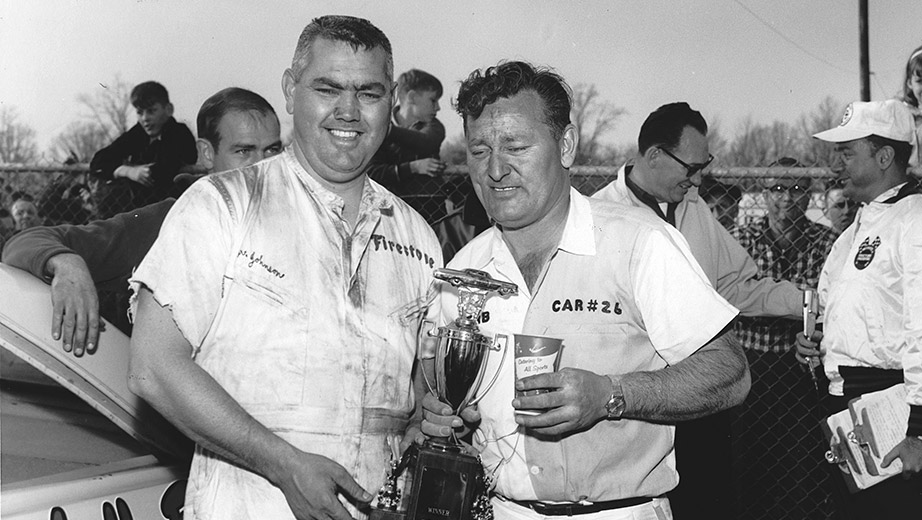
The end of a driving career didn’t mean the end of NASCAR for Johnson. Instead, he turned his attention to ownership, and by the time that had run its course, Johnson walked away as one of the most successful owners the sport had ever seen, with six championships, 132 victories and top 10s in more than half of his teams’ 1,000-plus starts.
Johnson hadn’t just built a team, he’d built a dynasty.
NASCAR Hall of Fame drivers Cale Yarborough, Darrell Waltrip and Bill Elliott were among those that drove for the Wilkes County based team.
“Up in Owensboro, when I was a little guy, I used to listen to the races on my transistor radio when I could get them,” Waltrip says. “There was always this guy named Junior Johnson from Ronda, North Carolina, driving a white ’63 Chevy, No. 3 with a 427 mystery engine in it.
“And I thought, ‘what a cool guy.’ I mean how much cooler can you be? A guy that drives a Chevy, which was kind of unique at the time, he had a 427 mystery engine. He was a moonshiner. He’d been in prison and here he is out here outrunning all of these guys.
“All the drivers in that era, whether it was LeeRoy Yarbrough, Cale (Yarborough) or any number of guys that drove his cars, they were legends in the sport. To think I had the opportunity to follow in their footsteps and drive for the great Junior Johnson, it was a thrill of a lifetime.”

The sedan eases off I-85, slipping unnoticed onto U.S. Route 52 north. Welcome, North Carolina, home of the Richard Childress Winery and RCR’s NASCAR headquarters are nearby.
Who was his best driver? Maybe that depends on whom you ask, or when you ask it.
Told that Waltrip has said Junior claimed he was his top driver (“He might hedge a little bit when it comes to Cale because he doesn’t want to hurt Cale’s feelings,” Waltrip explained), Johnson chuckles.
Maybe it was DW. Maybe it was Cale. Maybe Johnson didn’t want to hurt the feelings of either one.
“The one … I think was the best driver that ever drove a race car was LeeRoy (Yarbrough),” Johnson says. “Buddy, I tell you we could put it on anybody.”
Yarbrough won 10 times for Johnson, Cale 45 and Waltrip 43. There were others as well. Labonte, Bonnett, Spencer …
“He could put it on Cale or Darrell or any of ’em, just the most natural driver I ever seen,” Johnson says of Yarbrough. “If he needed to step it up, he could always step it up just a little bit more than they did.”
They were of different ages, different skill sets. But they all had one thing in common — all enjoyed some measure of success driving Johnson’s cars.
“You’ve got to remember, he won 50 races as a driver himself,” Waltrip says of Johnson. “He knew what he was doing as a driver. He understood drivers. When I first started driving for him, if I wasn’t getting the job done, if I wasn’t running as hard as he thought I should, he’d call me Cale on the radio and it would always make me mad. And that was always worth three-tenths (of a second) and he knew it.
“I knew when I got with Junior Johnson that it was a career changer.”
North now on U.S. 220, the Virginia state line is just ahead and a quick side-trip is necessary.
The building is nondescript, just another business set back off the highway. If anything stands out, it’s that nothing stands out.
Through the years, Johnson’s name has been attached to a variety of items — hams and ham products, for instance — but the best known by far is the one that landed him in the federal pen all those years ago.
This is Piedmont Distillers, makers of Midnight Moon, a brand of legal moonshine (meaning it’s taxed by the government).
“He comes up about once a week,” says Joe Michalek, founder of the Madison, North Carolina-based company. “He’ll come up and have lunch, see how business is doing, hang out with the folks. It’s a real treat and an honor to have Junior around.”
Piedmont currently produces eight different flavors of the whiskey. One of the first to jump into the market, Piedmont launched in 2005 and quickly outgrew its original base of operations. In ’07, a deal was struck for the Midnight Moon brand and today the product is sold in all 50 states.
“It’s cleaned up a lot, but the recipe is exactly like my daddy’s,” Johnson says. “He’s the only one I ever knew that made corn whiskey. Everybody else made sugar whiskey. … Over time sugar will turn and get muddy. But corn won’t do that. It stays just like you fixed it.
“When we got into it, there wasn’t nobody on the corn side of it, and still ain’t much. They advertise a lot of stuff that ain’t what they say it is.”
Johnson, part-owner in the Piedmont operation, often makes promotional appearances for the company — he was in St. Louis and Branson, Missouri, earlier this year; more recently, he showed up at a local charity golf tournament in Charlotte.
“Running somewhere all the time,” he says as we head out the door and resume the trip to Martinsville.
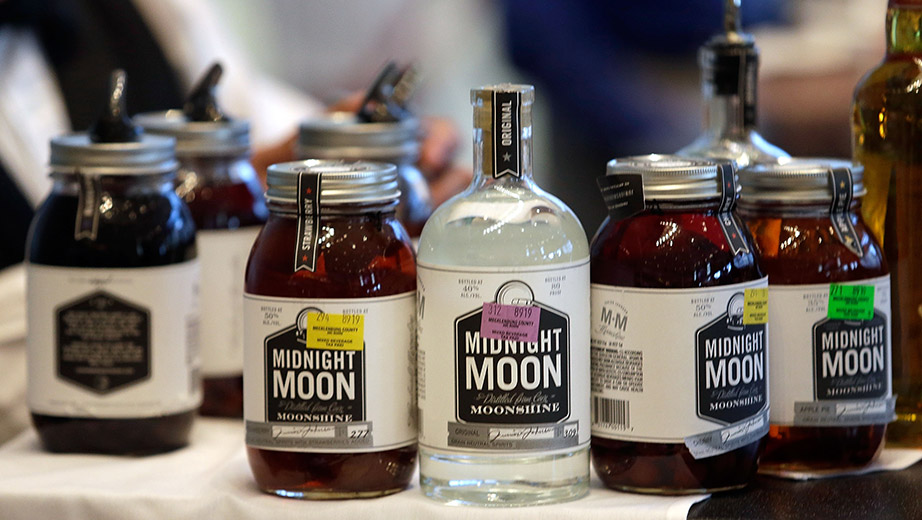
Why Midnight Moon? Some smart marketing company’s idea?
No, the name is as original as the man himself.
“That’s when I’d get out and haul the liquor,” Johnson said of his bootlegging days. “I’d haul from about 11 o’clock until daylight. Midnight moon was what I’d run by.
“Used to, a lot of times at night you didn’t even have to have car lights. It was just like daylight the moon was so bright. Fog and smog and all that stuff got it now to where you have to turn your lights on at 6 o’clock.
“I’ve hauled a lot of liquor from where I lived to Lexington, Salisbury, Spencer and all in there. Sometimes I wouldn’t even turn on the dad-gum headlights. You could see the highway without them. That’s where midnight moon came from. I basically waited until midnight to haul my whiskey.”
The traffic is backed up for miles, and the delay means Johnson won’t make it to the speedway in time for the drivers’ meeting. No problem, he sat through enough of them in his day.
Fingers point and heads turn as Johnson is ferried from outside the tiny track into the crowded infield. Fans with hot passes want his autograph and those with cameras want their picture with the Hall of Famer. Johnson smiles and nods, pausing long enough to accommodate each of the requests.

“I’m getting tips,” says team owner Rick Hendrick. “We started running better when he moved in next door.”
Johnson smiles. Hendrick, owner of a four-team operation, has become a close friend, a confidant. When Junior cut his ties with Wilkes County, he landed next door to Hendrick in the affluent Quail Hollow community in Charlotte.
“We tell him about all the things we’re trying, and they’re things he’s already done 20 years ago,” Hendrick says.
Occasionally, Johnson can be found with Hendrick at the track; other times he may be visiting the vast Hendrick Motorsports complex, where the teams of Jimmie Johnson, Jeff Gordon, Dale Earnhardt Jr. and Kasey Kahne are housed.
Today, Johnson is in the media center, and Hendrick has stopped by to say hello to his friend.
“It’s been really amazing how our guys, from the ones that travel to those in the engine shop and other areas that get to talk to him about different things, about what they think about doing,” Hendrick says. “It really means a lot to our guys for him to be on the (pit) box and be around us; he’s such a legend. I never thought we’d be friends and neighbors; it’s turned out to be really cool.
“The thing that blows me away is how innovative he was back when no manufacturer, nobody else was doing things, he was thinking so far out of the box. I’m glad I didn’t race against him back then. I’m glad he retired.”
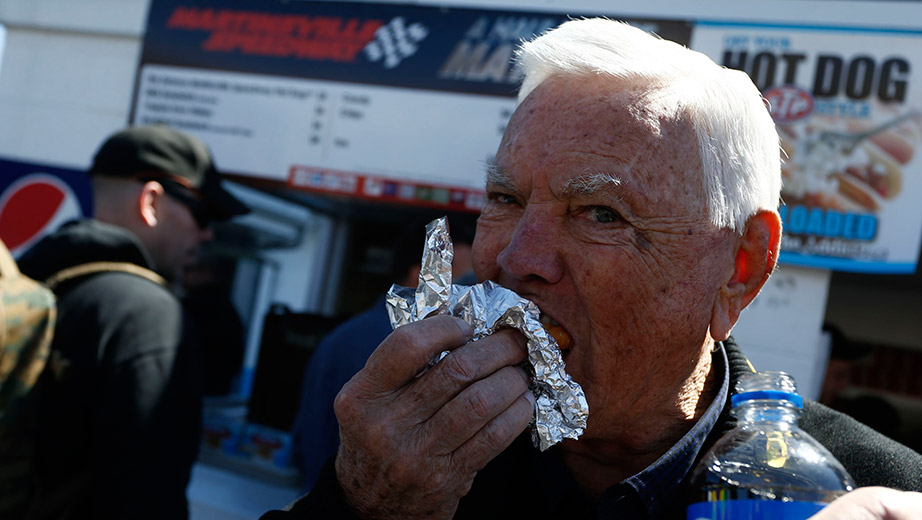
With the pre-race festivities getting underway, Johnson’s ready to head upstairs to watch the start of the race from one of the suites that overlook the track.
But not before a stop at the infield concession stand.
“I used to eat about six of these things,” Johnson says, munching on a one of the track’s famous hot dogs.
Fans notice, crewmen smile and wave. Others, embarrassed but not enough to interrupt a man and his meal, ask if he has time for a picture. With hot dog in hand, Johnson once again accommodates the requests.

The black sedan glides out of the track and onto U.S. 220, southbound now and headed back toward Charlotte.
Johnson won at Martinsville twice as a driver, and several more times as an owner. But with no dog in the fight today, he’s ready to move on down the road.
Five decades. It’s been five decades since Wolfe pulled into the “lil’ ol’ beer joint” as Johnson calls it, looking for a story and discovering an icon.
“I had been to the race track testing or something, might have been getting ready for the race,” Johnson said as the tires sing on the concrete of the highway and the countryside passes outside the tinted windows. “He walks in and it’s about 90 degrees and he’s got a damn wool suit on. A brand-new wool suit. And I think to myself when I saw him get out, I said, ‘That’s a crazy son of a bitch. He don’t know the sun’s shining.’ “
It’s one of those “you had to be there” moments, Johnson recalling with clarity the arrival of the young city-slicker author come to find the bootleggin’ racing star in the backwoods of the Carolinas.
To hear Johnson tell it:
“He come in and said ‘I’m looking for Junior Johnson.’
“And I said ‘What do you want with him?’
“He said ‘I want to talk to him about a story.’
“I was eating a cheese cracker and drinking a drink; I took a couple more bites of that cheese cracker and I said ‘Where you from?’
“He said, ‘Why? Do I have an accent?’
“I said “I can’t hardly understand you.’
“I told him, I said, ‘I guess you’re talking to Junior Johnson.’
“He said, ‘Well I want to write a story on you and I’d like to talk to you.’
“I said ‘If you want to write a story, you better get it from somebody else, ’cause I ain’t gonna give it to you. ‘Cause you’d think I was bragging.’
“He never did ask me anything. He went and got his own deal.”
Wolfe was in and out of Wilkes County and the surrounding North Carolina hill country numerous times after that initial meeting. He traveled to locales a bit further out, trying to grasp the enormity of a sport and a man so many folks outside the southeast knew so very little about.
“He’d come in and stay four or five days and nights and leave, and folks would say, ‘Well, that son of a bitch is gone,’ ” Johnson says. “Then he’d show up again somewhere or another; somebody’d call and tell me he’d been talking to them. He got out there and got his information.”
“Junior Johnson is the Last American Hero. Yes!” appeared in the March 1965 edition of Esquire magazine. It is still considered by many to be one of the finest pieces of sports journalism ever written.
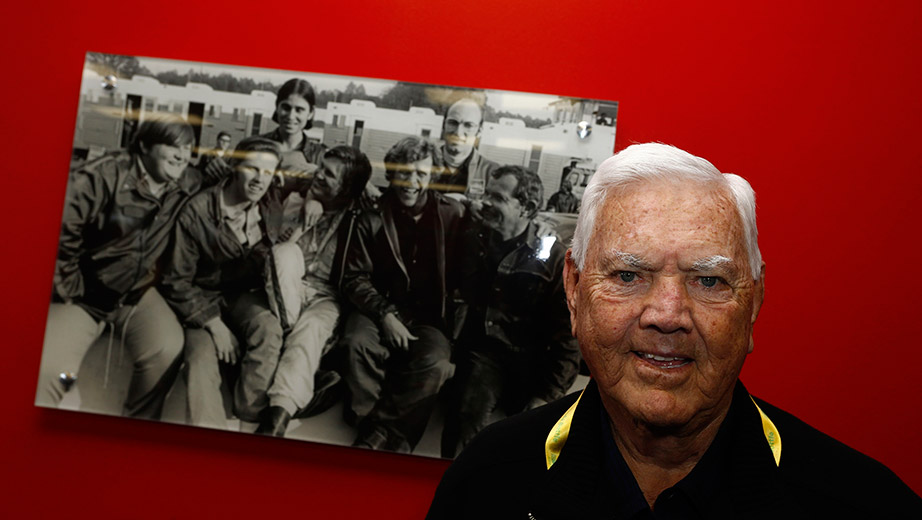
NASCAR has changed tremendously since Wolfe penned his piece on Johnson and the burgeoning southern sport. It expanded, exploded, gained national attention, sponsorship from Fortune 500 companies and lucrative TV contracts.
Johnson divorced, remarried, had kids and moved from the country to the city. He walked away from racing, selling off his team in 1995, but maybe he never really cleansed it entirely from his system.
Deep down, they both remain the same. NASCAR’s still about fast cars and brave drivers, pushing the limits, and by the end of the day we’ll just see who’s best.
Johnson, full of confidence when Wolfe found him inside that country store, is just as sure of himself today.
But for now he’s just a passenger in a black sedan headed back down the highway.
“You want to listen to the rest of the race?” Johnson asks, reaching for the radio dial.
Moments later, the voice of the turn announcer is ratcheting up as another caution has slowed the action on the track.
Outside, the sedan’s tires continue to hum and the world slides by.