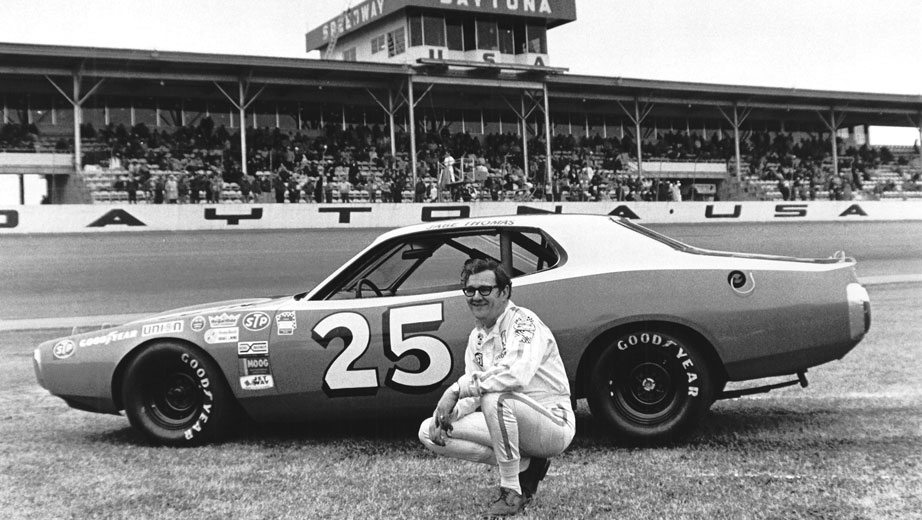
Bruce: ‘NASCAR exists today because of them’
Quietly, they slip through the cracks of NASCAR like some long-forgotten track, unnoticed by many of today’s fans, with names that fail to stir memories of fantastic finishes or incredible accomplishments.

You probably won’t find them on highlight reels, unless it’s in the background. The Hall of Fame hasn’t come calling.
But the contributions of drivers such as Jabe Thomas and Jim Vandiver, small as they may seem to some, were just as important to NASCAR during their time in the sport as the contributions of the better known, more successful drivers they competed against.
For every Petty or Allison, Yarborough, Baker or Pearson, there was a Thomas and Vandiver, an Arrington and a McDuffie. Through the years, generations have come and gone. Success in NASCAR followed some while turning a cold shoulder to others. But still they came.
Thomas, father of former Rookie of the Year Ronnie Thomas, passed away June 4. His career as a driver in NASCAR’s premier series lasted 14 years, and while it produced no wins, Thomas, a Christiansburg, Virginia, native, did finish eighth or better in the points standings for four consecutive years.
RELATED: Jabe Thomas passes away at 85
Vandiver, who called Huntersville, North Carolina, home, passed away last week at the age of 75. He, too, competed for 14 seasons, but never on a full-time basis. His record shows only 85 career starts during his time in NASCAR. In 1972, Vandiver started a career best 16 races; there were 31 on that season’s schedule.
But in 1969, he led 102 laps en route to a runnerup finish at Talladega Superspeedway, back when it was known as Alabama International Motor Speedway.
Turns out it was one of the most pivotal races ever contested by the sanctioning body.
When the series’ top stars of the day deemed the new 2.66-mile track unsafe for competition, they withdrew. It’s been the only time in the history of NASCAR that drivers have boycotted an event en masse.
Vandiver chose to stick around. He piloted a 1969 Dodge fielded by owner Ray Fox and in his first Grand National start on a superspeedway, he finished second to Richard Brickhouse.
But it wasn’t just the Talladega result that etched Vandiver’s name in that often-overlooked segment of NASCAR lore. Nor the top-10 points finishes for Thomas, impressive as they were.
It was because of the efforts and appearances of such fiercely independent drivers that the sport was able to keep churning forward. NASCAR needed traction, and they were there to help supply it.
They were drivers who relished the opportunity to compete against the bigger, often factory-backed teams of the day. They raced against them at Daytona and Talladega, Charlotte and Atlanta. And they raced against them at lesser-known stops as well — places like Macon and Montgomery, Hillsville and Islip, too.
Thomas and Vandiver were just two of many who could be counted on to show up, maybe under-funded and over-matched, but they showed up just the same. There would be a race, and whenever possible, they would be there, lined up and hoping for the best.
Of the 184 drivers who have posted at least one victory in NASCAR’s premier series, 60 never won more than once. It’s likely that hundreds of others had careers that never saw a single trip to the winner’s circle.
That didn’t make them any less worthy of recognition then and it doesn’t make them any less worthy now. Drivers such as Richard Petty and Bobby Allison and David Pearson went on to become legends in the sport, but they did so with the help of guys like Thomas, Vandiver and a host of others.
NASCAR’s history is filled with them. And lest we forget, NASCAR exists today because of them.
They weren’t household names. They were racers. And thank goodness for that.