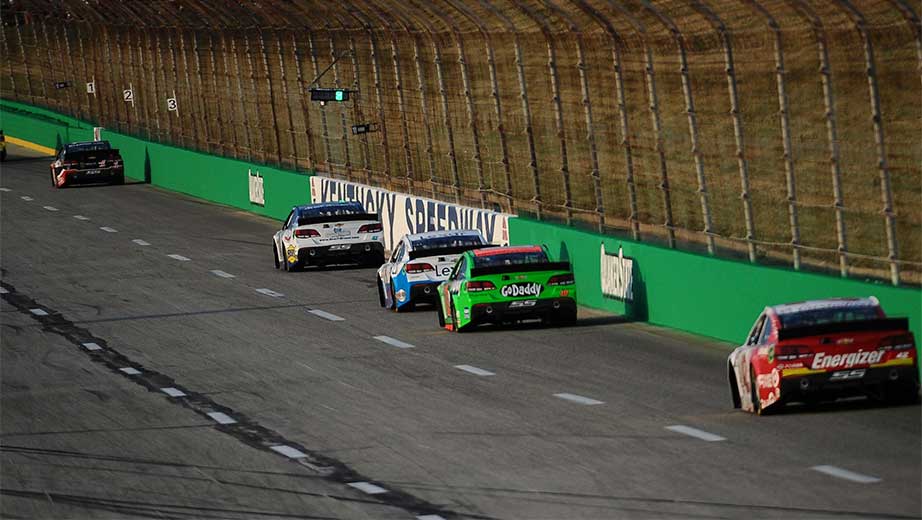
NASCAR.com’s Kenny Bruce and RJ Kraft debate this hot topic
RELATED: Kentucky to use new aero package | Several other tracks to use different packages
After weeks of discussion about new rules packages, NASCAR officials announced last month that new rules would be used for the NASCAR Sprint Cup Series Quaker State 400 Presented by Advance Auto Parts (July 11, 7:30 p.m. ET, NBC Sports Network, PRN, SiriusXM) at Kentucky Speedway.
The main focus is an aerodynamic package that will create less downforce on the cars and could help produce more side-by-side competition. The teams will get additional practice time today (Wednesday, July 8) — to get more time and comfort with the setup — as well as the usual practice time on Friday.
UPDATE: Cup practice canceled due to wet weather, moved to Thursday
According to NASCAR Executive Vice President and Chief Racing Development Officer Steve O’Donnell, the spoiler height will be reduced from 6 inches to 3.5 inches and the splitter extension panel (radiator pan) decreased from 38 inches to 25 inches. Additionally, the splitter will have 1.75 inches less overhang than the current splitter.
NASCAR announced on Tuesday that a similar package will be run in September at Darlington Raceway, although the spoiler will be bigger. Sprint Cup Series events in July at Indianapolis Motor Speedway and in August at Michigan International Speedway will use a different package with higher drag rules. The regular-season finale in September at Richmond International Raceway will use a new tire.

The fact that new packages are in place for points races is a hot topic. NASCAR.com’s Kenny Bruce and RJ Kraft debate whether this is a good or a bad thing.
Kraft: Excuse me while I dig into my bag of cliche phrases, Mr. Bruce. I am all for “change we can believe in” and I like that NASCAR is listening and making the product better to create more side-by-side racing and passing with different packages. But what I don’t like is how this is being implemented. This whole concept of “changing horses midstream,” so to speak. The 2015 rules package isn’t impossible. Four teams have it figured out pretty well (the 4, 41, 78 and 48). And changing the rules setup even for one race, let alone multiple ones, in the middle of a season just seems like a bit of a panic move. Even if that’s not the intention, it could certainly be perceived that way. You have been competing a certain way for most of the season and now all of sudden, it’s different. Has any sport messed with the rules significantly midseason? This also feels a bit like a hurried effort to try to solve something that honestly looks not much different than last year’s racing, in which the end result was a thrilling 10-race postseason under the new elimination-style Chase format. For better or worse, the 2015 package should be used for the entire 2015 season, not tossed out for a race here or a race there.
RELATED: Lots to be learned at Kentucky
Bruce: I’ll ignore the “has any other sport” comment because anyone who has followed NASCAR for any length of time knows that it isn’t like “any other sport.” You’re dealing with a competition that includes a car that weighs approximately 3,400 pounds and can travel in excess of 200 mph. And which, by the way, is made up of hundreds of parts. The fact remains that NASCAR officials believe changing the current package can produce better competition on the track. And even those you say have “figured it out” will tell you that the racing could be better. The teams themselves aren’t changing. The rules, as they pertain to how a race is contested, aren’t changing. It’s still the first one to the finish line wins. No, the current package isn’t impossible for some, but if there’s an opportunity to make it better, why wouldn’t you?
Kraft: Under the new Chase for the NASCAR Sprint Cup format every race takes on added significance as a win basically punches your postseason ticket. And now with new packages, these races could become wild cards, especially if one team finds something early in the extra practice time that they can use in a race. To me, you don’t test something out in an event that counts for plenty with postseason spots in play. You test something out in an exhibition like the Sprint All-Star Race, where they had hoped to do this. Again I’m all for the changes, I just don’t like implementing them in a race that means plenty and the uncertainty is great. What if the racing doesn’t improve, or takes a step backward or nothing changes as a result of the new package for the race? Making changes for Darlington, Indianapolis and Michigan, before we see how the Kentucky package plays out is an unnecessary risk in my view. See how that goes before making new packages for different tracks.
Bruce: NASCAR and the teams rely tremendously on the wind tunnel, simulation programs and testing to understand the effects of changes made to the cars. However, the only way to know for certain is to implement such changes in real-world race conditions with a full field of cars and something of value on the line. Sure, these races are now something of a wild card, but isn’t that a good thing? Aren’t the road-course races and the restrictor-plate races wild cards? Should we not count them toward the Chase? If these races with new packages provide a team with an opportunity that didn’t previously exist, I see that as a positive. For example, everyone will be relying solely on data before they hit the track for an extended practice leading into Kentucky; they’ll fine-tune that with what they learn on the track. But no one had all winter to tinker with the changes and gain any sort of advantage.
RELATED: Reactions to the new Kentucky package
Kraft: With the road courses and the restrictor-plate races, we knew they were wild cards from the get-go and that’s fine. You shouldn’t have the exact same type of tracks making up the schedule but you should have consistency in the rules over a season. NASCAR has been talking about trying to help keep the cost down for teams over the course of a lengthy season. Doesn’t changing the rules and what would be allowed on the car in terms of spoilers, splitters, etc., have an impact on how much money goes into the ride? Especially since teams are working on cars for particular races weeks in advance and the Kentucky package wasn’t given to them months in advance, since it was made official roughly four weeks out. I guess what I am saying Kenny is I don’t like immediate change when the uncertainty is great. Give me a gradual change that I can simmer on before it goes into effect.
Bruce: NASCAR has been cost conscious concerning the overall health of the sport, and not just “over the course of a lengthy season.” It’s on-going. Teams are already doing R&D work. They likely aren’t adding more money or resources or personnel to what they’re already doing, they’re just focusing on something different. So I don’t think cost is a point you can argue. The uncertainly exists, for sure, but it isn’t as if they weren’t being told of the specific changes until they arrived in Kentucky. They’ve done some homework; they have a general idea of what to expect. Yeah, if NASCAR told them when they showed up to remove the spoilers completely, take off the splitters or something equally radical, it would be an issue. But this is gradual in that it’s not a hard and fast “here’s what you’ve got to have for the rest of the year so deal with it.” Better to find out now, under real race conditions, than head into 2016 still uncertain of what lies ahead.