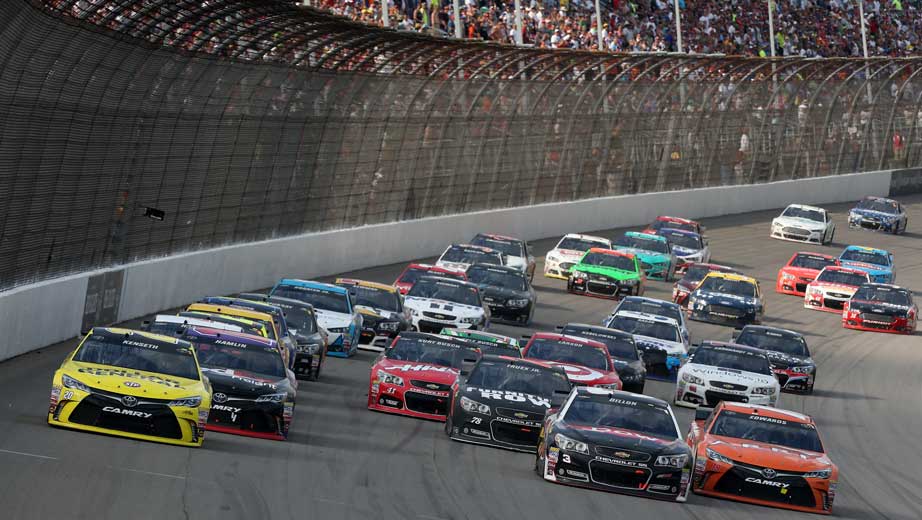
BROOKLYN, Mich. — Hot, sticky, and slick all described Sunday’s Pure Michigan 400 as the high-drag package and heat both gave drivers challenges. But this rules setup was deployed at Michigan International Speedway, a vastly different track than the where the aero package debuted at Indianapolis.
After Kyle Busch wrecked in practice and David Ragan spun on the first lap, the “it will be interesting” prediction of many drivers seemed apt. And restarts caused headaches, but some of the anticipated problems did not come to fruition.
Front-runners found plenty of power without pushing engines past their limits with the high RPMs created by the setup. Predictions of mass attrition failed to materialize. Still, many remained mum post-race rather than offer, at best, mixed reviews.
No. 22 Team Penske driver Joey Logano , who finished seventh, simply said passing was difficult — “really, really, really hard.” But some statistics offered a counterargument, as the 3,886 green-flag passes from Sunday’s race were second to 2009 event in the Irish Hills that saw a track-best 3,902 green-flag passes.
The handling didn’t bother race-winner Matt Kenseth at all, who joked, “I gotta be honest, I didn’t see much of the race, which was totally fine with me. We were up front.
“I got in a lot of different traffic situations with pit strategies and we raced around a lot of cars and we had a really strong car. You know, it’s hard to say how far we could have fell back and still won. We had the fastest car by a fair margin for today’s day and age, so I’m glad I didn’t mess that up.”
“Everyone at JGR has attacked this package really hard and it shows,” said Jason Ratcliff, crew chief for the No. 20 Joe Gibbs Racing Chevrolet. “It’s just execution from the time we unloaded. I would say Friday was a huge part of our weekend, getting that No. 1 pit stall. Starting on the front row and keeping that track position obviously was key.”
Austin Dillon, who had his second top-five finish of his career and first top-five of the season, said hot conditions didn’t hinder him from staying up front to finish fourth, as teams figured out how to attack the race with this aero package. Dillon was credited with the fastest lap of the race just above race winner Kenseth, his No. 3 Richard Childress Racing Chevrolet propelling around the speedway at 189.549 mph at Lap 26.
Starting from the back of the field after changing out an engine after losing horsepower in practice Saturday, Dillon had plenty of opportunities to see the high-drag package around other cars and in passing situations.
“If I had to do it over again, I would probably start freeing it up a little earlier,” Dillon said. “I seemed to be able to make passes and make moves and pass people. It wasn’t that awful. I’m glad the heat was out today. I think if it was cooler, it would have been a tougher day to pass because everybody would have been a little better.”
As for the effects the heat had on drivers, opinions varied widely. Dillon downplayed the heat, and veteran Jeff Gordon found it to be nearly unbearable.
“I need ice water, ice bags whatever you got. It’s hot as (expletive) in here,” Gordon radioed to his team shortly after the halfway point in the 400-mile race.
The weather was 84 degrees and partly cloudy at the race’s start on Sunday, with 65 percent humidity — high enough to curl Michigan fans’ hair and push cockpit temperatures up to 150 degrees.
“I don’t think we can blame it on the package,” Dillon said of the heat concerns aired by drivers at Indianapolis, where several were treated post-race for heat-related issues. “New Hampshire, I got really hot and Kentucky was really, really bad. But the past two races my team worked really hard to insulate the car.”
Teams have the options of using 14 NACA ducts to improve airflow in the cars, which run hotter with the high-drag package because air is trapped under the car. But teams didn’t want to give an aerodynamic advantage to competitors, so NASCAR required three NACA ducts be used after several drivers were treated for heat issues at Indianapolis Motor Speedway. The Jeff Kyle 400 at the Brickyard was the first race run with the high-drag package and had similar weather conditions, partly cloudy skies and temperatures around 90.
“I was fine. The only thing that got hot on me was my heels,” Dillon said. “If we just put some more insulation there I would have been fine. Body wise we’ve done a lot to cool my car, and what NASCAR did to put in that duct in the right side really helped. I thought a lot of air was flowing, and I wasn’t too bad.”
The package for Michigan includes a 9-inch spoiler on the rear deck (increased from six inches) with a 1-inch wicker bill; a rear fascia extension panel similar to those used for superspeedway events, a 2-inch leading edge on the splitter and a 43-inch splitter extension panel (radiator pan).