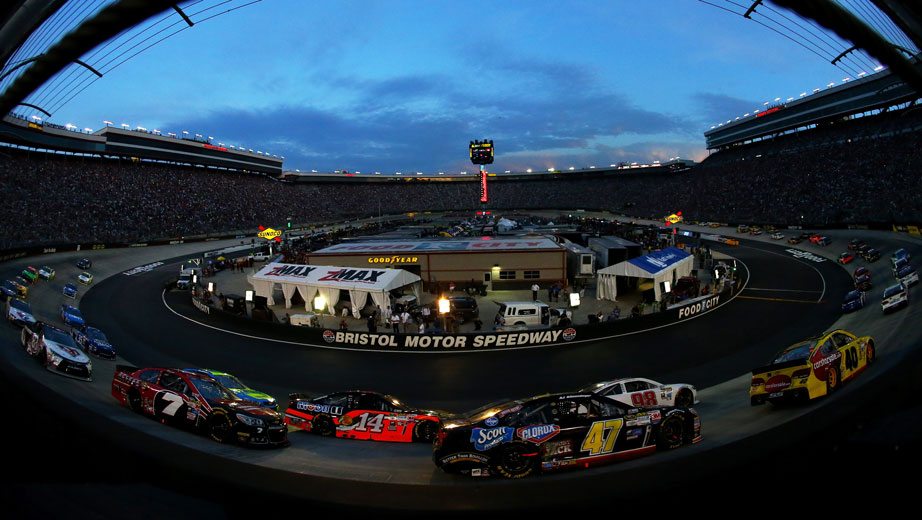
BRISTOL, Tenn. — The viewing and listening experience for fans attending events at Bristol Motor Speedway is about to get a lot clearer.
And larger. A whole lot larger.
Officials with the popular half-mile track unveiled plans for the world’s largest outdoor suspended digital display Wednesday, a 700 ton marvel of engineering that has already been dubbed “Colossus.”
This isn’t your father’s scoreboard.
Work on the new piece is scheduled to begin in November and be completed in time for next year’s NASCAR Sprint Cup Series weekend in April.
Each custom-built screen adorning the four sides of the display is approximately 30 feet tall and 63 feet wide, or twice as high and nearly three times as wide as the video displays atop the scoring pylon currently in the BMS infield. And with nearly 54 million LEDs and 18 million pixels, the picture quality is expected to exceed that of large-scale outdoor displays seen in Times Square.
A 540,000-watt audio system featuring 380 3-way loudspeakers and 48 stadium subwoofers will decrease the listening distance (from speakers to fans in the grandstands) from what had been between 200-400 feet (depending on location) to no more than 90 feet.
The new piece will be suspended by cables tethered to four towers located outside the race track. Sightlines for fans in the grandstands will not be impacted, according to track officials.
The idea for Colossus came about as track management began working toward next year’s Battle at Bristol, the college football game featuring the University of Tennessee and Virginia Tech that will be played inside BMS.
Moving the current scoring pylon in the center of the infield was a must; coming up with suitable viewing screens became necessary.
“We studied the football game (plans) for several months before we even went down that path,” Jerry Caldwell, BMS general manager, said. “Some options were coming out of that — we could do this with screens, we could put them in the turns, we could do other things. And then there was a “what if we did this.” Then you bring in people like Panasonic and the other companies we met with … and it became more of a reality.”
It’s the way Speedway Motorsports Inc., way, according to Caldwell. “We go after the ‘why nots?’ ” he said.
“It’s an amazing addition and enhancement for race fans. Both the (video) and the sound are going to take us to a new level.”
The video display, which will include a circular truss underneath providing pertinent information (such as the running order during races) will be suspended by cables roughly 30 percent thicker than the vertical cables suspending the Golden Gate Bridge, weighing in at approximately 63 pounds per foot.
“Suspending a screen like this is quite an engineering feat, challenge,” Richard Ballard, a consultant for Panasonic, said. “I quite frankly don’t know where one is of this size.”
Determining how large the screens needed to be for maximum results and optimum quality, he said, was similar to “picking the right size TV for your living room … is it the 50-inch, the 42, the 65-inch model? … You’re going to fit that perfectly inside your room.
“We did the same thing here — we took the sizing of the venue, the sight lines, figured out what size would it take to give you that living room experience. What we’re doing it trying to give you that experience that you would get at home.”
Marcus Smith, President and CEO of Speedway Motorsports Inc., said he expects Colossus to “totally transform the experience for Bristol Motor Speedway.
“And what it does for us with other events is going to be great,” he said. “The football game will have a bigger-than-life feel. We can host huge concerts. Any event that wants to have the biggest event ever, whether it’s hockey like the Winter Classic or the world’s biggest rodeo, you name it and we can host it.”
Caldwell agreed. “Really, the sky is the limit,” he said. “Some of those things (such as concerts and racing-related events) were possible before; this just makes it a whole lot easier and more cost effective to pull off.”