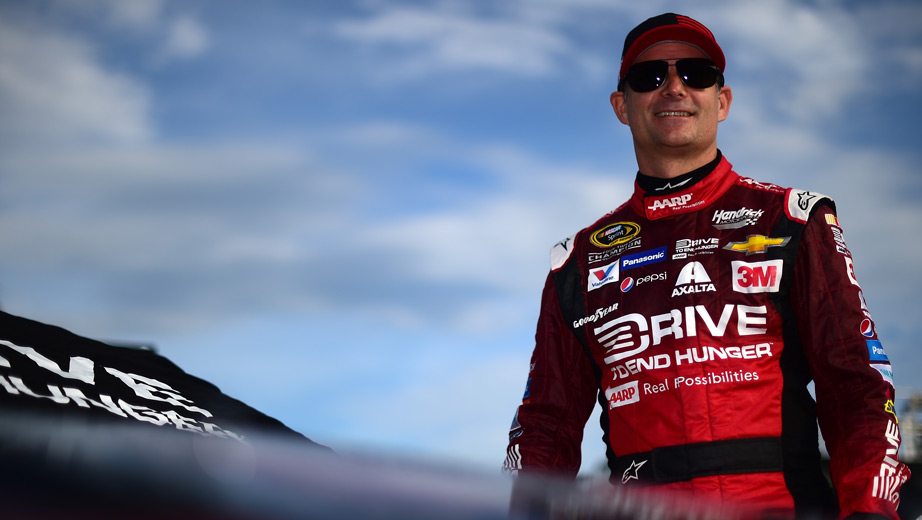
RELATED: Gordon’s teammates plan tribute | Final 24 paint scheme
My first meeting with Jeff Gordon came in Atlanta in 1992, two nights before what would be a sport-changing maiden NASCAR Winston Cup Series start for the then 20-year-old.
I remember he was dressed casually in jeans and yes, sported “that” mustache. I met him as part of a larger group of friends in a bustling Atlanta hotel lobby. He was without a single “handler” and since he knew a couple people in our group, wondered if he could tag along with us. The plan was to do a group dinner then later stop by a sports bar to watch the big fight between Evander Holyfield and Riddick Bowe.
The young Gordon looked as much like a fan as a driver. You’d never know he competed in NASCAR’s Grand National division. Even less apparent was that he would be making his first big Cup start that weekend, except for the occasional, “Hey Jeff,” which he acknowledged in a downplayed manner.
I still have a large button with a photo of Jeff and a friend of mine after we jokingly convinced the staff at Benihana’s that night it was Gordon’s birthday. It wasn’t, but we got free dessert and the funny button.
I had reported on a lot of IMSA sports car racing leading into this assignment for the Tampa Tribune, but this was my first big Cup race, too. Our primary racing beat writer, Herb Branham, was focusing his weekend coverage on “the big story” — Richard Petty’s last start.
I was to handle the more routine race story topped by the championship. Looking back at it, I discovered that I never even mentioned Gordon in that story. He crashed and finished 31st.
To be perfectly honest, my background was primarily stick-and-ball and I had no idea who Gordon was, especially compared to NASCAR’s bigger names like Petty, Davey Allison, Bill Elliott and Alan Kulwicki, who won the title that weekend.
Just to have a chance at this first big-time racing opportunity, I had to make myself valuable all around to the newspaper. So I offered to stop in Atlanta earlier in the week for a lengthy and candid interview with the Tampa Bay Lightning’s big news, a woman goalie, Manon Rheaume.
Manon was great. But NASCAR was better and 22 years later, I’m still here.
I remember congratulating Gordon the day after our dinner on his “best of second round qualifying,” but honestly had no idea of the fabulous racing legend this modest, fun, personable young man would become.
He eventually lost the mustache, but never the mojo.
RELATED: Photos of Gordon through the years
Gordon is the first major NASCAR champion that I have covered from the very beginning to the very end, which comes with his retirement this weekend after the 2015 season finale in Homestead, Florida — where he stands an impressive 1-in-4 chance to win a fifth title.
And while Gordon has accomplished so much, transformed the sport and truly deserves the opportunity to possibly leave as a champion, it will feel very odd to me — and to so many — to say goodbye now.
Gordon was the first NASCAR driver I had any lengthy conversation with or wrote any substantial stories about. Considering that now, after his four championships and 93 victories, it is something I will treasure as a reporter.
And truly it started with what a down-to-earth person I have always considered Gordon to be.
I’m fortunate to say I was there for so many of Gordon’s firsts — the Brickyards, the Daytona 500s, the championships … and the fabulous head-to-heads with Dale Earnhardt.
RELATED: Gordon’s top 24 NASCAR moments
I still have the February 1995 edition of “Beckett Racing Monthly” magazine with Gordon’s first cover photo and my story on him featured inside. I honestly hadn’t read it in more than 10-15 years.
The headline is “Flash Gordon” and talks about the amazing statistics he had already posted only two full seasons into what is now surely a Hall of Fame career.
He was already truly one of the most popular drivers on the circuit — later that very year winning his first Cup title — and I remember his public relations team wanting me to send a letter in advance with a list of potential questions.
I didn’t. And Gordon was still spectacular.
As impressive as his success on track had already been — the 1993 Rookie of the Year, a win in his first Gatorade Twin 125, and then in the Coca-Cola 600 and the inaugural 1994 Brickyard 400 — Gordon was genuinely humbled and amazed at the fan reaction in my story.
“When I get a second to sit down, which isn’t very often, I think back to when I got a chance to meet Charles Barkley or Chris Webber,” Gordon said in the article. “That was a big thrill for me and they weren’t rude, they were really nice. That made a big impact on me and I try to put myself in that same position. If I have an extra second, I always try to give it to the fans, especially the kids.”
And he always has.
This weekend in particular, Gordon will be honored, acknowledged, remembered and cheered for more than two decades of transforming this sport on track and off it.
As he said in that 1994 article, “I’m just a race car driver looking to make a living.”
And so he has. So, well done.