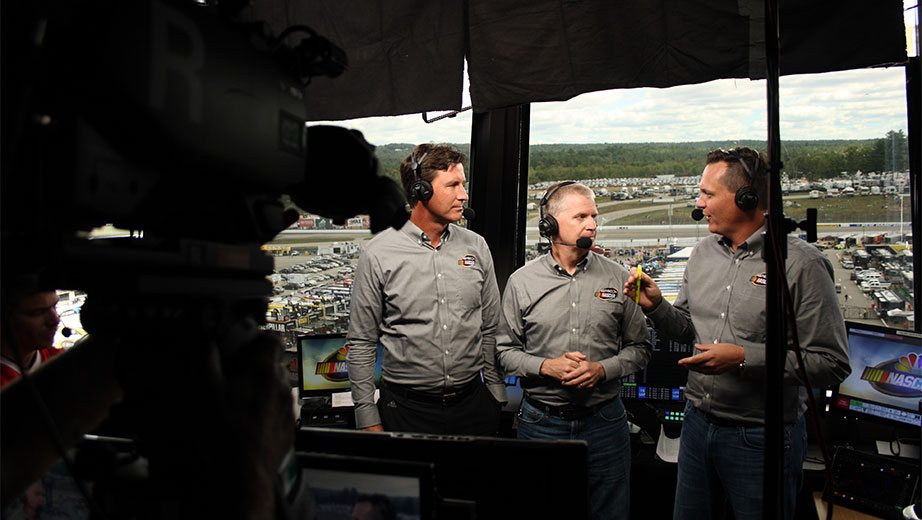
RELATED: An inside look at Dale Jr. joining the NBC team in the booth
A black Suburban pulls into the NBC TV compound just outside of Turn 3 at Talladega Superspeedway. Pit reporters Dave Burns, Marty Snider, Kelli Stavast and Mike Massaro jump out into the brisk, fall morning.
“All right, we can get started, now that we’re here,” Burns jokes as he fake yawns theatrically. It is 9:42 a.m. local time, more than three hours before the green flag will drop on this Sunday in mid-October.
Someone standing nearby offers helpful advice: “Don’t screw it up.”
“We’ll try not to,” Burns replies.
The pit reporters file into a portable trailer nearby called BP’s Place. “BP” stands for Benny Parsons, the late and beloved NASCAR broadcaster who will be inducted into the NASCAR Hall of Fame early next year. Around the table sit analyst Steve Letarte; lead race announcer Rick Allen; Jeff Behnke, NBC’s vice president of NASCAR production; Matt Marvin, the race producer; Mike Wells, the director; Rene Hatlelid, the pit road producer; the pit road reporters; and other NBC personnel.
They represent a small fraction of the 230 people required to broadcast the race. The topic at hand is what stories they will cover during today’s race. There are many to choose from. It’s Talladega, so there’s always the chance of a big wreck. It’s a cutoff race in the Round of 12 in the Chase for the NASCAR Sprint Cup, so four drivers will be eliminated from the postseason. The table discusses the many different strategies drivers could use throughout the race. Some drivers will try to run up front. Others will hang out in the back. They will form and disband packs throughout the day. Keeping track of all of it all day will be a difficult but important task.
“This could make for some very exciting things for the viewer all the way through,” Behnke says in words that seem prophetic after the checkered flag falls late that afternoon.
NBC Sports No. 1 goal in all of its programming is to tell stories, and the team of analysts and reporters finds them on this day before, during and after the race; on the track and off. Indeed, so much happens in the hours ahead that the challenge is not finding stories but deciding which ones to tell.
Most of the key players on NBC’s NASCAR broadcast team have televised other sports, and they unanimously say NASCAR is the most complicated and difficult to cover.
“For three and a half to four hours, it’s a real mental workout,” Marvin says. “It just doesn’t stop. Which, to be honest, is also the best part about it.”
Over and over again, they say broadcasting a NASCAR race is like broadcasting the Super Bowl week after week. If you set aside the world-wide viewership that the Super Bowl attracts as a factor, they are correct.
A case can be made that a cutoff race at Talladega is the single most complicated sporting event broadcast in the United States this year. Start with the fact it’s an important race in the Chase and for points: When the race starts, there are 12 drivers still alive in the Chase; when it ends, four will be eliminated. The drivers who are in and the drivers who are out changes from lap to lap.
Yes, there are other cutoff races-at Richmond, Dover and Phoenix and then the championship race at Homestead-Miami — and those are complicated, too. But none of those has the draft and the ever-present tension of drivers straddling the line between danger and daring.
If all of that wasn’t complicated enough, the technical, geographic and personnel scope of the Hellmann’s 500 is staggering. For this race, NBC uses 115 cameras, 150 microphones and 25 miles of cable to go along with the 230 production personnel. The track is 2.66 miles around and 48 feet wide. That’s 674,150 square feet-or more than 11 times the size of a football field (57,600 square feet).
Factor in additional space on pit road, the garage area and the drivers’ motor coach lot-which pit reporter Marty Snider visits to interview Brad Keselowski after a blown engine eliminates him from the postseason-and the total ground covered is unprecedented.
RELATED: Engine woes end Keselowski’s Chase
And even that fails to adequately address the challenges a NASCAR broadcast team faces. The play on a football field happens in one spot and moves at foot speed. There are breaks after every play. In a NASCAR race, the action happens in 40 places, moves at 200 mph and stops only for red flags.
It’s a few minutes before 1 p.m. local time and the drop of the green flag is fast approaching. Pit reporter Mike Massaro and his spotter, Brian Cox, work the scene on the starting grid.
Shiny racecars sit silently, awaiting the command that will roar them to life. Hundreds of people mill about. When security orders pit road cleared, millionaire car owners who arrived this morning in private jets walk alongside fans who slept in rickety RVs in the infield last night as they both retreat to their favorite spots to watch the race.
NASCAR is a sport of extremes. Started by moonshiners, it is now dominated by massive corporate sponsors. The sport’s drivers have transformed themselves from greasy-knuckled brawlers (who made sponsors happy if they had to) to polished corporate spokesmen (who still sometimes brawl). The cars are engineered to fractions of inches, yet, as driver Carl Edwards put it during qualifying, “With all this technology, you can still bang on something with a Stanley hammer to fix it.”
That tension between extremes exists even in the way the broadcast team reports on the race. The simple and the complicated exist side by side, and each needs the other.
Let’s say a pit reporter wants to know if a crew chief thinks his team has enough fuel to get to the finish. The crew chief, having just crunched the numbers, thinks unholy expletives but merely shakes his head. That’s literally the simplest form of communication humans use. The pit reporter uses his radio to tell his pit road producer, Rene Hatlelid. Hatlelid tells Marvin. Marvin uses his radio to tell Allen. Allen reports the news, and his comments fly to outer space, hit a satellite, and bounce back to your cable provider, which sends Allen’s report to your TV (or whatever device you watch on).
All of that happens in a matter of seconds … and then your team runs out of gas on the last lap and you scream unholy expletives.
Even the way pit reporters gather information carries whiffs of these extremes. Cox, Massaro’s spotter, writes longhand notes on a tablet. Massaro is old school-he uses a pen to write on a piece of cardboard. “It’s worked since 1999,” he says, laughing, “and I’m not changing.”
Massaro and Cox are responsible for 10 cars. Massaro unfolds his cardboard to show what he has prepared for today’s broadcast. In small, legible print, he has outlined stories he might tell about each of his teams, including the No. 19 of Edwards. For that team his notes say simply this: “JGR car draft? diff. Agenda.”
JGR refers to Joe Gibbs Racing (Edwards, Kyle Busch, Matt Kenseth and Denny Hamlin) and diff. means different. Massaro’s notes are based on a conversation he had that morning with Dave Rogers, Edwards’ crew chief. Rogers told Massaro that the four Joe Gibbs Racing drivers might drive in a pack together. But he wasn’t sure, because Edwards, Busch and Kenseth were relatively comfortable points-wise while Hamlin was not, so Hamlin might have a “diff. Agenda.”
Massaro’s little note tells a story that goes on to become one of the biggest of the race. He first reports it on-air at 1:32 p.m. local time, and the broadcast re-tells it, in varied forms, throughout the day, as Edwards, Busch and Kenseth spend the entire race in the back of the pack, trying to avoid trouble. They tell it again when Hamlin, after racing among the leaders all day without help from teammates, makes the cutoff via a tiebreaker. The other three drivers’ decision to stay in the back becomes a hotly debated topic throughout the week.
RELATED: Bold strategy pays off for JGR at Talladega
And Massaro’s five-word jot and title predicted it before the race even started.
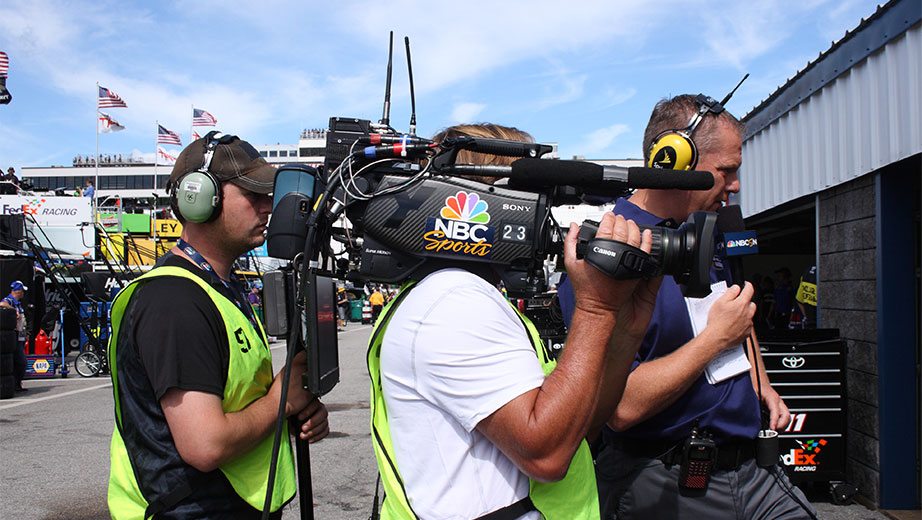
Marty Snider is among the NBC reporters who works the garage, looking for interviews.
The roar of the engines explodes as drivers mash their throttles near the start/finish line. In the booth, lead race announcer Rick Allen declares that the green flag is in the air. In NBC’s production truck, director Mike Wells yells, “Here we go, baby!”
Wells, a skinny man with straight brown hair that hangs to his collar, sits in the center of the first of two rows of seats. A bank of screens spreads to his right and left, reaching high above his head. He concentrates much of his attention on the two big ones directly in front of him. The one on his left shows what fans at home see. The screen on his right shows what they will see next.
He calls out instructions to the assistant director seated to his right. “Ready camera 22,” he says, and the screen to the right shows camera 22. Watching both, Wells waits … waits … waits. Then he snaps his fingers, which signals the assistant director to make the scene captured by 22 appear on the screen on his left.
Soon Wells calls for another camera to be ready, waits, and snaps again. Over and over this happens. In one two-minute span early in the race, he snaps his fingers 17 times.
Wells snaps his fingers because directing requires precision, and the snap provides it. He has directed every sport, and racing is his favorite because it’s so complicated — and therefore challenging. “I still learn something every race,” he says.
Behnke and Marvin stand and/or sit to Wells’ left. Behnke is like the owner, Marvin the coach and Wells the quarterback. They work as a team. If Marvin wants someone in the booth or on pit road to tell a story, he asks Wells to call up the appropriate camera angle. Throughout the race, Marvin also orders pre-packaged stories to be shown.
During live racing action, Behnke and Marvin trust Wells’ timing and judgment completely. The most common suggestion comes when Marvin says, “Ghost me when you can, Mikey.” That means Marvin wants Wells to display the “points as they run” graphic that runs down the left side of the screen, which is used increasingly as the cutoff approaches.
Behnke and Marvin marvel out loud multiple times during the race at how Wells directs the race with precision equal to the most exacting driver executing a perfect lap. “The director’s job in any sport is to capture the moment,” Wells says, and he has captured so many he has an incredible sense of when one moment is about to end and the next to begin.
Wells has directed so many races he couldn’t count them if he tried. His first NASCAR Sprint Cup race was in the early 1980s for ESPN, and he has directed numerous other racing series as well.
Considering Wells has decided what images fans see over hundreds of races in the last 30-plus years, there aren’t many people who have done more to shape NASCAR storytelling than he has. He shrugs off that notion. “I’m just so fortunate to be able to have the opportunity to be able to bring it to the people,” he says.
Everyone in the production truck is a NASCAR fan now. Pit road producer Rene Hatlelid was probably the biggest before she started covering the sport. She sits directly behind Wells. It’s her job to sift through the stories the pit road reporters want to tell as well as assign others. She pitches the best ones to Marvin, who has the final say of what makes it on air.
Wearing a metal-studded bracelet on her right wrist, Hatlelid works the radio buttons in front of her like a concert pianist. She holds one and talks to Massaro, holds others and talks to Burns, Snyder, Stavast and more.
Sometimes she sits, sometimes she hovers over her seat, and when something really big is happening — which is often — she bursts up and stands. Pit stops start, and the production truck explodes in organized chaos. “I need the 3 first, and then the 78,” Hatlelid says. “3 first, then the 78,” she repeats, shouting now.
She appears to be talking to Marvin, Wells and the pit road reporters at the same time, telling them all the order she wants reports to be filed. Working live, the pit reporters tell their stories-about tire changes, chassis adjustments, the quality of the car so far-which last only a few seconds each.
Pit stops are frenetic, but at least they are (usually) predictable and come at (usually) expected times. But NASCAR on NBC often has to crank out unpredictable, unexpected stories on the fly, which is what makes working in live TV fun, exhilarating and exhausting.
As a round of pit stops ends, NBC’s cameras catch Joey Logano’s car completing an entire lap with a jack wedged under his car. At the snap of a finger, Wells’ direction beams those images into TVs. He snaps again and the cameras follow Logano as he swerves back and forth, trying to dislodge it.
There is little time to laugh. Using an off-air radio, Allen asks Marvin if the fact Logano returned to his pit stall mean that will serve as his penalty for leaving pit road with equipment.
Marvin calls the NASCAR tower to ask NASCAR official Christy May that question directly. May says yes, returning to pit road to remove the jack covers Logano’s penalty. Marvin tells Allen, and soon Allen reports this on air. And another story, albeit one nobody in the production meeting this morning could have dreamed up, gets told.
RELATED: Why Logano’s jack stuck to his car
Guests in the booth are more of a staple in radio than TV. Listen to almost any NASCAR race on the radio and you’ll hear a few minutes of forced banter with the leading regional salesman from the Poughkeepsie office of whatever company bought the rights to tout its wares on that particular day.
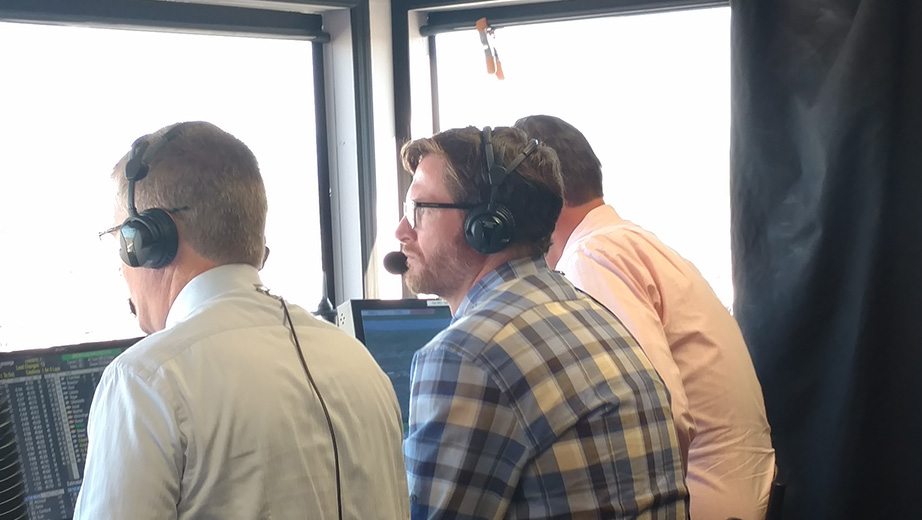
The TV booth hosts guests relatively infrequently. But when your name is Dale Earnhardt Jr., space is always available. And so Junior joins the booth on this day, and the result is pure TV magic. The analysis he provides in the hour-plus he spends in the booth is widely lauded.
A couple of surprising things about the booth and the guys in it-former driver Jeff Burton, Letarte and Allen: The view of Alabama is beautiful. The view of the track is limited. The backstretch is so far away-roughly 3,000 feet-that it’s almost impossible to tell one car from the next. They watch the TV monitors at least as much as they watch the track.
Their collective sock game is strong; Letarte’s have what appear to be penguins on them. Allen’s voice is immediately recognizable, and then he introduces himself and he’s like 8 feet tall and distressingly handsome. He’s also friendly and a big fan of Nutter Butters.
Burton, Letarte and Allen drive the storytelling throughout not just the broadcast but the weekend. At the production meeting this morning, Letarte dominated the conversation. On Friday, Burton drove NBC’s Toyota on-track car around the track and recorded several stories that were used throughout the weekend, and it appeared they were largely his ideas.
Many of the stories that come up during the race are first proposed off the air by the guys in the booth. Allen’s questioning of the Logano situation is one example. Junior provided another when he said off the air that the lead car in the high line during a single-file run always gets debris on his grille. When that happened twice during the race, a pit reporter lobbed him a question about the topic.
With 10 laps to go, it’s not yet clear who will qualify for the next round and who won’t. But seconds after the race ends, the pit reporters and the booth quickly tell a succession of stories. Hamlin is in, Austin Dillon is out on a tiebreaker, JGR’s passive strategy worked, and Kevin Harvick might have punched teammate Kurt Busch. That story remains half told. The video isn’t conclusive, Kurt Busch’s interview is as clear as mud, and Harvick’s contains no useful information.
RELATED: SHR teammates got physical post-race | Logano wins at Talladega
Oh, and there is one more tale to tell. It’s about a runaway jack, a bizarre race and a coveted checkered flag. “Win and you advance,” Allen says. “That’s what Joey Logano did today.”
The final story of the day is as simple, and complicated, as that.