Editor’s Note: This story was published on February 12, 2016 as Daytona completed work on the Daytona Rising project ahead of the 2016 season. NASCAR.com’s Holly Cain has the story of the track’s evolution to the first motorsports stadium of its kind.
RELATED: Daytona through the years | Full Speedweeks schedule
DAYTONA BEACH, Fla. — Lesa France Kennedy and her uncle Jim France clutched a giant pair of scissors and officially cut the ribbon inside the new-look, re-imagined Daytona International Speedway last month, flashing wide smiles and knowing eyes.
When these same International Speedway Corporation executives first broke ground on the $400 million Daytona Rising project more than two years ago, Kennedy promised, “We are truly creating history with this unprecedented endeavor.”
So even as she and France took their positions and prepared for the ceremonial dedication, the pair couldn’t contain their excitement — it was palpable as they continually stole glimpses across the vast new open-air concourse, out to the track below and even toward the famous beach in the distance where Jim’s father and Lesa’s grandfather Bill France Sr.’s stock car racing idea first flourished 60 years ago.
It was ironic that the actual ribbon cutting on the facility occurred on a rare breezy, rainy, chilly day in Daytona Beach, because the people who attended were joyful and oblivious to the weather.
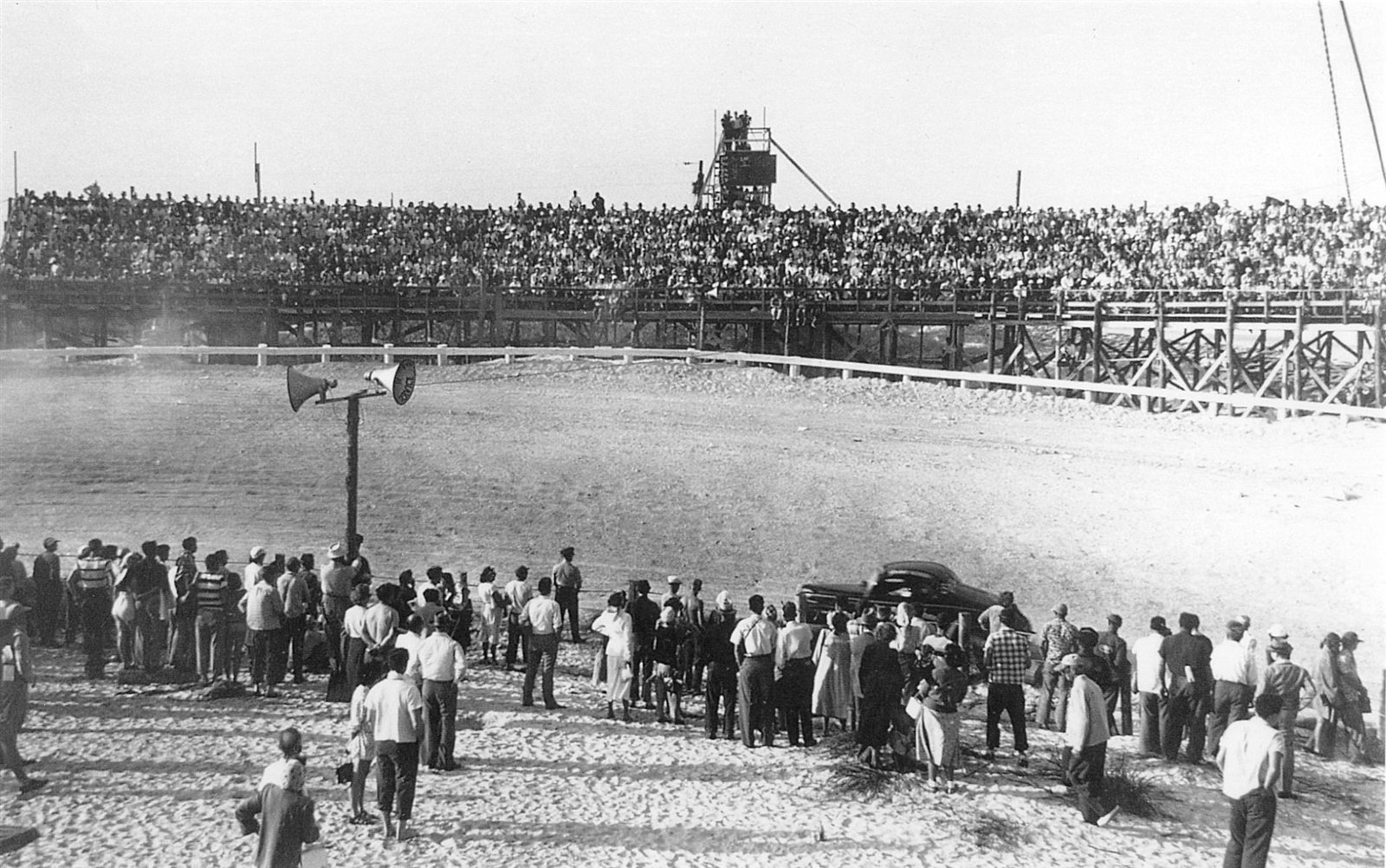
Huge crowds line the dunes to watch Daytona racing in 1949
There was history to make.
The Daytona Rising project has been touted as a “re-imagining,” and its finished look is nothing short of transformative. Even the new nomenclature of the speedway sounds impressive — from its “injectors” outside to its “neighborhoods” inside.
Previous modifications to the track have been for the thrill of competition and the safety of the racers. This massive investment is foremost for the comfort and pleasure of the loyal fans, and it will be evident this week as people begin arriving for NASCAR’s season-opening events at Daytona Speedweeks, which culminate with the Feb. 21 Daytona 500.
Evolution from race track to racing’s first sporting stadium is not unlike moving the course from its origins at the beach to a sprawling remarkable speedway. It is the third version of high-end Daytona stock car racing.
“I don’t know of another speedway in the world that’s this nice and this beautiful,” racing legend A.J. Foyt declared at the track’s Rolex 24 debut the last week of January.
And that’s high praise for a structure that is simultaneously imposing and inspiring from a racer known and appreciated for his grit and honesty.

The Chevrolet Injector at Daytona International Speedway
NASCAR team owner Chip Ganassi was in complete agreement with Foyt.
“When you first hear they spent $400 million, and you go see the work that’s been done, stand on pit lane and look at the grandstand, it looks like $800 million,” Ganassi said. “It’s really, really something really first class and I think it’s going to take our sport to a new level for what fans expect.
“This is going to be the Ritz-Carlton of race tracks, there are so many amenities. I couldn’t be happier for our fans and what it’s going to do for our sport.”
WATCH: Daytona rises in time lapse video
The smiles, the wide-eyes, the enthusiasm that has been brimming under the surface has been notable since this project began more than two years ago.
Everyone from the car manufacturers to longtime racing sponsors have gladly joined in the effort. Chevrolet, one of the original and primary corporate sponsors of the new-look speedway, has been eager to support modernization of the facility, recognizing the benefits of balancing modern updates with historic importance.
“Chevrolet’s commitment to racing originated more than a century ago with Louis Chevrolet and remains strong today as we solidify our presence at the ‘World Center of Racing,’ ” President of General Motors North America Alan Batey said when announcing the company’s partnership with Daytona.
And for all the attention paid to historic detail, fans will also undoubtedly notice the refined façade outside and appreciate the refinements inside, from larger, more comfortable seating to high-tech huge screens and WiFi availability to the most escalators (40) and newly refurbished restrooms (1,891) of any sports stadium in the country.

Artwork in the Sunoco Injector at Daytona International Speedway
WATCH: Joie Chitwood III excited to unveil speedway additions
Toyota joins Chevrolet as an “injector” sponsor and was actually the first to formally announce its partnership with the new Daytona project more than two years ago.
The two manufacturers’ efforts at creating welcoming, interesting and exciting interactive elements at the track offer a glimpse of how a far-reaching a corporate plan can be.
Creativity is the theme throughout the facility with each of the corporate-sponsored injector entrances from Toyota to Chervolet and from Sunoco to Florida Hospital providing an extensive and interactive “experience” for fans.
“Philosophically, I think it demonstrates our commitment to motorsports in general and NASCAR in particular, and like anyone else, we’re always looking for a way to engage the fans in a meaningful way,” said Toyota’s Keith Dahl, general manager for motorsports and asset management for Toyota Motor Sales USA.
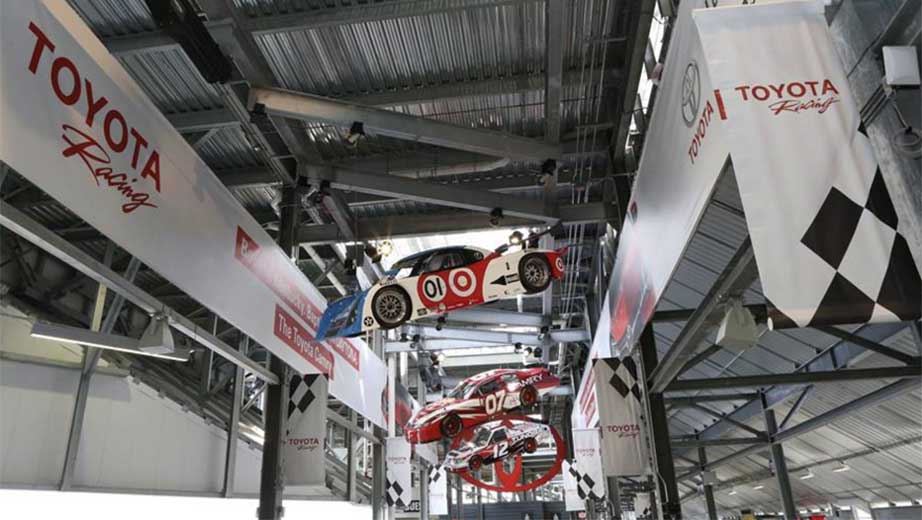
The Toyota Injector at Daytona International Speedway
The bigger-than-life Toyota logo that greets Daytona fans at its injector entrance is the largest commercial logo in the United States, according to Dahl. And the company’s historic relationship with NASCAR is immediately evident feet away with five full-size Toyota race car replicas representing the Sprint Cup Series’ Camrys fielded by Joe Gibbs Racing, and this year’s new addition, Furniture Row Racing.
Take the escalator up 35 feet to the main concourse and fans are greeted by the reigning Sprint Cup Series championship No. 18 Toyota similar to the one driven by champion Kyle Busch — a replica so precise it’s adorned with both celebratory confetti and bumper-rubbing scrapes. A Sprint Cup trophy sits encased alongside.
The massive concourse called a “neighborhood” is 100,000 square feet and there is a common and connecting theme along the Toyota area — photos and stories of the company’s workers — from car sales associates to manufacturing plant workers to race shop mechanics. A massive “touchscreen wall” made of eight big screens features humble stories and real-life profiles from the company’s employees.
The headline “From American Factories to American Roads” greets fans and reminds them of the company’s commitment to the ultimate of American sports, stock car racing. And vice versa.
“Obviously, as time went by more and more effort got put into this,” Dahl said. “We literally would have meetings and throw some ideas out there. I know it’s cliché to say it’s a ‘blank canvas,’ but it really is. There are a lot of ideas we wanted to try.
“This was a chance to try some things. And what you see today, I would hope is not what you would see in perpetuity. We want to keep things vibrant and relative. We’ll have different things going on.”
For example, the refreshment area in each injector is similar but uniquely decorated. In Toyota’s version, there are seats refurbished and retained from the speedway’s former grandstands. Toyota Tundra truck tailgates were made into benches for many of the tables.
As you walk along the massive concourse, Toyota has an area featuring its latest passenger cars and trucks. Take an elevator up to the next level and you are immediately greeted with a replica of the nose cone of the Space Shuttle Endeavor — the real spacecraft that a Toyota Tundra famously gave a lift to a museum in downtown Los Angeles in 2012. And winning Toyota race cars and race trucks hang from the ceiling.

The Florida Hospital Injector at Daytona International Speedway
Stand on a level high atop the grandstands, alongside the luxury corporate suites looking outward from the speedway and you can feel the breeze and see what’s coming next.
Across the street, tractors and bulldozers are working to build a massive mall and eatery, “One Daytona” for the next phase of the facility’s modernization. It will include popular restaurants, a Bass Pro Shops store and famous hotels, plus – importantly — ease of passage from sidetrack to race track.
“As you walk through the stadium, you see the potential for anything,” Daytona International Speedway President Joie Chitwood III said proudly, glancing across the street. “For us the goal is to continue to push the envelope. Yes, we’re the world center of racing, but also the world center of entertainment is very doable.”
But what is most important to both the executives and definitely the fans is a one-of-a-kind, top-shelf experience at Daytona from thrilling racing on track to thrilling ways to watch the racing on track.
The speedway is not only keeping up with the times, it’s setting fast time.
“Probably what makes me most proud is that the France family entrusted me with their most valuable property,” Chitwood said. “Being around Lesa and Jim France and seeing the legacy that Bill France created in the 1950s, we have to live up to that.
“This is the Daytona International Speedway and Big Bill built this place and we are not going to misstep. It has to be right. And I’m proud to say, I think we nailed it.”
WATCH: ‘Untold Stories: Daytona’