
In the fall 2017 race at Martinsville Speedway, leader Brad Keselowski made what appeared to be a bold choice during the event’s waning laps. He elected to restart from the outside groove with 35 laps remaining. Decades of dominance proved Martinsville’s bottom lane was its most prominent, a notion perceptible to the naked eye.
Why such a brash decision? Clearly, Keselowski had erred. To some, losing the lead and the race was a justified result.
How our eyes deceive us.
Critics of Keselowski’s decision to restart from the outside groove were loud in its aftermath. In hindsight, the driver of the No. 2 Ford was an early adopter of a rising trend that became popular knowledge during last year’s spring race. Martinsville’s outside groove is, by far, its most dominant on restarts, a truism for the last five races held at the facility.
RELATED: Deep dive into 2019 stats
And this isn’t just a change in preference — Martinsville’s outside lane is one of the most reliable restart grooves in NASCAR. On all five restarts last spring, cars on the outside of the front row retained position. Through the first seven rows, its occupants held steady 91 percent of the time, 12 percentage points better than the series-wide rate for all tracks in 2018.
The inside groove on the flat, corner-heavy half-mile track allowed its drivers to successfully defend restart positions 63 percent of the time — far better than last year’s 44 percent series-wide rate, but nowhere as competitive as what its counterpart offered to drivers and teams. In total, over the last four races, cars in the outside groove out-gained those restarting from the inside by a 120-position margin. The once superior inside groove saddled its drivers with a net loss of 74 collective positions.
This year, Martinsville restarts may provide a welcome sight to weary drivers who’ve found the initial races of 2019 more volatile than usual. In all, drivers are retaining their restart positions 65 percent of the time out of the preferred groove, down from 79 percent last year. Only four drivers — Clint Bowyer (plus-14), Ricky Stenhouse (13), Aric Almirola (11) and Keselowski (10) — have secured double-digit net gains out of the preferred groove through the first five races.
FIRST LOOK: Brand-new paint schemes
Drivers return to Martinsville with the same rules package that allowed for the high success rates last season. Either from the track’s penchant for positional security or a majority change in which lane drivers most often find themselves restarting, here’s a glance at a few candidates whose results this Sunday could be bolstered by improved restart performance.
Kyle Busch
Despite front-row starting spots in both Martinsville races last year, such enviable initial track position couldn’t propel Busch to Victory Lane. Lane assignment on restarts was a factor. Combined, 11 of his 14 restart attempts from inside the first seven rows began from the inside groove, stunting his positional defense and slowing his efforts in making up ground.
Ryan Blaney
Blaney led 145 laps in last year’s spring race, but four of five restart attempts emanated from the non-preferred inside groove. This was a quantifiable hindrance as he lost his position on each of those attempts, including a try as the leader on Lap 143.
Aric Almirola
One of this season’s most prolific preferred groove restarters is Almirola, who wasn’t fortunate enough to win out on lane assignment at Martinsville last fall. Six of his nine attempts from a top-14 position were from the inside groove, including both of his efforts inside the final 100 laps.
Clint Bowyer
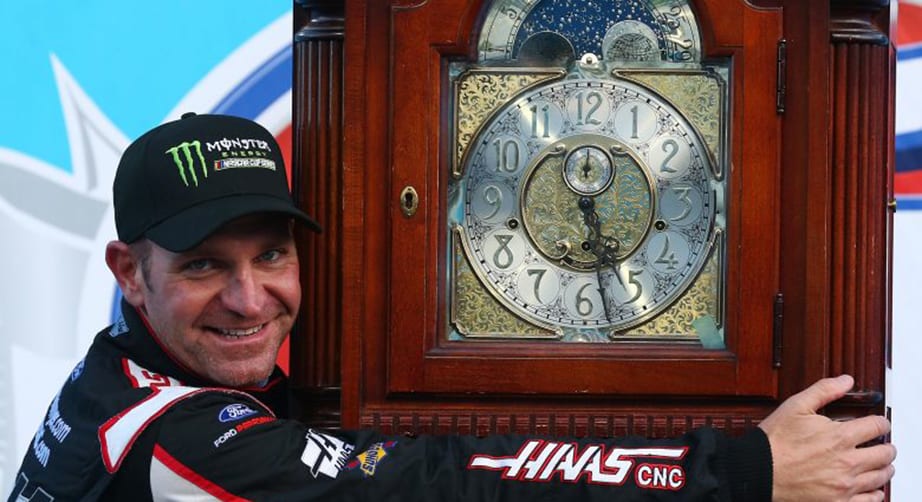
Bowyer is the defending spring race winner and his achievement probably doesn’t receive its due. He lined up on the inside on four of his five restart attempts in that race, successfully retaining position on all of them. The final restart of the day on Lap 392 saw Bowyer choose the outside in his only attempt as race leader.
Kyle Larson
Larson is retaining his preferred groove restart positions nearly 20 percent less often than he did in 2018. Martinsville’s tight corners are ill suited for the former dirt-track driver’s freewheeling ways, visible in his 24.2-place career average finish at the track. Still, a return to normalcy — and a time when Larson was a surefire defender of preferred groove restart positions — may help shift his Martinsville narrative.
Brad Keselowski
The driver at the epicenter of all this confusion may feel Martinsville owes him one. Across the last three Martinsville races, the car restarting from the front row’s outside spot retained position in 21 out of 25 tries, spelling a failure rate of just 16 percent. Indeed, it was a bad beat for Keselowski, who ranked as a top-five restarter in 2018 and remains one through the early part of the new season, keeping position on 13 of 17 clean restart attempts across both grooves.
David Smith is the founder of MotorsportsAnalytics.com and co-host of Positive Regression: A Motorsports Analytics Podcast. Follow him on Twitter at @DavidSmithMA.