Editor’s note: Bozi Tatarevic is a professional racing mechanic and pit-crew member. He will provide technical analysis for NASCAR.com throughout the 2022 season.
BRISTOL, Tenn. — The first day of track activity at Bristol was eventful as the Next Gen car made its dirt debut Friday in practice.
With rubber already laid down due to the previous Truck Series practice, track conditions had most drivers following a line down the middle of the track. Some tried to move up the track, but it became tricky and the No. 11 of Denny Hamlin ended up colliding with the wall and limping back to pit road.
RELATED: Full practice speeds
Once Hamlin was out of the car, his crew got to work where they were able to replace an upper control and a toe link while that first practice was wrapping up. Due to the modularity of the Next Gen car, they were able to replace these components quickly and even had time to run the car through tech to verify that everything was back in place before the second practice session started. Those repairs were seemingly back in place as Hamlin was able to head back out for that second practice session and top the chart with a lap time of 87.218 mph (20.638 seconds).
The second practice session proved to be even more eventful as many others followed the path of Hamlin while getting close to the wall and ending up with a stripe on their right side. Dirt aces like Kyle Larson and Christopher Bell were running at the top of the track as the practice session went, and both ended up impacting the wall and leaving stripes on the right side of their cars. Larson sustained damage similar to what was seen on Hamlin’s car while Bell seemingly got off lucky as all of the suspension components on that No. 20 passed team checks.
Similar repairs were happening all along pit road as teams worked on replacing components on the right side of the car. The crew on the No. 24 Hendrick Motorsports team of William Byron chose to replace the entire front corner of the suspension as an assembly and pulled those parts from their backup car. When multiple suspension components might be damaged on a corner, it is often easier to pull the entire assembly as you can unbolt the control arms and just transfer it over.
Further down pit lane there were other teams similarly replacing toe link or control arms after their drivers got just a little too close to the wall. The crew on the No. 2 Team Penske Ford of Austin Cindric was hard at work replacing the right rear suspension assembly after an on-track impact – and Cindric was helping out by cleaning up his car.
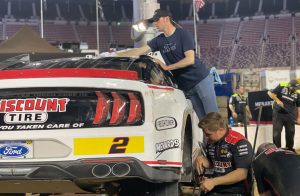
Cindric shared that he thought we were seeing some of these suspension components breaking or bending due to the nature of the wall at Bristol being harder than what is seen at some of the larger ovals.
The good news for most teams is that even though there were plenty of right-side impacts, there weren’t a lot of suspension repairs as the composite body on the Next Gen car took the impacts well and snapped back into shape immediately after impact in most cases. Many of the impacts were light enough that the only repair that was required was the replacement of some vinyl. As the No. 11 crew was able to complete the suspension repair prior to the start of the second practice, the team was able to spend time cleaning their car and fixing vinyl after the conclusion of the final practice.
While Bristol dirt might be trying to compete with Darlington for the honor of having a signature stripe, the modularity of the suspension components on the Next Gen car and the composite body panels meant that most repairs could be completed quickly and crews would be able to make it to dinner at a reasonable time.