For 17 consecutive years, the final descent into Daytona Beach International Airport in February has seemed the unofficial start of the NASCAR season for Joey Logano.
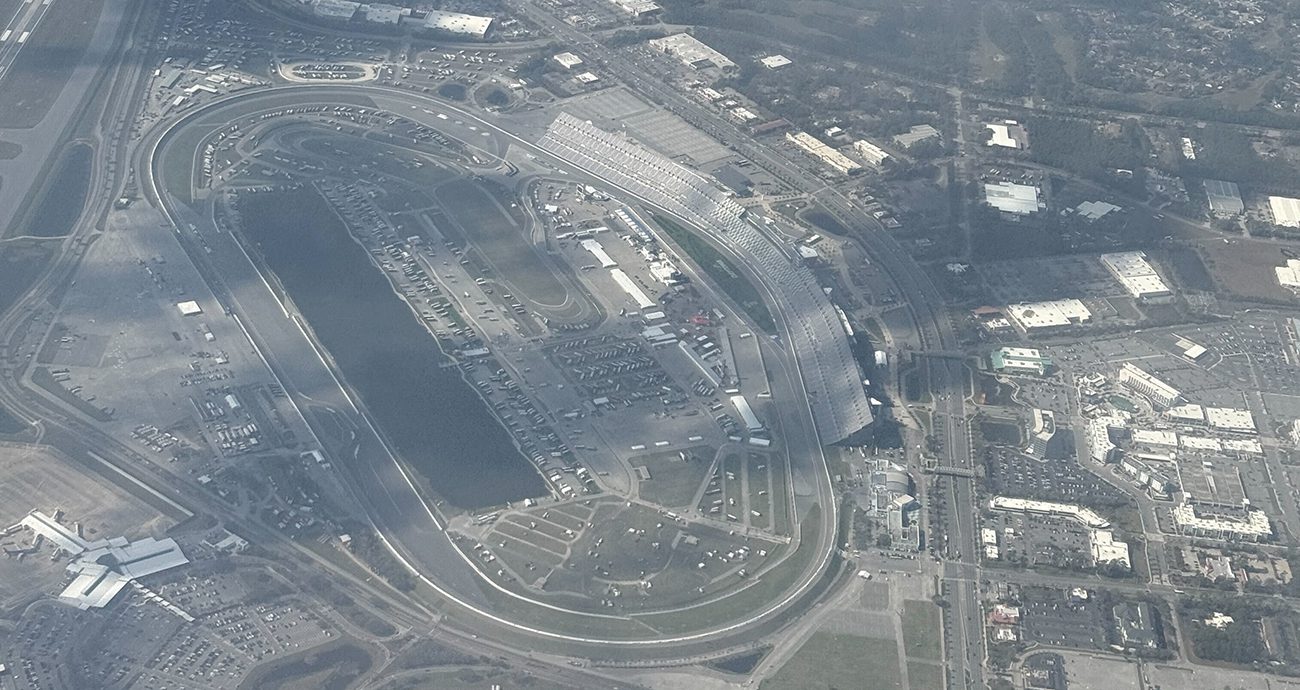
The approach offers a jaw-droppingly sprawling vista of the 2.5-mile home to the Daytona 500 that kicks off the year annually.
“It’s still cool, and it never changes,” the three-time Cup Series champion said. “I always enjoy the first flight of the year because you get on, and everyone is excited. You land right next to the race track, then you drive right into the tunnel, and it’s, ‘OK, a new year, here we go.’ That magic to me has never left.
“It is more fun now to do that with your kids. My oldest being 7, he gets excited when he sees the race track flying in now. He’s like, ‘Oh, it’s right there!’ and you’re landing, and he’s still talking about it. That’s a little extra special moment.”
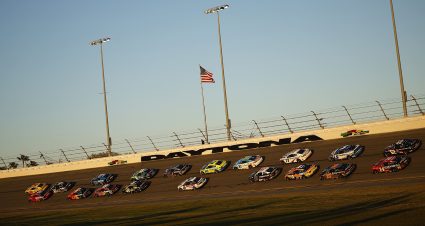
From sheer physical proximity to an awe-inspiring arrival zone, Daytona Beach International Airport is the literal doorstep to Daytona International Speedway.
It’s fewer than five minutes from the unloading zone on Catalina Drive to the Turn 4 tunnel – making it the shortest trip from an airport to virtually any major sports stadium in the country.
The track actually occupies 376 of the airport’s 2,000 acres. It’s a swath that cuts through Turns 2 and 3 and is leased by the track for facility buildings and parking lots (DAB counts DIS among its oldest long-term tenants).
That next-door presence has made the airport synonymous with some of the most iconic images in the speedway’s history.
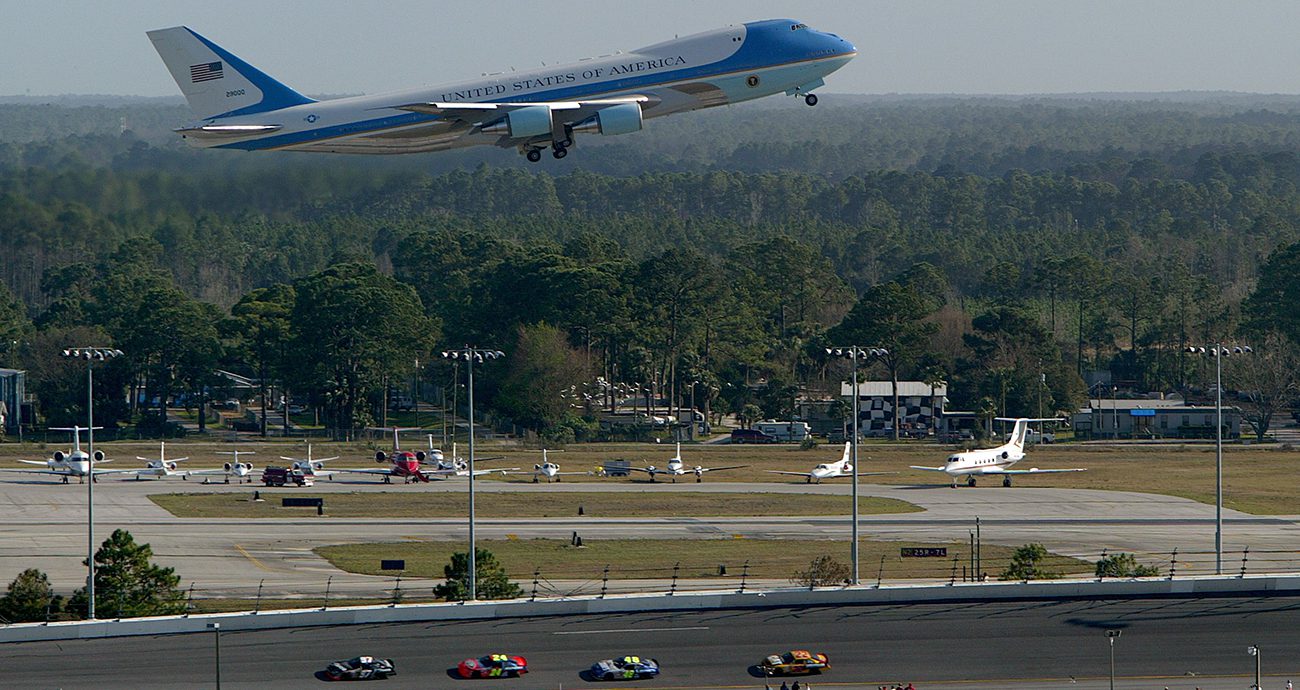
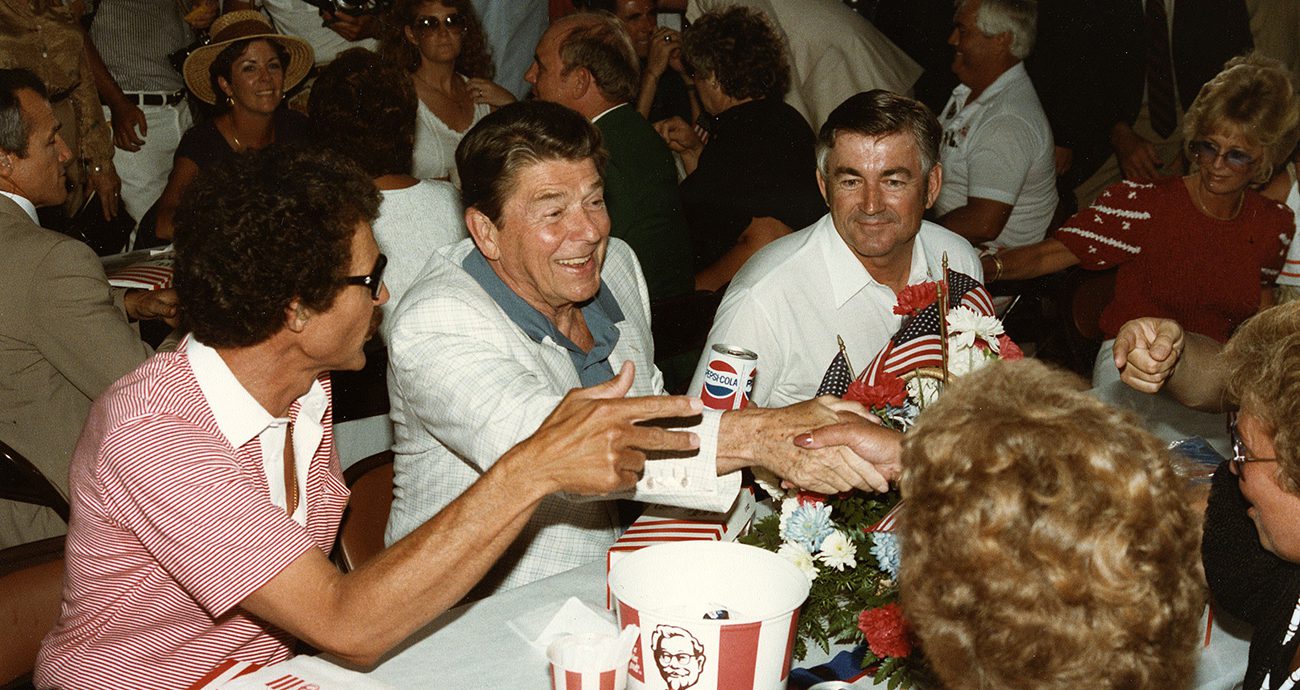
There have been four DAB landings by Air Force One during NASCAR weekends, including a very famous arrival by President Ronald Reagan during Richard Petty’s 200th and final victory.
“I think the airport is such a critical component in the success of NASCAR at the World Center of Racing, from presidents of the United States to presidents of the FIA,” track president Frank Kelleher said. “The ease and the luxury that it is right behind the backstretch and with the police escort, you quickly can get right to at the start-finish line.
“It’s one of the busiest airports in the state of Florida, and when you stack on from the Rolex 24, through the Daytona 500 through the conclusion of Supercross, it’s got to just be a breathtaking number of jets in and out.”
Airports have played a longtime intrinsic role in NASCAR. The Cup Series’ first road course race was held June 13, 1954 at an airport in Linden, New Jersey (Al Keller won in a Jaguar). Many tracks (namely Atlanta Motor Speedway and Talladega Superspeedway) lay claim to having adjacent airstrips.
But DAB is unique in having commercial flights that link the World Center of Racing to the outside world in a way unlike any other speedway.
Air traffic spikes during Speedweeks with nearly 10,000 flying in and out of the 175,000-square-foot airport that has six gates and an international terminal. This year, Friday was busiest with an additional eight flights, more than doubling the arriving passenger capacity to 2,300. Undoubtedly, at least a few were fans visiting NASCAR’s cathedral of speed for the first time.
Flying in from the west over I-95 and its nearby junctions with I-4 and International Speedway Boulevard, they were treated with an eye-popping introduction to the speedway. The runway is so close, it’s easy to read the car numbers on the scoring pylon.
“Years ago, we used to have a slogan, ‘If you land any closer to the speedway, you’d be on the backstretch,’ ” said airport director Karen Feaster, who has worked at DAB for 32 years.
Feaster said the speedway and airport have a tight working relationship reflective of their neighborly location.
During a recent hurricane season, an Aer Lingus flight from Orlando to Dublin was diverted to DAB for a late-night emergency landing that created a scramble to find lodging. Noticing several Florida Power & Light buses were staged in the DIS parking lot, airport officials called the track, which helped coordinate busing the stranded passengers out of Daytona within an hour.
The airport and speedway regularly meet about their big events and prepare contingency plans. In a triennial drill to test the airport’s emergency response, the track took part in simulating a plane crash into Lake Lloyd, assembling hundreds of first responders in the infield.
“We’re very intertwined, and they work very well with us,” Feaster said of the Daytona track. “They’re always open to help in any way they can, and we are as well. So it’s just really nice having that relationship.”
The airport’s operations and security team also work with Daytona International Speedway for the logistics of accommodating special guests and VIPs, such as Air Force One and the motorcade of more than 100 vehicles for the short drive to the track.
Reagan’s July 4, 1984 visit was the first to a NASCAR race by a sitting president, followed by George H.W. Bush on July 4, 1992, George W. Bush on Feb. 15, 2004 and Donald Trump on Feb. 16, 2020.
Each gave the command to start engines, and Reagan famously delivered his address while in flight. His landing at DAB was captured on national TV as a memorable backstretch backdrop for stock cars racing near halfway of the Firecracker 400.
Reagan witnessed the final 50 laps from the press box and then congratulated Petty in person at an “invitation-only” postrace picnic that drew a crowd of 1,200.
“It just blew his mind that we were running at each other like that at 200 mph,” Petty later told reporters while chomping a victory cigar. “He couldn’t believe we were touching at those speeds.”
During his high-profile stay, Reagan anointed NASCAR as “a major American sport” in praising drivers for a courageous display.
“We are celebrating our country’s birthday and the skill and daring of our forefathers,” Reagan said. “If Patrick Henry had been here, from what I’ve read about him, he would have been out there in one of those cars.”
Aside from sharing property, the airport and race track also share daredevil roots in the white sands of the world’s most famous beach.
At roughly the same time that stock cars began zooming around the famous south and north turns on the road course along A1A, the beach also was serving as a runway for pilots who were hired by upscale hotels to provide entertainment for guests. With a growing need for airmail deliveries, it eventually morphed into the first airport in Volusia County.
It moved from the beach to Bethune Point along the Halifax River in 1928. Two years later (and near 30 years before Daytona International Speedway was born), the airport was moved to its current location and became a pilot training ground during World War II.
Terminal construction began in 1942 to establish a new gateway to the city then known as “the Atlantic City of the South.” Volusia County took over management in 1969, and the newly rechristened Daytona Beach International Airport unveiled a $47 million renovation in 1992 with a 10,500-foot runway extension and widened access roads snaking around the speedway.
DAB endured rocky years before and after Sept. 11 (with the departure of US Airways and Continental, only Delta remained with six daily flights at the end of 2001). But the airport has rebounded well in the 21st century as a quieter alternative to the vacationing throngs of families who swarm Orlando.
In a 2022 economic impact study, the Florida Department of Transportation estimated DAB generates $3.2 billion annually for the region (up from $2.1 billion in 2019), and more than 719,000 flew through the airport last year. With a high volume of flight training for nearby Embry-Riddle Aeronautical University, DAB consistently ranks as Florida’s fifth-busiest airport – and Speedweeks ensures February typically is its craziest month.
Delta added flights this week from New York’s LaGuardia and Detroit, and American brought in extra planes from Dallas-Fort Worth and Washington, D.C. New DAB carrier Breeze used Speedweeks to launch twice weekly flights to Westchester County, New York, Providence, Rhode Island, Hartford, Connecticut, and Raleigh, North Carolina.
The airport runs promotions to highlight its NASCAR connections (two-time Daytona 500 winner Michael Waltrip recently was a celebrity bartender and greeter). Joanne Magley, the director of air service, marketing and customer experience at DAB, said the race track sells itself when there are cars on track.
“The exposure during events at DIS is very valuable, mainly for visitors who may not realize Daytona Beach has a commercial airport,” she said. “Anytime there’s racing going, you can hear the race cars all the time, so imagine if you’re a visitor just getting off the plane, and you’re hearing that already.”
Even those immersed in racing can be awed. When he flew in for an ARCA test, Alex Bowman recalls being shocked at “how big the race track and the facility are and just the magnitude of everything” from the majestic bird’s-eye view.
“Landing next to the race track is always really special,” Bowman said. “It definitely kind of feels like that first day of the year at school.”
Nate Ryan has written about NASCAR since 1996 while working at the San Bernardino Sun, Richmond Times-Dispatch, USA TODAY and for the past 10 years at NBC Sports Digital. He also has covered various other motorsports, including the IndyCar and IMSA series.