Sunday’s Cook Out 400 at Martinsville Speedway may only be the seventh race on the 2025 NASCAR Cup Series calendar, but it marks an important pivot point nonetheless.
Much like Phoenix and Las Vegas earlier this month, Martinsville will be the site of a crucial late-playoffs race in the fall, so any information gleaned here will be important for planning for the final transfer race to determine the Championship 4. And just like Homestead last week, Martinsville will also give us clues about contenders over the rest of the schedule because it marks the first of six short-track races (not counting the exhibitions at Bowman Gray and North Wilkesboro).
So those are the big-picture stakes for Sunday afternoon. But there are also personal stakes for each driver — and perhaps none more than for the drivers we expect to do well at Martinsville. These drivers need to live up to projections to keep pace with their own expectations for the season … or maybe even just to salvage something good from a rough start.
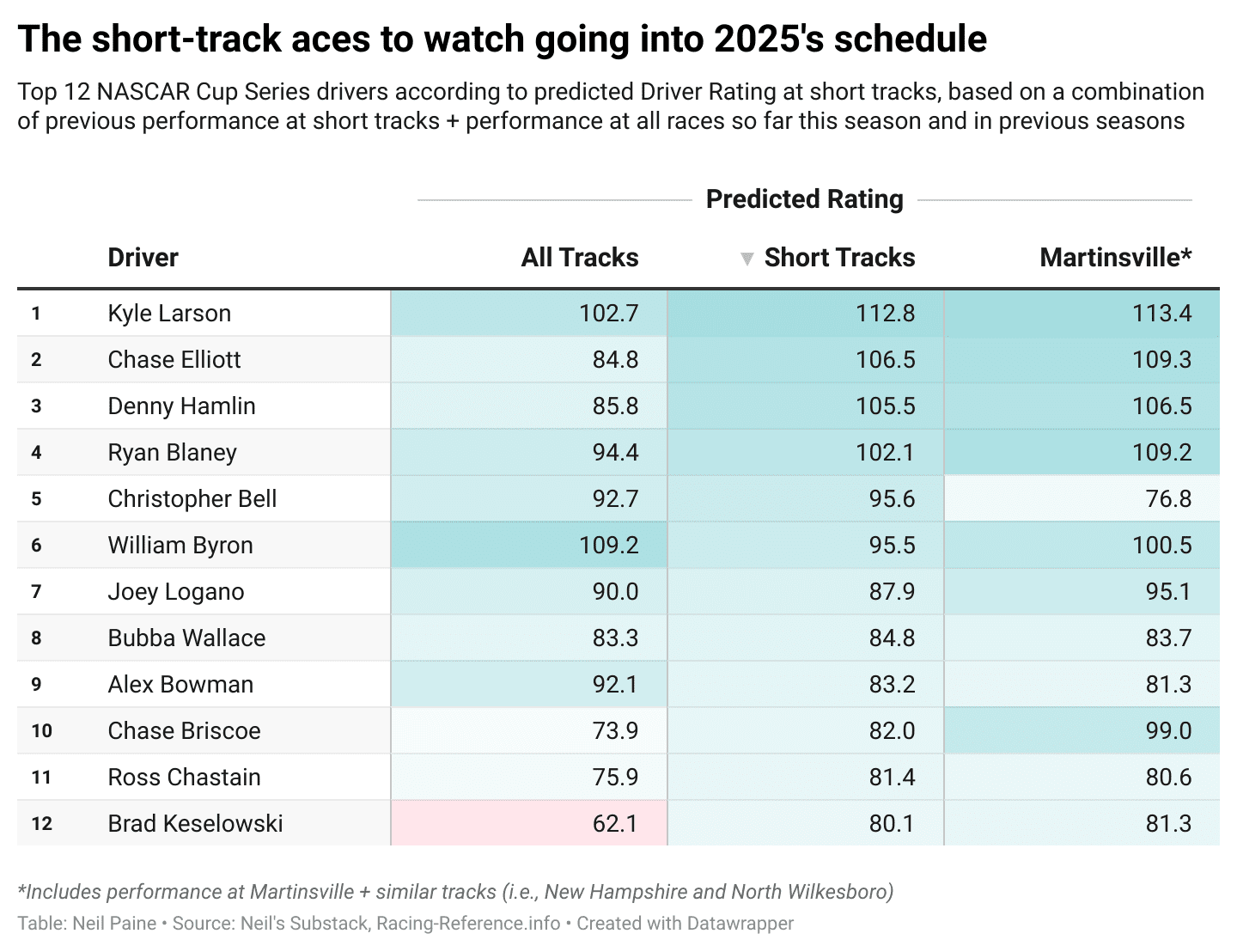
As we head into the first short track race of the season, let’s take a look at the top 12 drivers in my current predicted Driver Rating rankings for these types of tracks — grouping them by what’s at stake for each, and what they’ll be aiming to accomplish on race day.
Tier 1: Keep it rolling
There isn’t much to complain about with the seasons of Kyle Larson, Christopher Bell and William Byron. Bell and Byron combined to win each of the season’s first four races, and Larson just scored what was probably an overdue first win of the season at Homestead to re-establish his place in the pecking order of title favorites. All have good previous records on short tracks, with Bell posting a 95.1 career Driver Rating on the track type (fourth-best among active Cup regulars, behind Denny Hamlin, Kyle Busch and Chase Elliott), Larson riding a streak of three straight years with an average rating of 103.0 or better and Byron improving from an average rating of 85.7 in 2023 to a 93.4 in 2024.
The interesting thing for Bell is that his recent performance on short tracks is carried by his performance pretty much everywhere except Martinsville, despite his clutch win there in 2022. While Larson has an elite rating at any short track, and Byron is markedly better at Martinsville than elsewhere, Bell has a huge split in the opposite direction:
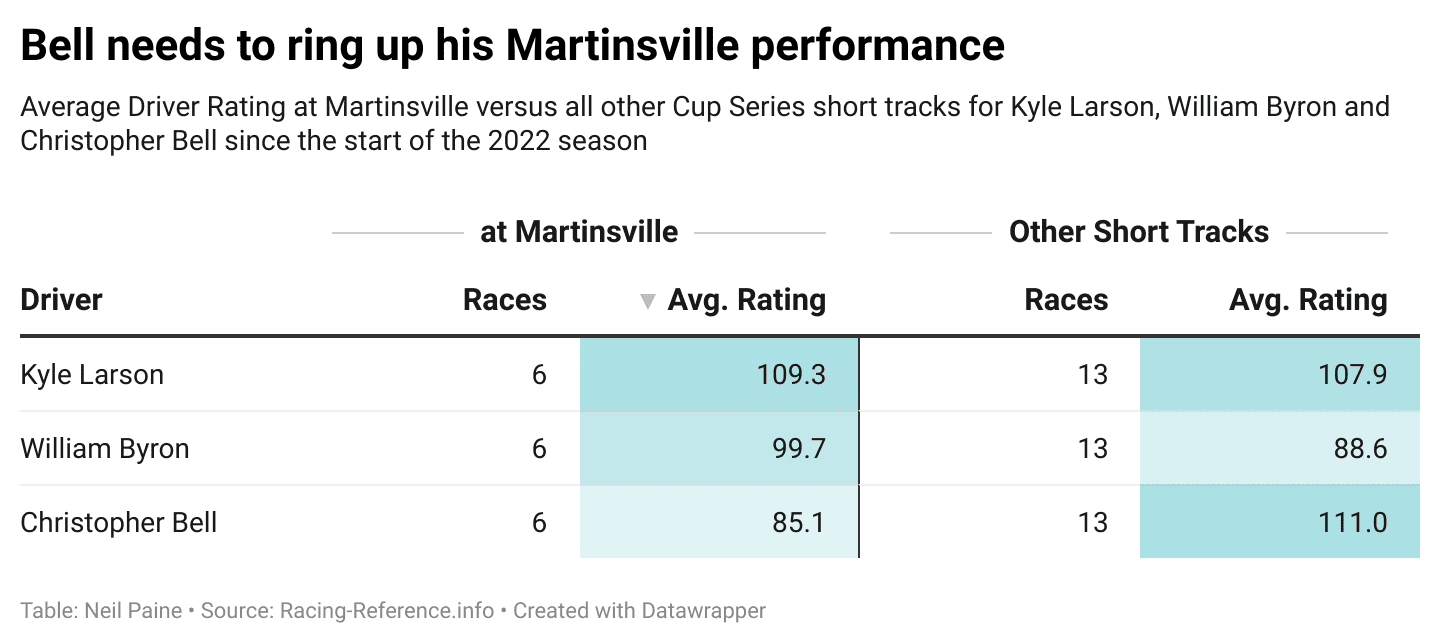
Surely, Bell would love to see a reversal in that trend, given how important Martinsville is to making the Championship 4 — remember, his 22nd-place finish there last fall cost him a spot by just one place. But otherwise, these guys won’t feel pressure aside from keeping the momentum going and gathering more data for playoff prep.
Tier 2: Solid, seeking a breakthrough
No active driver has been better at short tracks over the years than Denny Hamlin, according to Driver Rating — and he’s been especially dominant at Martinsville, where his five grandfather clocks are the most among active drivers. At No. 8 in the standings, he’s not exactly in desperation mode, though an 81.3 average Driver Rating this season is less dominant than we’re used to seeing from him. In a place where track position has been at a premium in the Next Gen era, we may not get to see Denny try to improve on his 15th-place ranking in Racing Insights’ new passing metric, but he will certainly put his No. 12 ranking on restarts to the test.
We’re also on the lookout for big days from Chase Elliott and Ryan Blaney, two of the top projected short-track drivers, particularly at Martinsville. The pair come to Virginia having had mirror-image seasons of sorts: Elliott consistently grinding out a very solid 12.8 average finish despite a lack of dominance (80.3 average Driver Rating, just one top five and zero wins), while Blaney has shown tremendous speed (fourth per Racing Insights) and passing ability (first) but has also blown two engines already and was running at the finish of only half the races so far. Blaney sits 10th in the standings and has more urgency for a strong day — or really just a clean race — but this is a golden opportunity for both drivers to ignite a title chase.
And finally, Alex Bowman and Bubba Wallace are a pair of interesting names for this tier: On the one hand, neither is a Martinsville master, despite Bowman having a win from 2021. Both have been inconsistent at short tracks over the years — Bowman and Wallace own fairly unspectacular career Driver Ratings of 73.5 and 69.2, respectively, although both have improved in recent years — so they are not especially high on the list of favorites for this weekend. However, Bowman is third in the standings with an average finish (9.5) that ranks second only to Byron. And while Wallace hasn’t had quite that same consistency of finishes (his average is 19.7), he ranks ninth in Driver Rating and No. 7 in points. These guys may not be looking at a checker, but any kind of good finish for either would be gravy, given their points placement early this year.
Tier 3: Time to make some noise
Joey Logano, Chase Briscoe and Ross Chastain all rank outside the Top 10 in points, even though they’ve landed there for a few different reasons. But the common thread is that this group is starting to feel urgency for results — with a good chance to get them this weekend.
For Chastain and Briscoe, they’ve lacked speed and have finagled some halfway-decent finishes (three combined top fives, four top 10s) almost purely on the strength of their racecraft. But their average running positions this season are 17.8 and 19.2, respectively, and they’ve both spent around only 50% of laps running in the Top 15 on average (Chastain 56.8%, Briscoe 44.9%). It’s still nice to make something out of nothing when you don’t have the horses to gallop to the front, and Martinsville is where savvy matters more than the average track. Briscoe is especially good at this: his average career Driver Rating is far higher on short tracks (77.7) than it is overall (67.2).
As for Logano, the pace hasn’t been an issue – he ranks seventh in Racing Insights’ new speed metric, to go with ranking sixth in passing and third in defense. (You think the latter two skills might come in handy at a track where bump-and-run maneuvers, like the one Joey did to Martin Truex Jr. in 2018, are an art form?) But the finishes haven’t followed, as the No. 22 car has a grand total of zero wins, zero top fives and zero top 10s in six starts this year. Logano still ranks 11th in points, but he needs some strong finishes. Why not get that started at the place where he’s won before and has a career Driver Rating of 96.8?
Tier 4: Desperate for signs of life
To say Brad Keselowski isn’t enjoying a vintage start to 2025 would be the season’s biggest understatement.
Just like Logano, Brad K. has zero top 10s – but unlike his longtime former Penske teammate, Keselowski’s underlying numbers do not suggest a process that will eventually yield results. He currently ranks 27th out of 36 Cup regulars in average Driver Rating (58.7, sandwiched between Todd Gilliland and Justin Haley), 32nd in average finish (25.0) and 33rd in Adjusted Points+ Index (52, or 48% worse than average). While he ranks 12th on defense, Keselowski is outside the Top 20 in each of Racing Insights’ other performance metrics.
And because of all this, he also ranks an unthinkably distant (and career-worst as a regular) 30th in points, far from the playoff cutline.
With all of the other drivers above, it’s far too early to call Martinsville a make-or-break race. But for Keselowski, that might actually be true. As a two-time winner there, and one of the sport’s top short track racers, he must drive to a respectable finish just to keep pace with any kind of expectations for a turnaround. Without a good run at what has traditionally been his best track type, what hope is there for Keselowski to perform well elsewhere?