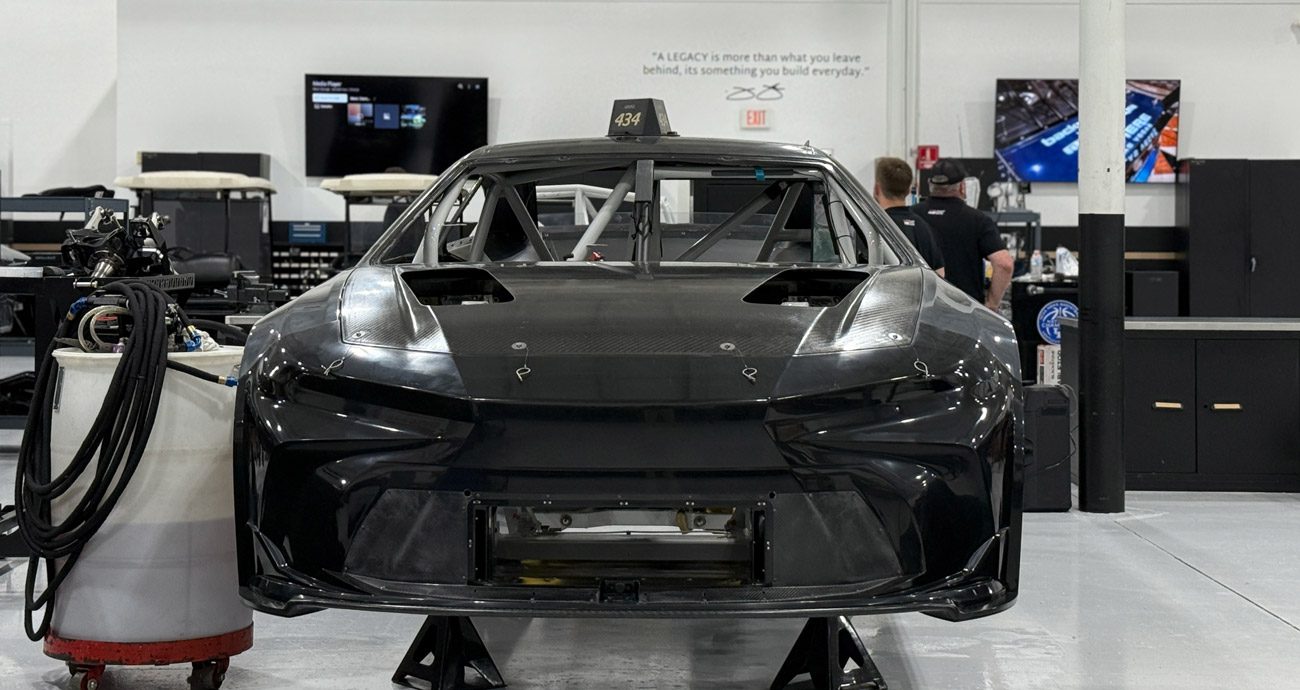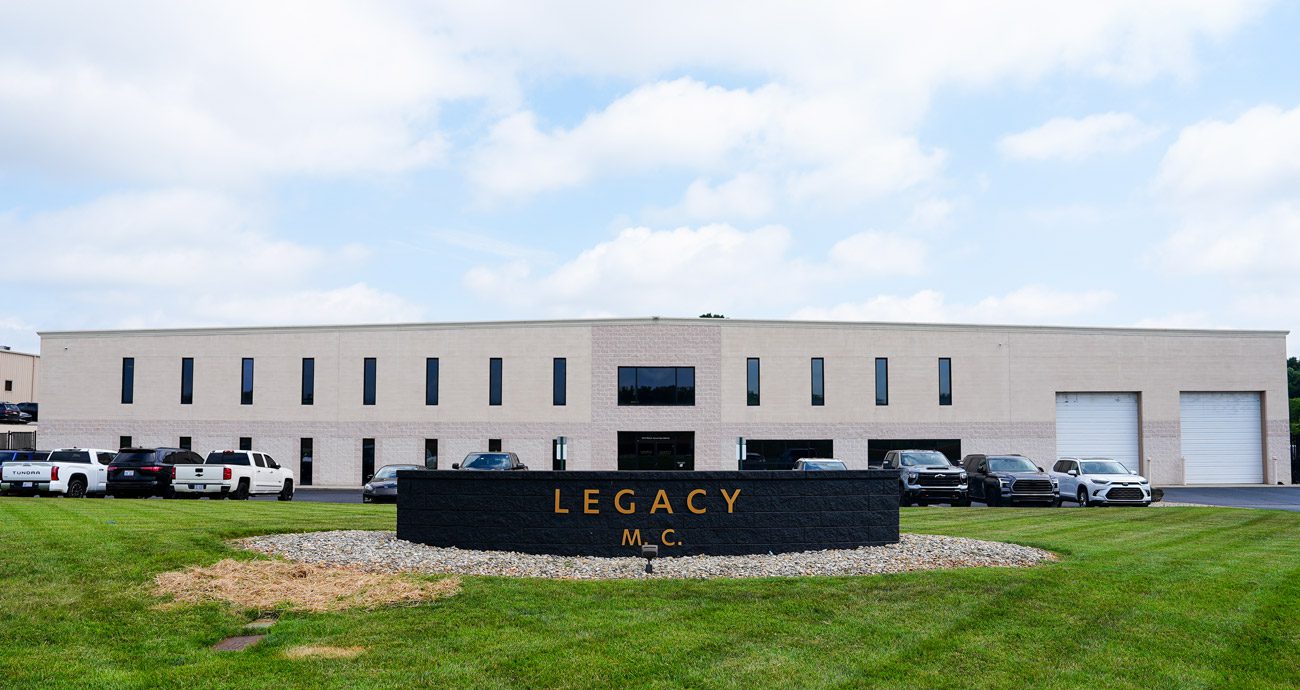
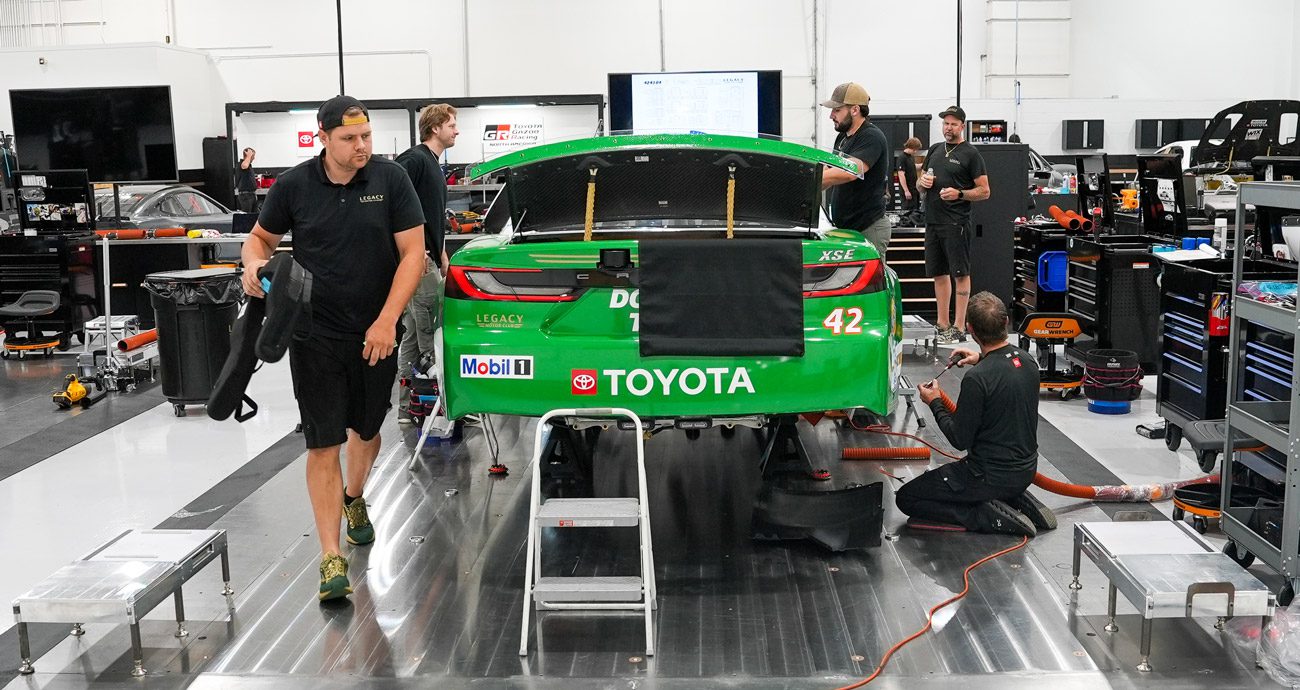
STATESVILLE, N.C. — Thin cardboard boxes are strewn throughout the upper levels of Legacy Motor Club. Soon-to-be-completed desks and workspaces are slowly unpackaged and assembled — not by outside installers, but by the same hands that piece together the Nos. 42 and 43 Toyotas driven each weekend by John Hunter Nemechek and Erik Jones.
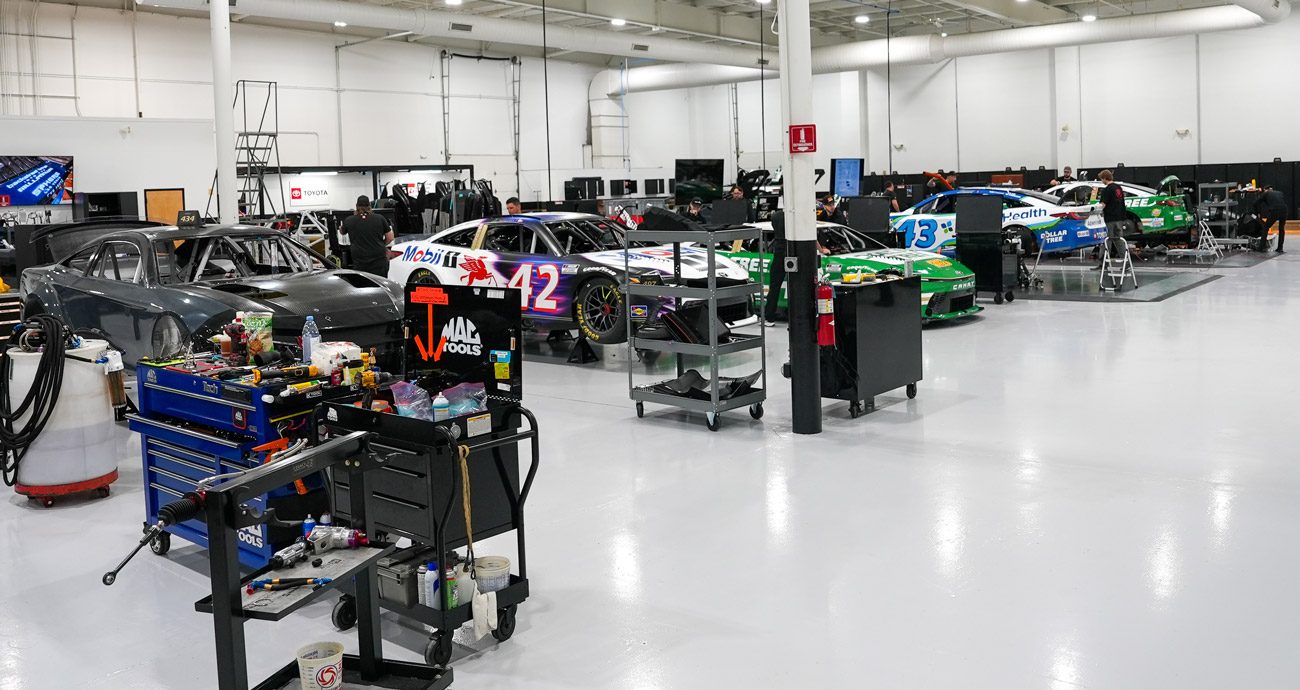
Downstairs on the shop floor where those men and women perform their day jobs sit roughly a dozen Next Gen chassis, ranging in stages from fully completed race cars to shells of bare-bone chassis clips. Alongside them in one corner are pallets of furniture, couches wrapped in the plastic they arrived in, waiting to be placed in their future locations.
“We don’t have furniture installers,” shop foreman Tony Cardamone tells NASCAR.com. “It’s our guys, so we have to break away from a car to do this stuff. It’s just stuff that we have to do that people don’t see. But we’re all doing it for the right reason.”
Why? To drive Legacy Motor Club forward together as one, an intentional deviation from past years that those within the shop have witnessed over the last 12 months.
MORE: Cup standings
Collectively, those who don the black and gold of Legacy Motor Club have bought into the visions implemented and set forth by Jimmie Johnson, the seven-time NASCAR Cup Series champion and majority owner of Legacy. And after years of struggling to find its footing, Legacy is reaping the rewards as Jones and Nemechek begin to bring their cars to prominence.
“Jimmie’s vision is to make it a club where everyone feels a part of it, everyone wants to work hard,” Nemechek told NASCAR.com. “And everyone wants to do that at every race team, right? But there are some that are strictly business, per se, and there are some that feel like one big family. And I think that that’s kind of the vision that Jimmie has, is to make it one big family and to make it a club that everyone is a part of — and when there are successes, that everyone feels that.”
Seemingly everything at Legacy has changed over the past two years — and more is anticipated as the team continues to grow both figuratively and literally.
A wave of leadership hires started in July 2023 when former race-team owner Cal Wells III joined as the team’s CEO, helping oversee the program’s shift from Chevrolet in 2023 to Toyota in 2024. Amid admittedly considerable struggles as the organization adapted to its new manufacturer partner, Jacob Canter was hired in August 2024 as the team’s director of competition after spending nearly 16 years at Joe Gibbs Racing, first as a race engineer and lastly as its Research and Development Team Manager. His hiring coincided with Bobby Kennedy’s as the program’s general manager, which was then a new position at Legacy. Former Hendrick Motorsports and Team Penske employee Brian Campe was then added to the team’s roster in October 2024 as Legacy’s technical director.
Those moves all culminated in January, when Johnson became the majority owner of Legacy Motor Club in a partnership with Knighthead Capital Management, LLC. Former team co-owner Maury Gallagher stepped back as part of the deal after 12 years heading GMS Racing, a title-winning organization across the Craftsman Truck Series and ARCA Menards Series before acquiring Richard Petty Motorsports in 2021 to forge Petty GMS in 2022.
The 2025 statistics prove the changes are paying off, even if those results didn’t come immediately. Through 19 races, the team has racked up 10 top-10 finishes – seven of which came in the last nine races. At least one of the program’s drivers has finished inside the top 10 in six of the last nine races; Legacy only ended with a driver inside the top 10 in two of the first 10 this season.
Results are the ultimate measuring tool in a hypercompetitive sport. The measuring sticks, so far, are in the team’s favor. The inaugural In-Season Challenge highlights both Jones (the No. 20 seed) and Nemechek (No. 12) as they have advanced to the third round, where they will face off against each other Sunday at Sonoma Raceway (3:30 p.m. ET, TNT Sports/truTV, HBO Max, PRN Radio, SiriusXM NASCAR Radio) as two of just eight drivers remaining for a $1 million prize.
Legacy Motor Club
| 2024 | 2025 (through 19 races) | |
|---|---|---|
| Top fives | 1 | 4 |
| Top 10s | 6 | 10 |
| Average finish | 24.9 | 19 |
| No. 42 points position | 34th | 20th |
| No. 43 points position | 28th | 17th |
The goal was always to compete for race wins — something Jones did in 2022, winning the Southern 500 at Darlington Raceway for then-Petty GMS. But Jones said the ability to drive further forward was hindered.
“There was, for a while, just a lack of leadership,” Jones said. “Especially in racing, you need to have an engineering group, an engineering flow chart. People need to have positions, people to report to. And we lacked that structure in our company until Brian and Jacob came around and they were able to set that up. We had some good people, like I said, but we had to give them positions and places to go and people to report (to). Once that was in place is when we started to see things improve.”
Upon his arrival and taking in the lay of the land, Canter made solving that disorganization one of his immediate focuses.
“The way it was laid out prior, there was a lot of silos, per se,” said Canter. “Physical division becomes more real and hurts communication. So we’ve tried to really open it up and open up our workflow to encourage communication. When you put people together closer together physically, then it forces more of that communication. And then it starts to become more organic and more natural. Then you start to bear fruit from it because the guys know who to go to. They know who to talk to.”
But for as much work was needed, so too was patience. While Canter saw things to change — like physically changing the layout of the building to enhance communication — he and the team’s leaders recognized they couldn’t implement every new idea overnight, and that it instead needed to be a process.
“This offseason, we had a real big line in the sand: ‘Hey, let’s start fresh,’ ” Canter said.
Such a pivot, he and Campe recognized, can be difficult for longtime employees to accept immediately.
“It’s hard when you’re working somewhere and everyone comes down and like, ‘We’re starting fresh tomorrow! Whole new program!’ ” Canter said. “That can feel like a slap in the face. Our group, collectively, everyone bought in and was like, ‘How can we be better?’ And that ‘how can we be better?’ is still present today.”
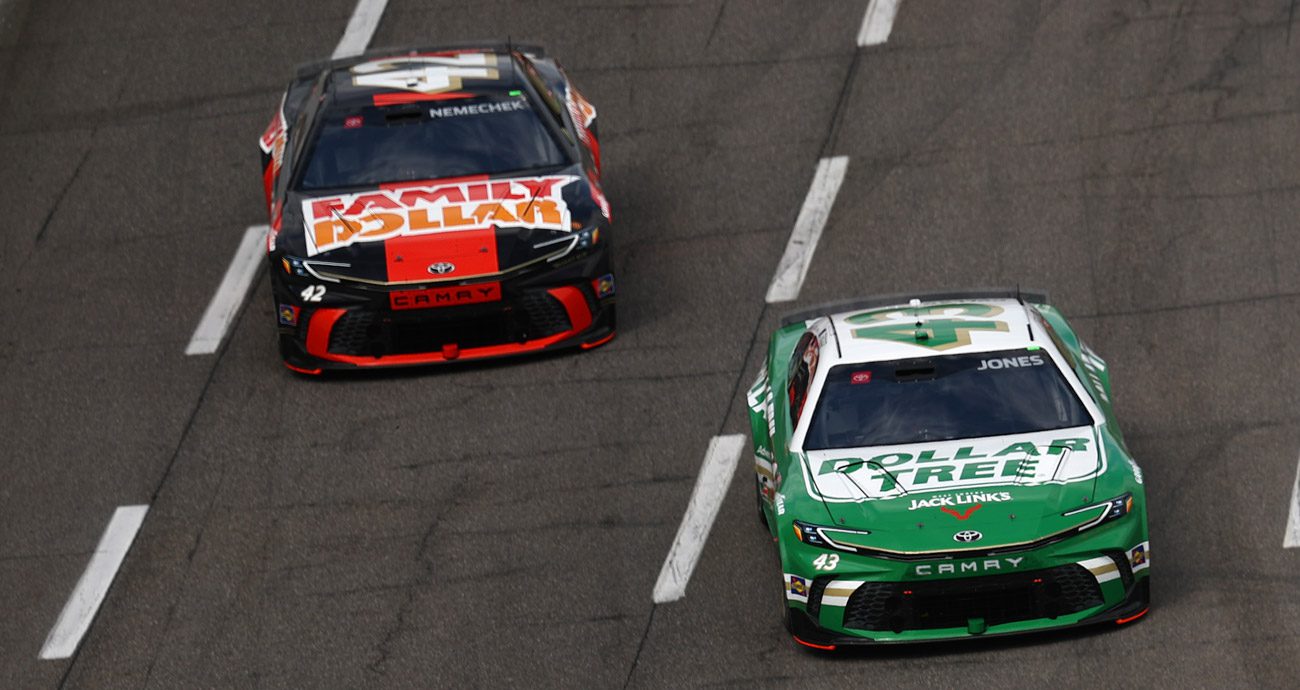
A keen example came in April. Nemechek finished 30th, one lap down at Talladega Superspeedway after the season’s lone off week. The No. 42 team’s single biggest hiccup came at Lap 112, when Nemechek spun exiting pit road under green-flag conditions.
“We had a miserable race,” Campe recalled. “The cars didn’t have speed. We missed on the execution side. We made mistakes on pit road, and I think that was right after the Easter break. And we had a lot of hard conversations in small groups with ownership to individually within our groups of, ‘OK, hey, this isn’t working. What needs to change?’ We laid this stuff bare on the table. And we said, ‘OK, there are 30 things. Here’s the five we’re gonna go do to get better.’
“And I felt so confident that the team — and that’s everyone here — had made those right decisions. After the race, I went up to John Hunter, and I said, ‘You’ll have a better car in Texas.’ “
Nemechek remembers the moment well, in large part because he was incredulous at Campe’s promise.
“To be honest, I didn’t believe him,” Nemechek said. “When he said, ‘Hey, we’re gonna have way better race cars when we come back,’ well, how does that happen? Right? Like, what is that?”
Flash forward to the following week at Texas Motor Speedway: Lining up for the race’s final overtime restart, Jones and Nemechek were both inside the top 10, with Jones fourth and Nemechek ninth, a chance to win in hand.
“That was the moment for me,” Campe said. “I was like, OK, we have the right people. We’re trusting the process. Everyone’s bought into this. Now it’s my job, Jacob’s job, Bobby’s job, Cal, Jimmie’s to build the 43 feet of road ahead to make sure we just continue on down that path.”
“I think it was a lot of small things,” Nemechek said. “But I also think it’s the buy-in from everyone that works at the shop and everyone that works on both the 42 and 43.”
The collective jostling around Legacy centered on the common vision laid out by Johnson, a seven-time series champion who has climbed into a No. 84 Legacy Toyota to compete in a handful of races for the past three seasons. Nine different team members — ranging from drivers to crew chiefs to crew members and directors — mentioned Johnson’s leadership as a key guide toward their willingness to buy into Legacy’s future and ultimate uptick in performance.
In the nine races from Talladega through Atlanta Motor Speedway on June 28, Jones tallied the sixth-most points in the Cup Series while posting two top fives, three top 10s and eight top-20 finishes in that span.
“It’s just kind of a mentality of it was time to turn it around,” Jones said. “I felt like we had good tracks coming up. We had been putting more and more speed in our cars. I would say right around Charlotte is probably the time things started to go good. I kind of reset on my own and said, ‘All right, I need to do the things that I do well again and just focus on what I can control and try to make it work.’ And about that time, cars started getting better, (and) I felt like I started making good decisions. And since then, it’s worked out really well.
“We haven’t always got the finishes, I think, that we’ve been capable of, but we’ve ran well in stages and got a ton of points. So it’s all going to come together more and more. The more you bring top-10 cars, that’s going to come your way more consistently. But the points rally has been probably the biggest, I think, in my career.”
There are no delusions held within the shop. Their work isn’t done, and they are not yet where they would like to be. But they know where they’d like to be.
“The next realistic step is to win a race in the next [eight],” Campe said. “That’s everybody’s goal is to get into the playoffs. It’s tangible. It’s not just a ‘roll your eyes after the technical director says it in a meeting.’ … I hope everyone here believes that it’s possible.”
On the shop floor is where much of the magic happens to make those once-lofty goals possible. There is a camaraderie throughout the expansive garage — lighthearted as Nemechek rolls past on his scooter and laughs with crewmen but diligent as tasks are completed. On the back wall stands a quote from Johnson himself: “A Legacy is more than what you leave behind; it’s something you build every day.”
What is being built now is an opportunity. What was once improbable is now not just possible — it lies within the grasp of a club trying to build its legacy.