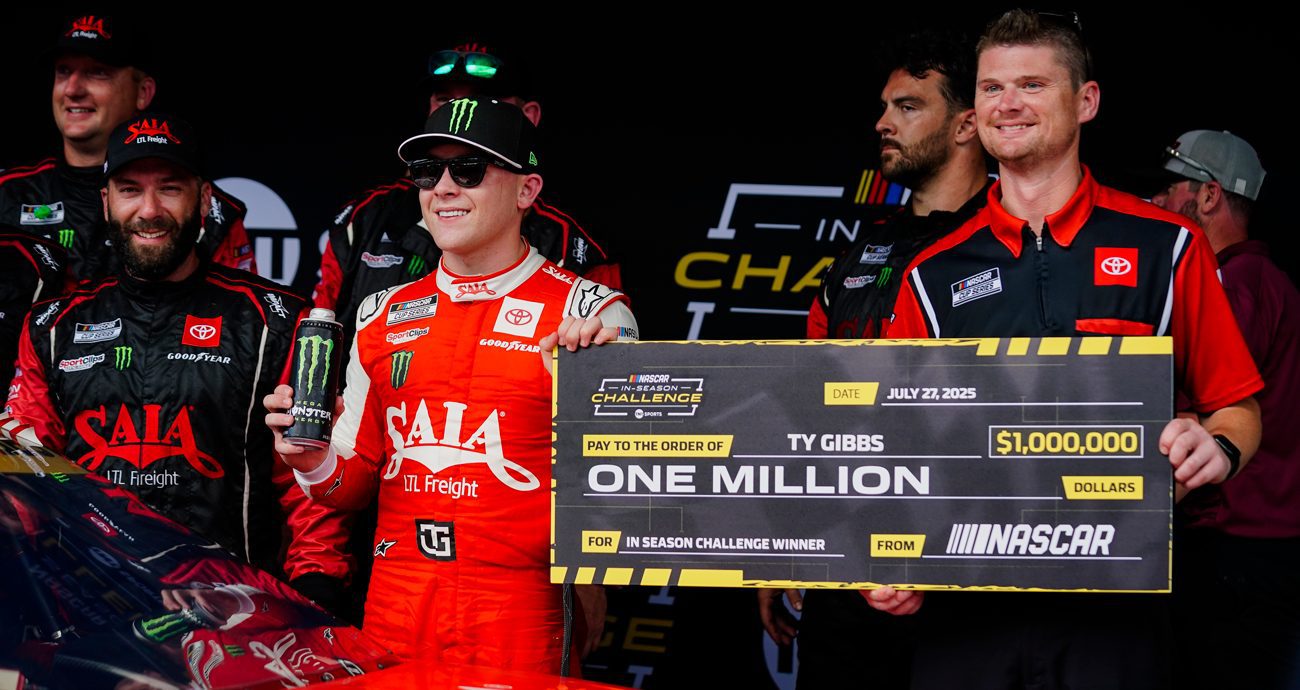
NASCAR’s inaugural In-Season Challenge is now in the books, and Ty Gibbs is officially your first-ever champion. The No. 6 seed in the bracket, Gibbs survived what was hardly an easy path to the final, capped off by outlasting Cinderella No. 32 Ty Dillon in the finale on Sunday at Indianapolis Motor Speedway. The head-to-head win earned the 22-year-old Gibbs a $1 million bonus, and it provided the conclusion to what was an interesting new experiment in NASCAR’s season structure.
So now that the Challenge is in the rearview mirror, it’s worth asking what worked … and what didn’t? So, let’s dive into six big takeaways from the In-Season Challenge — three things it got right, and three areas where there’s room to improve:
It spiced up the midseason calendar.
One of the challenges in today’s sports media landscape is maintaining momentum with fan interest through a full schedule of both regular-season and playoff events — and few leagues have a longer schedule than NASCAR. Here’s a plot of the calendar months in which the sport is active, compared with eight other major American pro leagues:
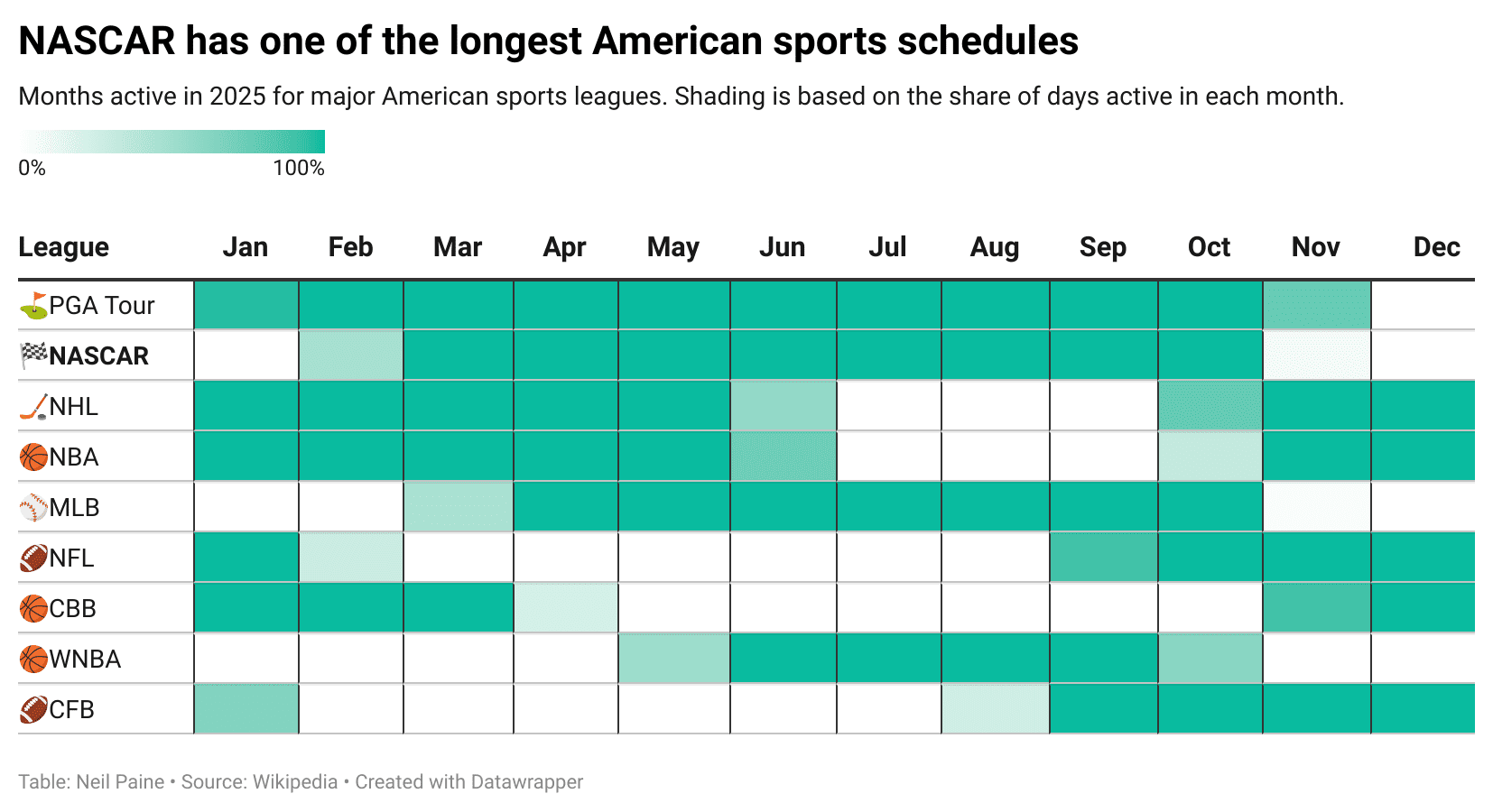
While golf (at 10.7 active months!) has NASCAR beat for the longest season, the Cup Series does check in at No. 2 with 8.5 active months, beating out the NHL’s mark of 8.3. And the midpoint of the NASCAR schedule comes smack-dab in the heat of the summer, when the rest of the sports calendar slows down a bit and fans’ minds might be shifting gears to vacations and off-field headlines in other leagues.
So the In-Season Challenge represented an opportunity to shake up the dog days a bit and inject some competitive urgency into a time of year when the schedule can otherwise feel like a grind. Not coincidentally, this is the same reason the NBA stages its own in-season tournament during the early part of its schedule, when fan interest tends to lag otherwise.
Sure, the big picture of the standings, the playoffs and the championship race remained on everyone’s minds, and natural subplots like Shane van Gisbergen’s road-course dominance took over at times. But the In-Season Challenge also ensured that we’d have higher-than-normal stakes for the midseason races this year — and that was a welcome change of pace.
The knockout format begs for brackets to be filled out.
The NCAA men’s and women’s basketball tournaments are among the most popular events on the sporting calendar, and one huge contributing factor is a widespread culture of office pools and various other bracket-picking contests. ESPN reported a record 24.4 million entries for its annual Men’s Tournament Challenge in 2025, and an AP poll from March showed that 26% of U.S. adults fill out a men’s March Madness bracket “every year” or “some years,” with 16% saying they did the same for the women’s tourney as well.
Obviously, a brand-new NASCAR in-season tournament is not going to have the same cultural sway as an American institution like March Madness. But tapping into that same bracket-building impulse is a good idea all the same. And while the desire to wager is a big part of office pools’ appeal, that same AP poll reported that just as many or more people simply wanted either bragging rights, or to join in on what their friends, family and colleagues were doing:
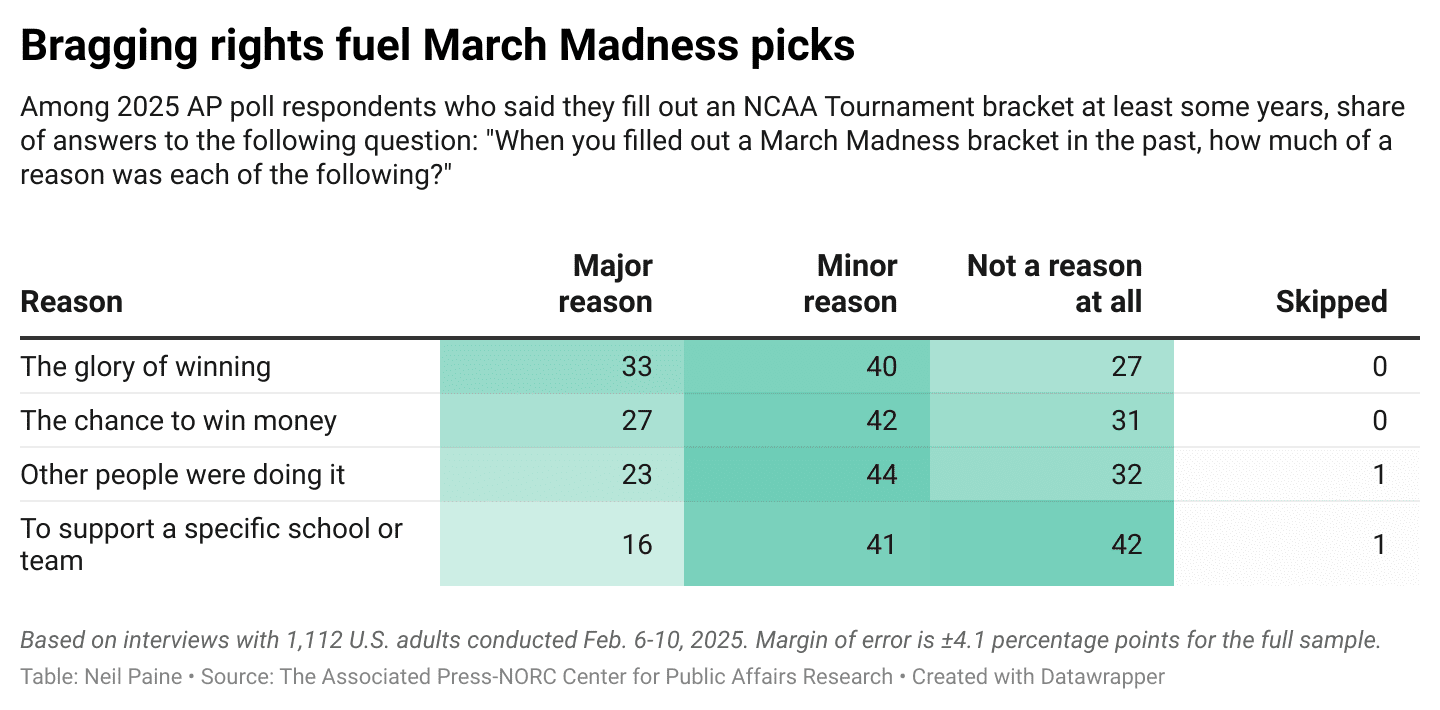
It turns out that Americans really just love filling out a great, big bracket to prove their sports knowledge — and the In-Season Challenge certainly provided one of those.
The setup could probably be tweaked a bit.
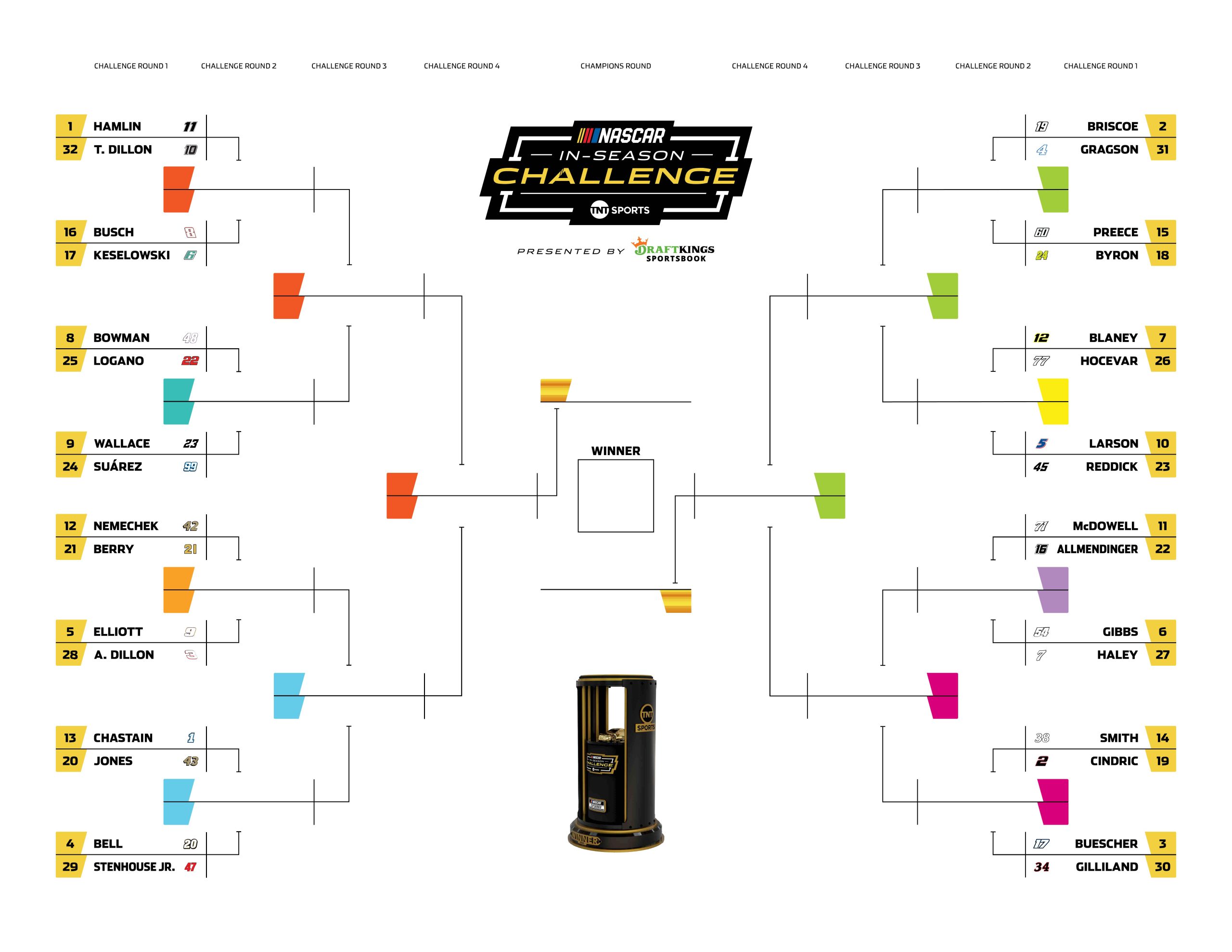
One of the more confusing aspects of filling out said bracket was the pre-tournament seeding, which turned a number of star drivers into underdogs and made identifying Cinderella picks a bit of a challenge. The seeds were derived from the highest finishes in the three races leading up to the opening round — one at an oval, one at a road course, one at a triangle — in the spirit of something like the World Cup group stage. On paper, it’s an intriguing idea, but in practice, it resulted in odd seedings (Zane Smith was ranked four spots ahead of William Byron, for instance) and clusters of elite drivers within the bracket, many of whom cannibalized each other early in the tournament.
The fix might be fairly straightforward: Just use the point standings as of the start of the In-Season Challenge. Or, if the goal is to give those Amazon Prime lead-in races added weight, assign them double points for seeding purposes. A hybrid system could also work — guaranteeing top seeds to the top points-earners while letting the remaining bracket positions be determined by the seeding races. That part is just a math problem: finding the sweet spot between rewarding top drivers (plus scattering them more evenly throughout the bracket) and giving the pre-challenge races enhanced importance.
The bigger challenge is structural. In an ideal world, the Challenge would test drivers across a variety of track types to crown a well-rounded champion, but the block of mid-summer races that made up the In-Season Challenge was dictated by the realities of NASCAR’s existing schedule. Perhaps predictably, having the opening round of the Challenge at a drafting-style track (Atlanta) resulted in a wave of multicar wrecks that knocked out seeds No. 1 Denny Hamlin, No. 2 Chase Briscoe, No. 4 Christopher Bell, No. 7 Ryan Blaney and No. 13 Ross Chastain, plus the underseeded William Byron, Austin Cindric and Joey Logano (among others), right away. Then the next two races were at street or road courses, which tilted things toward a completely different skill set — most notably benefiting SVG, who wasn’t even in the Challenge field.
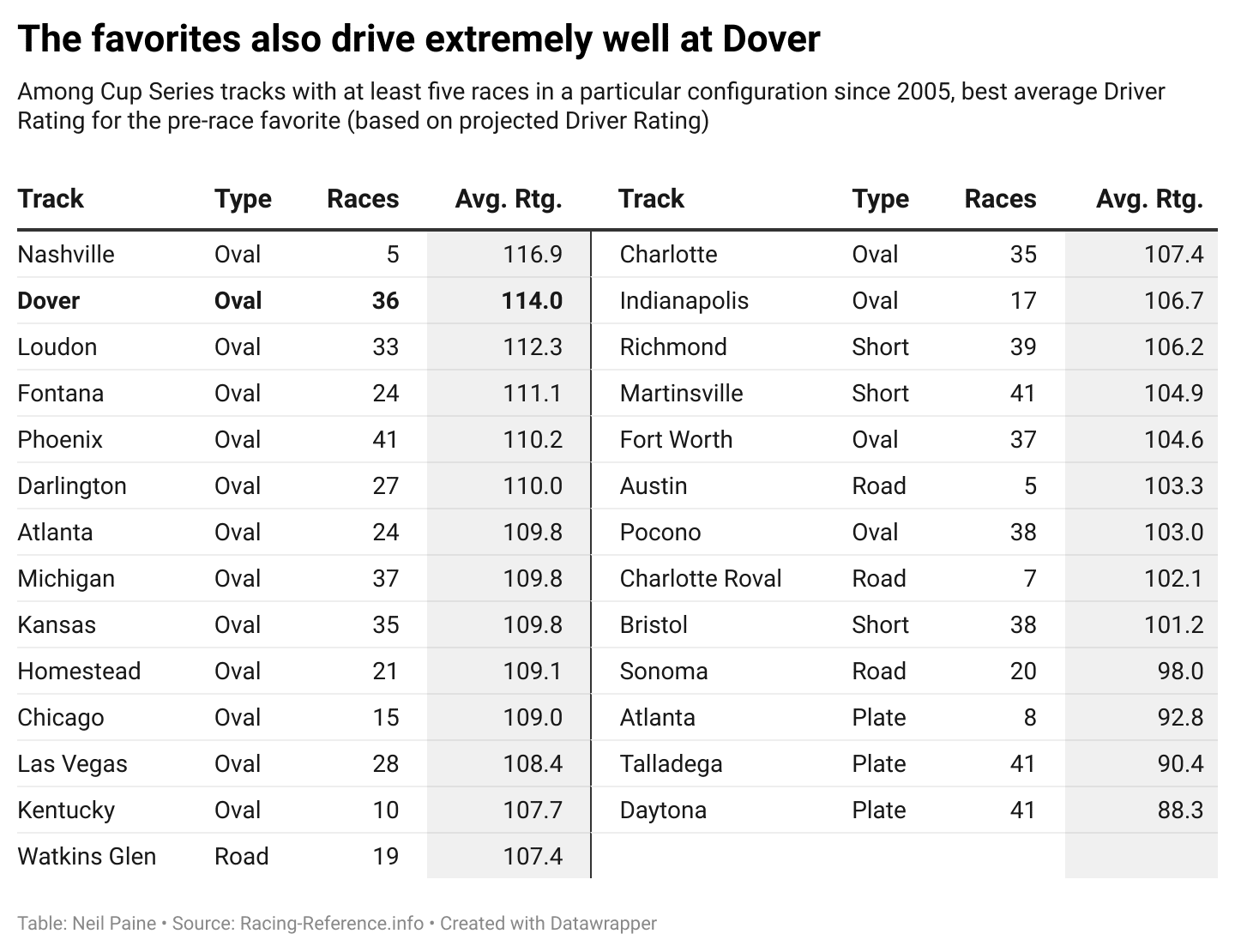
It wasn’t until Race 4 at Dover — itself a highly unique concrete track — that we saw anything close to a regular oval on the docket. And with the finale taking place at Indy, we didn’t get a single track of the standard, mile-and-a-half fare — nor a short track, for that matter. That may be unavoidable; travel constraints, network windows and sponsor priorities all heavily influence the calendar, and the schedule-makers already face the impossible task of satisfying dozens of competing interests each year. But it’s still fair to say the inaugural In-Season Challenge was, in many ways, defined by the races atop which it was layered.
Everyone loves Cinderella. But did we have too much of a good thing?
Ahead of the Challenge, there was a roughly 1-in-1,000 chance of a Ty Gibbs versus Ty Dillon finale at Indianapolis, owing to both Gibbs’ mid-pack odds and even more to Dillon needing to pull a Cinderella run of upsets just to reach the championship round. It ended up happening in the face of those long odds, in part because Dillon’s first two foes (Denny Hamlin and Brad Keselowski) both crashed out of their races early. By maintaining a steady average finish of 16.3 in the lead-up to the final, Dillon was the definition of a survive-and-advance driver.
However, anytime the lowest-seeded competitor makes the final in an event’s very first year, it begs the question of whether this was an anomaly or something built into the DNA of the system. Consider the fact that Dillon, while an underdog, had a 34% chance of knocking off Hamlin in Round 1’s 1-versus-32 matchup at Atlanta before the Challenge began. By comparison, the highest-rated No. 16 seed in the NCAA men’s tournament, Norfolk State, had just a 1.6% chance to beat the No. 1 seed (and eventual champion) Florida Gators in Round 1.
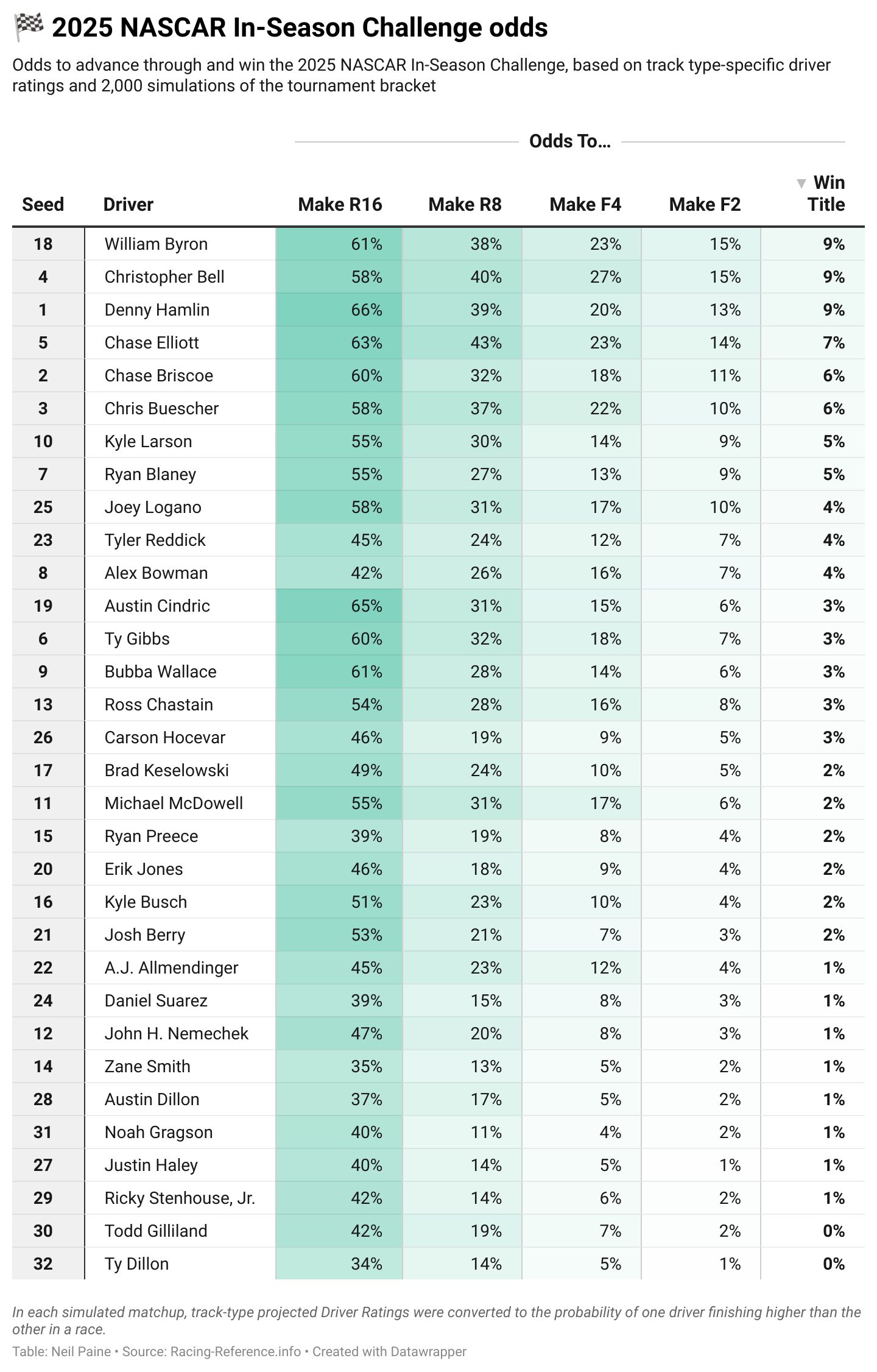
In other words, for any given head-to-head matchup — especially at a drafting track — even the lowest-seeded Cup Series regular can beat the highest a healthy amount of the time. And while other sports, such as the NFL playoffs or, nowadays, the first round of the expanded College Football Playoff, offer home games to better seeds to reward the favorite, there was no mechanism to favor better drivers in the In-Season Challenge, aside from their own talent and equipment.
Because of this, it’s worth asking whether the favorites need an extra boost in their matchups, if not simply to replicate a “home-field advantage” of sorts for being the higher seed. To that end, a handicapping system could be introduced whereby the lower-seeded driver needs to beat the higher seed by some number of places (perhaps related to the difference in seeds) in order to advance. Or as my podcast co-host Tyler Lauletta smartly suggested, a system of byes for top seeds could ensure star drivers’ passage into the later rounds while also reducing the number of head-to-heads the broadcast needs to track early on.
Either way, some tinkering might be in order to prevent there from being a bit too much parity in the bracket, to the point that randomness outweighs merit.
How do you cover two races at once?
Along the same lines as Tyler’s suggestion about managing fewer matchups at once, it was interesting to watch how the broadcasters juggled the head-to-head bracket battles while also making sure nothing about the bigger picture of the overall race was missed.
Throughout the Challenge, the standard TNT presentation mostly focused on the regular business of each race as usual, with some mentions of the bracket matchups and an occasional graphic — plus some picture-in-picture and cutaways to battles within the pack, particularly in cases where things got juicy (such as Alex Bowman vs. Bubba Wallace at Chicago).
When they did try to highlight the matchups, especially in early rounds, it was a lot to keep track of at once — particularly against the backdrop of what was happening in the main race. Between pit cycles, tire strategies, in-race adjustments and a thousand other considerations, each NASCAR race already has so much going on anyway that the extra layer of the Challenge verged on information overload. By contrast, truTV ran an alternate broadcast with Larry McReynolds and Jeff Burton, which had the opposite effect: By focusing so much on the bracket, it was difficult to process what happened in the actual race.
There are trade-offs to each approach, and the two simulcasts exist for a reason. But it would be nice to experiment with more ways — perhaps through on-screen graphics or other technological innovations — to help track both the regular race and the key In-Season Challenge matchups at the same time, without missing out on one or the other.
It’s good to try new things!
Overall, though, the In-Season Challenge has to be commended for experimenting with a new type of competition — particularly one that might appeal to a different audience than a standard race.
Aside from the Championship 4 in the season finale and certain other cases where the points shake out a particular way, purely head-to-head battles are rare in NASCAR. But this format leaned into them completely, with enough money on the line that drivers and teams had to pay attention to the Challenge matchups in addition to the bigger picture. Everyone intuitively knows and loves a bracket, too, so the stakes were clear and it wasn’t hard to explain how the tournament worked — always a plus when trying to introduce a new concept to the world.
Not everything is going to be perfect right away, of course, and the execution can be refined in future iterations. Some factors are going to face harder constraints than others — with the hardest ones mainly revolving around the schedule, and how it interacts with the plans of tracks and broadcast partners. In that regard, the perfect can’t be allowed to become the enemy of the good, and some trade-offs will have to happen. But other fixes are lower-hanging fruit, and they provide another opportunity to listen to fans and give them more of the product they want.
Even if the inaugural In-Season Challenge contained a few rough edges, it was a creative addition to the mid-summer calendar — and trying bold new things is great! This was exactly the kind of forward-thinking idea that many leagues have been attempting, as the way we consume sports continues to evolve. With the right tweaks, this tournament could become a summer tradition that fans look forward to every year. Now that the foundation is in place, the next step is to just build on it.