And yet, the hottest driver in NASCAR might still be the most underrated, too.
Chase Briscoe has always been an easy driver to support. At various times throughout his career, things haven’t gone his way — from having to crash on a friend’s couch in North Carolina while chasing a seat to nearly giving up on racing before a call about an ARCA test changed everything. But he persisted, even winning the Southern 500 last year as his team at Stewart-Haas Racing was preparing to shut down. The fan favorite — he was the Truck Series’ Most Popular Driver in 2017 — has come a long way, through good times and bad.
RELATED: Chase Briscoe driver page | Cup Series schedule
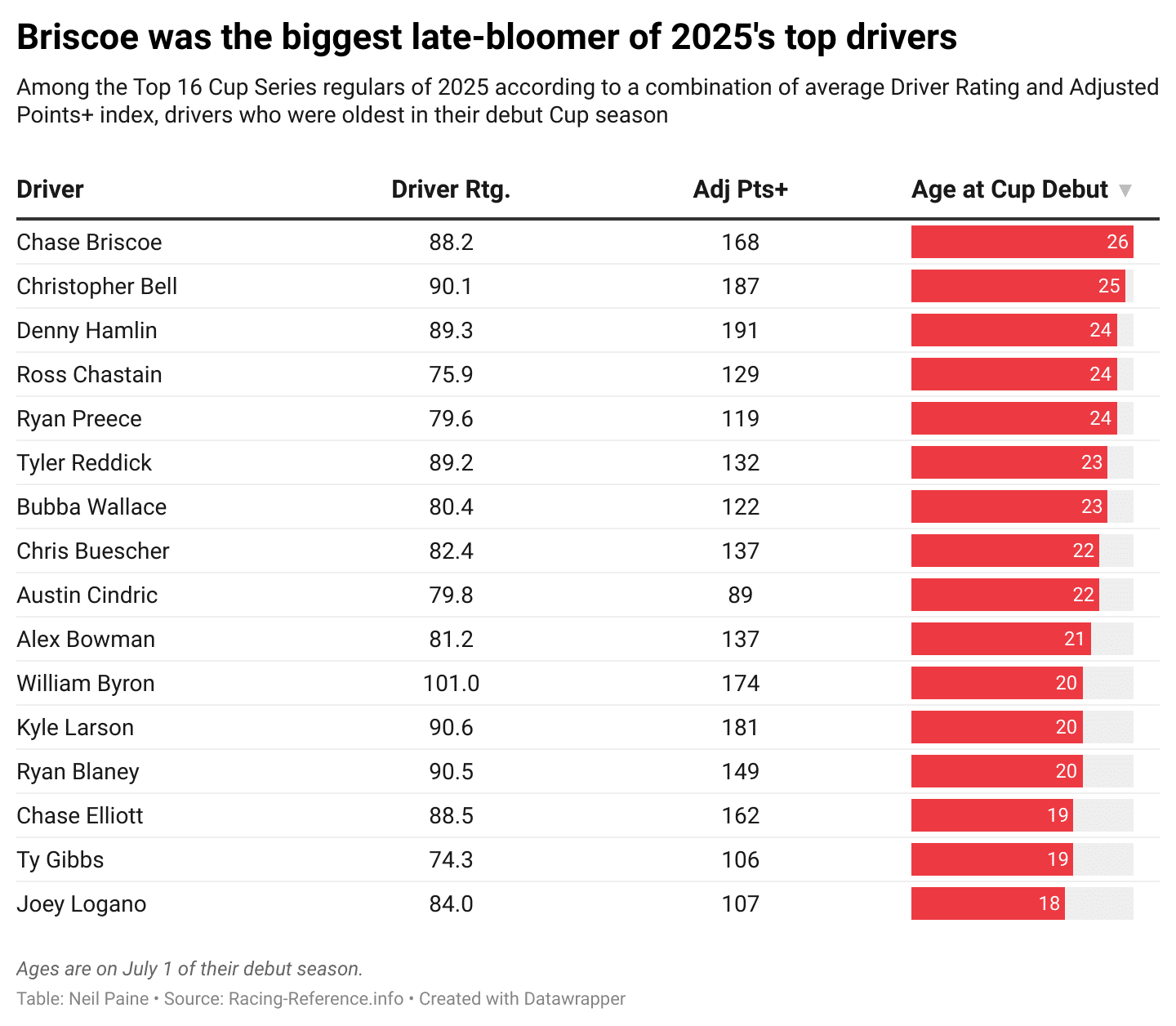
Now Briscoe is reinventing himself again, this time in a top-tier Joe Gibbs Racing seat. He has a win at Pocono Raceway and ranks eighth in the playoff standings, and he sits eighth in average Driver Rating and fifth in Adjusted Points+ index. Not bad for a guy who debuted in Cup later — in many cases, much later — than all of the other top drivers from this season:
Briscoe has been a playoff driver twice before (2022, 2024), and he advanced at least one round in each of those trips. But now, it feels like his sights ought to be set even higher: Riding for JGR in the same No. 19 car that used to belong to former champion Martin Truex Jr., is this the year Briscoe swaps the “underdog” label for the ultimate redemption — raising the biggest trophy of them all?
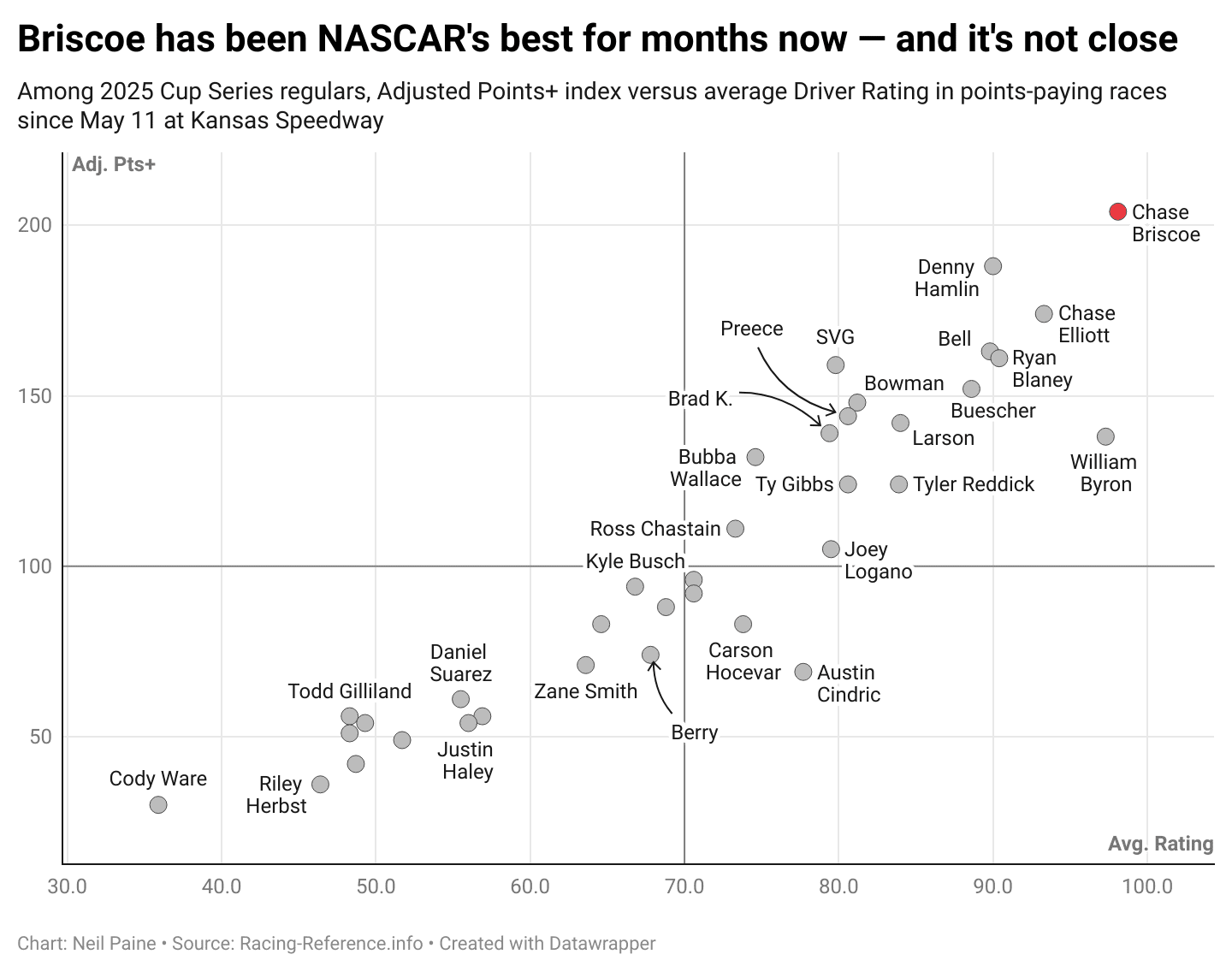
If momentum and recent form are any indication, he could do it. Since Kansas Speedway on May 11, Briscoe boasts both the highest average Driver Rating (98.1) and Adjusted Points+ index (204, or 104% better than Cup average) of any regular driver. On a week-in, week-out basis, you could make a fairly clear case that Briscoe has been the Cup Series’ top performer over a sustained period of three full months:
Showcasing the raw speed of his No. 19 Camry, Briscoe also has a series-high five poles in that span, including streaks of three in a row (Charlotte, Nashville, Michigan) and, later, two in a row (Indianapolis, Iowa). His average start of 10.0 leads all drivers this season, and while that would be the first time since 2006 — when Jeff Gordon posted a matching 10.0 mark — that the fastest qualifying driver in a Cup season didn’t have an average start in single-digits, it does prove Briscoe’s ability to run faster than his equipment has carried over from SHR to JGR.
So overall, that stretch alone would be impressive. But lately, Briscoe has found yet another gear, with his rolling nine-race averages — nine races being exactly one-quarter of the 36-race Cup Series schedule — reaching new season-highs in both Adjusted Pts+ (216.3) and Driver Rating (102.4) in his latest nine outings, including a fifth-place finish at Watkins Glen International that was his fourth top five in the span of five races.
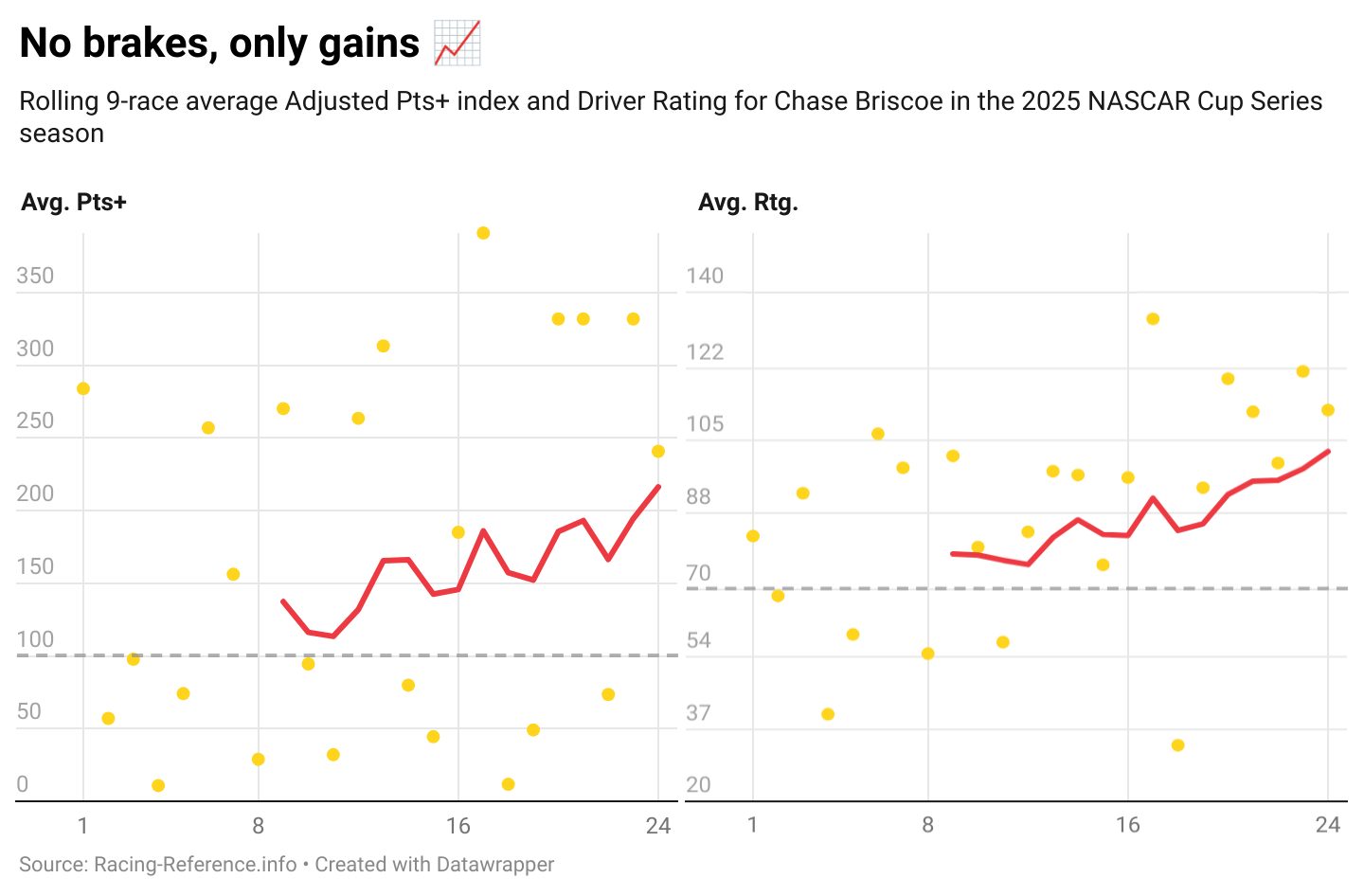
So in an otherwise wide-open title race, we appear to have a driver who has been the most productive in the sport for a while now, and who is currently peaking at exactly the right time heading into the playoffs. Lest we think that makes an open-and-shut case for Briscoe as a title frontrunner, however, we have to ask: How much does a late regular-season hot streak really tell us about his performance down the stretch of the schedule?
To check this, I looked back to the earliest season of Driver Rating data at Racing-Reference.info (2005) and measured — among drivers who were above average entering the fourth quarter of the calendar — how well a stat from an earlier quarter predicted that same stat in Q4. The big takeaway is that, at the very least, Driver Rating from the period when Briscoe has been his best does tend to carry over into the final leg of the schedule.
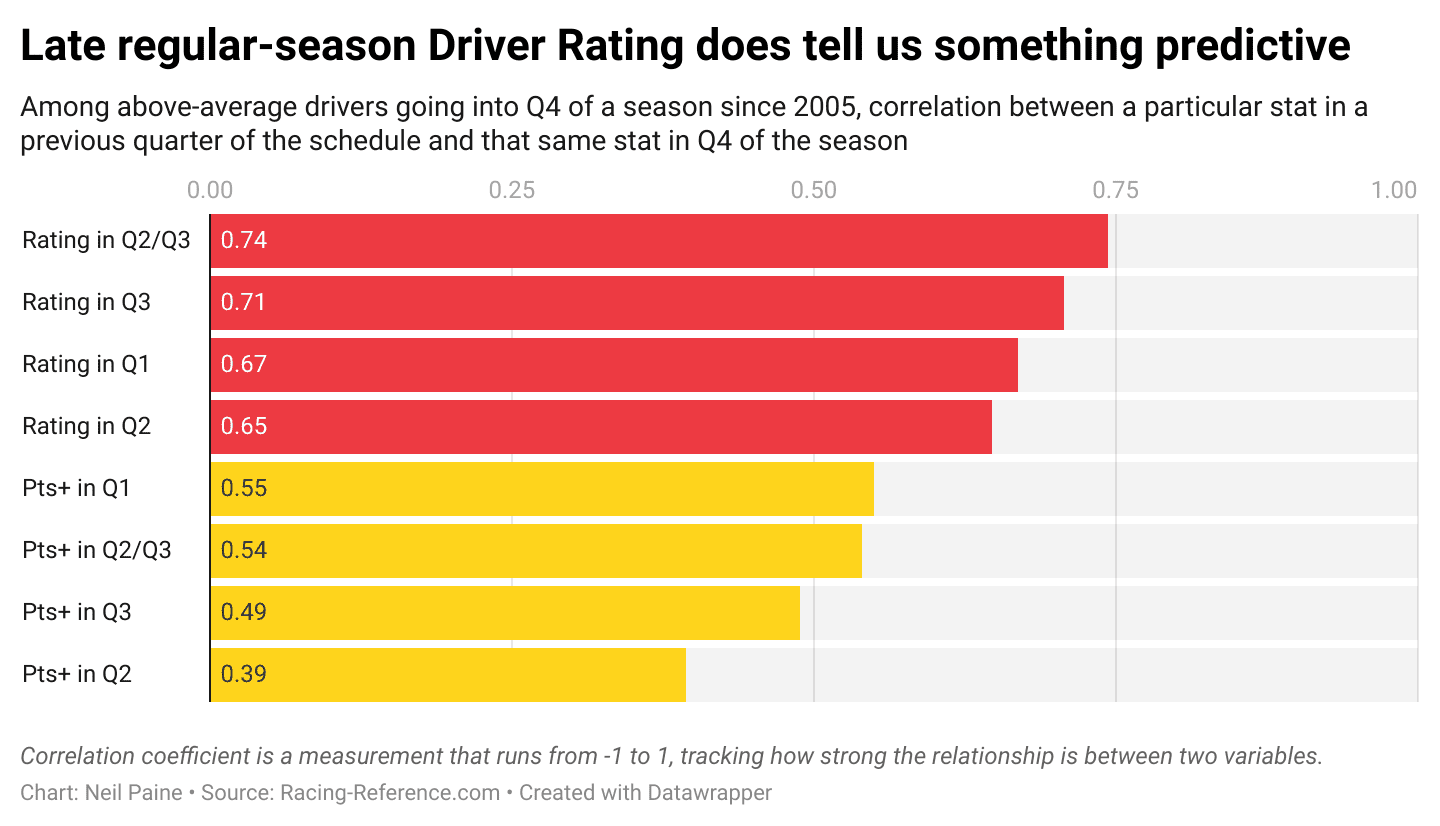
A driver’s combined Q2+Q3 Driver Rating tracks most strongly with Q4 Driver Rating, with a correlation coefficient of 0.74, and Q3 alone is nearly as good (0.71). Q1 and Q2 Driver Ratings tell us less, so there is a meaningful effect by which the best predictor of late-season form is who’s doing the best right now. By comparison, Adjusted Pts+ is noisier as a leading indicator — which makes sense, given how strategy and luck can inflate or deflate pure finishes in ways that Driver Rating is more resistant to — and the quality of a driver’s finishes early in the season is roughly as important as finishes in Q2+Q3.
Still, in the most predictive of stats during the most meaningful of season segments, Briscoe has been NASCAR’s best driver — and that should translate into sustained speed in the playoffs, if history is any guide.
Not that the oddsmakers have paid much attention: According to DraftKings’ odds, Briscoe is tied (with Shane van Gisbergen) for the ninth-best championship odds of any driver, at +2000 as of Tuesday. (The favorite, Kyle Larson, sits at +350 by comparison, even though his recent form has been nowhere near as good as Briscoe’s.)
In some ways, though, that’s par for the course in the journeyman-underdog arc of Briscoe’s career. Even during the season of his life, driving for an elite team with his best-ever shot at winning a title, he still finds himself fighting for respect. And for Chase Briscoe, maybe that’s also exactly where he’s most dangerous.