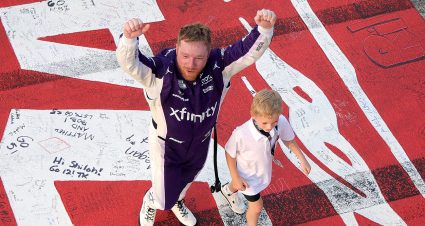
Tyler Reddick won at Darlington Raceway in part because he switched to a heavier battery with a larger capacity after the alternator malfunctioned in his No. 45 Toyota.
That move fell within the NASCAR rules, but there are some restrictions on the batteries used in Cup Series cars.
MORE: Cup Series standings
During the latest episode of “Hauler Talk,” NASCAR vice president of race communications Mike Forde explained that teams are permitted the installation of up to two batteries with a maximum of 12 volts apiece. All batteries must also be mounted in the proper location.
“We don’t have any rules as far as the size of the batteries, but the vehicle still needs to make weight,” Forde said. “If you start with a heavy battery and you swap to a lighter battery, and you came in underweight, then you could have a DQ on your hands.
“So moving to a larger battery, as long as it matched the rules, which the 45 did, you’re good to go.”
Reddick’s first victory at Darlington came in the debut of a higher-horsepower, lower-downforce package at the 1.366-mile oval. The combination will also be used this weekend at Martinsville Speedway and other tracks shorter than Darlington.
Forde said NASCAR would consider introducing additional horsepower at 1.5-mile ovals and longer, but that it’s unlikely this season.
“We just felt that you look at the mile-and-a-half races, and I think everyone’s in agreement that it’s the best racing we have, and so let’s not fix what’s not broken,” he said. “We don’t want to hurt something that we all feel is pretty good. I think this is more of a 2027 situation, so what we have for the remainder of the year, we’re going to stick with that. At the end of the season, we’ll look at Darlington, Nashville, Gateway and the short tracks and see how they raced, and how the mile-and-a-halfs raced, too. Because every single year, the teams catch up to the car and fine-tune it, and that affects the racing.”
Forde said NASCAR officials expected the Darlington race to be “a little more wild, chaotic.” It was the fifth consecutive Cup race without a yellow flag during the first stage.
“I think fans liked it, maybe not loved it,” Forde said. “When you look at that, it’s such a small sample size, though, and a lot has to do with the number of restarts, and there wasn’t a ton of wrecks, spins or cautions outside the stage breaks. So I think we’ll put everything in the pot and see where it came out. But overall, I think the drivers were happy.”
NASCAR will meet with drivers this weekend at Martinsville in one of its regularly scheduled gatherings to solicit feedback on the package and other items.
Other topics covered by Forde and senior director of racing communications Amanda Ellis during the 47th episode of “Hauler Talk,” which explores competition issues in NASCAR:
- Why the Ford of Austin Cindric and Chevrolet of Carson Hocevar were taken to the R&D Center after Darlington;
- The rash of pre-race inspection failures at Darlington, which led to penalties for Chase Elliott and Chris Buescher. Only about half the field passed inspection on the first attempt;
- The Chase status of Craftsman Truck Series winner Corey Heim.
Nate Ryan has written about NASCAR since 1996 while working at the San Bernardino Sun, Richmond Times-Dispatch, USA TODAY and for the past 10 years at NBC Sports Digital. He is a contributor to the “Hauler Talk” show on the NASCAR Podcast Network. He also has covered various other motorsports, including the IndyCar and IMSA series.