Tyler Reddick is racing like a man on a mission to win every single race – and he sure picked the right year to do it.
The driver of the No. 45 23XI Racing Toyota is off to an absolute season for the ages so far in 2026, winning again last Sunday at Darlington for his fourth victory in the first six races on the schedule. Going back to the dawn of NASCAR’s modern era in 1972, only two other drivers also won four times in the first six races of a season: Dale Earnhardt in 1987 and Bill Elliott in 1992 – and Reddick had greater consistency and/or a higher floor in his non-wins:
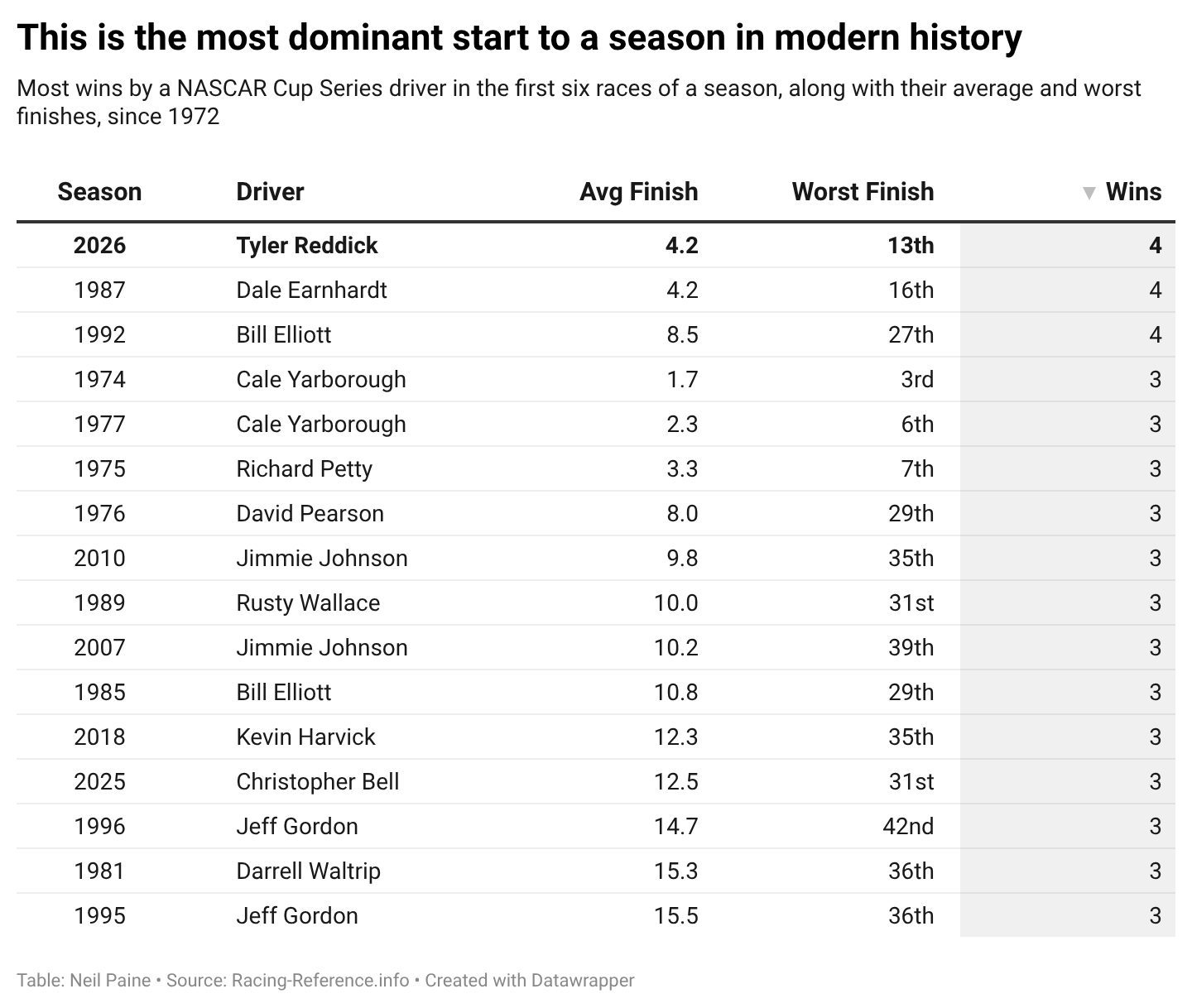
Simply put, we haven’t really seen a performance like this in the early phase of a season in a long time, if ever. And the benefit to Reddick in the standings is disproportionate this particular season, due to the new Chase system’s points format. As part of the trade-off for mothballing the old win-and-in mechanism for clinching a playoff spot, each trip to Victory Lane carries an extra 15-point bonus (compared with last year) to encourage a priority on winning.
And as it turns out, when you win almost every race in a season, those bonuses really start to pile up quickly.
Here’s a comparison between Reddick’s cumulative lead in the standings each week of the 2026 season under the current Chase points system – currently +95 over Ryan Blaney – and what his lead would be under the old system, without the 15-point bump for winning:
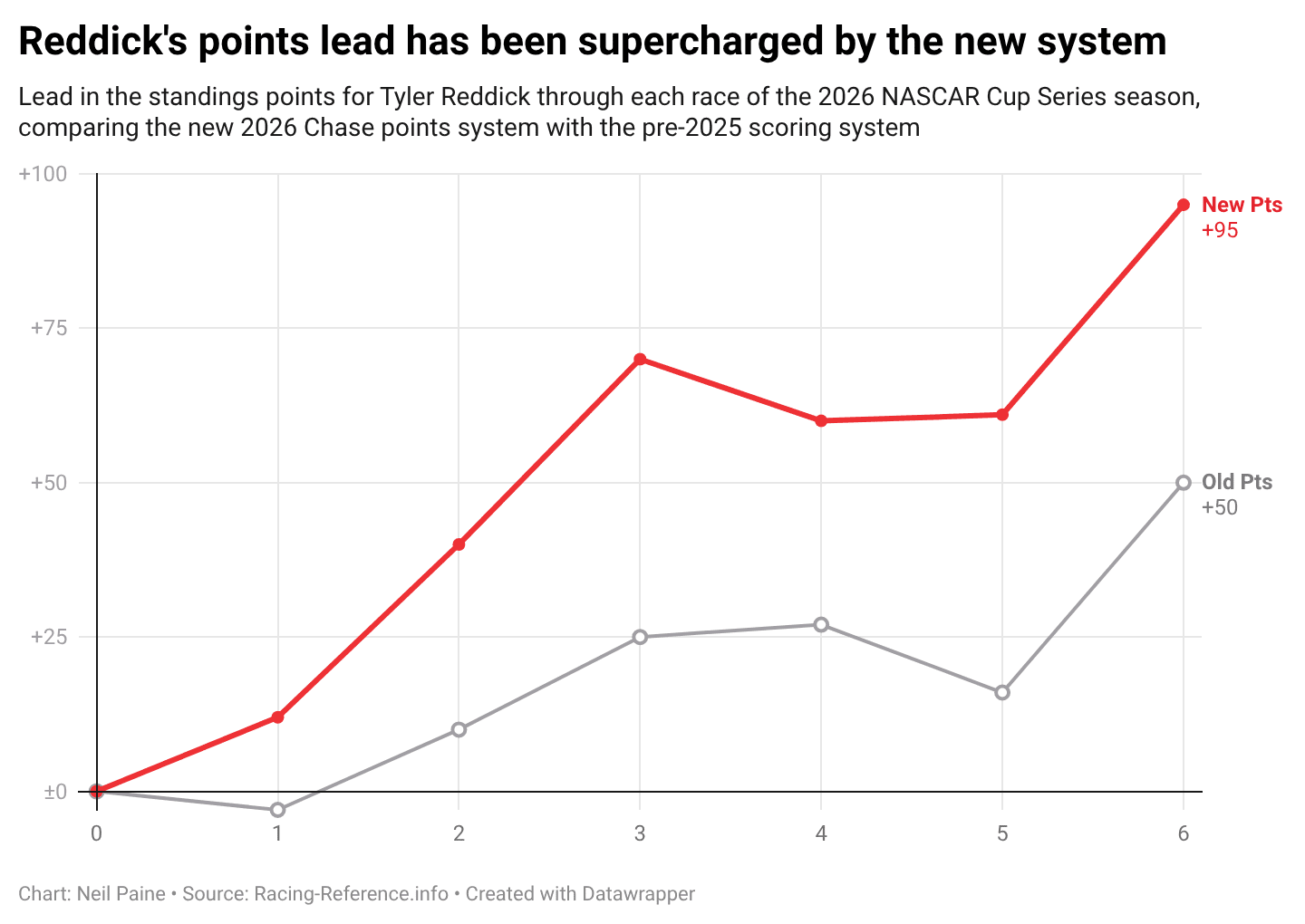
Under the old points format, Reddick would still be the clear standings leader at this point of the season. But he would “only” be up 50 points on the rest of the field: a healthy margin for sure, but also well within striking distance of a win, plus a strong performance in the stages, under the old system. Instead, as the wins have piled up within this new format, Reddick’s lead over Blaney and company is nearly doubled compared with what it would have been a year ago.
The better he keeps driving, the more Reddick leaves the competition further and further in the standings dust. Of course, the extra bonus potentially makes a comeback quicker to pull off as well – it’s a bit like the 3-pointer for a trailing team in basketball that way. But to catch the guy with a big winning streak, you need to put together one of your own, which feels like the way it should be.
Now the main question might be, how many wins can Reddick reach by season’s end?
The record for wins in a single Cup Series season was 27 by – who else? – Richard Petty in 1967, though he did it in 48 races. Pro-rated to a 36-race schedule, that works out to 20.3 wins, which means Reddick’s current 24-win pace is actually ahead of the record as we sit one-sixth of the way through the 2026 calendar. But before we get too excited, Reddick will obviously not go on to win anything close to two out of every three races he enters all season, so winning at the requisite 54.2% clip to match Petty from here is probably out the window. (Sorry to disappoint!)
The modern-era Cup record of 13 wins, however, is held by Jeff Gordon in 1998 and Petty himself in 1975, and Reddick would need to win 30% of races from here on to match that. (Still a very tall order – although, incredibly, Gordon won 39.4% of his races that season, so it can be done … in theory at least.)
More realistically, at the most basic level, Reddick has won 5.4% of his career Cup races, which works out to an expectation of 1.6 additional wins over the rest of the year (and 5.6 overall). But that includes his early seasons with Richard Childress Racing, which may not be very relevant; at his 7.9% win rate since moving to 23XI, we might expect 2.4 additional wins (and 6.4 overall) for Reddick by season’s end – still only half of the record number.
This method is simplistic, treating every remaining race the same (regardless of track type) and lumping all seasons together, which isn’t ideal. We can do a better job of estimating Reddick’s true odds of winning each remaining race by looking at track-specific data weighted by recency. If we anchor his win percentages in recent years at each track type to the typical rates for a top-10 driver in the standings during the Next Gen car era, giving more weight to more recent years (including 2026), we can come up with more reasonable guesses at his “true” chance to win at each track type.
(This includes an estimated 5% chance to win at short tracks, even though Reddick himself is 0-for-36 on short tracks in his career – the only track type he’s never won on before. Through our method, he still gets some small odds of winning because the average top-10 Cup driver wins 8% of the time on short tracks.)
Plug all of those values into the remaining schedule, simulate the rest of the 2026 season a bunch of times, track how often Reddick wins a given number of races and we arrive at a plausible distribution of winning outcomes for his year in full:
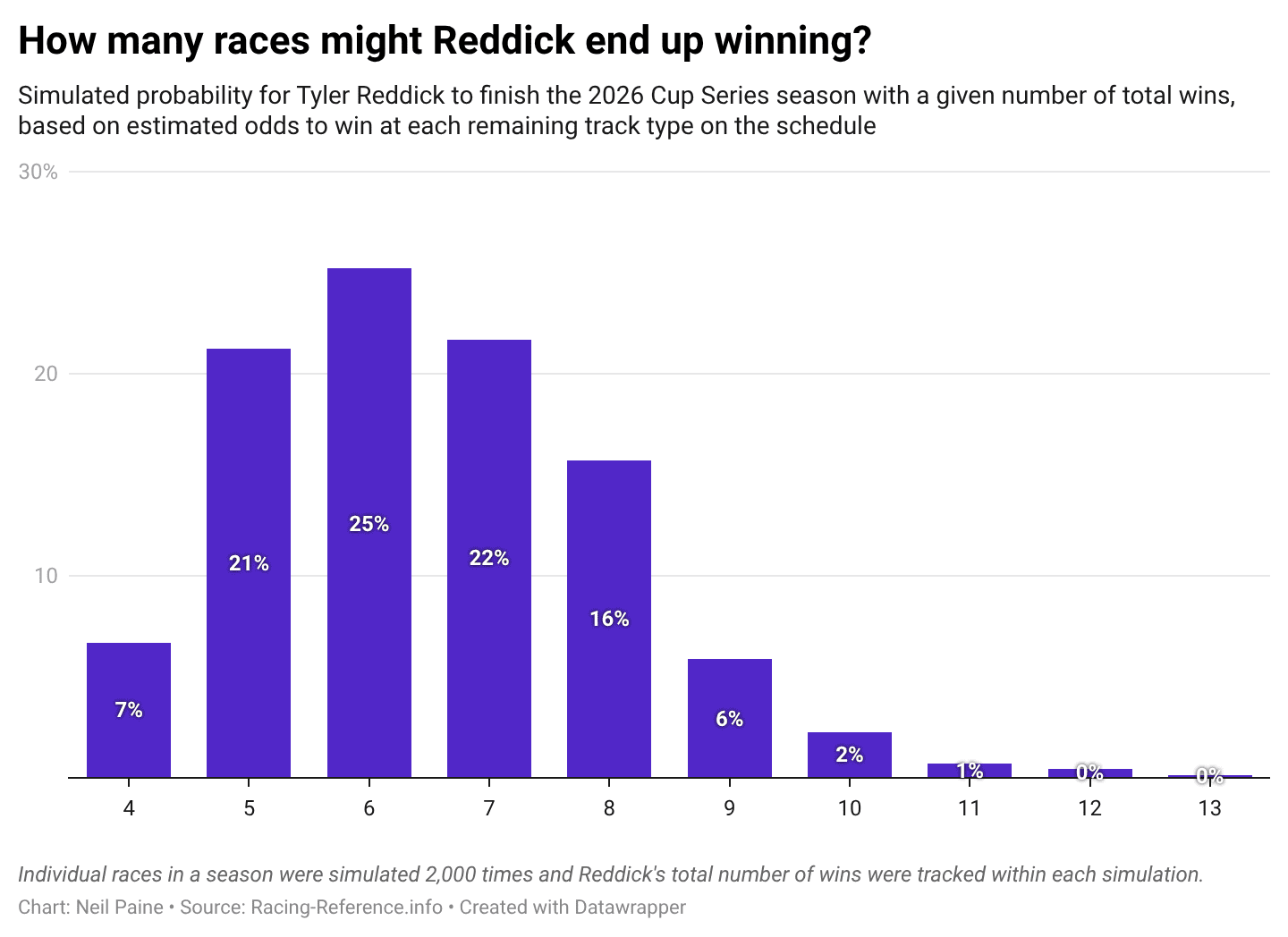
According to this method, there’s around a 7% chance he doesn’t win another race all year, which would be somewhat shocking but absolutely possible – think about Christopher Bell winning three of the first four races last year, then not winning again for more than six months.
More likely, though, Reddick will win at least one more race. On average, he wins 2.5 additional times to finish with either six or seven victories on the year. (Exactly six wins was the most common outcome in the simulations.) There is a 47% chance he ends up with at least seven wins, which would break the Next Gen-era record of six (co-held by William Byron in 2023, Kyle Larson in 2024 and Denny Hamlin in 2025), a 4% chance he gets to double-digits – joining a club with Jimmie Johnson (2007) and Larson (2021) for the most of the 2000s – and even a 0.15% probability (1 in around 600 to 700) that he gets to 13 and ties Gordon’s record.
So we’re saying there’s a chance!
But just the same, Reddick doesn’t need to catch Petty or Gordon to make history. He’s looking for his first career Cup Series title, so although a wins record would be nice, the main function of these victories is to keep padding that standings lead with the extra emphasis on winning in this year’s points format. Anything beyond that is just icing on the cake of a season that’s already off to a historic start.