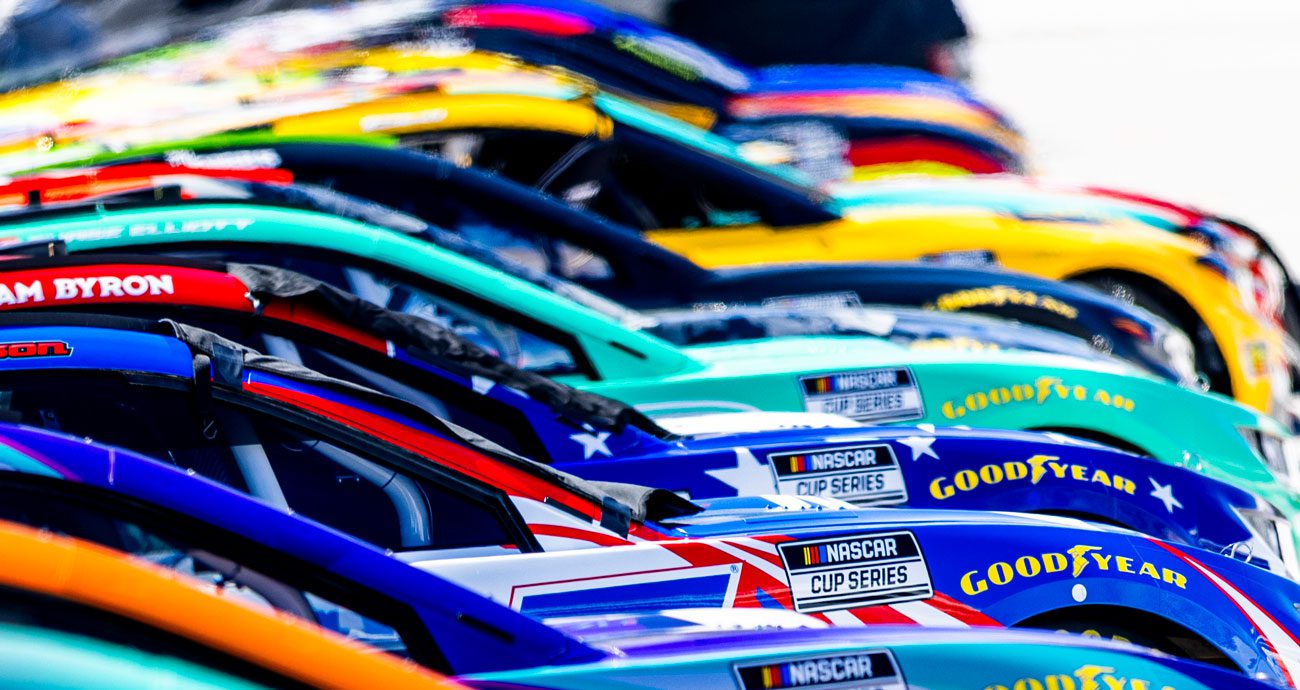
MARTINSVILLE, Va. — There’s more power under the hood this weekend at Martinsville Speedway, and that might mean more excessive tire wear in Sunday’s Cook Out 400 (3:30 p.m. ET, FS1, HBO Max, MRN Radio, SiriusXM NASCAR Radio).
But hot dog, it’s the same old Martinsville.
MORE: Starting lineup | At-track photos
The track’s most recent NASCAR Cup Series winner is William Byron, who dominated last fall’s 500-lap feature. But the spring race is a shorter affair, leaving 100 fewer laps to charge toward glory.
Crew chief Rudy Fugle gave Byron everything he needed in October, leading the No. 24 Hendrick Motorsports team to a dominant win in which Byron led 304 laps and swept the stages after winning the Busch Light Pole Award. Their spring affair started well Saturday with Byron qualifying second in Saturday’s time trials.
But Sunday’s race may be a different challenge than last year. Drivers have 750 horsepower to manage this week, an 80-horsepower increase from the last four seasons of notes teams have with the Next Gen car. That added significance to Saturday’s lone practice session as teams gathered data over 40 or more laps.
“We just tried to get a really good feel, and then we’ll know which direction we’re gonna go,” Fugle told NASCAR.com after qualifying. “We know what the track’s gonna do. We’re just trying to feel everything so we can make some adjustments or not make some adjustments. So I think we got that feel, and we’ll see what happens.”
Byron said he found his light-switch moment at Martinsville en route to a 2022 victory at the 0.526-mile track, noting “there was just the last little bit of getting through the corner that I needed to understand.” That puts the responsibility in Fugle’s hands to provide that feel on corner exit.
“It’s really just being in tune with him and everything he’s talking about,” Fugle said. “And I think the tire, the car and generation of car, all that stuff changes on what you need by a little bit. But Martinsville is so unique that once you get that rhythm, it’s like, I know that’s that. So I think he’s had that a few different times. We lose it sometimes. So just try to really literally listen to him, try to give him that cut, but also make sure you’re not sacrificing entry or late exit or anything like that to get it.”
Ryan Preece certainly knows the feel he’s looking for behind the wheel at Martinsville. The driver of RFK Racing’s No. 60 Ford is a two-time winner at “The Paperclip” in NASCAR Whelen Modified Tour competition and grew up racing on tracks like this — half-mile asphalt ovals with long straights, tight turns and occasional contact.
That resume hasn’t resulted in a Cup win here for him in 13 starts, but the Connecticut native has finished ninth, 14th, sixth and seventh in each of his last four starts at Martinsville. He also earned a victory in February’s exhibition Cook Out Clash at Bowman Gray Stadium, a 0.25-mile oval just 43 miles southwest of Martinsville.
“I just think with Ryan’s background and his short-track experience that we set the car up more like a short-track car — like a modified,” No. 60 crew chief Derrick Finley told NASCAR.com. “So he kind of likes that. Seems to work pretty well. Did at Bowman (Gray Stadium) and did here last fall. We’ll find out. Hopefully it will again.”
RELATED: Pit stalls for Sunday’s race
Preece will start 17th in Sunday’s 400-lapper but showed promise throughout longer runs in practice, placing 10th in 30-lap averages. He will need to work through traffic again Sunday, but that’s not unusual for Preece, who earned his 2025 Martinsville top 10s after qualifying 21st in the spring and 18th in the fall.
“He needs to be able to be fast on the start and have good long-run drive in particular — forward drive,” Finley said. “So if we can do that, we’ll be good. It’s so hard to pass sometimes early in the run that if your car is really good early and you can get a few spots, that really helps you later in the run.”
But how that added power impacts tire life still remains a question mark. In theory, if a driver uses too much throttle on the front side of a green-flag run, there will be less grip in their tires to rely on later in the stint.
“It’s tough to say because this is a track where you already pedaled it as soon as you went back to throttle,” Finley said. “So I mean, I think they’re going to pedal it just like they did before, till we get to the edge of the tire. So it’ll probably be harder once they get wide open on the tire, but I don’t think it’s going to be a ton different.”