The past month of NASCAR action has seen the Cup Series pay visits to some of its most familiar locales: Watkins Glen, Dover, Charlotte, Michigan and Pocono. Nashville was the only track in that stretch with fewer than 40 races run in the modern era (since 1972), and even it now has six races under its belt since making its Cup debut in summer 2021.
The last time we saw Cup cars out on a track with five or fewer all-time races was Gateway last September — before that, it was Iowa in August — and the last completely brand-new track to hit the series schedule was Mexico City last June. Given that the hottest driver in NASCAR right now – riding a three-race winning streak – is 45-year-old Denny Hamlin, who’s seen it all in his 22-year stint behind the wheel, perhaps the only way for the field to catch up is to render all of that experience irrelevant.
Enter Naval Base Coronado in San Diego, which will stage its first-ever race on Sunday at 4 p.m. ET on Prime Video.
The track is a temporary street course in the mold of Chicago, which was the first street race in Cup Series history when it debuted in 2023, so perhaps drivers can tap into those three races for valuable intel Sunday. But it’s not really the same otherwise: Watching a virtual lap around the circuit, it feels instead like a blend between old CART-era street tracks like Toronto and the runways of the iconic Burke Lakefront Airport in Cleveland.
So it’s going to be up to NASCAR’s quickest studies to learn how to handle this track in stock cars, and fast.
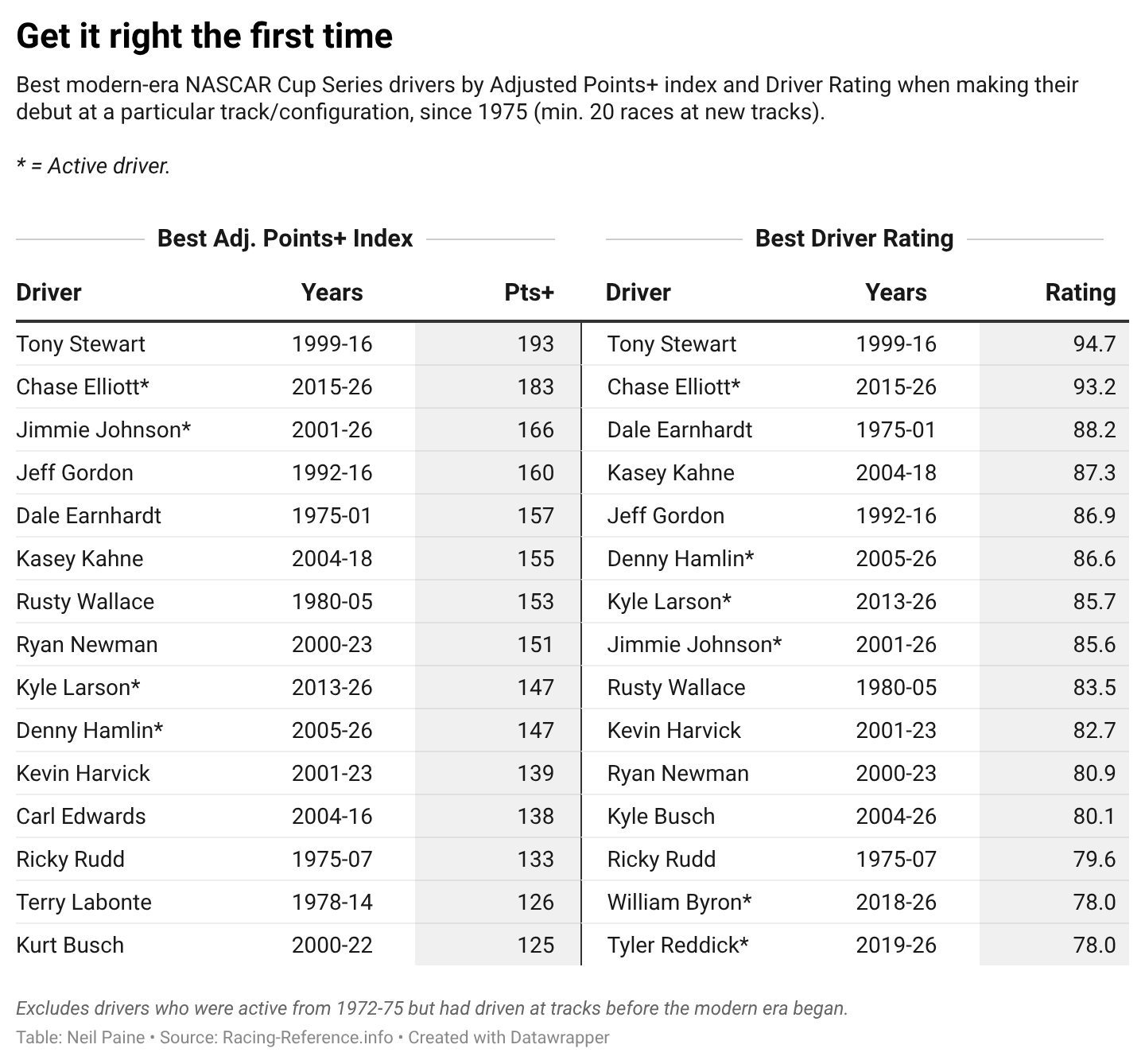
Some drivers have excelled more than others in their first-ever encounter with a track. According to either Adjusted Points+ index or Driver Rating — take your pick — the best modern-era Cup driver in his career debut at a particular circuit was Tony Stewart, whose finishes were nearly twice as good as the Cup average and had a 94.7 average rating at tracks he had never seen before at the highest level of stock-car racing.
(Would we expect anything less from a three-time Cup champ who also won an IndyCar title, and has proven he can drive anything from Daytona to dirt tracks to dragsters?)
Among active Cup names, the best stats belong to Chase Elliott, who (among other figures) is tied with Jeff Gordon and Shane van Gisbergen — more on that guy in a bit — for the most wins ever on tracks he was debuting on at the time, at three. Hamlin, Kyle Larson and Jimmie Johnson (technically active in ’26) also stand out in this regard, although Hamlin’s first experiences with most tracks are getting pretty far back in the rearview mirror by now. (Sorry, Denny!)
RELATED: Naval Base Coronado weekend schedule
It’s one thing to hop in the car during your first trip to a track and do well — at least some of your teammates, or your crew chief, may have a notebook or setup tip that helps ease your adjustment. But what about when nobody knows what they’re doing, and everyone has to figure it out on the fly?
Here are the best modern-era drivers at races where at least 75% of the field was making their first-ever career start at a track/configuration, with a minimum of five races under that circumstance:
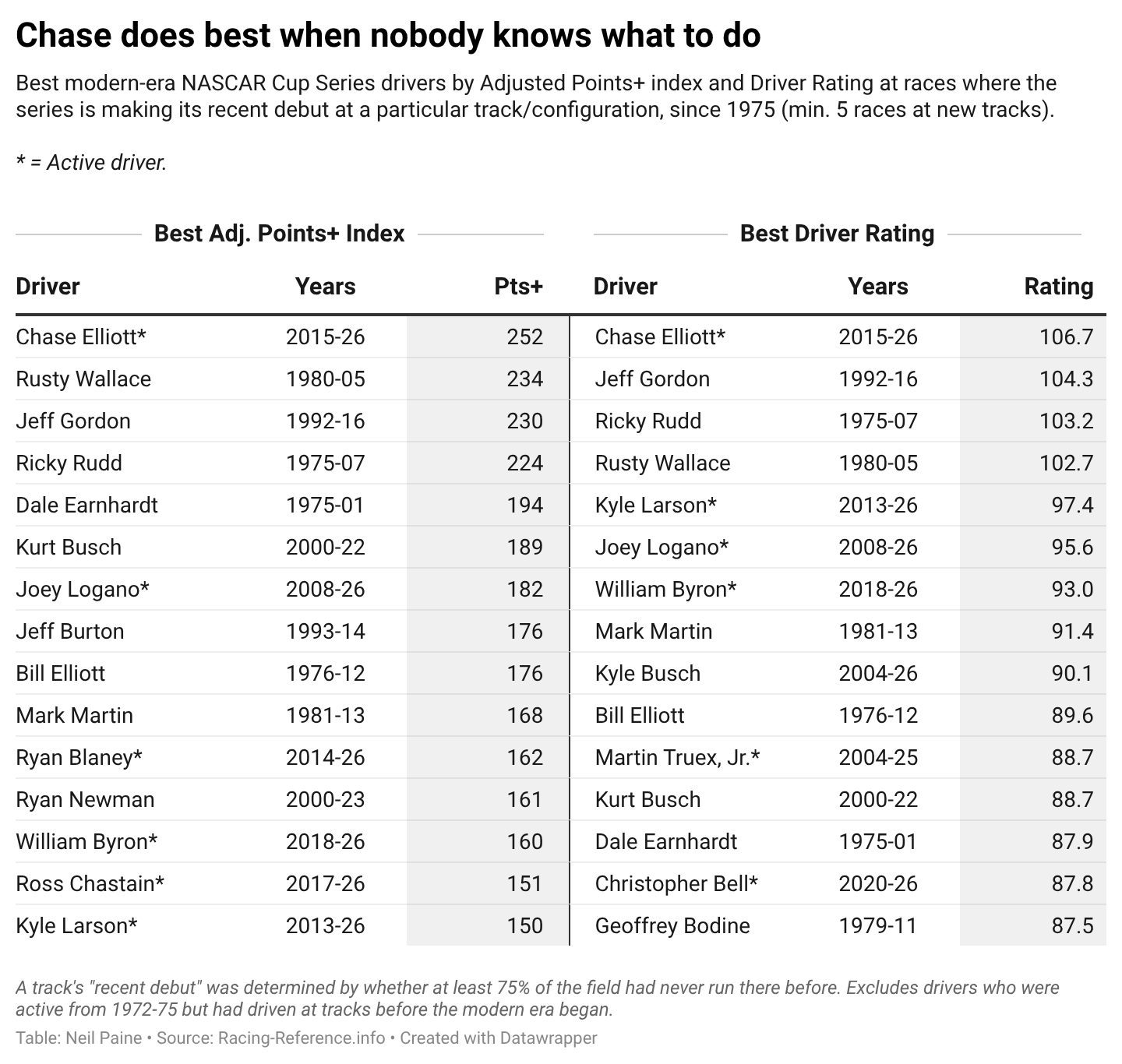
Chase Elliott again shows up as shining brightest when a track has either never been run before in NASCAR history, or at least never in recent history. He is one of only four drivers — joining Rusty Wallace, Jeff Gordon and Ricky Rudd — with finishes at least 100% better than Cup average under those circumstances, and that quartet is the only group that carries a triple-digit Driver Rating there as well. Other active drivers on both lists that you can plop down at a totally unfamiliar track and get great performances anyway include Joey Logano, William Byron and Kyle Larson.
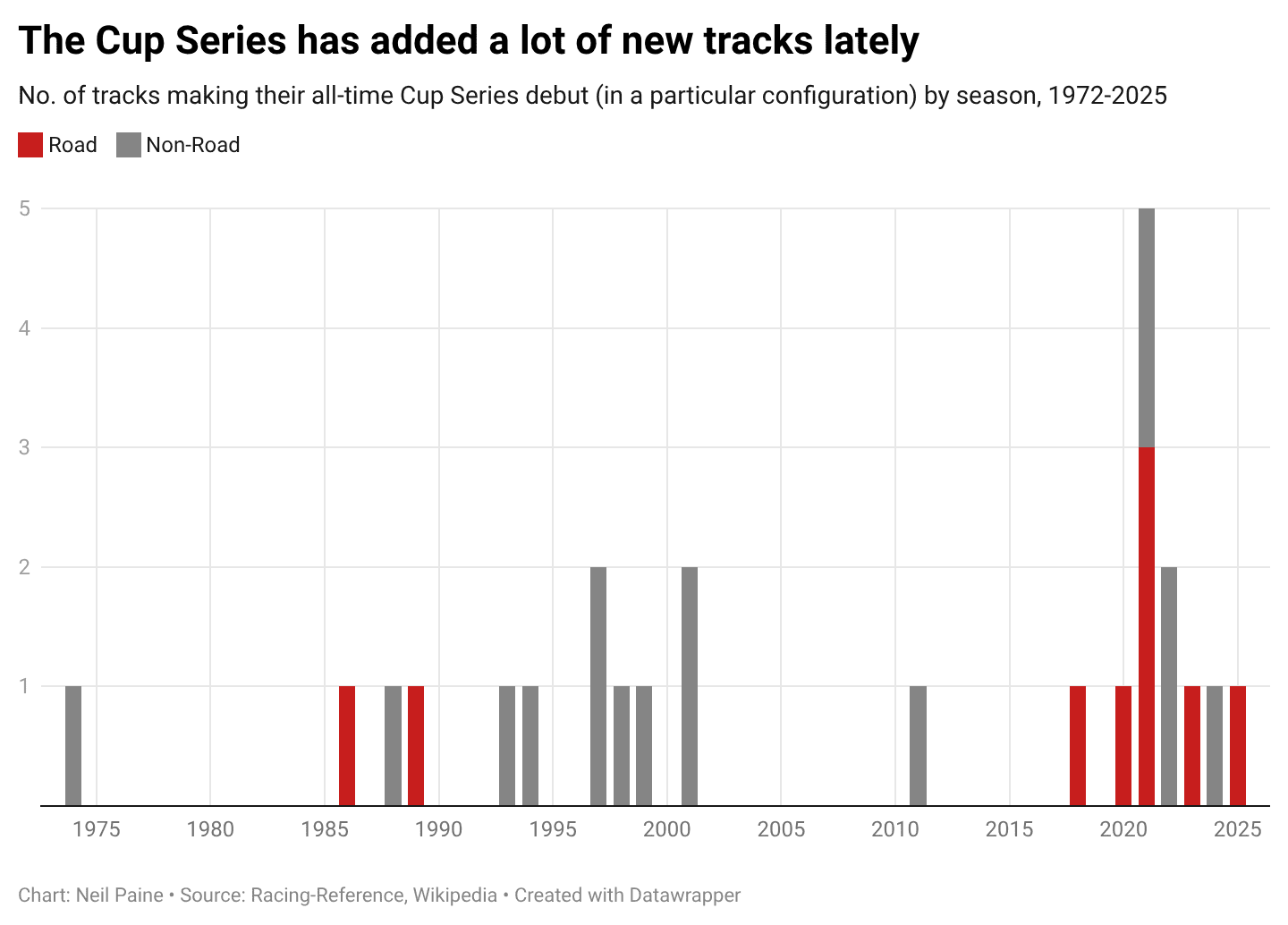
That type of situation has become more and more relevant in the 2020s, as NASCAR has added a bunch of new tracks, either making their all-time debut (Iowa, San Diego, etc.), returning to the calendar after a long hiatus (North Wilkesboro), or even debuting a new configuration (Atlanta after its repave). That differs from the previous era: While the series also added a number of new sites from the mid-1980s into the 2000s, between Chicagoland/Kansas making their debuts in 2001 and the Charlotte Roval joining the schedule in 2018, only one new track – Kentucky in 2011 – was added to the docket.
Naval Base Coronado will only add to that new tradition. And the main driver to watch is one we’ve only briefly mentioned, because he didn’t have a large enough sample to appear on the rankings. But what a sample it has been.
I’m referring, of course, to van Gisbergen, perhaps the ultimate new-track savant when it comes to a brand-new road course. Like most things involving left- and right-hand turns, SVG absolutely dominates the statistical lists for drivers with a minimum of two starts in those situations:
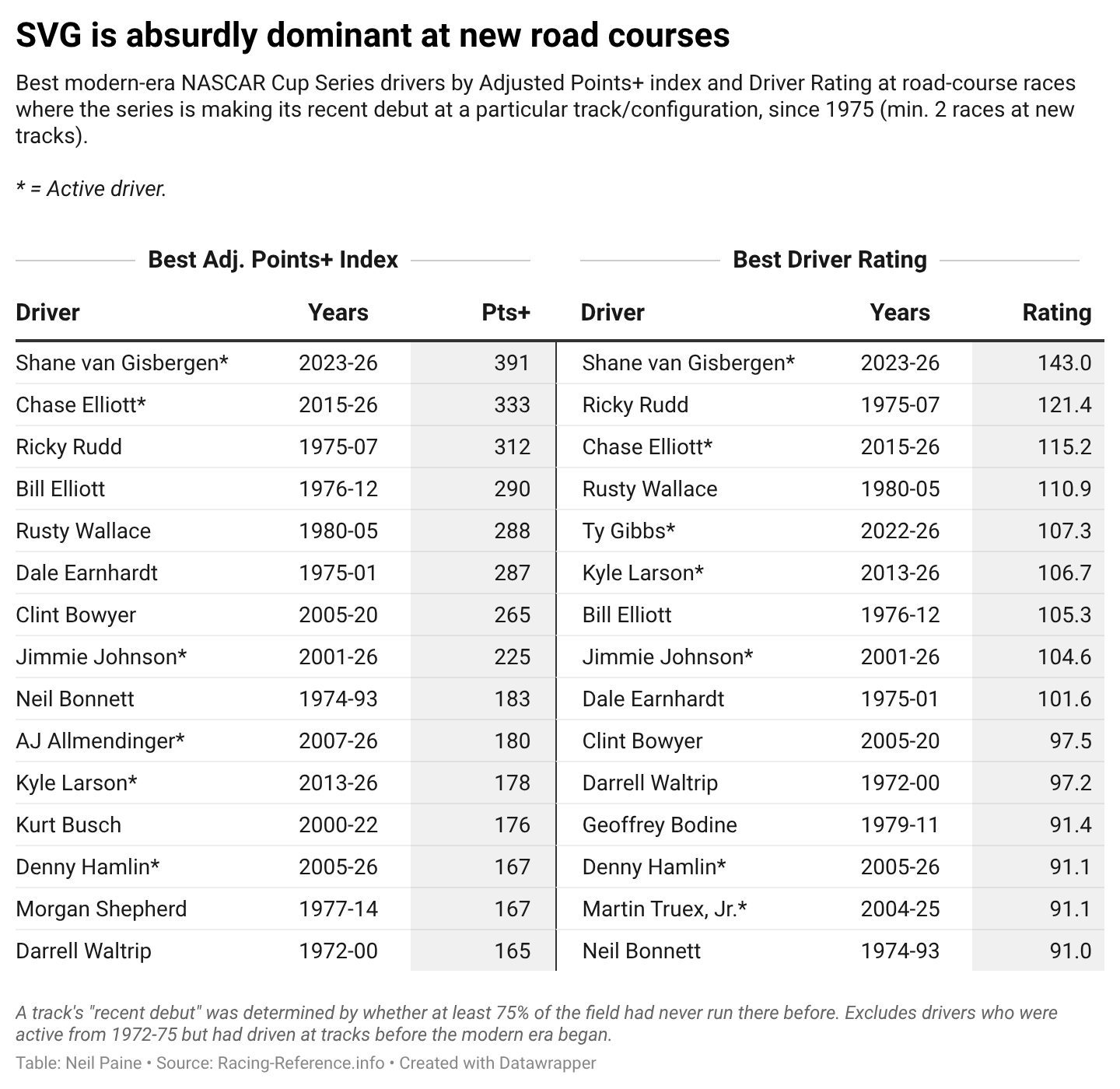
Now, of course, SVG is the greatest road-racer in series history anyway, so it may not seem all that surprising that he dominates any list of road-course prowess. But van Gisbergen’s overall career road course performance rates are “only” a 291 Adjusted Points+ and 123.5 Driver Rating. His performances at Chicago — winning in his Cup debut, the very race that began the legend of SVG — and Mexico City — where he won by a stunning 16.567 seconds — were extra-dominant even by his usual road-racing standards.
And that’s bad news for the other 38 drivers in the field this Sunday. You don’t really want to run up against van Gisbergen at any road course, even the ones like Sonoma or Watkins Glen, where you and he both have full notebooks (and he just executes better with the help of his heel-toe footwork). But at a new track where you have to both learn and drive as him?
Good luck.