GRANBY, Quebec — I sat in the back seat of a race car as it motored down the frontstretch. We had one car snug to our left, another hugging our right, and four more in front of us. There was no path forward, no escape route high or low, no way to not put even more dents on our red 2007 Dodge Charger that was already full of them.
We were going to wreck; the only question was how bad. And yet my driver, Kevin Breton, pushed our Charger steadily, if not particularly quickly, forward. He maneuvered based on help from his lifelong friend and co-pilot, Jonathan Alarie, who was riding shotgun. “Left,” Alarie said (in their native French, as this was in Quebec). “Left. Right. Right.”
Alarie’s patient instruction and Breton’s precise following of it meant we hadn’t hit anything on this particular lap … yet. Alarie’s tone became more urgent as the cars in front of us merged into an impassable dam of white and yellow and black.
There was nowhere to go. Breton kept inching ahead, anyway, because Alarie had not told him otherwise. Suddenly, the white car moved forward, passing the yellow one. Then one black car stopped perpendicular to the track. Another black one t-boned it, and their collision created an opening big enough for the Charger to squeeze through. … That’s what Alarie hoped, at least, as he shouted, “RIGHT! RIGHT! RIGHT!”
Breton’s left hand spun all the way down to 6 o’clock, the Charger’s nose turned hard right, and a second later, we emerged without so much as a scratch. I couldn’t believe my eyes as clear track yawned ahead of us.
In our stunned surprise, Alarie and I burst out laughing. Breton joined in the celebration, though he knew the events on the track were calamitous only by our guffawing. He hadn’t seen any of the cars in front of us or beside us, had no idea how close he had come to hitting five different cars, was clueless as to the wizardry he had just performed.
That’s because Breton is blind.
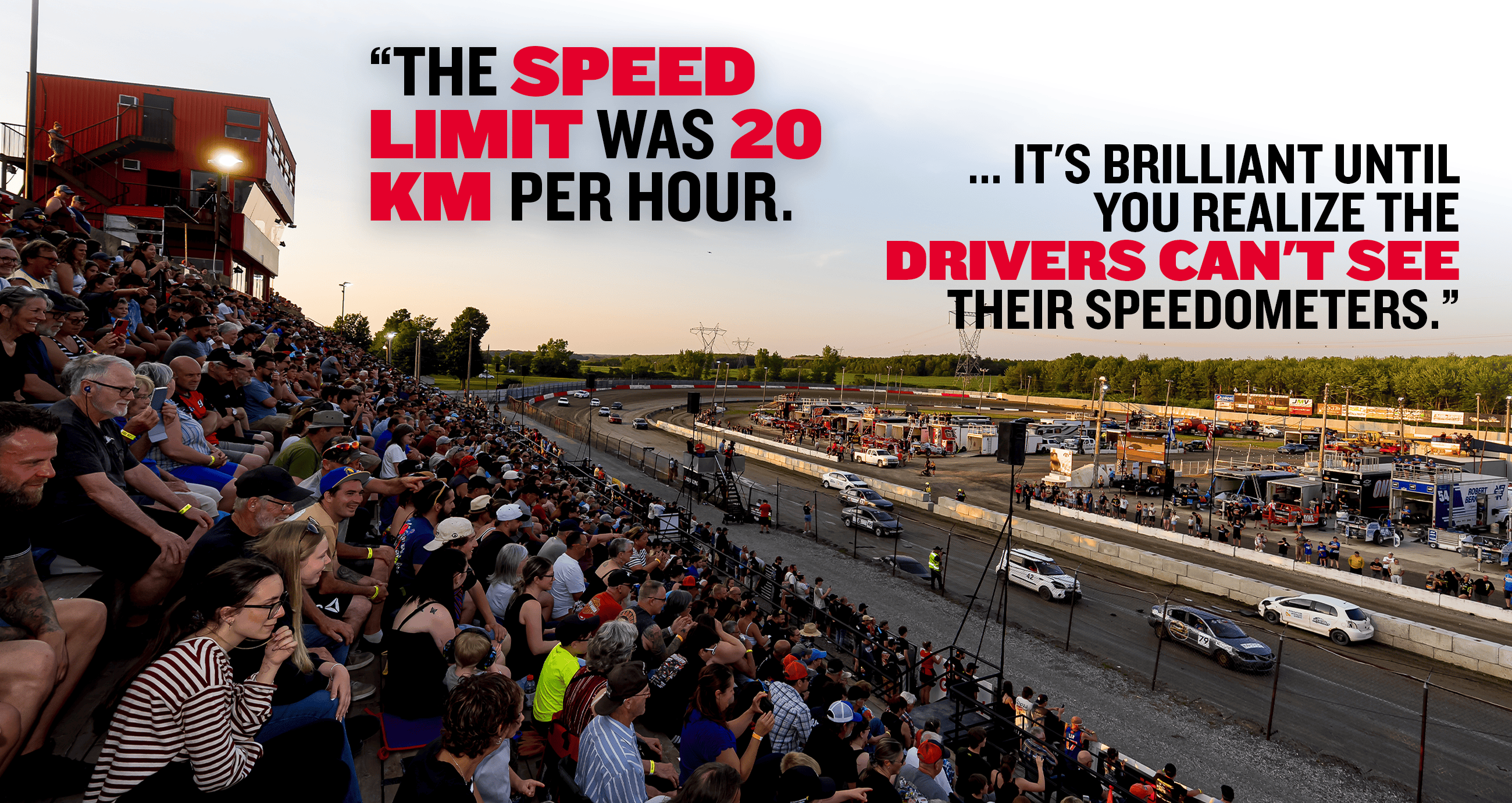
The race is called Défi-Vision, and this was its 37th running at Autodrome Granby, a half-mile dirt track about an hour east of Montreal. Thirty-one blind drivers and eight blindfolded sighted drivers entered the event, a fundraiser for the Mira Foundation, which provides guide dogs and service dogs to people with visual impairments, physical disabilities and autism.
Mira gives away dogs; each one costs $25,000 to train. Through the history of the event, Défi-Vision has raised $1.27 million for Mira, and this year’s version raised $57,000.
Before the race, all the drivers, their co-pilots and guide dogs (some in training) escaped the blistering July heat by gathering under a giant white tent. I found a seat across from Breton and next to Alarie.
“I’m putting a lot of trust in you,” I told Alarie.
“Don’t trust me. Trust him,” he said, nodding at Breton. “I’m just here to laugh.”
Breton described his vision impairment as like looking through a straw. I waved my right hand. “Can you see this?” I asked.
“See what?” he said.
“I can’t see him,” he said, pointing at Alarie to my left. “I can’t see this,” he said, patting the helmet on the table in front of him. He could see my face, and that was it.
In addition to driving a race car, Breton, who has two teenage children and a long-term girlfriend, has dabbled in kickboxing, running, coaching soccer and more, all of which combine into his raison d’être: “To prove to people that when you want to do something, you can do it,” he said. “That’s my main goal — teaching my kids that if you want to go, go for it. Work hard. You can do it.”
Breton, Alarie and their families drove seven hours southeast from Val-d’Or to Granby for the race. Breton entered so he could raise funds for Mira; he expects he’ll need a guide dog as his vision diminishes. He solicited donations, and earlier in the year, he walked 15 hours in one 24-hour stretch as a fundraiser.
This is his second time running the race, and his third will be next year. He wants to win, of course, but he’d rather laugh a lot. To do both would be parfait. “I love life,” he says. “I love inspiring people. I only have one speed: full speed ahead.”
We talked about whether he had ever driven before (not counting last year’s race.) He got a look on his face I recognized from knowing many teenagers, by which I mean he debated how much of the truth to tell me. “Yes,” he said. “But I can’t tell that story.”
The story is better because he won’t tell it. His smile as he said it, gosh, I was (and still am) dying to hear it. It seems like a safe guess that Alarie was involved, and probably/hopefully a parking lot and definitely a lot of laughter.
Breton said he is “25 with 15 years of experience.” He joked that he wanted to drive with one of those helmets with beer cans on each side and straws to his mouth. I’m guessing that was against the rules, but they were read in French, so I can’t be positive.
The drivers meeting seemed mostly to be a discussion of the fact it will hurt if you hit the wall, you should keep your arms inside the car, and wisecracks about what’s the point of waving a green or yellow or checkered flag if the driver can’t see it. “It’s the only race you can run next to the car and be faster,” someone said.
Race officials also spelled out perhaps the most unfollowable racing rule ever: The speed limit was 20 kilometers per hour. It sounds like a great safety precaution, right? This race is supposed to be funny and inspiring, not dangerous and painful. Nobody will get hurt if nobody goes faster than 20 km.
It’s brilliant … until you realize the drivers can’t see their speedometers.
After the drivers meeting, Breton left the table to get a drink. As he walked back, Alarie “guided” him to his seat: “Here, Kevin, Kevin, Kevin.”
Me: “Are you teasing the blind guy?”
Alarie: “Yes.”
That goes both ways. “Last year, I felt safe,” Breton said. “This year, I don’t know — because of my co-pilot.”
Alarie and Breton have been friends since they were five. When they were boys, they fought like brothers, hating each other one minute and hugging the next. Now it’s all hugs … and teasing.
“Do you know the difference,” Alarie asked me, “between a friend and a best friend?”
“No,” I said.
“If a friend sees you fall, he helps you up. If your best friend sees you fall, he laughs. Then he helps you up.”
Alarie is godfather to Breton’s son. When Breton needed help navigating through the crowded tent, Alarie jumped up to help. “He’s the kind of guy who is scared of nothing,” Alarie says. “He likes to prove to himself that he can do anything.”
We walked from the tent to the track, and Alarie led Breton by the arm. After we got buckled into our Charger, I looked at the car to our right. It had No. 911 on the side. I hoped I didn’t have to call it.
The blind drivers honked their horns as they waited to start. Forgive their impatience. Most of them had never driven before, so they were eager to get going. Breton pulled on a blindfold. Because the 31 blind drivers had varying degrees of visual impairment, everyone wore one to level the playing field.
Our Dodge Charger was, I’m 99.9 percent sure, the stoutest car in the field. I walked among the vehicles the day before, and they were mostly, if not entirely, minivans, sedans and crossovers. They were all donated for the race and retired to the junkyard afterward. Breton would have rather driven any one of those. He worried the Charger’s 250 horsepower would be too much, and he’d be unable to control his speed. He need not have worried; the ride was surprisingly smooth … or perhaps it was surprisingly smooth because he worried.
Before and after the race, Breton, Alarie and I spoke English. During, they spoke French, of which I know little more than croissant, croque monsieur and crepe. I learned quickly that gohsh (actual spelling: gauche) means left and dwat (droit) means right. I didn’t learn until later that dwat also means straight. The same word means straight and right. That’s dumber than a speed limit for someone who can’t see the speedometer.
Anyway, I also learned that advance said with a French accent means go. I didn’t need anybody to translate “oh, shit!” not least because I was the one saying it.
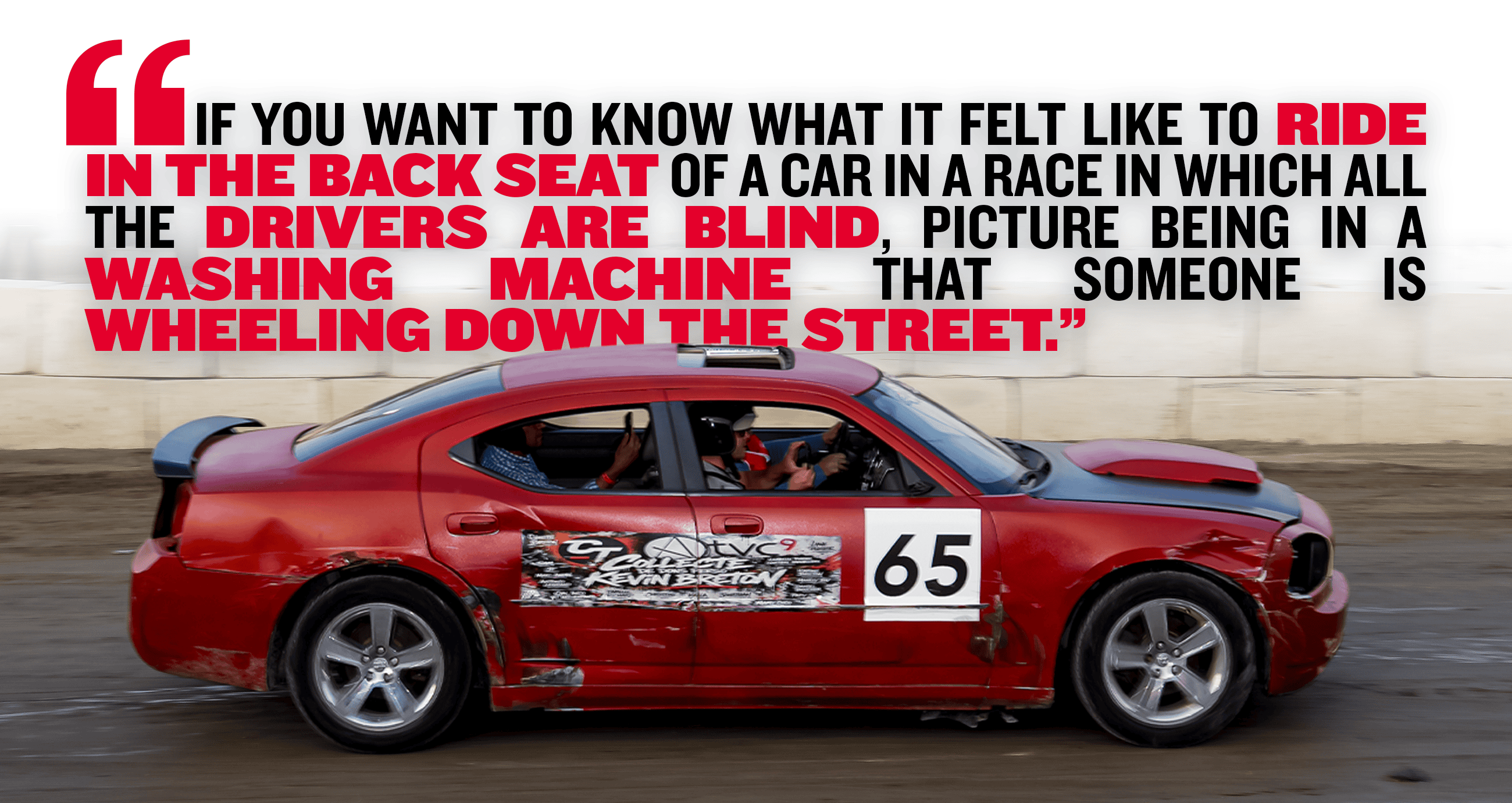
If you want to know what it felt like to ride in the back seat of a car in a race in which all the drivers are blind, picture being in a washing machine that someone is wheeling down the street. We got sideswiped on the left. We got sideswiped on the right. We got rear-ended. We got doored.
Once, early on, a car cut us off, we clipped its rear end, and the collision lifted both of our driver’s side tires off the ground. Someone sent me video of it taken from the grandstands, and it sounded like everyone in the place howled in laughter.
Only one hit felt hard enough to be worth mentioning, and that was when we got smacked from behind, which propelled us into the car in front of us. All of which brings up a fair question: Was it safe?
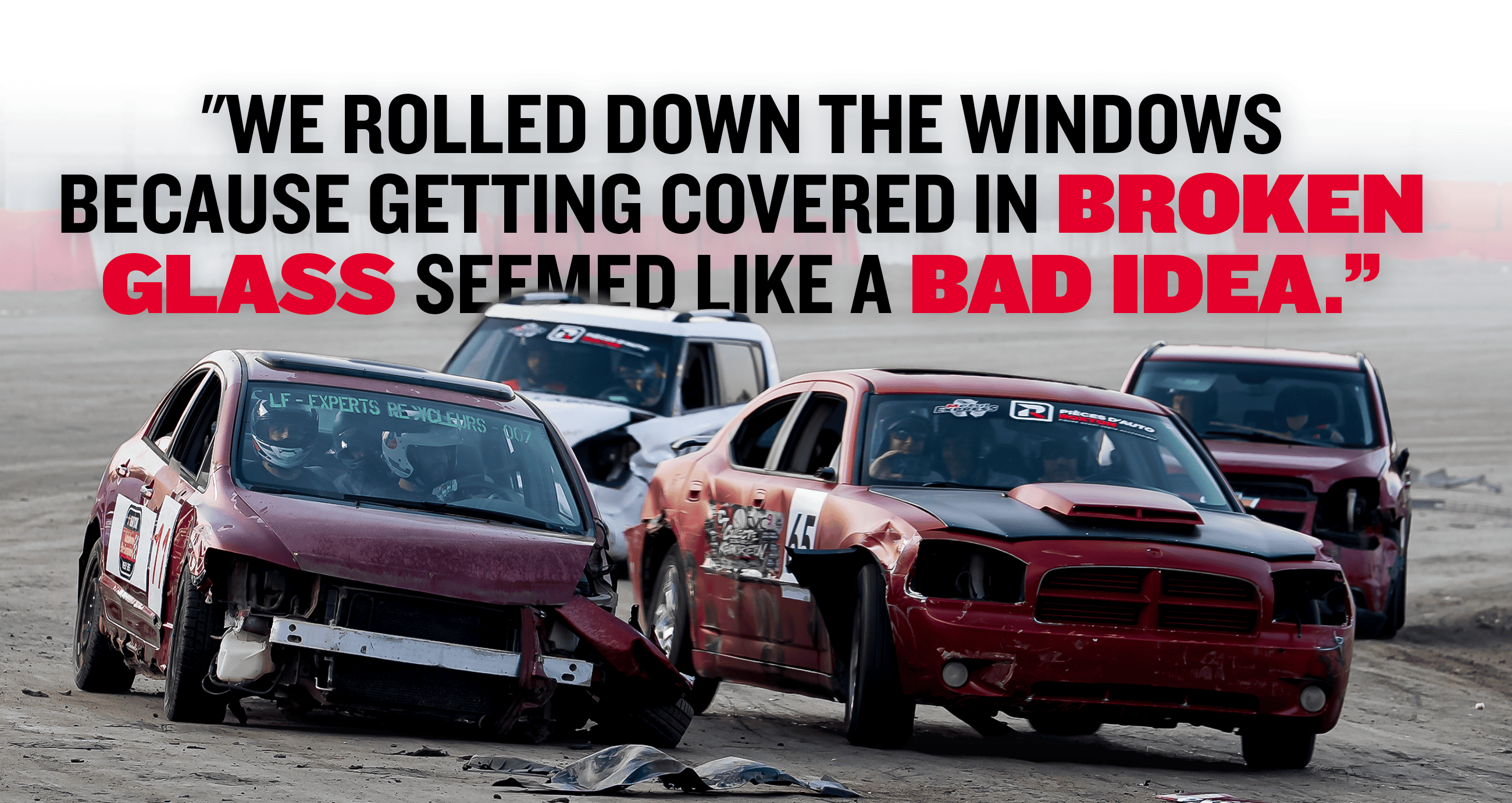
Mira has been running Défi-Vision for 37 years, and nobody has ever gotten hurt. We wore helmets and seatbelts. The cars were inspected (steering, brakes, throttle, seat belts). Mechanics removed headlights, taillights, airbags and Ford Pintos. We rolled down the windows because getting covered in broken glass seemed like a bad idea.
After a few laps, bumpers and various other car parts spread across the track like dirty laundry strewn across my daughter’s bedroom. Nobody picked any of it up. Alarie didn’t tell Breton to avoid that detritus, because that would have caused more problems than it solved.
Before the race, a mentalist named Edward Gebrael walked around the tent entertaining drivers, co-pilots and their families and friends with magic tricks. He told me to pick a card, look at the letter on it, put it back in the deck without showing him, and think of a name that started with the letter. He asked me how many letters my chosen name had then told me to close my eyes as he wrote down his guess.
“Now say the name and open your eyes,” he said, and when I did, I saw he had written the name I just said.
I thought of that encounter after Breton threaded the Charger through that barely-big-enough opening: I had seen magic twice in an hour.
I figured out the magic in the tent, only it wasn’t magic at all. It was a trick. I’m not 100 percent sure how he did it, but somehow Gebrael knew my letter. By knowing that and the number, he figuratively led me by the hand to an answer. It was a fait accompli; I just didn’t know it.
I figured out the magic in the car, too, only that wasn’t a trick.
Now, for sure, part of the reason we didn’t crash was luck. But Breton performed three other escapes nearly as astounding as that one. One escape might be luck. Four are not.
While Gebrael figuratively led me by the hand as part of the trick, Alarie has literally led Breton by the hand as part of their friendship many, many times, including several times that day. The instructions in the car were an extension of that. The tone with which Alarie said gohsh and dwat contained multitudes that Breton — and only Breton — could hear. When the hole between the cars opened and Breton had a split second to slice our Charger through it, Alarie — and perhaps Alarie alone — was prepared to help him.
But was that magic? Yes, indeed: magic produced by 35 years of friendship, compressed into one unforgettable night that showed the way to survive life’s biggest challenges is to have someone you love guide you through them.
As the race went on, I thought for sure we were among the best cars. When we weren’t getting run into from behind, doored, cut off or sideswiped, Breton drove almost straight almost the entire time. He had a sense for the angle of the corners, and he traveled through them nicely. For real: My man held a pretty wheel. I bet if the race had qualifying, he would have won the pole.
We only randomly ran into something for no reason once (the inside wall). Meanwhile, it looked to me like every other car spent half the time driving at 45-degree angles because their drivers got confused about dwat (right) and dwat (straight) and split the difference.
I peeked at the scoreboard a couple times, didn’t see us in the top five, and assumed the scoreboard wasn’t on for our race. It was on all right. Alas, we were five laps down.
Allegedly.
If you trust the official race report.
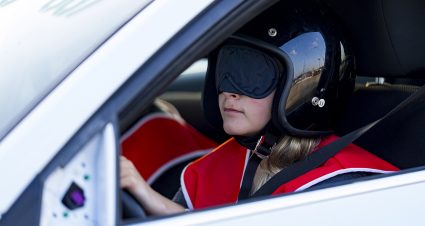
The race ended when a driver in a gray minivan reached the prescribed distance of 12 laps. A race official standing near the inside wall signaled for us to stop, Alarie relayed that to Breton, and he parked the Charger between Turns 3 and 4.
We waited to make sure everybody else stopped, too, then we got out and walked a lap around the car. The final 3.5 miles of the Charger’s life were filled with excitement. The trunk was open, surely the result of that hard hit. It looked like someone had put the car in a vice: all four doors were scraped and dented. All four corners were damaged, too, though the nose looked surprisingly good.
The back right quarter panel was half torn off. A quarter panel, I think, or some other part from another car was dangling out of the right front wheel well. I have no idea how it got there, how long it was there or how we drove with it there.
Still, even with all that damage, all the parts were still connected to the car (if in some cases barely), making us unusual if not an N of 1. I looked around the track and … OH MY GOSH. I thought it was bad during the race.
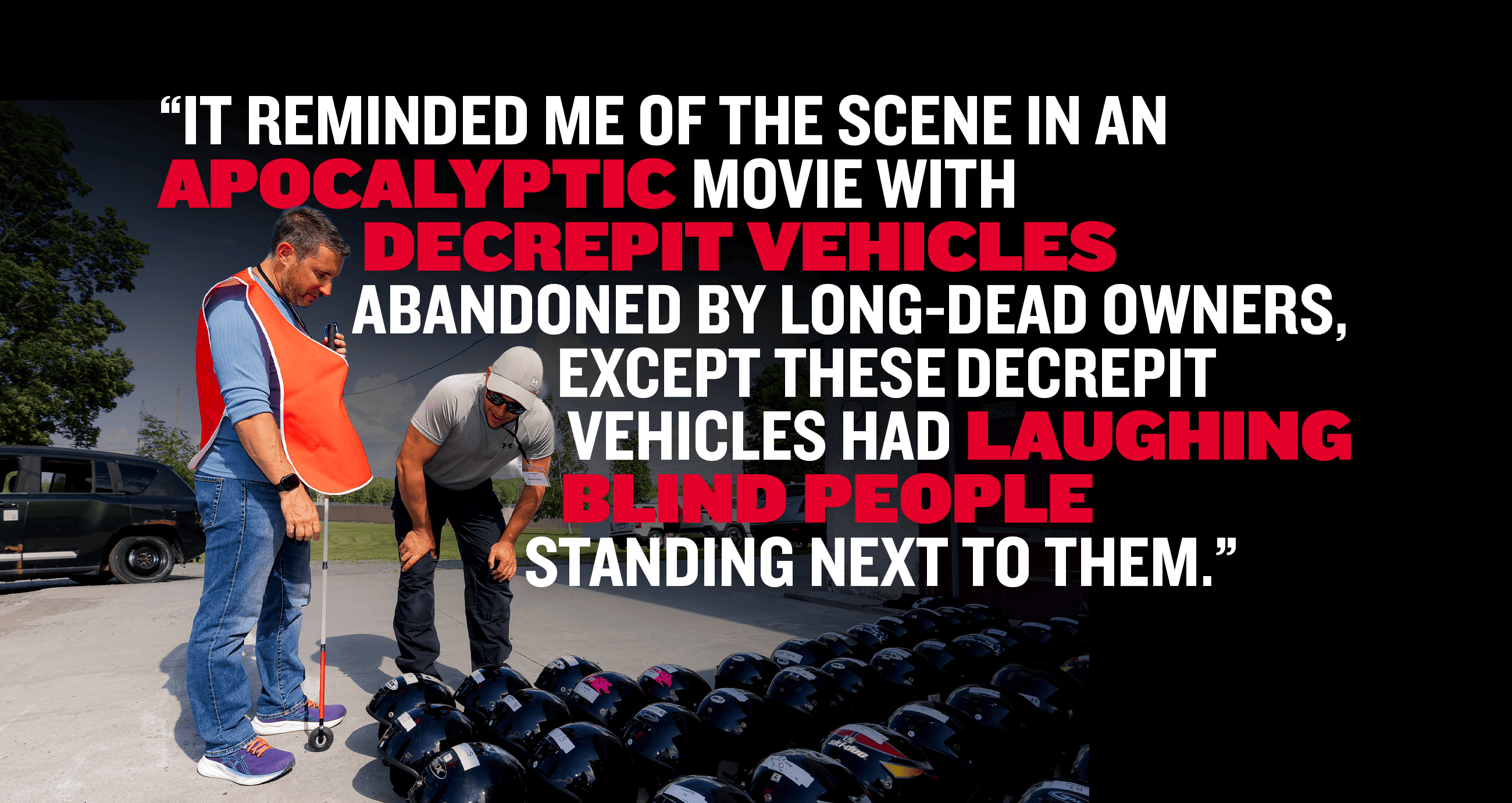
Now that it was over … imagine a junkyard sneezed, and you’ll start to know what it looked like. It reminded me of the scene in an apocalyptic movie with decrepit vehicles abandoned by long-dead owners, except these decrepit vehicles had laughing blind people standing next to them.
We all piled into a school bus to drive back to the giant white tent. That short trip overflowed with joie de vivre. Chatter bounced from one row to the next, with participants gleefully recounting their races. I heard plenty of gohsh and dwat … but not much oh, shit!
I had not picked up enough French to discern exactly happened in their races. But I know they had fun. Anyone could see that.