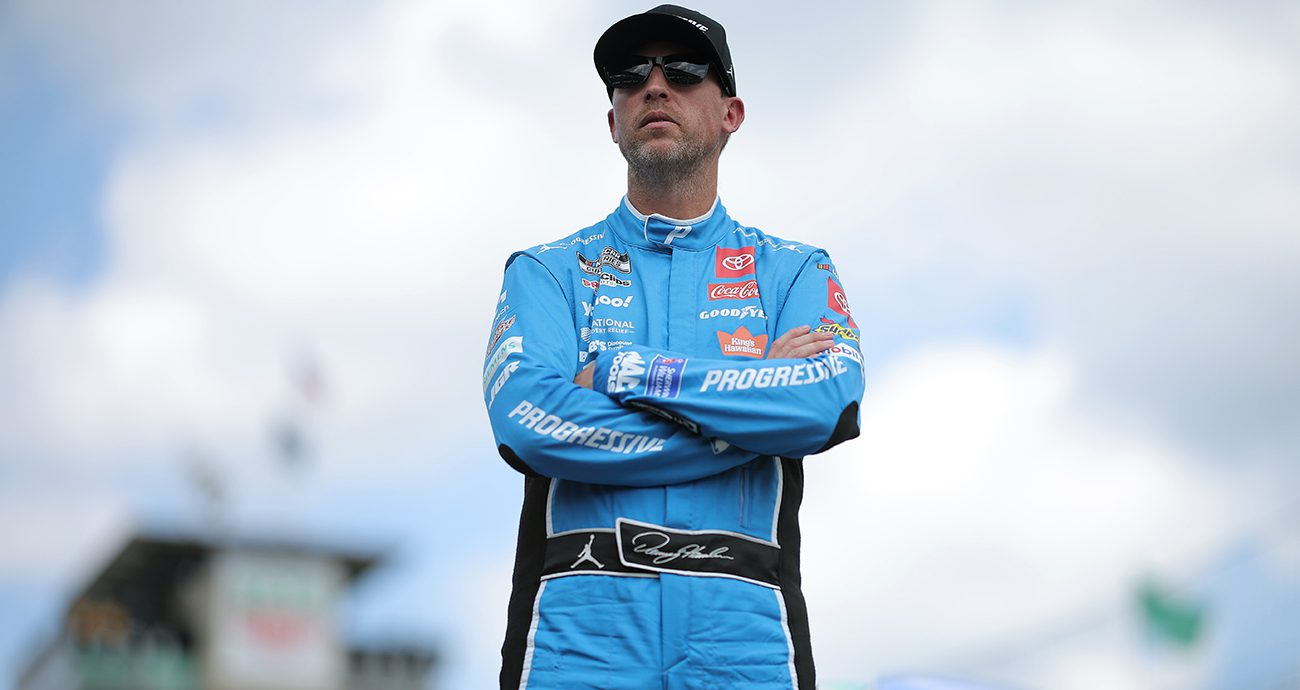
The Chase presented by Mobil 1 is on — and it’s going to be a fascinating twist on the old days of the pre-playoff system. The last time we saw a postseason format quite like this, with the final 10 races serving as a mini-season of sorts, it was 2013 and Jeff Gordon had just been added as a 13th Chase driver because of “Spingate.”
This time around, 16 drivers have made The Chase, including Ryan Preece, who brought back echoes of the win-and-in era with his victory at Daytona, and they’ll be off and rolling toward the championship starting on Sunday at Darlington. Just as we’ve done in the past, we used projected Driver Ratings (blending overall and track-type-specific performance) to simulate The Chase 10,000 times, tracking how far each contender tends to get, and how often they’re able to win the championship.
And one thing is clear right from the start: Denny Hamlin is a strong favorite to finally win his first career title.
A year after suffering one of the most heartbreaking losses in sports history, losing what would have been his first career Cup Series championship on a late Phoenix caution and restart, Hamlin is back for another try — and he’s in a great position to put his claim as Best Driver to Never Win a Title in the dustbin forever. According to the forecast simulations, Denny has around a 50-50 chance to capture his first championship, well clear of anyone else in the field:
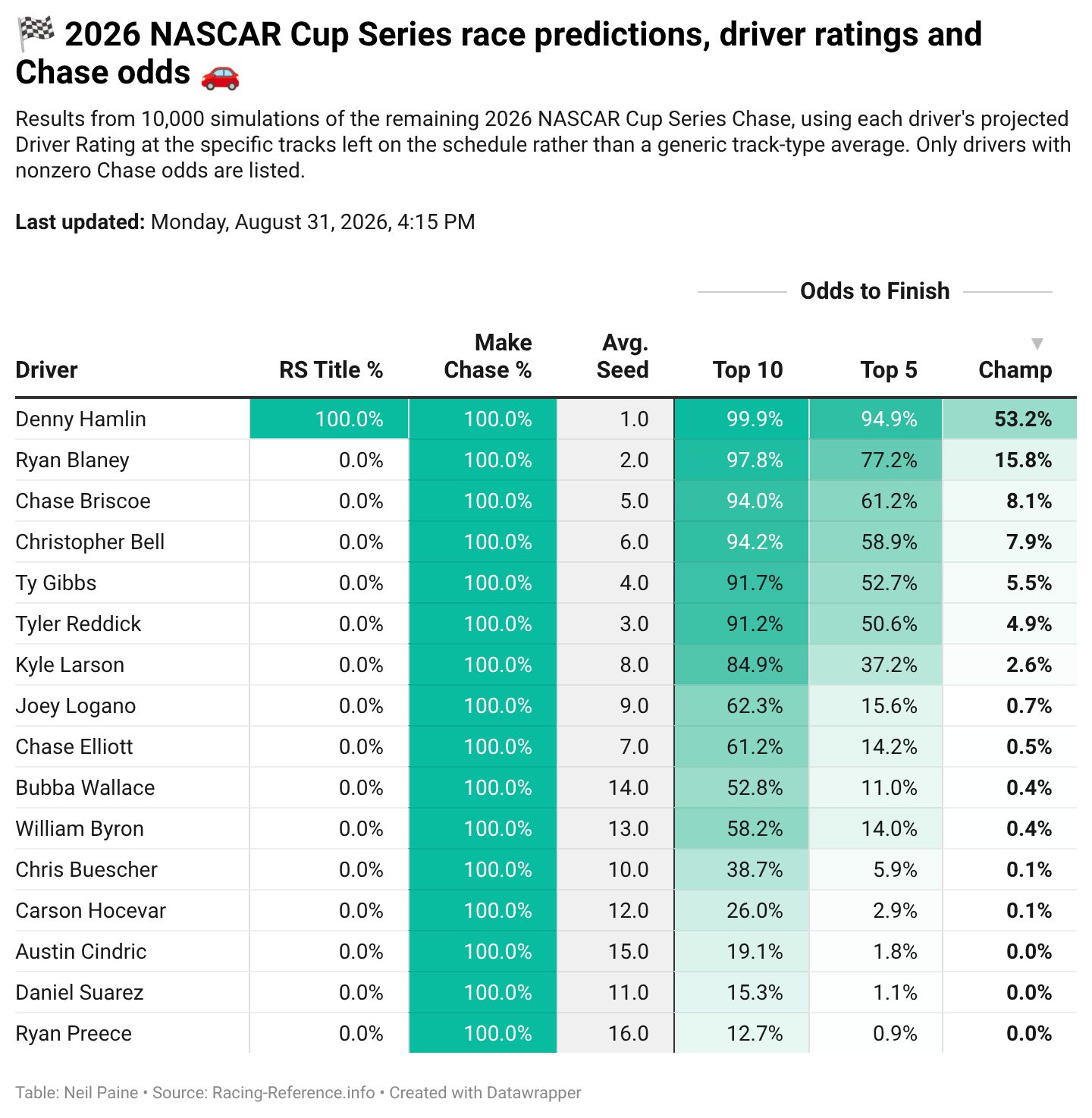
If that sounds high — the prediction markets are around 40% for him, by comparison — consider that Denny not only was the best driver of the 2026 regular season — the only Cup regular to break triple-digits (100.6) in average Driver Rating — but he also is by far The Chase driver most suited to the 10 tracks left on the schedule. Here’s a breakdown of which track types/categories make up The Chase races, relative to the overall mix of tracks on the 2026 schedule:
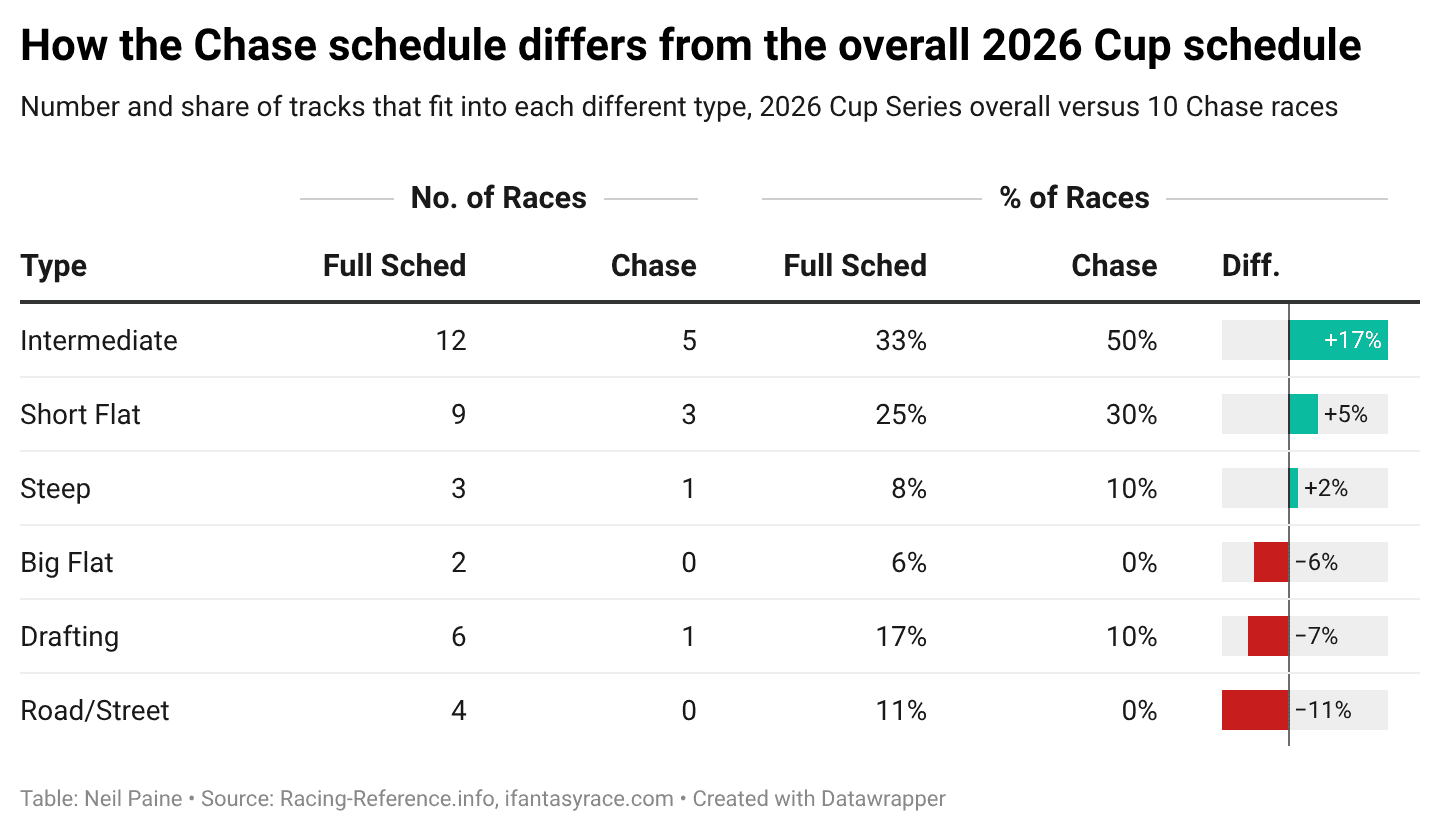
We can see that intermediates (like Darlington, Kansas, Las Vegas, Charlotte and Homestead) are heavily over-represented in The Chase, with flat short tracks (Gateway, Phoenix, Martinsville) and steep tracks (Bristol) also showing up more often than usual. For his part, Hamlin happens to be the best intermediate driver in the series by far, and second only to Blaney at short/flat and steep tracks. Meanwhile, road/street courses and drafting tracks — where Denny is notably less dominant — are disproportionately absent from The Chase. (And in fairness, so are big flat tracks like Indianapolis and Pocono, where Denny does dominate.)
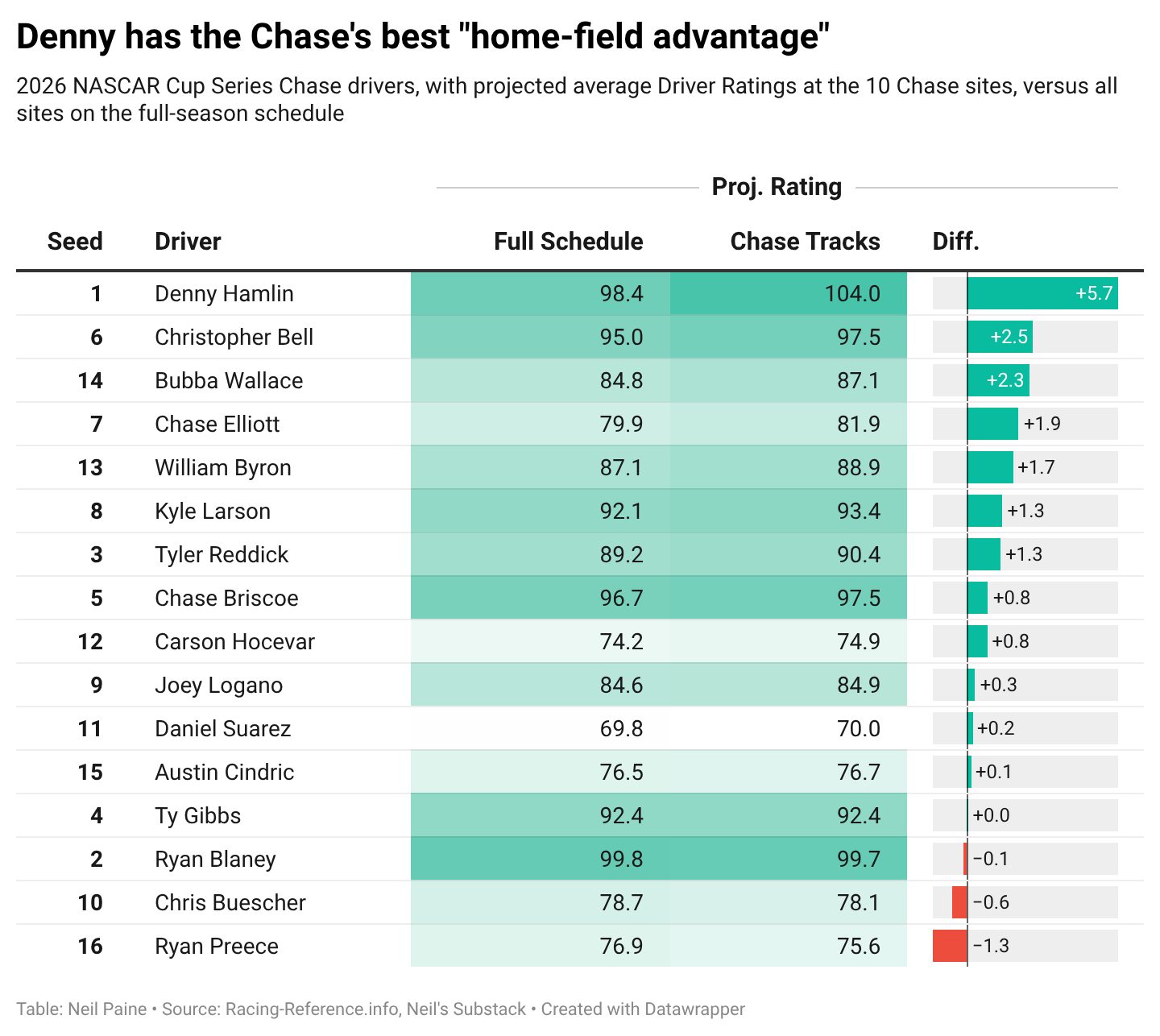
How much does that help Hamlin? His average projected Driver Rating across the 10 Chase tracks is 104.0, versus 98.4 across all the sites on the 2026 Cup schedule. While most title-eligible drivers are more suited to The Chase tracks than the average track at this point — again, tracks that are high-variance (superspeedways) or cut against typical oval-racing skills (road courses) have been downplayed relative to bread-and-butter ovals — Hamlin’s advantage is more than double that of the next-highest Chase drivers, Christopher Bell and Bubba Wallace:
But even if things are lined up for Denny’s date with destiny, he still has to go out and execute it. The key track to watch for Hamlin will be Las Vegas in the fifth Chase race on Oct. 4. Unsurprisingly, Denny is projected as a heavy favorite to win on maybe the most quintessential of all intermediate 1.5-mile tracks, which sets up opportunity — in the simulations, he wins the title 74% of the time when he takes the checkered flag in the Nevada desert — but also pressure if he doesn’t perform at a track where he’s supposed to dominate.
In fact, each of Las Vegas, Homestead, Phoenix and Charlotte are potential playgrounds for the No. 11, but also see Hamlin’s title odds drop by at least 20% if he finishes outside the top 20. Even Darlington this weekend could eat into his title chances nearly as much with a bad finish right away.
And if Hamlin doesn’t go on to take the title, who might claim it instead?
The obvious pick is Blaney, who has been driving at a higher level than Hamlin recently. The problem for the No. 12 team, though, is they start at multiple disadvantages: Not only does Hamlin have the built-in 25-point standings lead over Blaney from the opening green flag, but the mix of Chase tracks also does not favor Blaney nearly as well as it does Hamlin.
As mentioned before, Blaney is great on short flat tracks and steep tracks, so he is the model’s top favorite to win at Gateway, Bristol, Phoenix and Martinsville. He’s also the highest-rated superspeedway driver, so he’s favored to win at Talladega, too. The problem, though, is those tracks only make up half of The Chase schedule; the rest are intermediates, where Blaney was outpaced by a handful of drivers this season, none more so than Hamlin. And any potential advantage for the No. 12 car at road courses — where Blaney was massively better than Hamlin this season (106.0 rating versus 69.3) — is nullified by there being none of those in the ’26 Chase.
Even so, Blaney should put forward a strong showing in the next 10 races. There’s a reason why either Hamlin or Blaney win the championship a huge share of the time, beyond simply the big cushion they start with in the pre-Chase standings. But if the two favorites falter, things truly become wide-open. Here are the model odds in just the subset of simulations where neither Hamlin nor Blaney end up winning the ’26 crown:
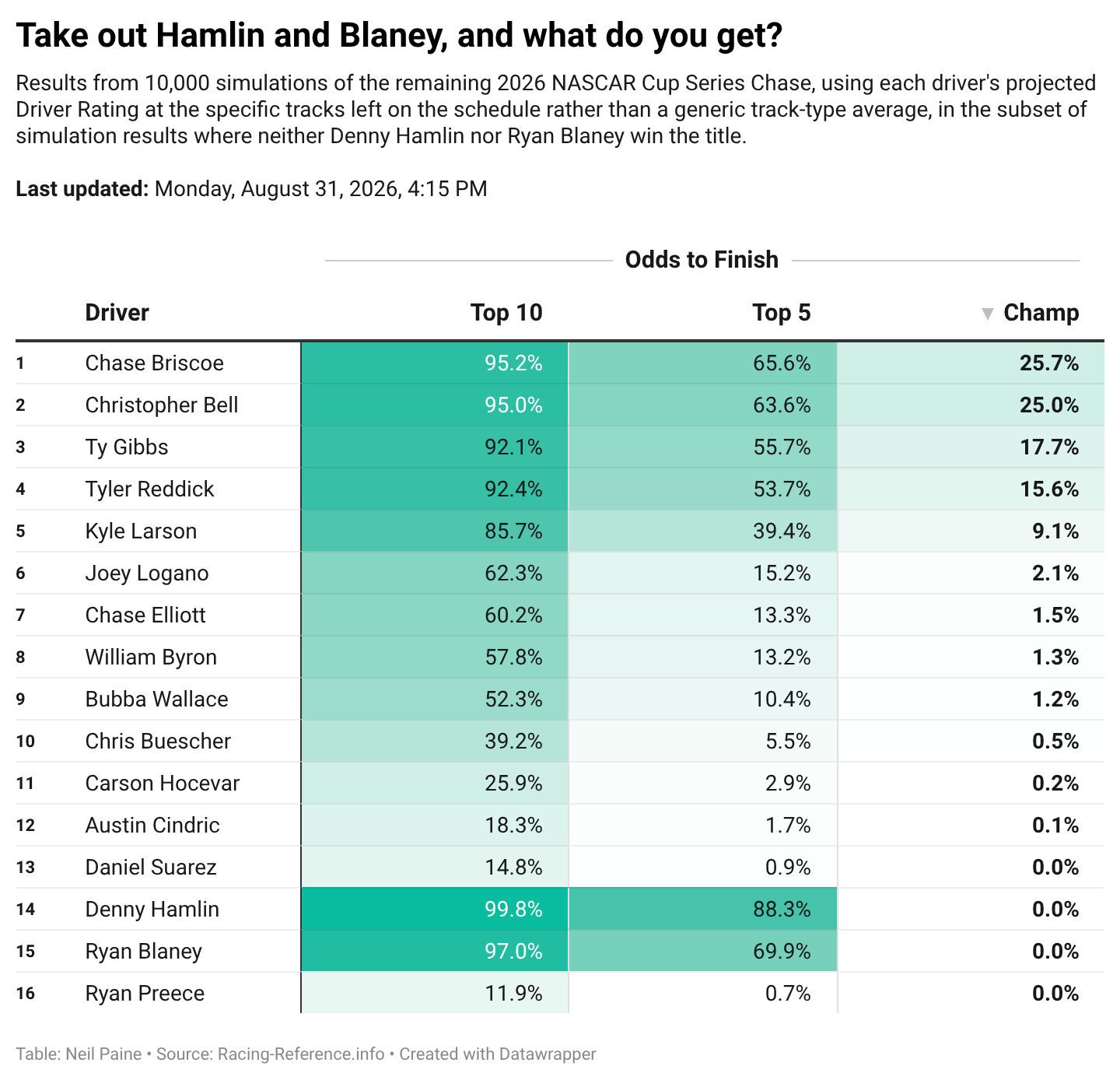
Given the way they’ve been driving recently, both Bell and Chase Briscoe have a real shot at playing spoiler despite neither being seeded within the top four. (Similar to his JGR teammate Hamlin, Bell in particular also benefits from the set of tracks making up The Chase; Briscoe, less so, despite driving the same equipment). Briscoe has won two of the past four races held at Darlington, so he’ll be especially under pressure to live up to that pedigree from the start of the postseason, just to keep up with the points Hamlin is expected to produce once The Chase schedule hits its Kansas-Vegas-Charlotte corridor midway through.
The same can be said for Tyler Reddick, whose recent drop in form has been well-documented — and who no longer has any margin for error while trying to rediscover his early-season speed. (Even en route to a third-place run at Daytona, Reddick posted only a 79.2 Driver Rating after running 75% of the race outside the top 15.) Reddick needs a strong run Sunday at Darlington, where he won in March, to get his title bid back on track; even a run outside the top 10 causes his odds in the forecast model to drop, all else being equal. Still, he and Ty Gibbs are within enough striking distance in the points to stand a solid chance of stealing the title if Hamlin and Blaney both come up short.
Not coincidentally, the drivers highlighted above round out seed Nos. 1-6 in the pre-Chase standings, forming the conventional-wisdom boundary separating those who might realistically win from everyone else. But the model doesn’t think that’s a completely hard-and-fast rule: It gives about a 5% chance to drivers outside the top six — led by Kyle Larson, who has much higher odds than anyone else in that group, due in part to his own high proficiency on intermediate tracks. (Only Hamlin, Reddick and Bell had a better average rating on ovals this season.) While Larson has struggled to turn his pace into finishing results this season — 2026 is tracking to be his first full, winless season since 2018 — his championship odds climb to 5.5% in universes where he wins at least one race, and 14.8% in ones where he wins twice.
As for the rest, most of the remaining Chase drivers did win the title at least once in our 10,000 simulations, even if some of the scenarios it took to make it happen required a pretty wild sequence of results. (Yes, we are saying there’s a chance, Austin Cindric.)
But that’s also what makes this new version of The Chase so interesting. Without round-by-round eliminations or a winner-take-all finale, like the old playoff system had, we won’t necessarily be able to predict ahead of time the big moments that decide the championship — until, perhaps, they are right on top of us. Mostly, though, the title race hinges on whether the favorites maximize the tracks where they should have the biggest edge — and whether anyone else can make them pay when they don’t.
For Hamlin, that means cashing in on the intermediate-heavy section of the schedule that seems almost perfect for his strengths. For Blaney, it means piling up points at his own set of preferred places, like Gateway, Bristol, Talladega, Phoenix and Martinsville. And for everybody chasing them, the path to the championship probably starts with taking advantage anytime and anyplace the 11 and 12 cars leave points on the table.
The Chase may be back to looking more like a 10-race closing marathon than the old series of elimination rounds used to. But with every point carrying forward all the way to the season finale, the pressure to bring your best every week is probably greater than ever.