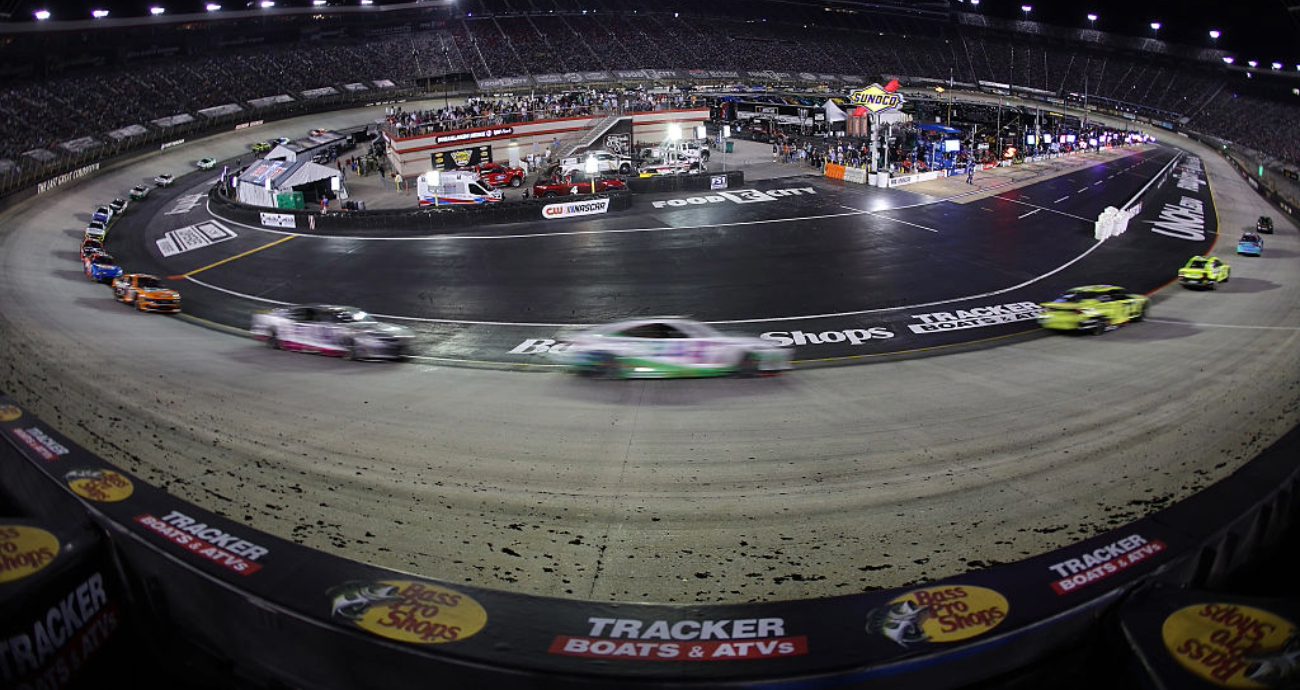
BRISTOL, Tenn. — For many years, the idea of NASCAR drivers running a lap faster than 15 seconds on the half-mile surface at Bristol Motor Speedway was considered to be something of a fantasy.
Steadily, tires changed, engines got stronger, drivers got bolder, Bristol’s “best” groove got better. Fifteen seconds eventually became something more than a concept. Carl Edwards ran a lap in 14.989 seconds to win the pole for the Bristol spring race in 2011. He was the only driver in the field under 15 seconds.
RELATED: Cup Series standings | At-track photos
Eventually, another half-second was “found,” and the all-time Cup Series qualifying record at BMS now belongs to Ryan Blaney, who circled the concrete half-mile in 14.528 seconds (132.075 mph) in April 2019.
That record has stood for seven years as NASCAR has made modifications in car design, engine power and tire compounds and the track has toyed with adding various substances to the track surface in attempts to enhance competition. Through all that, Bristol has remained ridiculously fast for a half-mile track — indeed, one of the fastest half-miles in the world. But will drivers in NASCAR’s top three series eventually break the 14-second barrier?
That idea is considered fanciful by most, but a 15-second lap once was thought to be in the same Wonderland.
“I would say that a 14-second lap around here is ripping,” Chris Buescher said. “To go a half-second faster would be significant on a half-mile race track. I don’t believe you’ll see us get there. We’re not using a ton of brake here at Bristol, especially on our fast laps. We’re using a ton of throttle, but I think more horsepower would be the only way to get it up out of the hole faster, but I would say that it’s going to have to come from tire and grip, or simply downforce. With the simpler package that we have, the simpler diffuser package, it’s definitely taken a little bit of speed out of it already.”
The qualifying records in NASCAR’s other national series at Bristol are similar to Blaney’s Cup mark. The late Kyle Busch, known for pushing the edges of the speed envelope at practically every track he visited, has the fastest Craftsman Truck Series lap at 14.827 seconds (129.413 mph). Kyle Larson is fastest here in O’Reilly Auto Parts Series qualifying at 14.992 seconds (127.988 mph). Those records were set in 2017.
Texas driver Sam Hafertepe Jr. ran a lap at 13.326 seconds (142.098 mph) in a World of Outlaws sprint car on Bristol dirt. That speed, registered in a lighter car and on what then was a temporary dirt-on-concrete surface, can’t be easily compared to the heavier vehicles of NASCAR’s top three series.
“Aerodynamics, horsepower and tires play a huge part in how fast do you want them to go or how fast do you not want them to go,” Ryan Preece said. “Tires are certainly a big part of it. We were practicing here in November when we did the tire test, and we were in the 14.70s and 14.80s consistently, not just in one lap.”
NASCAR Whelen Modified Tour cars, which no longer race at BMS, ran faster qualifying laps than Cup cars on the Bristol surface.
“That’s the reason why they (Modifieds) don’t come here as much anymore,” Preece said. “When you qualify close to 140, that’s pretty fast. The concern becomes will the car be able to take a hit if you’re going that fast? Safety becomes a problem.”
Limits on body design, engines and tires control speeds, but extra effort occasionally can create surprising results. Joey Logano won the pole last week at Gateway near St. Louis with a speed of 137.124 mph, dramatically faster than second-place Kyle Larson (135.980) on the 1.25-mile track.
“I think qualifying last week showed that there is a lot of potential left in this (generation) car,” Ross Chastain said. “We’re several years into the Gen 7, but the lap the 22 (Logano) put down last week was so far ahead of everybody that you could see there are still gaps in this car as far as leaps in speed. So I don’t know what the limit is.”
Chase Briscoe said the weight of the current Cup car always will limit speed gains. “I don’t know how we would ever get under 14 seconds with this car,” he said. “We’re pretty heavy. I would never say never, but I don’t think this car will get there unless Goodyear brought some kind of crazy tire or something.”
Although more speed is a virtually constant goal of every team, Buescher said faster laps at Bristol don’t lead to better racing.
“I don’t see where running a 13.9 around here is going to create anything better than what we have,” he said. “It’s not simply about the raw speed of it. We’re fast now, and a lot can go wrong in a quick hurry. That keeps us on our toes.”