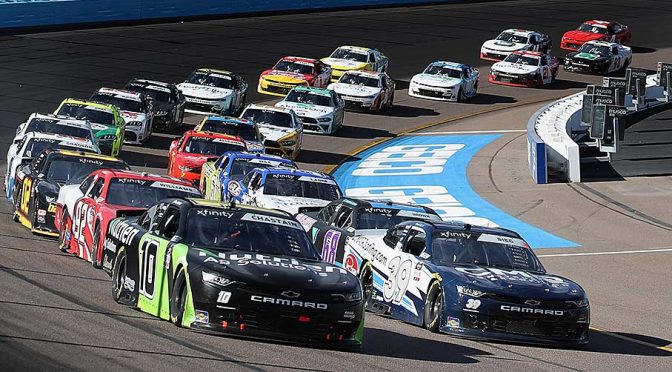
NASCAR competition officials announced Monday that the field size for Xfinity and Gander Trucks races temporarily will be expanded to a maximum of 40 vehicles each. The change will be in place for events scheduled without qualifying as the sanctioning body attempts to hold its first races after the outbreak of COVID-19.

The temporary procedure change increases the field from Xfinity Series’ customary 36 entries and the Gander RV & Outdoors Truck Series’ usual 32. No changes were made to the NASCAR Cup Series’ field size, which remains at a maximum 40 cars.

RELATED: NASCAR’s revised May schedule | Stage lengths for May races

NASCAR officials recently unveiled a revised schedule to return to racing with events scheduled at Darlington Raceway and Charlotte Motor Speedway later this month. Races at both tracks will be held with safety precautions in place, including restricting track time, travel time and exposure for essential personnel by forgoing pole qualifying at the majority of rescheduled events.

Officials indicated that the sanctioning body did not want to punish part-time or new teams in each series by continuing to limit the field without the opportunity to qualify. The two series plan to return to their normal field sizes once restrictions begin to lift and qualifying is restored as part of the event schedule.

“This move is critical for the long-term health of the NASCAR Xfinity Series and NASCAR Gander RV & Outdoors Truck Series,” said Scott Miller, NASCAR Senior Vice President of Competition. “There are many new full-time and part-time team owners who have made significant commitments to our sport and secured sponsorship to participate this season. NASCAR wants to enable these teams to fulfill their commitments and grow their businesses without being affected by circumstances out of their control.”

Section 1.6 of the 2020 NASCAR Rule Book allows for the sanctioning body to adapt to unforeseen and/or extraordinary circumstances under the “EIRI” clause — “Except In Rare Instances” — which applies to the current public-health crisis and unprecedented NASCAR industry work stoppage.

The temporary change will not dramatically alter the points structure for each race. In the Xfinity Series, officials will continue to award a baseline of 40 championship points for first place and one point for 36th (formerly last) place; teams finishing 37th through 40th in the expanded field will also receive one point. In Gander Trucks, first place will continue to earn 40 points with five points for 32nd (formerly last) place; teams finishing 33rd through 40th in the expanded field will each receive five points.

A NASCAR spokesperson indicated that post-deadline entries will not be eligible for these events.
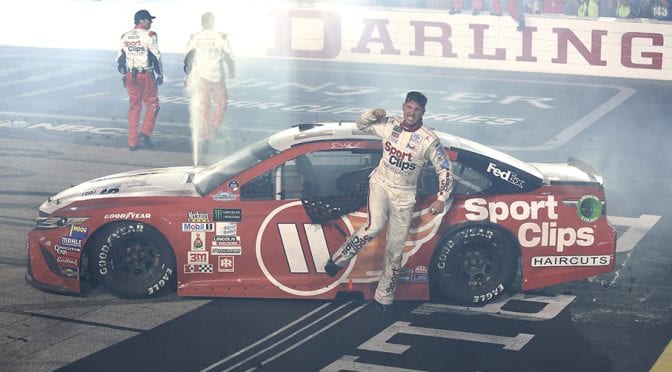
Denny Hamlin is going to do as he’s told at Darlington Raceway when NASCAR returns May 17 (3:30 p.m. ET on FOX, MRN, SiriusXM NASCAR Radio) and the driver of the No. 11 Joe Gibbs Toyota expects all of the other Cup Series drivers present to cooperate in the same way. There’s too much on the line to not. Live racing is almost back, and no one wants to lose it again.

Race-day protocol is obviously going to be different. There will not only be an absence of fans, but team personnel will also be limited. Rosters are limited to 16 people, which includes those required such the driver, spotter and crew chief. The owner even counts if attending.

RELATED: Stage lengths, at-track procedures revealed | FAQ’s for NASCAR’s return

That’s only the beginning of the precautions the sanctioning body is implementing and everyone involved in the sport is taking seriously amid the COVID-19 pandemic.

“Obviously there will be a huge microscope on how we’re doing things,” Hamlin said Saturday after his second win in the eNASCAR iRacing Pro Invitational Series. “For all of us, it’s just the unknown of making sure we’re doing it the right way.”

RELATED: Pro Invitational Series results from North Wilkesboro Speedway

The aspect of the unknown bleeds into the on-track competition, too.

None of these drivers have had actual seat time since Joey Logano’s win more than two months ago on March 8 at Phoenix Raceway. They also won’t have any practice time at Darlington prior to the drop of the green flag for the 400.2-mile race. They don’t even qualify. NASCAR truly wanted this to be a one-day event.

“I envision people are going to be pretty timid, at least for the first few laps, just trying to understand, checking your travels,” Hamlin said. “There’s plenty of times where these things unload, the cars are hitting the race track, you’re not ready to be in a pack quite yet. That will certainly be different.”

Darlington is known as the track “Too Tough to Tame.”

“I mean, it will be a challenge,” Hamlin said. “I think every driver thinks they have an advantage, right?  But I like that there’s so many unknowns.”

Hamlin has won twice at Darlington in his 14 career starts there so far — 2010 and 2017. He also already has a 2020 win thanks to his third Daytona 500 victory back in February. That means he’s locked into this season’s NASCAR Playoffs, as are Alex Bowman (who won at Fontana) and Joey Logano (who won at Las Vegas and Phoenix). They were the three drivers to win before the competition pause hit in March due to COVID-19, halting the season for two-plus months.

Darlington will welcome back postseason repercussions to the racing world. A playoff berth is on the line. Amid all of the other changes, that part has remained the same.

There can’t be any post-race pit-road dust-ups, though, which will make things interesting if drivers get heated during the waning laps. Social-distancing rules rule the day and prevent any type of physical contact; people must be six feet apart at all times. Revenge will have to wait, or at least carry over to a later event.

“If there’s ever a time to be aggressive, ruffle some feathers, this is probably the time to do it,” Hamlin said, “because you don’t have to face the consequences after the race.”

This is the first installment in a series where NASCAR.com looks back at each race this season and gets you caught up for Sunday’s return at Darlington Raceway. We start with the Daytona 500, which took place Feb. 17, 2020 at Daytona International Speedway. 

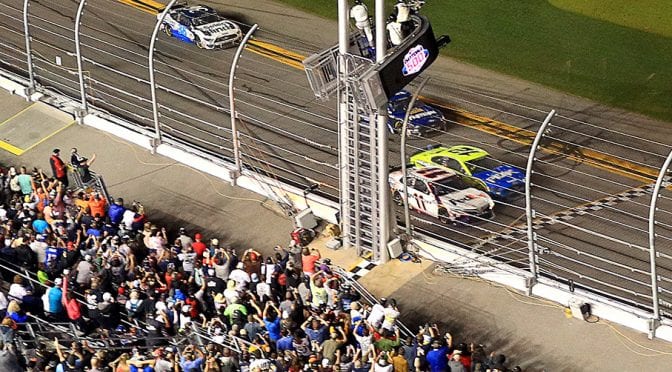
WINNER: Denny Hamlin won his third Daytona 500 and became the fourth driver to win “The Great American Race” in back-to-back years and the first since Sterling Marlin did so in 1994-95. Hamlin led a race-high 79 laps and was engaged in a back-and-forth battle with Ryan Blaney and Ryan Newman in a NASCAR Overtime finish.

KEY MOMENTS: The second closest finish in Daytona 500 history saw Denny Hamlin, Ryan Blaney and Ryan Newman trading the lead in the two-lap finish. Newman held the lead coming off of Turn 4 when contact from Blaney sent Newman up the track, into the wall and saw his car flip over with sparks flying. Blaney and Hamlin raced side-by-side to the line with the Joe Gibbs Racing driver edging out the Team Penske driver. Newman was taken to a local hospital after the last-lap wreck, and he would be released from Halifax Medical Center two days later.

A chain-reaction crash that started when Joey Logano bumped Aric Almirola into Brad Keselowski on Lap 184 involved 19 of the 37 cars still in the race and eliminated Keselowski and seven-time champion Jimmie Johnson from contention. This was the first of four cautions in the final 25 laps. 

RELATED: Full results from race

KEY DRIVERS: Ryan Blaney finished as the runner-up, and despite a strong show of speed from him to open 2020, this is his only top-five and top-10 finish so far in the season. In his first NASCAR Cup Series race back at Roush Fenway Racing, Chris Buescher finished third. Ryan Newman finished ninth even with his involvement in a last-lap wreck. Jimmie Johnson opened his final full-time season with a 35th-place finish after he was in a wreck on Lap 184.

KEY TAKEAWAYS:
1. Ryan Newman’s last-lap wreck sidelined him for the next three races. Ross Chastain filled in for Newman while during that time, but last month, the veteran driver was medically cleared to return when the season resumes.

2. Denny Hamlin strengthened his Hall of Fame case with a third Daytona 500 crown. The other drivers with at least three Daytona 500 wins – Jeff Gordon, Dale Jarrett, Bobby Allison, Cale Yarborough and Richard Petty – are all in the NASCAR Hall of Fame. Unlike those five, Hamlin does not yet have a NASCAR Cup Series title. The victory looked to be a sign of Joe Gibbs Racing picking up where it left off from 2019, but to date, it’s the organization’s lone Cup Series win of the season.

3. Ryan Blaney’s crew-chief change pays early dividends. The speed shown at Daytona by Blaney was a trend NASCAR would see over the early weeks with new crew chief Todd Gordon. Blaney was strong at Las Vegas Motor Speedway and Auto Club Speedway before late-race misfortunes impacted his finishing position in those races.

4. Chris Buescher scored his first NASCAR Cup Series top five since 2018 in his first start with Roush Fenway Racing. The 27-year-old made the move back to the Roush program after three seasons with JTG Daugherty Racing, and his season-opening top five served noticed that he would be a points factor in the playoff race.

5. David Ragan, Brendan Gaughan and Corey LaJoie nabbed top-10 finishes to open the season. LaJoie is the only one of the three who is running full time, while Gaughan has become strictly a superspeedway racer (and 2020 is his final year of that) and Ragan just retired from full-time racing after 2019. Ragan finished fourth, while Gaughan finished seventh and LaJoie finished eighth. John Hunter Nemechek was the highest finishing rookie – 11th – in a trend that would show the driver of the No. 38 Front Row Motorsports Ford routinely getting the most out of his ride.

6. William Byron was the trendy breakout pick for the 2020 season, but the 2020 Bluegreen Vacations Duel No. 2 winner finished last in the Daytona 500 in what amounted to a junior-year jinx. The 2020 season has started slow for Byron with his lone top 10 coming in the last of the four races so far (Phoenix Raceway) and his 19th-place position in the standings being the lowest of all four Hendrick Motorsports cars – the other three are all in the top five in points.

2020 SEASON REFRESHERS

MOORESVILLE, N.C. – Gaunt Brothers Racing, which fields the No. 96 Toyota Camry for driver Daniel Suárez in the NASCAR Cup Series, has hired Nick Ollila (pronounced Oh-li-lah) as its technical director, with the motorsports veteran overseeing the team’s engineering department.

Ollila comes to Gaunt Brothers Racing after a three-year stint as the technical director for Kelly Racing in the Virgin Australia Supercars Championship. The Warren, Michigan-native returned to the United States late last week in time for the resumption of the 2020 NASCAR Cup Series schedule, which begins May 17 at Darlington (S.C.) Raceway as NASCAR becomes one of the first major North American sports to return to action since the COVID-19 pandemic.

MORE: Stage lengths, procedures for May events

“Nick brings considerable insight into what we’re doing with our current inventory of race cars and what we’ll be doing with our Next Gen car in 2022,” said Marty Gaunt, president and CEO, Gaunt Brothers Racing. “He has deep experience in all forms of motorsports, specifically in embracing technology and managing people. Nick also has a strong rapport with our partner Toyota, as many of the people he worked with when he was at Red Bull are the same people there today. He’ll be able to hit the ground running, which is good, because with two to three races a week, we’re all going to be running.”

Gaunt first worked with Ollila in 1997 when the two were at Kranefuss-Haas Racing. Gaunt was the general manager of the NASCAR Cup Series team and Ollila was its chief engineer. Their NASCAR paths crossed again 10 years later when both worked at Red Bull Racing – Gaunt as general manager and Ollila as chief aerodynamicist.

“It’s the people who make the cars go, and Nick has been making cars go since the early ‘70s,” Gaunt said. “We’re lucky to have a lot of long-term employees who have been with us for 10 years, but scaling up from running a part-time schedule to a full schedule meant bringing in more people. Coming up with the recipe of having all the right people in all the right places isn’t easy, but Nick is a good chef.”

NASCAR is where Ollila has spent the bulk of his career, which includes being the drivetrain specialist at Rod Osterlund Racing in 1980 when Dale Earnhardt won the first of his seven NASCAR Cup Series championships.

“Motorsports is my passion, and I’m proud to have turned it into a career,” Ollila said. “I’ve spent time in a variety of racing series, but NASCAR is the one that intrigues me the most. The level of competition is unmatched, so success is very satisfying. I’ve known and worked with Marty Gaunt and many of the people at Gaunt Brothers Racing for years. They’ve got a great foundation and they’re building for the future, and I’m very happy to be a part of shaping that future.”

Ollila’s racing career began at Team Penske in 1972 as a mechanic. He prepared cars for each of the series in which the organization competed; a lineup that included IndyCar, NASCAR, Can-Am, Formula 5000, sports cars and Formula One.

NASCAR became Ollila’s focus in late 1976. He joined DiGard Racing as the team’s drivetrain specialist, working with NASCAR Hall of Famer Darrell Waltrip until the end of the 1978 season, whereupon he went to work for Osterlund.

IndyCar and Penske beckoned in 1982, and Ollila returned as the team’s engine builder, enjoying four championships (1982, 1983, 1985 and 1988) and four Indianapolis 500 victories (1984, 1985, 1987 and 1988).

Keep this handy guide by your side when watching your next NASCAR race to stay in the know with stock-car racing terminology:

Camber: The amount a tire is tilted in or out from vertical. Described in degrees, either positive or negative.

Dirty air: Aerodynamic term for the turbulent air currents caused by fast-moving cars that can cause a particular car to lose control or find difficulty in passing.

Downforce: A combination of aerodynamic and centrifugal forces that help “plant” a race car to the ground. The more downforce, the more grip a car has. But more downforce also means more drag, which can rob a race car of speed.

Drafting: The practice of two or more cars, while racing, to run nose-to-tail, almost touching. The lead car, by displacing the air in front of it, creates a vacuum between its rear end and the nose of the following car, actually pulling the second car along with it.

RELATED: How to follow the races on NASCAR.com

Drag: The resistance a car experiences when passing through air at high speeds. A resisting force exerted on a car parallel to its air stream and opposite in direction to its motion.

Groove: Slang term for the best route around the race track; the most efficient or quickest way around the track for a particular driver. The “high groove” takes a car closer to the outside wall for most of a lap, while the “low groove” takes a car closer to the apron than the outside wall. Road racers use the term “line.” Drivers search for a fast groove, and that has been known to change depending on track and weather conditions.

Loose:
 Also known as “oversteer.” When the rear tires of the car have trouble sticking in the corners. This causes the car to “fishtail” as the rear end swings outward during turns. A minor amount of this effect can be desirable on certain tracks.

Quarter-panel: The sheet metal on both sides of the car from the C-post to the rear bumper below the deck lid and above the wheel well.

Round (of wedge): Slang term for a way of making chassis adjustments utilizing the race car’s springs. A wrench is inserted in a jack bolt attached to the springs, and is used to tighten or loosen the amount of play in the spring. This in turn can loosen or tighten up the handling of a race car.

SAFER barrier: The Steel and Foam Energy Reduction barrier system — SAFER, for short — is an impact-absorbing wall of welded steel tubing backed by foam. The majority of tracks where NASCAR national series compete have SAFER barriers lining the retaining walls as a safety measure, designed to reduce the energy of crashes.

Short pit: The strategy of pitting well before running out of fuel, getting fresh tires to make up time on the front-runners and theoretically taking the lead once those lead cars need to pit. Short pitting puts a car on an alternate pit cycle and could be beneficial or not depending in part upon how cautions fall the rest of the race.

Side drafting: When a car races alongside another car and “dumps” air flow from that car’s nose to the spoiler of the other car, causing the other car to lose momentum and allowing the side-drafting car to pull away. It’s a strategy used on larger tracks such as Talladega, Daytona and Michigan.

Slingshot: A maneuver in which a car following the leader in a draft suddenly steers around it, breaking the vacuum; this can provide an extra burst of speed that allows the second car to take the lead.

Splitter: Runs the entire width of the car at the front and sometimes appears as if it’s touching the ground. What the spoiler does for downforce in the back of the car, the splitter provides downforce to the front. Damage to the splitter can be difficult to overcome because of the important role it plays in the aerodynamics of the car.

Spoiler: A metal blade attached to the rear deck lid of the car. It helps restrict airflow over the rear of the car, providing downforce and traction.

Tapered spacer: A metal piece that limits how much air gets into the engine cylinder, which in turn limits how much fuel can go into the cylinder and reduces the amount of energy produced.

Tight: Also known as “understeer.” A car is said to be tight if the front wheels lose traction before the rear wheels do. A tight race car doesn’t seem able to steer sharply enough through the turns. Instead, the front end continues toward the wall.

Track bar: A lateral bar that keeps the rear tires centered within the body of the car. It connects the frame on one side and the rear axle on the other. Changes to the track bar settings affect the weight distribution of the car and how it moves through the corners on the track. Also called the panhard bar.

‘Tower’: Short for race control tower, it’s the term used by racing officials and teams in radio communications to address the NASCAR race director for a given event. Fans, teams and spotters listening on the race officials’ scanner channel will hear frequent references to “tower” for race control.

Wave around: Lapped cars that do not pit during a regular yellow-flag pit cycle are allowed to take a “wave around” past the pace car once the one-to-go signal is given during that caution period. This procedure ensures that lead-lap cars restart at the front of the field. Wave-around cars restart at the rear of the field, but they are placed in front of cars that have received a penalty.

Fresh off its run in the eNASCAR iRacing Pro Invitational Series and due to popular demand, North Wilkesboro Speedway will be made available to iRacing users starting on Monday, May 11.

Originally, the track was going to be released to iRacing users in June.

Last December, Dale Earnhardt Jr. led an effort to help clean up the historic track so that iRacing could scan the .625-mile layout for its online sim racing service.

RELATED: Hamlin wins Pro Invitational Series race at North Wilkesboro | Rewatch last Cup race 

Which channels have NASCAR programming this week? We answer that and give the weekly NASCAR television listings here in the NASCAR TV schedule.

Note: All times are ET.

MORE: How to find NBCSNGet the NBC Sports App | How to find FS1 | Get FOX Sports App

RELATED: How to follow races on NASCAR.com

Monday, May 11
1 a.m., NASCAR Race Classic: 1994 Coca-Cola 600 (re-air), FS1/FOX Sports App
1:30 a.m., eNASCAR iRacing Pro Invitational Series at virtual North Wilkesboro (re-air), FS1/FOX Sports App
6 p.m., NASCAR Race Hub, FS1/FOX Sports App

Tuesday, May 12
6 p.m., NASCAR Race Hub, FS1/FOX Sports App

On MRN
7 p.m., NASCAR Live

Wednesday, May 13
4 p.m., Dale Jr. Download, NBCSN/NBC Sports App
6 p.m., NASCAR Race Hub, FS1/FOX Sports App
7 p.m., Greatest Races: TBD (re-air), FS1/FOX Sports App
10:30 p.m., Greatest Races: 2013 Auto Club 400 (re-air), FS1/FOX Sports App

Thursday, May 14
3 p.m., eNASCAR iRacing Pro Invitational Series at virtual North Wilkesboro (re-air), FS2/FOX Sports App
6 p.m., NASCAR Race Hub, FS1/FOX Sports App
7 p.m., NASCAR Race Classic: 1993 Daytona 500 (re-air), FS1/FOX Sports App

Friday, May 15
7 p.m., Greatest Races: 2013 Auto Club 400 (re-air), FS2/FOX Sports App
10 p.m., Greatest Races: TBD (re-air), FS2/FOX Sports App

Saturday, May 16
9 a.m., Greatest Races: 1996 Gander RV & Outdoors Truck Series at Bristol (re-air), FS1/FOX Sports App
6:30 p.m., Greatest Races: 1996 Gander RV & Outdoors Truck Series at Bristol (re-air), FS2/FOX Sports App
7:30 p.m., NASCAR Race Classic: 1993 Daytona 500 (re-air), FS2/FOX Sports App

Sunday, May 17
6 a.m., NASCAR Race Classic: 1998 Daytona 500 (re-air), FS1/FOX Sports App
6:30 a.m., NASCAR’s Greatest Races: 2012 Bojangles’ Southern 500 (re-air), FS1/FOX Sports App
3 p.m., NASCAR Race Hub, FOX/FOX Sports App
3:30 p.m., NASCAR Cup Series The Real Heroes 400, FOX/FOX Sports App | HOW TO FOLLOW
10 p.m., NASCAR Cup Series race The Real Heroes 400 at Darlington (re-air), FS1/FOX Sports App

On MRN
2:30 p.m., NASCAR Cup Series The Real Heroes 400 at Darlington

NASCAR driver Daniel Hemric and his wife, Kenzie, welcomed their first child just before the clock officially turned to Mother’s Day with the birth of baby girl Rhen Haven Hemric at 11:56 p.m. on Saturday, May 9.

Racing will certainly be in her blood as her dad is the 2019 Sunoco Rookie of the Year in the NASCAR Cup Series and is running a partial schedule behind the wheel of the No. 8 Chevrolet for JR Motorsports in the Xfinity Series. Her mom competed in what was called the NASCAR K&N Pro Series East from 2013 to 2015.

Congrats to the Hemric family on their new addition.

Here are the race results from the finale of the eNASCAR iRacing Pro Invitational Series North Wilkesboro 160 at virtual North Wilkesboro Speedway.

Fin Str Car Driver Mfr Led Status
1 9 11 Denny Hamlin Toyota 24 Running
2 25 66 Timmy Hill Toyota 0 Running
3 3 31 Tyler Reddick Chevrolet 0 Running
4 8 6 Ross Chastain Ford 31 Running
5 11 3 Austin Dillon Chevrolet 0 Running
6 6 51 Garrett Smithley Chevrolet 0 Running
7 15 15 Brennan Poole Chevrolet 0 Running
8 10 77 Parker Kligerman Toyota 0 Running
9 13 4 Kevin Harvick Ford 0 Running
10 12 89 Landon Cassill Chevrolet 0 Running
11 21 52 JJ Yeley Ford 0 Running
12 29 14 Clint Bowyer Ford 0 Running
13 22 21 Jon Wood Ford 0 Running
14 26 95 Christopher Bell Toyota 61 Running
15 5 8 Dale Earnhardt Jr. Chevrolet 0 Running
16 1 41 Cole Custer Ford 12 Running
17 28 53 Joey Gase Ford 0 Running
18 23 24 Jeff Gordon Chevrolet 0 Running
19 16 018 Bobby Labonte Toyota 0 Running
20 14 19 Martin Truex Jr Toyota 0 Running
21 24 17 Chris Buescher Ford 0 Running
22 17 20 Erik Jones Toyota 0 Running
23 20 18 Kyle Busch Toyota 0 Disconnected
24 7 38 John H. Nemechek Ford 0 Disconnected
25 4 32 Corey LaJoie Ford 0 Disconnected
26 19 10 Aric Almirola Ford 0 Disconnected
27 2 37 Ryan Preece Chevrolet 32 Disconnected
28 27 34 Michael McDowell Ford 0 Disconnected
29 18 13 Ty Dillon Chevrolet 0 Disqualified

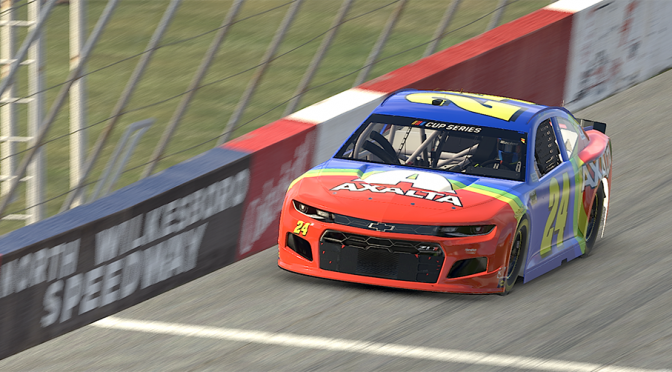
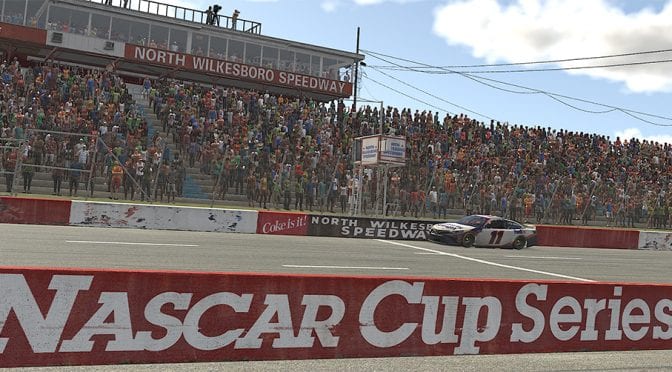
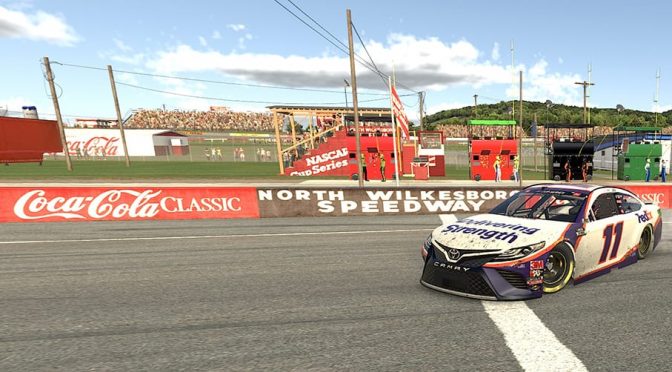
Denny Hamlin’s bump-and-run virtual victory in the North Wilkesboro 160 at the historic North Wilkesboro Speedway on Saturday afternoon book-ended an impressive showing in the eNASCAR iRacing Pro Invitational Series for Hamlin, this year’s Daytona 500 winner. The race served as a competitive send-off for the resumption of the marquee NASCAR Cup Series next weekend at the very real Darlington Raceway.

Hamlin, who drives the No. 11 Joe Gibbs Racing Toyota, also won the eNASCAR iRacing Pro Invitational Series inaugural race at virtual Homestead-Miami Speedway seven weeks ago kicking off a fun, well-received series of virtual races as the sport took time off during the COVID-19 pandemic.

RELATED: Full results | Paint schemes

This weekend, Hamlin had to nudge Ross Chastain’s car in the waning laps to take the checkered flag, holding off one of iRacing’s best, Timmy Hill, by 0.914 seconds to claim a dramatic second win. Hamlin joins Hendrick Motorsport’s William Byron, a three-time race winner, as the only two multi-time race winners during the eNASCAR iRacing Pro Invitational Series competition.

“Talk about a bump-and-run, it’s a textbook way to do it, move him out of the groove, but you don’t wreck him,” Hamlin said of his battle with Chastain, who spun Hamlin in retribution on the virtual cool-down lap.

NASCAR Cup Series rookie and Richard Childress Racing driver Tyler Reddick finished third. Chastain rallied to fourth, and Austin Dillon out-dueled another iRacing star, Garrett Smithley, for the fifth position.

Smithley, Brennan Poole, Parker Kligerman, Kevin Harvick and Landon Cassill rounded out the top 10 in what was a high-action day at the historic venue’s iRacing debut. The race was essentially made possible by Dale Earnhardt Jr., who led the charge in getting the .625-mile oval on the iRacing platform, which opened it up for its first-ever competition Saturday.

Earnhardt finished 15th, and NASCAR Hall of Famer Jeff Gordon, who won the last NASCAR Cup Series race at North Wilkesboro on Sept. 29, 1996, finished 18th.

It was a busy day at the track, with eight caution periods for 53 laps. NASCAR Cup Series rookie Christopher Bell led a race-high 61 laps, finishing 14th in the Leavine Family Racing Toyota. Chastain led 31 laps, and Hamlin was out front for 24 of the 160 laps.

Hamlin conceded getting the last win heading back into regular-season competition was a boost in confidence. Prior to the break in action, Hamlin had already earned his third Daytona 500 victory in the season opener and is ranked 11th in the championship points standings with his NASCAR Playoffs ticket already punched.

“I can only speak for me, but yeah, sure, I’m way more excited than if I wouldn’t have won,” Hamlin said. “Winning the last iRace, the first and the last one, it’s significant. We have millions of people watching. It’s good publicity for my sponsors. It’s good for me and my confidence.

“We know, every driver knows, that everything is equal. There is no advantage for anybody. It’s about who can hone their craft in iRacing. … It’s not like playing Madden or NBA 2K where you’re using your hand-eye coordination pushing the buttons. You’re using the gas, brakes, running two at the same time, steering wheel. Everything is the same. I take pride in that.”

Hill, who started 25th in the 29-car grid, earned his sixth top-three finish in the seven eNASCAR iRacing Pro Invitational Series events.

“Well, it’s been a fun experience, we had the best average and capped the finish off finishing second at North Wilkesboro,” Hill said. “We can’t wait to get back to racing at Darlington next week. I’ve really enjoyed what this was but can’t wait to get back to driving what we normally do.”

Regular competition resumes at the venerable Darlington egg-shaped oval May 17 (3:30 p.m. ET, FOX, MRN SiriusXM NASCAR Radio) with a 400-miler. Kevin Harvick, who finished ninth Saturday, leads the NASCAR Cup Series championship standings by a single point over Joey Logano, whose already won twice in the four races to date.

Hamlin was, as one may anticipate, extremely eager to get racing again. No fans will be allowed at Darlington, and there are strict social distancing standards applied to teams, drivers and crews. But Hamlin is optimistic the racing will be as good and compelling as ever.

“I think all-in-all it’s going to be like an old shoe,” Hamlin said. “I don’t think from the TV’s perspective, fans will see anything different than just a normal race that they would normally see at Darlington.”

In addition to the NASCAR Cup Series race, the NASCAR action will continue at Darlington with a 200-mile NASCAR Xfinity Series race May 19 (8 p.m. ET on FS1, MRN and SiriusXM NASCAR Radio) and a second NASCAR Cup Series event (500K) May 20 (7:30 p.m. ET on FS1, MRN and SiriusXM NASCAR Radio).