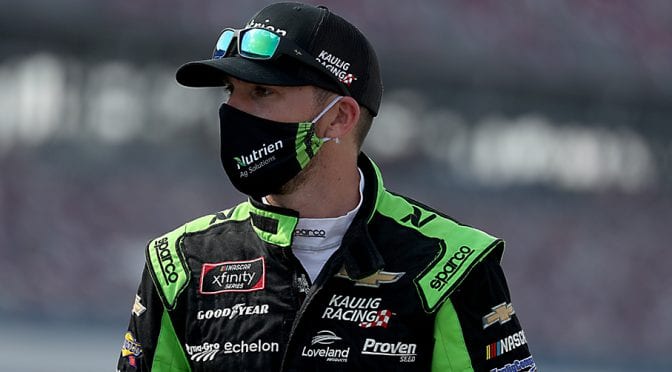
Ross Chastain came .299 seconds short of the checkered flag Saturday at Talladega Superspeedway, but the driver of the No. 10 Kaulig Racing Chevrolet still left the Alabama track a winner.
Thanks to his runner-up finish in the NASCAR Xfinity Series’ Unhinged 300 behind teammate Justin Haley, Chastain took home the $100,000 Dash 4 Cash prize money. He was the highest finisher among his race-within-a-race competitors: AJ Allmendinger, Brandon Jones and Chase Briscoe. Chastain led a race-high 24 of 113 laps around the 2.66-mile circuit. He was fourth and fifth, respectively, in Stages 1 and 2.
“The almighty dollar still wins in the world, so it’ll go a long way,” Chastain said. “It doesn’t all go to me. No driver gets all of it. Don’t let anybody fool you. But everybody gets bonuses on the team. It helps the whole program. It makes the bad days a little easier.”
Allmendinger won last weekend’s Dash 4 Cash bonus at Homestead-Miami Speedway. He finished Talladega seventh despite spending the first two stages toward the back of the pack. He was 23rd in Stage 1 and 25th in Stage 2. Allmendinger, who drew a 34th starting spot, had to drop to the rear prior to the green flag because his No. 16 Kaulig Racing Chevrolet failed pre-race inspection three times.
Jones came in 16th at Talladega with his No. 19 Joe Gibbs Racing Toyota. He got caught up in the race’s final crash along with 10 other cars on Lap 106 after placing fifth and eighth in the first two stages.
Chase Briscoe was third in Stage 1, won Stage 2 and led 15 laps overall, but he ended up 18th at Talladega after getting involved in a multi-car wreck in the final stage. His No. 98 Stewart-Haas Racing Ford got tangled up with Riley Herbst, Brett Moffitt and Joe Graf Jr. on the frontstretch of Lap 78, drawing the first on-track caution.
There’s one event left in the Dash 4 Cash program: June 28 at Pocono Raceway (12:30 p.m. ET on FS1, MRN and SiriusXM NASCAR Radio). Haley, Chastain, Austin Cindric (fourth) and Alex Labbe (ninth) will be racing for the last $100,000 check.
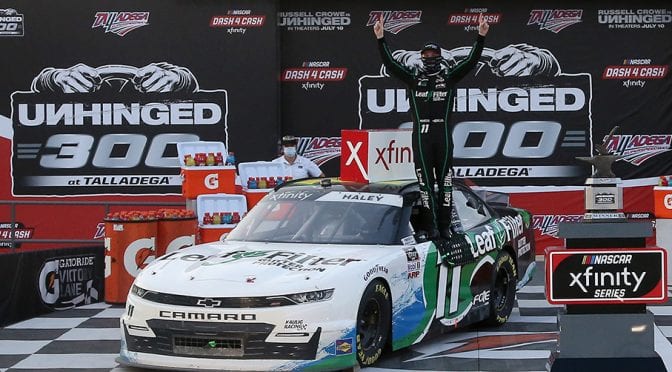
On a banner day for Kaulig Racing at Talladega Superspeedway, Justin Haley got his first NASCAR Xfinity Series victory and Ross Chastain got the cash.
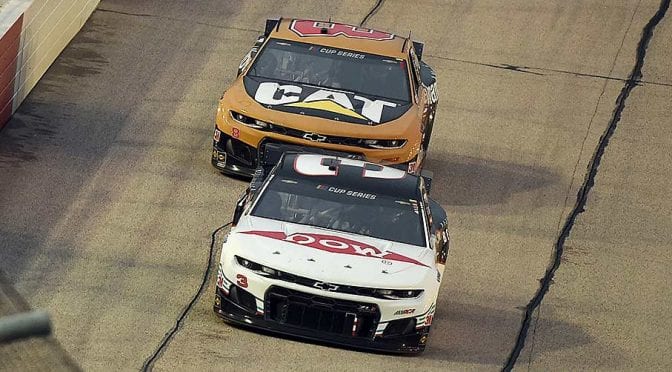
Haley, who doesn’t have a ride locked down for next year, beat teammate Chastain to the finish line by .299-seconds at the end of a three-lap dash in Saturday’s Unhinged 300 at the 2.66-mile track.
Chastain collected the $100,000 Xfinity Dash 4 Cash bonus as the highest finisher among four eligible drivers—a week after teammate AJ Allmendinger claimed an identical cash prize with a fourth-place run at Homestead-Miami Speedway.
With Allmendinger winning in a part-time role June 7 at Atlanta, Kaulig now has won two of the last four Xfinity Series races in addition to the consecutive cash bonuses.
An emotional Haley climbed from the right-side window of his car after the race, with more than one reason to be choked up by the maiden win. Haley’s crew chief during his rookie season, Nick Harrison, passed away unexpectedly on July 21 last year, and Haley celebrated his bond with his former crew chief.
“First of all, I want to dedicate this win to Nick Harrison and the Harrison family, who started this journey with me last year in my rookie year,” Haley said. “Losing him was pretty big.
“Just an incredible day. Emotionally, I’m fighting for a ride, fighting for the next time I get in a race car next year, so anytime you can win, it definitely helps.”
As for climbing through the “wrong” window, Haley said he was looking for a signature move after winning.
“I’m the littlest guy,” said the 21-year-old. “I’m the only one that can do it, and I still struggled.”
Fortuitously, all three Kaulig drivers were on pit road on Lap 76, when Riley Herbst’s spin off the bumper of fifth-place finisher Brett Moffitt’s Chevrolet caused the fourth caution of the afternoon. The three teammates restarted up front on Lap 81 of 113 and were contenders thereafter.
Jeb Burton had the lead for the restart with three laps left, but with help from Chastain, Haley pulled away on the final lap. Burton came home third and Austin Cindric grabbed fourth.
“When I saw Justin get free of the 8 car (Burton), I knew it was his race, and I honestly have never been so happy to finish second,” Chastain said.
Allgaier triggered the last caution when JR Motorsports teammate Noah Gragson checked up behind Chastain’s block on Lap 106.
“It was just disappointing,” Allgaier said. “I hate it for everybody at JR Motorsports. Right there, Noah had a really good run to the outside of the 10 (Chastain), and he pulled up to block, and as soon as he did, it started to get (Gragson’s) car loose.
“He checked up, and I ran into the back of him. I thought we were going to be OK, and then (JRM teammate) Michael (Annett) got into the back of me.”
Harrison Burton’s record streak of 10 straight top-10 finishes as a Sunoco rookie came to an end in Turn 3 on Lap 97. The No. 52 Chevrolet of Kody Vanderwal checked up after contact with the car of Jefferey Earnhardt in front of him, turned sideways near the top of the track and chased the No. 20 Toyota of Burton down the track. Contact from Vanderwal’s car turned Burton sideways and propelled him nose first into the outside wall. The cars of Joe Graf Jr., Josh Williams and Colin Garrett also were collected.
“It looks like we were all running the top and we were single file, and they checked up really hard,” said Burton, who had finished in the top 10 with two wins in the first 10 races of the season. “I don’t know if I didn’t get checked up in time. It looks like one of them got sideways and then it was just all over.
“It’s so hard to tell what’s going on. There’s so much going on, even when you’re running single file. Just a tough day for us. We had a fast race car and trying to make moves work on the bottom. Just kind of got shuffled to the back and from then on, that’s just kind of how it went down.”
Gragson salvaged a 10th-place result and maintained a 15-point lead over second-place Chase Briscoe in the series standings.
Up next, the NASCAR Xfinity Series heads to Pocono Raceway for the Pocono Green 225 Recycled by J.P. Mascaro & Son on June 28 (12:30 p.m. ET on FS1, MRN, SiriusXM NASCAR Radio). Haley, Chastain, Cindric and Alex Labbe are the Dash 4 Cash eligible drivers.
Note: The No. 21 Richard Childress Racing Chevrolet driven by Anthony Alfredo was found to have one lug nut not safe and secure in post-race inspection.
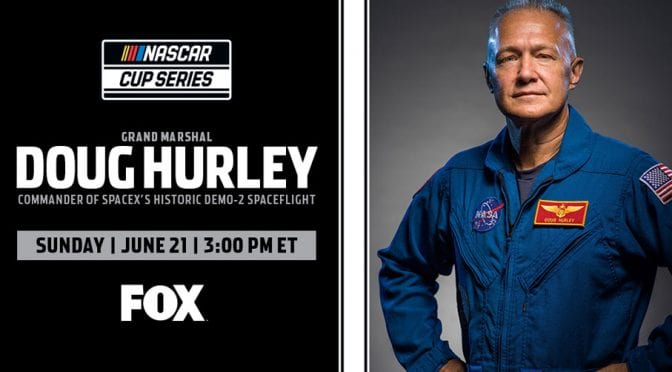
TALLADEGA, Ala. —Astronaut Doug Hurley, currently 250 miles above Earth on board the International Space Station as commander of SpaceX’s historic Demo-2 (DM-2) spaceflight, will give the command to fire engines for Monday’s GEICO 500 NASCAR Cup Series race at Talladega Superspeedway.
Talladega, NASCAR’s longest track, will be one of the first sports venues to have a return of fans — up to 5,000 — in attendance. The GEICO 500, set for a 3 p.m. ET start, will be broadcast live on FOX, MRN Radio and SiriusXM NASCAR Radio. Chase Elliott is the race’s defending champion.
DM-2 is the first crewed spaceflight launched from American soil since STS-135, the final flight of the Space Shuttle program, in July 2011. Hurley, a longtime NASCAR fan, served as pilot for that mission. DM-2 also represents history’s first crewed commercial flight.
Hurley is a veteran of one other spaceflight — STS-127 in July 2009. A native of Endicot, New York, who considers nearby Apalachin his hometown, Hurley is a graduate of Tulane University and the U.S. Naval Test Pilot School. Prior to joining NASA as a member of the 2000 astronaut candidate class, he was a test and fighter pilot in the U.S. Marine Corps.
Apollo 11 astronaut Edwin “Buzz” Aldrin, the second man to walk on the moon, was the Grand Marshal of the 1994 summer Talladega 500. Aldrin added a personal touch in commanding the drivers to start their engines, stating, “Gentlemen, energize your groundcraft.”
NASCAR’s modified event procedures, protocols and number of attendees for the GEICO 500 have been finalized with guidance from public health officials, medical experts and local, state and federal officials. In order to adhere to local social-distancing guidelines, the limited number of guests will be allowed in the frontstretch grandstands and towers. In addition, there will be limited motorhome and fifth-wheel camping spots — 44 — available outside the track high atop the Alabama Superstretch.
The GEICO 500 will be the anchor event of the weekend, which will also feature a doubleheader Saturday. The General Tire 200 for the ARCA Menards Series gets the green flag at 2 p.m. ET, followed by the Unhinged 300 at for the NASCAR Xfinity Series at 5:30 p.m. ET. Both events will compete without fans in attendance but will be broadcast live on FS1, MRN and SiriusXM NASCAR Radio.
Stewart-Haas Racing confirmed in a statement Friday night that two of its employees who work from the team’s shop in North Carolina have tested positive for COVID-19.
The full statement: “Stewart-Haas Racing has experienced two positive COVID-19 test results, neither of which involve personnel who travel to race events. Robust protocols have been in place and continue to be followed diligently to mitigate the spread of the virus while maintaining the health and safety of all members of the organization and greater community.”
NASCAR returned to racing May 17 following a two-month pause due to the novel coronavirus. The return came with an enhanced, deliberate plan as NASCAR worked closely with health experts and government officials to ensure best practices.
Part of those safeguards includes keeping road crew members separate from the designated staff who primarily work in the shop.
NASCAR and track officials have also made screening and other wellness checks mandatory for essential at-track personnel.
TEAM PENSKE
Saturday afternoon, Team Penske announced in a statement that one of its team members had tested positive for COVID-19 earlier in the week as well.
“Earlier this week, Team Penske had one of its team members report positive for COVID-19,” the statement read. “This employee has been in quarantine all week and has recovered without any further symptoms. Due to the team’s stringent protocols, only a few of our personnel had reason to quarantine and none of those individuals are experiencing any symptoms. The identities of those impacted, along with additional details, will not be released due to privacy concerns.”
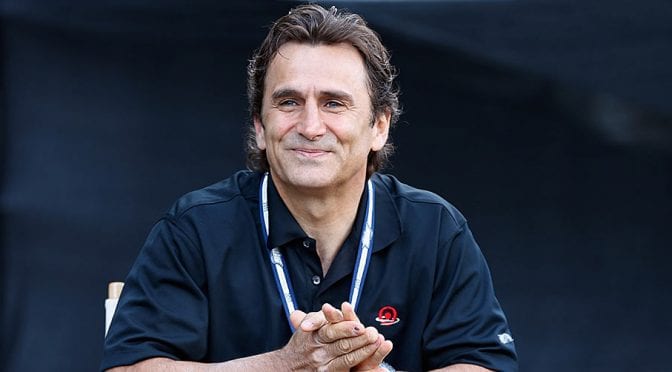
Alex Zanardi, a two-time CART Series champion who became an elite Paralympian after the loss of his legs in a racing crash, was seriously injured Friday after a handbike accident in his native Italy.
Zanardi, 53, was competing in a national race for Paralympic athletes when he crashed near the town of Pienza, according to the Associated Press. Those reports said that Zanardi’s bike collided with a truck, and that he had been airlifted to a nearby hospital, where he underwent what medical officials called “a delicate neurosurgery operation.”
Zanardi, who briefly competed in Formula One, claimed two championships for longtime IndyCar and NASCAR team owner Chip Ganassi. All 15 of his victories in the Championship Auto Racing Teams (CART) series for Indianapolis-type cars came in Ganassi entries.
Zanardi was competing at EuroSpeedway Lausitz in Germany in 2001 when a crash left him critically injured. He lost both legs in the wreck — his right at the knee and his left four to five inches higher at the thigh. Zanardi later wore prosthetic limbs of his own design.
After multiple surgeries and rigorous recovery, Zanardi returned to driving in sports-car series primarily in Europe. In 2019, he returned to America for to drive a BMW in IMSA’s Rolex 24 at Daytona, finishing ninth in the GT Le Mans class.
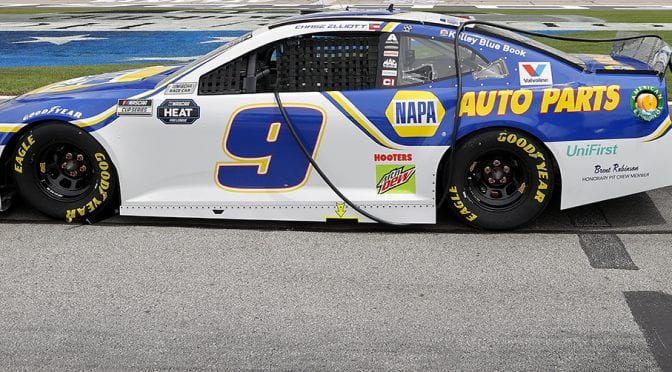
Fans will get a chance to be a virtual passenger with Chase Elliott at Talladega.
NASCAR will feature Elliott’s live in-car camera in Monday’s GEICO 500 NASCAR Cup Series race at Talladega Superspeedway (3 p.m. ET on FOX, MRN, SiriusXM NASCAR Radio).
https://youtu.be/TF-00TUP-0o
Be sure to save the YouTube link so you can ride along with Elliott in the No. 9 Hendrick Motorsports Chevrolet as he attempts to defend his 2019 victory in the spring race at the 2.66-mile Alabama superspeedway.
Elliott has earned one win — coming in the second race at Charlotte Motor Speedway — along with six top fives and eight top 10s so far in the 2020 season.
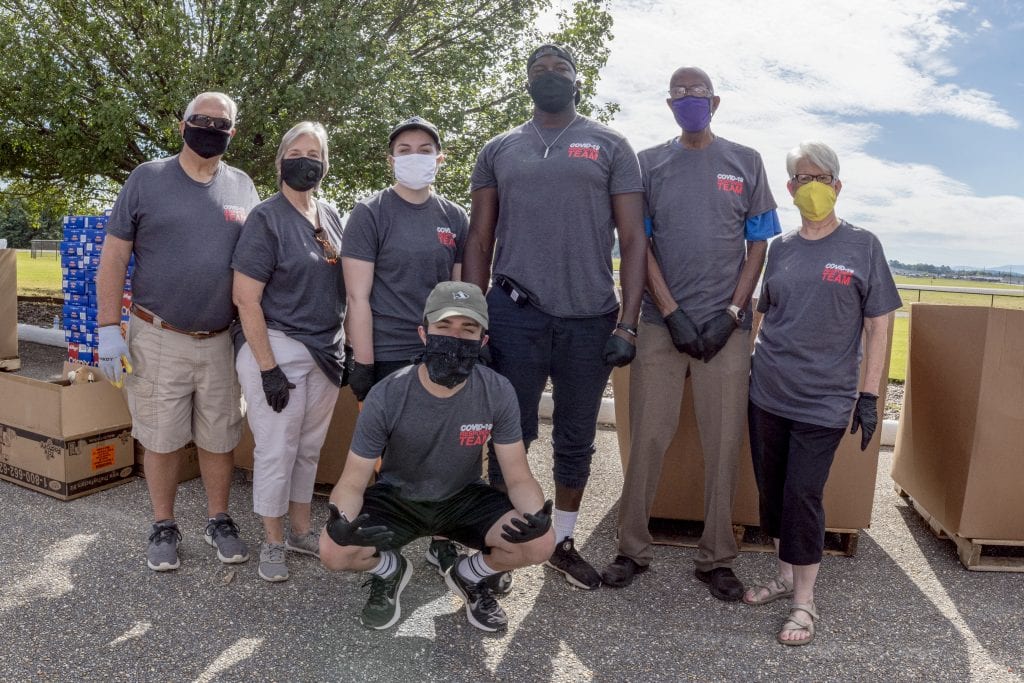
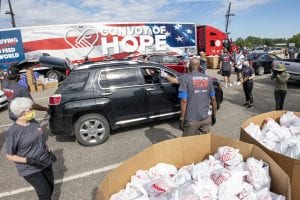
After two successful donation events at Darlington Raceway and Martinsville Speedway, where 1,600 families were served, the Joey Logano Foundation, The NASCAR Foundation and Elevation Outreach, an outreach ministry of Elevation Church based in Charlotte, North Carolina, again partnered to bring Convoy of Hope to Talladega Superspeedway.
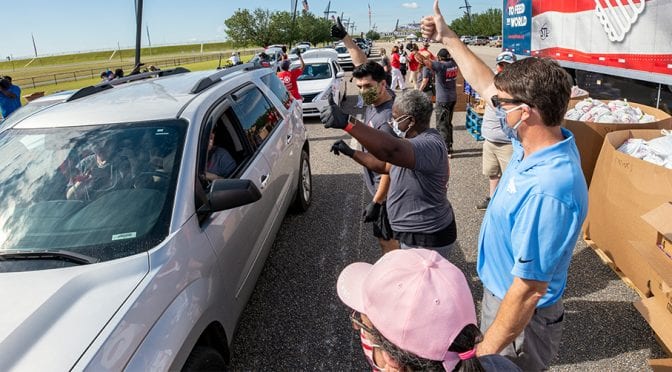
On Wednesday, a tractor trailer with 30,000 pounds of food and supplies arrived. Volunteers set up a staging operation and spent hours organizing for Friday’s relief effort designed to bring hope to this racing community affected by the COVID-19 pandemic. Among the items donated were non-perishable foods, Coca-Cola products, Shell gas cards and even The NASCAR Foundation’s Speedy Bears for younger guests.
“We organized this last stop in Talladega in short order and are overflowing with gratitude to those volunteers who made it happen,” said Nichole Krieger, The NASCAR Foundation’s executive director. “The Talladega community rallied and made it one of our largest and most rewarding yet.”
Families were queued up one hour early as 75 volunteers, including some NASCAR employees and Talladega Superspeedway president Brian Crichton, loaded grocery bags full of food, water and hygiene supplies into approximately 750 vehicles. Convoy of Hope’s contactless drive-thru ensured the safety of its staff, volunteers and deserving guests.
“We want to thank Talladega Superspeedway and its staff for the warm welcome today,” Joey Logano Foundation executive director Ali O’Connor said. “When we partnered on our first event 30 days ago at Darlington Raceway, we couldn’t have anticipated how much impact this relief effort would have and you could really see that today in the faces of the families we served.”
From Darlington, South Carolina, to Martinsville, Virginia, and now Talladega, Alabama, the Joey Logano Foundation’s $1 million COVID-19 Response and Recovery Fund donated approximately 100,000 pounds of food and supplies to 2,350 families across the south.
The starting lineup for Monday’s GEICO 500 NASCAR Cup Series race at Talladega Superspeedway (3 p.m. ET on FOX, MRN, SiriusXM NASCAR Radio) has been set.
Martin Truex Jr. will start from the pole position, with Denny Hamlin joining him on the front row to lead the field to green for the 188-lap, 500-mile race.
There is an unmistakable vibe permeating the legendary Richard Childress Racing team. From management to crew to driver, the upswing in performance for the organization is palpable.
As the NASCAR Cup Series heads to Talladega Superspeedway for Monday’s GEICO 500 (3 p.m. ET, FOX, MRN, SiriusXM NASCAR Radio), optimism and expectation are at high levels and with good reason.
Twelve races into the NASCAR Cup Series season, both RCR team drivers, Austin Dillon and rookie Tyler Reddick have earned top-five finishes. Dillon has four top 10s and Reddick has three. Last week, for the first time, they both finished among the top 10 in the same race with Reddick scoring a career-best fourth place at Homestead-Miami Speedway in the No. 8 Richard Childress Racing Chevrolet and his teammate Dillon finishing seventh in the No. 3 RCR Chevy.
Those numbers are especially significant in comparison to recent seasons. In 2019, Dillon had six top 10s over the 36-race schedule and not a single top-five run. The seven combined top-10 finishes in the bag already for RCR — only a third of the way through the schedule — nearly equal last year’s entire season total for the two-car Chevrolet team (eight).
“I’m really optimistic about where we are and where we’re going,” said Richard Childress Racing’s Vice President of Competition Andy Petree.
“I think we’ve got a lot of areas where we’re improving on and I see a lot of promise. Both teams are better this year than we were last year. And what I’m seeing is they battle through a lot of adversity when the car maybe isn’t as good and they’re able to get it right and get a good finish out of it.”
Petree believes the team’s new combination of drivers has been a legitimate uptick for the organization — as important as a new Chevrolet body that has raised the competition level as well. Dillon, 30, the 2017 Daytona 500 winner, is in his seventh full-time NASCAR Cup Series season and has quietly assumed a more experienced, leadership role. And Reddick, 24, who won his second consecutive NASCAR Xfinity Series championship last year in an RCR Chevy, has been a quick study in his step-up to NASCAR’s version of primetime.
Although the two drivers hail from opposite sides of the country — Dillon from North Carolina and Reddick from Northern California — the pair have a lot in common and genuinely get along well. They have known each other for years — competing together in late models as they made their way up through the stock-car ranks. And now they are both new fathers.
Dillon’s wife, Whitney, gave birth to the couple’s first child, son Ace, last weekend. Reddick is a new dad as well, famously declaring his son’s name would be “Beau” as he celebrated his race win and Xfinity title last November at Homestead. His wife, Alexa, had promised him he could pick the baby’s name if he won the championship. Beau was born in December.
“Even outside the race car we get along great,” Reddick said of his teammate. “We know each other back from when he and his brother raced dirt late models and I raced dirt late models at some of the same tracks.
“I’ve been texting him asking him how he’s doing as a new dad. I remember very well because it wasn’t that long ago, and the first week or two you don’t know what’s happening, you’re just like, ‘what the heck is going on?’ ”
Dillon talked fondly about the life changes and was smiling widely as he spoke to the national media this week, “I’m tired, but it’s been an amazing experience. He’s an amazing little guy. … Pumped to have him in this world.”
As for the team, Dillon was adamant that this season has been a game-changer. And he’s convinced that multiple victories are very reasonable expectations for an organization that has only scored wins by multiple drivers one time (2017, Dillon and Ryan Newman) in the last decade.
“It’s been an awesome year so far,” Dillon said. “Always want more, but compared to years past I’m very optimistic about where we are, especially from last year to this year. Big jumps and those jumps are hard to come by.
“Tyler coming in with an Xfinity Series championship brought some momentum and I think fired up everybody. It fired up myself. He’s a good wheelman and builds both teams to kind of compete within and that comes with these good finishes that we’re having.
“The competition is great at RCR and that’s a big part of it. And Chevrolet stepped up its game in the offseason and really gave us something else to work with as far as the car goes.”
The compatibility between Dillon and Reddick is considered a real competition boost. They push each other hard on-track and are real support systems away from the track. Both bring different skillsets to the team.
And both are flourishing.
Jared C. Tilton | Getty Images
“Tyler is probably one of the most mentally strong drivers that I have ever worked with,” said Petree, who served as the late seven-time champion Dale Earnhardt’s crew chief for three seasons at RCR, guiding him to the 1993 and 1994 Cup titles.
“Some drivers are hung up on things if they feel like one little detail is not right or somebody else has a better this or that,” Petree continued. “They get into this mental state that they feel they are beat, that another team is better. Tyler never lets those kind of thoughts enter his mind. He assumes his car is car is as good as the other guys. And it’s not always, we’re always working on it.
“He just goes at it with the attitude that ‘I’ve got as good a car as Kyle Busch’ or whoever and ‘I want to go race them.’
“Once we put Tyler in the 8 car, he’s just got that energy that comes with that,” Petree added. “Won the championship last year in Xfinity, won six races for us. That was really our bright spot at RCR last year. He brought all that energy to the Cup side, and I think that’s helped fuel a lot of this, too.”
Dillon’s statistics are encouraging as well. Although he earned big wins in 2017 at Daytona and 2018 at Charlotte, his season-long numbers lagged. He had only three top-five and four top-10 efforts in all of 2017. He had only two top-five and eight top-10 showings in all of 2018. And last year, he had zero top-five finishes and only six top-10 finishes.
This year he was fourth at Las Vegas and posted top 10s at Charlotte, Bristol and Homestead.
“Austin’s got so much experience now,” Petree said. “He’s in that phase in his career where he should really be rising to the top, in his prime. That’s paying off for us. You’ve got your young guy in Tyler putting all this energy into it. And I think it helps Austin to feel better about his stuff to see that car run good, too.”
Dillon and Reddick are ranked 16th and 17th, respectively, in the championship standings heading to Talladega. They trail 10th-place Kurt Busch by only 57 and 59 points. And Reddick leads a highly competitive Sunoco Rookie of the Year competition.
“I really felt like going into this year, it would be like this,” Petree said of the team’s success. “I was expecting it. Now actually doing it is another thing. Knowing we could be even better and have chances to win, it’s culminating in what I tried to achieve in coming here. It took longer than I wanted it to but we’re starting to really see the fruits of the things we’ve done. Good times right now.
“These opportunities don’t come along often. You’ve really got to seize them when they’re here. It’s great opportunity but it’s also great responsibility. Everyone feels the optimism but also the pressure to perform and step up. And they’re doing it.”
Every driver’s career has at least one defining moment.
The list for Dale Earnhardt Jr. is a long one. His first win at Texas Motor Speedway in 2000, his first Daytona 500 in 2004 and most recently his election into the NASCAR Hall of Fame Class of 2021.
Somewhere in the middle of that list is Michigan International Speedway in 2012. The race was run on Father’s Day, and at the time, Earnhardt was riding a four-year, 143-race winless drought.
Earnhardt Jr. led nearly half of the laps around the two-mile track, and most importantly, the last one.
Earnhardt Jr. would go on to win seven more races for Hendrick Motorsports, including the 2014 Daytona 500.
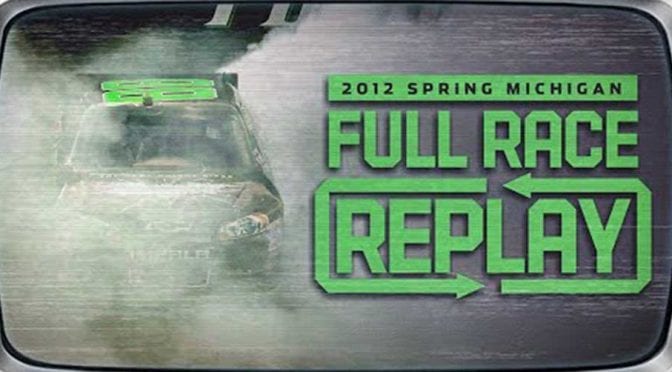
Celebrate Earnhardt Jr.’s election to the NASCAR Hall of Fame and Father’s Day with this week’s NASCAR Classic Full Race Replay — the 2012 Quicken Loans 400.
 On Wednesday, a tractor trailer with 30,000 pounds of food and supplies arrived. Volunteers set up a staging operation and spent hours organizing for Friday’s relief effort designed to bring hope to this racing community affected by the COVID-19 pandemic. Among the items donated were non-perishable foods, Coca-Cola products, Shell gas cards and even The NASCAR Foundation’s Speedy Bears for younger guests.