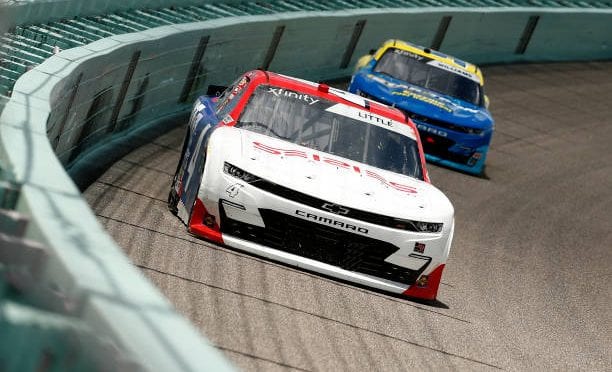
NASCAR offerings at the William Hill sportsbooks expanded on Friday night to include eNASCAR — specifically Sunday’s iRacing Pro Series Invitational race at virtual Bristol Motor Speedway.

Sunday’s Food City Showdown presented by M&Ms (1 p.m. ET, FOX, FS1, FOX Sports App) is the third iRacing event on the docket as the real-world cars remain idle due to the COVID-19 pandemic. But with plenty of tight racing, wrecks and thrilling finishes, the iRacing events have set a new record for all-time viewership of an esport for two consecutive weeks. Last week’s race at virtual Texas Motor Speedway pulled in 1.3 million viewers.

Below are the full odds from William Hill.

RELATED: Play NASCAR Finish Line!

Timmy Hill: 4-1
Dale Earnhardt Jr.: 13-2
Garrett Smithley: 7-1
William Byron: 7-1
Denny Hamlin:
12-1
Alex Bowman:
12-1
Ryan Preece: 12-1
Parker Kligerman: 15-1
Erik Jones: 25-1
Landon Cassill: 25-1
Christopher Bell: 25-1
Chase Elliott: 28-1
Kyle Larson: 30-1
Matt DiBenedetto: 30-1
Joey Logano: 30-1
John Hunter Nemechek: 30-1
Michael McDowell: 35-1
Ryan Blaney: 35-1
Ross Chastain: 40-1
Bubba Wallace: 40-1
Clint Bowyer: 40-1
Kyle Busch: 40-1
Tyler Reddick: 40-1
Ty Dillon: 50-1
Jimmie Johnson: 50-1
Kurt Busch: 60-1
Bobby Labonte: 60-1
Ricky Stenhouse Jr.: 60-1
Chris Buescher: 75-1
Austin Dillon: 75-1

Virtual Bristol Motor Speedway will host two races this week as the eNASCAR iRacing Pro Invitational Series gets a bit of a new look.

What won’t be different is the participation of NASCAR Cup Series stars, both past and present. What will be different is the race format on Sunday — plus a new Saturday night show that uses ARCA Menards Series cars and includes drivers from the NASCAR Xfinity Series, NASCAR Gander RV & Outdoors Truck Series, ARCA, the NASCAR PEAK Mexico Series and the NASCAR Whelen Euro Series.

The lineup for Sunday’s main event, the Food City Showdown presented by M&Ms (1 p.m. ET, FOX, FS1, FOX Sports App), will be set after two heat races. Everyone in the heat races will transfer to the main event.

RELATED: See Sunday’s paint schemes

Additional information:

A two-lap qualifying effort will determine the lineup for the heat races.
Drivers who qualify in an odd position (1st, 3rd, 5th, etc.) will be placed in Heat 1.
Drivers who qualifying in an even position (2nd, 4th, 6th, etc.) will be placed in Heat 2.

There will be two heat races, 50 laps each, with no elimination. Every driver will advance to the main 150-lap event. The heat races set the grid for the main event and the winner of the first heat race will start on the pole. Cautions will be enabled during the heat races and drivers will receive two “resets” for their heat races. Unused “resets” do not carry over to the main race.

Finishing order from Heat 1 will determine odd positions for the Main Event (1st, 3rd, 5th, etc.). The Busch Pole will be awarded to the winner of Heat 1.
Finishing order from Heat #2 will determine even grid positions for the Main Event (2nd, 4th, 6th, etc.)
No drivers will be eliminated in these races; all 32 competitors will advance.

The main event race itself will consist of 150 laps with double-file restarts and lapped cars will go to the rear. There will be three attempts at a green-white-checkered finish, if necessary.

Drivers will be allowed two resets this week at virtual Bristol Motor Speedway. If a car is damaged, drivers must drive back to their pit stall and come to a complete stop. This will automatically apply the fast repair and give the driver a new car.

Below is the entry list, subject to change.

FOOD CITY SHOWDOWN PRESENTED BY M&Ms ENTRY LIST

* Subject to change


No. Driver Affiliation
1 Kurt Busch Chip Ganassi Racing
2 Brad Keselowski Team Penske
3 Austin Dillon Richard Childress Racing
6 Ross Chastain Roush Fenway Racing
8 Dale Earnhardt Jr. Invitational
9 Chase Elliott Hendrick Motorsports
11 Denny Hamlin Joe Gibbs Racing
12 Ryan Blaney Team Penske
13 Ty Dillon Germain Racing
14 Clint Bowyer Stewart-Haas Racing
17 Chris Buescher Roush Fenway Racing
18 Kyle Busch Joe Gibbs Racing
19 Bobby Labonte Invitational
20 Erik Jones Joe Gibbs Racing
21 Matt DiBenedetto Wood Brothers Racing
22 Joey Logano Team Penske
24 William Byron Hendrick Motorsports
31 Tyler Reddick Richard Childress Racing
34 Michael McDowell Front Row Motorsports
37 Ryan Preece JTG Daugherty Racing
38 John Hunter Nemechek Front Row Motorsports
42 Kyle Larson Chip Ganassi Racing
43 Bubba Wallace Richard Petty Motorsports
47 Ricky Stenhouse Jr. JTG Daugherty Racing
48 Jimmie Johnson Hendrick Motorsports
51 Garrett Smithley Invitational
66 Timmy Hill Invitational
77 Parker Kligerman Invitational
88 Alex Bowman Hendrick Motorsports
89 Landon Cassill Invitational
95 Christopher Bell Leavine Family Racing
96 Daniel Suarez Gaunt Brothers Racing

Nick Lyons has been the picture of consistency over the more than a decade he’s been racing at All American Speedway.

Lyons has driven the same limited modified at the third-mile NASCAR-sanctioned track in Roseville, California, all with the same sponsor for the last 14 years.

“A long time,” Lyons said. “It doesn’t seem that long. It goes by so quick.”

And the last three years he’s been a consistent winner, winning the track championship in the limited mods division in 2017 and 2019. The track didn’t have a points race in 2018, meaning Lyons will go into 2020 looking for a 3-peat.

Nick Lyons 1

The Roseville veteran locked up his second championship on the final night of the season in 2019, after his biggest competition got into a late wreck that allowed Lyons to finish ahead of him and ultimately take the title. Lyons went into championship night with just a four-point lead in the points.

“It was still a good season,” Lyons said. “We wanted to kind of battle it out versus having a big wreck at the end of the season and take out a bunch of cars but sometimes it happens, as we know.”

Lyons felt so good about where his car finished last fall that he said he hasn’t done anything to it this offseason.

“The car was pretty good the whole entire season. We didn’t have any damage on the car so we’re pretty much ready to rock and roll other than a simple couple of shop nights getting the car set up and putting some new tires on it,” he said. “I’m pretty confident with the setup that we have on it right now, we should be able to go out there and win. That’s the goal.”

Running an open-motor that put him at a disadvantage of being overweight by about 200 pounds, he said he’s always been confident in his car he called “old faithful.”

“It’s not the latest and greatest car that’s out there that I’m competing against, but the car’s been very loyal to us,” he said. “We made some adjustments from the prior year as far as the suspension and stuff just trying to squeeze some more out of it so we can keep up with some of the little bit faster cars.”

Another old faithful for Lyons over the course of his racing career has been his sponsor, Tim Berry of Berco Redwood, a lumber company in Northern California. Berry sponsors several other race cars in the area, and has been by Lyons’s side since he was about six or seven years old.

“He’s been with me from Day 1. He’s also a big racing supporter in the community,” Lyons said. “He’s very involved. Without him it would pretty much almost be impossible. He’s about as loyal as they come.”

Everything in combination helped lead Lyons to a 2019 season that he said was probably the most sentimental to him in his career.

And it all has him ready for the 2020 season, whenever that may begin. All American was scheduled to open the season on April 11, but racing has come to a halt due to coronavirus concerns.

Lyons said this year could possibly be the final season he runs for a points championship. He has a 6-year-old son who is starting to race quarter-midgets, which takes up a lot of his time.

“Got the kid hooked now. We’re in trouble,” he said with a laugh. “It’s pretty cool watching the little kids out there racing their hearts out.

“He’s really into it. He comes and helps out with us on the big nights. He likes to see all the other drivers and listen to the radio. He has a pretty good aspect of full-sized race cars at only six years old, which is pretty cool.”

Lyons also recently opened a second shop for his smog emissions testing business. Between all of that, it’s hard to find the time to focus on his own racing.

But whenever the 2020 season finally begins to roll around, Lyons and his old faithful car will be ready to chase another championship.

“We’re ready to go,” he said. “We’re going to make a couple little changes here and there but as far as the car goes we’re pretty happy with the way it’s handling and been handling.

“I’m pretty excited about that honestly. I know there’s a lot of other competitors coming out this year. Some guys I used to race with five, 10 years ago that have kind of just hanging out and laying low. I know that they’re coming out this year so it’s definitely going to be a challenge to win some races let alone a championship.”

Nick Lyons 2

Jeff Gordon and Rusty Wallace, two NASCAR Hall of Famers, didn’t see eye to eye for a long while.

The two drivers were among the greatest of their generation, and that led to inevitable on-track clashes. Two in particular that stand out occurred five years apart, but both at Bristol Motor Speedway — in 1997 and 2002, Gordon used his bumper to knock Wallace up the track during the final laps and pull ahead for the victory.

It contributed to an icy relationship between the two competitors and champions.

Following those Bristol races re-airing in full on our YouTube channel this week, both Gordon and Wallace sat down with NASCAR host Alex Weaver to discuss those Bristol finishes, their rivalry then … and their relationship today.

Watch the entire interview and discussion below.

Bristol Motor Speedway served as the site for a few intense battles between Jeff Gordon and Rusty Wallace, two drivers who had finished first and second at the Tennessee track three times before. The 2002 Bristol Night Race hosted another one of those iconic moments in the rivalry between the NASCAR Hall of Famers.

Contested over 500 laps on the .533-mile short track, that Saturday night’s race had Gordon, who had not won in 31 straight races, take the first step toward ending his drought by winning the pole. Wallace was on the hunt for a victory, carrying a 49-race winless streak.

RELATED: Full race results | Watch more Classic Race Replays | 1-2 Gordon-Wallace finishes

The final laps were shaping up to be déjà vu from five years earlier. Wallace led with just three laps left; Gordon was close behind in second. As they approached lap traffic, Gordon saw a chance to make his move. The No. 24 pilot knew the perfect amount of contact needed to bump the leading Wallace out of the way and get his first victory of the season. One of the best drivers on short tracks would be dethroned yet again by the Californian in a familiar move almost identical to the Bristol spring race of 1997.

Gordon went on to finish his career with five wins at Bristol, while Wallace closed with nine.

Check out the bump-and run-finish between Jeff Gordon and Rusty Wallace in this Classic Race Replay of the 2002 Sharpie 500 at Bristol Motor Speedway.

As part of its free access to racing fans due to the COVID-19 pandemic, TrackPass on NBC Sports Gold is featuring nearly 50 long-form documentaries for viewing pleasure. Throughout the week, NASCAR.com will preview one documentary each day that looks back on some of the sport’s biggest stars, venues and stories from the past.

RELATED: Get free access to all nine channels

After briefing NASCAR Decades: The 90s, The 80s  and The 70s, along with The List: Dale Earnhardt Sr., it’s time to take a long look back at the man who made today’s stock-car racing possible: Bill France Sr. Known as “Big Bill” due to his 6-foot-5 stature, France founded NASCAR in 1948. He also built Daytona International Superspeedway and Talladega Superspeedway before passing away in 1992. This edition of TrackPass’ NASCAR Hall of Fame Biography series documents France’s legacy.

Other available content includes full-event replays of all races since TrackPass launched in December 2019. Condensed replays of every American Flat Track, IMSA WeatherTech, K&N and Modified race from the 2019 season will also be made available shortly.

Free access to TrackPass runs through May 1. Fans can learn more about the streaming service here.

RELATED: FAQs on product

While we wait for the 2020 NASCAR Cup Series season to resume, we can find comfort in knowing there will be plenty of trophies for drivers to chase once we get back to the race track.

But is there one trophy that stands out above all the rest?

NASCAR.com’s Jonathan Merryman and Chase Wilhelm debate which piece of hardware awarded to race winners throughout the year might look best in every driver’s trophy case.

RELATED: The best trophies in NASCAR, ranked

MERRYMAN: The best trophy in NASCAR has got to be the famous Grandfather Clock from Martinsville Speedway. It’s only fitting NASCAR’s oldest track, a track that has stood the test of time, awards its winner a classic timepiece.

There is no denying the prestige of winning the Daytona 500, the Southern 500 or the Brickyard 400, but there is something about a trophy that every hour on the hour is a reminder of success at the toughest bullring in the NASCAR Cup Series. The clock was first awarded in 1964 to Fred Lorenzen. Back then, the Ridgeway clocks were built right down the road from the track, further engraining the history of the venue into the hardware the drivers took home.

There are a few added bonuses to the unique trophy as well. First off, it’s useful. Secondly, you can put it just about anywhere in your house and don’t have to worry about your wife second-guessing its placement.

WILHELM: Of course the Rustburg, Virginia, native is going to rally around the home-state trophy. Yeah, it’s a cool piece of hardware to strap atop your SUV like the Clampetts (shoutout to Clint Bowyer) and take home after a victorious day in Southern Virginia, but I think Harley J. Earl would probably clean your clock if you thought it was better than the one earned in Daytona Beach, Florida, each February.

The renowned Harley J. Earl trophy awarded to the Daytona 500 champion each year is not only arguably the most iconic in motorsports and sleek in design, its namesake is rich in both NASCAR and automobile history.

Earl served as a car designer for General Motors before becoming NASCAR’s second commissioner. NASCAR founder Bill France Sr. named the Daytona 500 trophy after Earl out of respect for his hard work and dedication to stock-car racing and the automotive industry. The car that sits atop the trophy is Earl’s Firebird I concept car design, and the base is shaped like the 2.5-mile superspeedway.

While drivers receive a replica of the Harley J. Earl trophy, the actual trophy stands over 4-feet tall. Each year, a driver gets his or her name etched onto it and can forever be called a Daytona 500 champion. I’d definitely want that trophy the most among those in my display if I wheeled a NASCAR Cup Series car every Sunday.

DEBATE: Which driver is the biggest early surprise outside the top 10?

The interruption to the 2020 NASCAR season as the country and world manages the COVID-19 pandemic has been understandably disappointing and disconcerting for racers, fans, teams and the industry as a whole. But instead of completely retreating during this time of general uncertainty, NASCAR and the racing industry at large have responded immediately with exactly the kind of pick-me-up that is making a legitimate life-saving difference.

The NASCAR Research & Development Center, located outside Charlotte, has turned its high-tech capabilities into real-life medical assistance, manufacturing face shields with its 3D printers and even a prototype human head that Wake Forest University doctors and scientists are using to research better treatment supply options.

RELATED: Latest schedule, timeline updates related to coronavirus

CORE Autosport, a team in IMSA’s WeatherTech SportsCar Championship, is similarly committed to helping out. Its team shop is manufacturing thousands of face masks for distribution across the country. Technique Inc., a Michigan-based company that normally supplies chassis components to NASCAR teams, has turned its efforts during this pause in racing to making face shields for medical distribution and ramped up production to 20,000 shields per day.

Roush Fenway Racing has developed a special prototype “transport box” that helps provide a safe, workable barrier between COVID-19 patients and the many medical personnel treating them in hospital rooms and transporting them on hospital floors.

When it comes to innovation, rapid response and answering the call, the sport of NASCAR is all in.

“I think NASCAR is in a unique position across the industry and especially at the Cup (Series) level where you have some of the best fabricators and engineers in the world and we have all this capability to make all these parts for cars, parts for testing, so you have a high talent pool and then you have the machinery and the people needed to kinda do all this now,” said Eric Jacuzzi, senior director of aerodynamics at the NASCAR R&D Center. “That’s what really puts us in a unique spot to be able to help out.”

Unlike any other major sports, the very essence of NASCAR racing involves cutting-edge technology conducted – literally – by rocket scientists, engineers and tech geniuses who would normally be putting their minds around new racing innovations. Instead of making cars go faster, they are now helping a nation try to fight a historic global medical pandemic.

“Sitting at home for a day or two is great, but I think most people are starting to look at what they can do,” Jacuzzi said. “And the crew we have here working on this stuff is all volunteer. People are volunteering to come here at 9 o’clock at night and stay until midnight – all different types of departments. It helps having people do that, and even people are taking some parts home and having their teenage children help with cutting things out. So it’s even giving students at home right now the opportunity to contribute.

“We’re used to working hard and being on the go all the time, so it’s a big adjustment for us to kind of have this pause. But this is helping us keep going and really just from an education side, more people are learning about how to run these machines and all that so it’s good for everyone to feel like they are contributing and helping out and they certainly are.”

At the NASCAR R&D Center, Jacuzzi said the idea to mass produce the face shields came from a random homeowners association post on a Facebook page.

It was a similar connection for Roush Fenway Racing, said the team’s operations director, Tommy Wheeler. Dr. Brian Palank, the brother-in-law of Roush simulation director Marcus Marty, reached out to see if Roush operations had the capability to help both conceptualize and manufacture a device that would provide another line of defense for the medical professionals treating virus patients.

“I said, ‘Yes, of course we can. Let’s do this now,’ ” Wheeler said. “That was around lunchtime (last Thursday), so we mobilized here so we could make some prototypes, which we did that afternoon and got them delivered to Brian (Palank) to see if they worked.

“What ensued from there was a round of tweaks and things that the doctors and such wanted. He started sending pictures and discussing with his network of physicians and anesthesiologists around the greater Charlotte area. We then did approximately three more prototypes and by Friday – a day later, which I’m pretty proud of – we were online with what we call our Version 2 Box. They were impressed by that.”

RELATED: How industry, drivers, partners are responding to coronavirus

Since then, Roush Fenway Racing has delivered 58 units to hospitals from Wake Forest to Miami. Wheeler describes the devices as something similar to a “sneeze guard” at a salad bar. The clear guard is placed over the patient in bed, covering his or her upper body from head to about chest level. There are two holes that allow physicians and nurses access, but the protection helps prevent the kind of immediate exposure that has spread the virus.

“When they are intubating people, it can be a messy and high-risk environment, because there’s coughing, there’s fluid, it can become an aerosol,” Wheeler said. “That’s why they’re called aerosol boxes because there’s pressurized air effectively spewing small droplets into the atmosphere. Imagine you’re in critical care in the ICU or something: What was happening was you’d have two or three healthcare professionals standing around the patient as this (intubating) occurs and wipes out all their personal protection equipment that as we know is already in short supply right now.

“What this does is contains it, so now it moves their outer garments from being the first line of defense to now a secondary or third line of defense. It means we’re wiping out less face masks, less goggles, and effectively, the only thing exposed to the threat is their gloves and sleeves.”

What’s telling is all these organizations – plus many more in the auto-racing industry – were immediately willing to offer their help. In many cases, teams turned their facilities into impromptu manufacturing hubs, absorbing the costs themselves in the name of providing a greater good.

CORE Autosport, whose Porsches finished second and third in the GT Class of IMSA WeatherTech SportsCar Series’ 2020 Rolex 24 at Daytona International Speedway season opener, is making thousands of face masks daily to help the supply, improving the product as they go.

“As the word has gotten out about these face masks the demand has been increasing every day and we will continue to produce these face masks as long as there is a need in this country,” CORE Autosport team manager Morgan Brady said.

It’s a common and assuring theme for so many in the racing industry: all willing to be all-in.

“I am very proud of our guys and what we’ve been able to do for our community,” Wheeler said. “This is a great example because the thing that makes NASCAR and Roush Fenway employees unique compared to the real world is that we have very highly skilled craftsman and fabricators and engineers. What really makes it unique is our ‘whatever it takes’ attitude and our time to market expectation far exceeds what the real world is accustomed to. That’s what allows us to go from concept to production to release in less than 36 hours. This was my rallying speech to my staff working on this project: No one else can do this in this amount of time except us, and we’re going to. We’re glad and proud to be asked to do it.

“What can we do? Here’s something we can do, so let’s do it and help everyone.”

NASCAR officials announced Thursday that the planned 2021 debut of the Next Gen car has been delayed until 2022.

“Due to challenges related to the coronavirus pandemic, the debut of the Next Gen car will be delayed until 2022,” said John Probst, NASCAR Senior Vice President of Racing Innovation. “The decision was made in collaboration with the OEMs and team owners. We will continue to develop the Next Gen car, and a revised testing timeline will be shared when more information is available.”

NASCAR Cup Series drivers had been testing the Next Gen model at a variety of tracks since October 2019, prepping for its initial planned debut at the 2021 Daytona 500.

The Next Gen car was on track for its fourth formal test in March, when William Byron took the wheel at 2-mile Auto Club Speedway. Previously, Austin Dillon (Richmond, .75 miles), Joey Logano (Phoenix, 1 mile) and Erik Jones (Miami, 1.5 miles) took their turns testing the car and providing crucial feedback to NASCAR officials.

MORE: Pictures from Auto Club

Earlier this year, NASCAR announced the Next Gen prototype’s new features include 18-inch, single center-locking lug wheels designed by German wheel manufacturer BBS.

Other features include a new body design, a shorter rear spoiler, a raised splitter and larger brakes, giving the Next Gen model a closer correlation between a highway-going consumer vehicle and its NASCAR counterpart, a move that also means increased brand identity.

Drivers who have piloted the car come away with plenty of learnings – and positive reviews.

“It’s not about what drives the best, what’s the easiest to drive … we don’t want that,” Joey Logano said after testing the car at Richmond. “We want something that’s challenging that will show that the best driver and the best team will prevail. … So we’re trying things on different extremes.

“We’re still in the preliminary stages, but we definitely have some cool pieces to the car.”

MORE: Logano talks ins, outs

DAYTONA BEACH, Fla. (April 2, 2020) – Just days after breaking its own record for staging the most-watched eSports event in television history, NASCAR today announced a slate of new fantasy and prop betting offerings on the eNASCAR iRacing.com Pro Invitational Series, created courtesy of NASCAR’s official gaming partner, Penn Interactive.

In February, NASCAR and Penn Interactive, a subsidiary of Penn National Gaming, Inc. (PENN: NASDAQ) (“Penn National” or the “Company”), announced a new multi-year partnership that led to the creation of a brand new, free-to-play, mobile game named NASCAR Finish Line, which offered users the chance to win a $50,000 jackpot every race. Now, today, courtesy of Penn Interactive, the app is being relaunched to include eNASCAR contests – thus providing fans of the fast-growing eNASCAR iRacing.com Pro Invitational Series with even deeper ways to engage with the sport.

MORE: NASCAR Finish Line

Alongside the launch of the game, Penn also announced that it would serve as the entitlement sponsor of the upcoming eNASCAR iRacing.com Pro Invitational Series event from virtual Dover International Speedway on Sunday, May 3 . The event will be entitled by the eNASCAR Finish Line app. It also will feature special integration from Barstool Sports’ personalities – with more details slated to come at a later date.

“During this time of uncertainty, eNASCAR has provided sports fans around the world with an exciting form of sports entertainment that is helping restore some normalcy to the weekend,” said Scott Warfield, NASCAR managing director of gaming. “Now, courtesy of our partners at Penn Interactive, fans can foster an even deeper connection with the new series and have even more incentive to tune into eNASCAR on FOX and FS1.”

The newly relaunched eNASCAR Finish Line mobile game is available now across iOS and Android phones and tablets and can be downloaded on the App Store and Google Play store. Players can win a $5,000 jackpot by accurately predicting the top two finishers and the highest finishers across six different groupings of four drivers.

RELATED: Full eNASCAR coverage

In addition to the gamification elements that fans will be able to enjoy alongside eNASCAR, more fans than ever before will be able to engage with the fast-growing eSport courtesy of NASCAR.com.

eNASCAR.com has been freshly updated to reflect the addition of the eNASCAR iRacing.com Pro Invitational Series – providing fans with a centralized hub for information surrounding the world’s most watched eSport series.

Fans can tune in this weekend to watch a full slate of eNASCAR iRacing.com Pro Invitational Series events from virtual Bristol Motor Speedway, with the  main event, the “Food City Showdown,” being televised live at 1 p.m. ET on FOX, FS1 and the FOX Sports App, while a separate event from virtual BMS, Saturday Night Thunder, will be live-streamed on eNASCAR.com on Saturday night.